

.webp)
.webp)

A complete guide to personalized product recommendations in e-commerce: how recommendation engines work, proven strategies, placement tips, and real examples.
You have already seen personalized product recommendations work. Amazon shows you "customers also bought," Netflix queues the next thing to watch, and you click or buy more than you planned to. So the question you came here with is not what they are. It is how to get that same effect on your own store, and whether it is worth the effort.
Here is the honest version. Personalized product recommendations are one of the highest-leverage things an e-commerce store can add, but only when you match the right type of recommendation to the right shopper in the right place. Bolt a generic "you may also like" row onto every page and you get noise. Do it deliberately and it moves real money: recommendations can drive up to a third of revenue in sessions where shoppers engage with them (Barilliance, 2025).
This guide is built for that decision. It covers how recommendation engines work and what they look at, the recommendation types that actually convert, the strategies that win in e-commerce, and where to place recommendations so they sell instead of cluttering the page.
TL;DR
- Personalized product recommendations account for up to 31% of e-commerce revenue in sessions where shoppers engage with them.
- Companies that excel at personalization generate 40% more revenue from those activities than average performers.
- 71% of consumers expect personalized interactions and 76% get frustrated when they do not get them. Consumers also spend 54% more with brands that personalize well.
- Engine type decides everything: collaborative filtering, content-based filtering, and hybrid models each fail differently, and most stores pick the wrong one for their catalog size.
- Placement beats sophistication. A decent algorithm on the product page and cart will out-earn a brilliant one buried where nobody looks.
What are personalized product recommendations?
Personalized product recommendations are product suggestions generated for an individual shopper based on their behavior, history, and profile, rather than the same list shown to everyone. A first-time visitor from a paid ad and a returning customer who bought twice last month should not see identical "recommended for you" rows. If they do, it is not personalization. It is merchandising with a nicer label.
The distinction that matters is the data behind them:
- Generic suggestions ("best sellers," "new arrivals") use store-level data. Same list for everyone.
- Personalized recommendations use shopper-level data: what they browsed, what they bought, what people like them tend to buy next.
That shift from "what is popular in the store" to "what is relevant to this person" is the entire game.
Why personalized product recommendations matter in e-commerce
Personalization shortens the path from landing to checkout. When shoppers see products that fit them, they buy more, come back sooner, and need less convincing along the way. Three things make the case worth acting on:
- It is what shoppers now expect.
71% of consumers expect personalized interactions and 76% get frustrated when they do not get them (McKinsey). Miss the bar and you are not neutral. You are actively irritating most of the people who land on your page.
- It shows up in revenue.
Companies that excel at personalization generate 40% more revenue from those activities than average performers (McKinsey, Next in Personalization), and consumers spend 54% more with brands that personalize well (Twilio Segment).
- Recommendations are the sharpest edge of it.
They account for up to 31% of e-commerce revenue in sessions where shoppers engage with them (Barilliance), so one well-tuned widget row can move close to a third of your money. Get it wrong and 91% of consumers say they are more likely to buy from a brand that shows relevant recommendations instead (Accenture). Irrelevance sends the rest to a competitor who bothered.
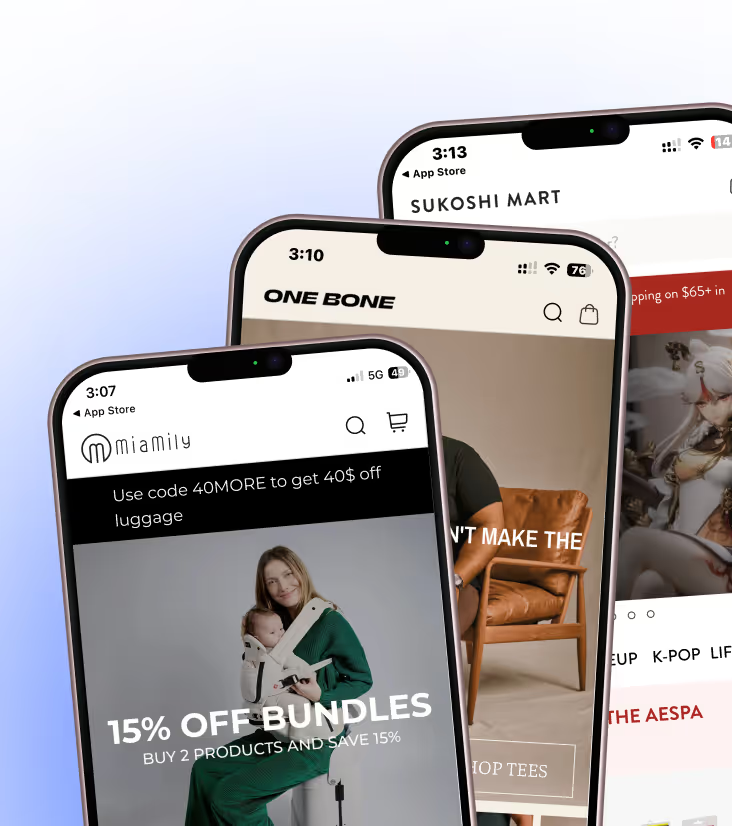
Here is what that looks like in practice, not in a report. Kiyoko Beauty rebuilt its mobile experience around a more tailored, app-native journey and saw a 60% higher conversion rate on app compared to web. Same catalog, same traffic, different relevance. The lift did not come from more products. It came from showing the right ones.
How personalized recommendation engines work
Every recommendation engine answers one question: given what we know about this shopper, what should we show next? There are three main ways to answer it, and picking the wrong one for your catalog is the most common reason recommendations underperform.
|
Engine type |
How it decides |
Strength |
Weakness |
Best for |
|
Collaborative filtering |
"Shoppers like you also bought X" |
Strong discovery, gets smarter with scale |
Needs high purchase volume; weak on brand-new items |
High-traffic stores with real purchase history |
|
Content-based filtering |
Matches product attributes (category, brand, price, material) |
Works from day one, no other-shopper data needed |
Stays narrow, rarely surprises the shopper |
New or low-traffic stores with rich product data |
|
Hybrid |
Combines both signals |
Relevance and discovery at once |
More complex to run and tune |
Most serious e-commerce catalogs |
The problem every engine has to solve is the cold start: a brand-new shopper or product has no history to learn from. Strong systems bridge it with real-time session signals (what someone clicked in the last two minutes) plus content-based matching, until enough behavioral data builds up.
If a tool handles cold starts badly, your recommendations will be useless exactly when you need them most: on new visitors and new inventory.
What do recommendation engines look at?
The algorithm decides how to rank products. These are the signals it ranks on, and an engine is only ever as good as the data you feed it:
- Search queries. What the shopper typed, stated intent in their own words.
- Purchase history. What they bought and when, which drives replenishment and complementary picks.
- Cart contents. What is in the cart right now, the strongest signal for cross-sell and bundles.
- Browsing behavior. Products and categories viewed this session and in past ones.
- Product attributes. Category, brand, price band, color, material: the data content-based filtering runs on.
- Context. Location, device, season, and time of day. A raincoat makes sense the week rain hits their city, not before.
- Audience segment. Demographics and lifecycle stage: new visitor, repeat buyer, or lapsed customer.
The point is not "collect everything." It is that thin or messy signal data caps how good any engine can be, no matter how clever the algorithm on top. Clean product data and real-time behavioral tracking move recommendation quality more than switching vendors ever will. This is also why an app tends to out-recommend mobile web: it captures richer, more continuous behavioral signals from the same shopper.
Once an engine has enough signals to understand intent, the next question becomes what kind of recommendation it should surface.
Types of product recommendations that actually convert
Not all recommendations are the same. Matching the right type to the right customer at the right time is crucial. Here’s a list of the most common Personalised Product Recommendations.
|
Type |
What it does |
Best placement |
Metric it moves |
|
Cross-sell |
Suggests complementary items |
Product page, cart |
AOV |
|
Upsell |
Suggests a higher-value version |
Product page |
AOV, margin |
|
Frequently bought together |
Bundles items commonly purchased as a set |
Product page, cart |
AOV |
|
Popularity / trending |
Surfaces proven best-sellers |
Homepage, category |
Conversion |
|
Recently viewed |
Re-surfaces items the shopper already looked at |
Homepage, PDP |
Conversion |
|
Data-driven "for you" |
AI-ranked picks from the full behavioral profile |
Homepage, app home |
Conversion, LTV |
Cross-selling
Cross-sell puts complementary items in front of a shopper who has already committed to one.
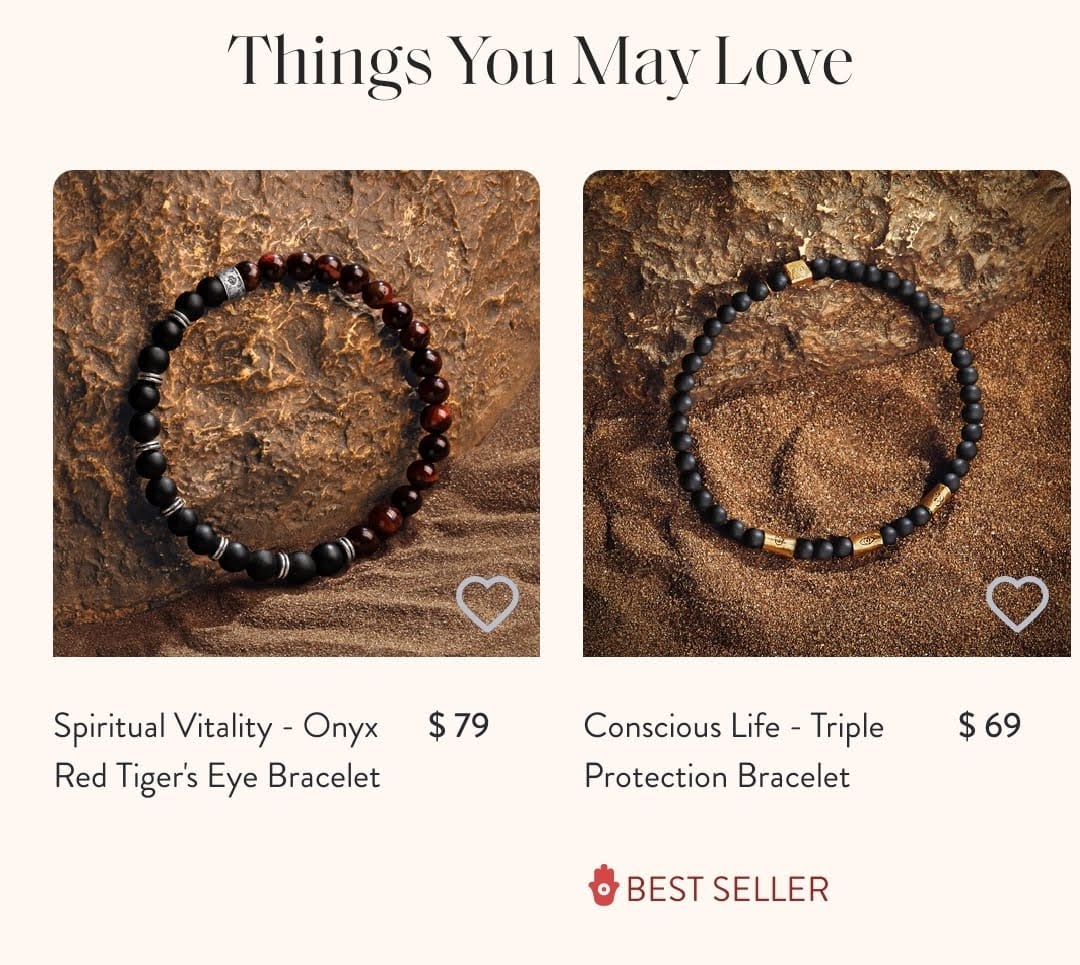
For example, Karma and Luck is known for its meaningful jewelry and mindful home decor. They smartly suggest items that align with customers' interests. If someone looks at a $79 Spiritual Vitality Onyx Red Tiger's Eye Bracelet, Karma and Luck may recommend the $69 Conscious Life Triple Protection Bracelet, a best seller, as a related product.
Upselling
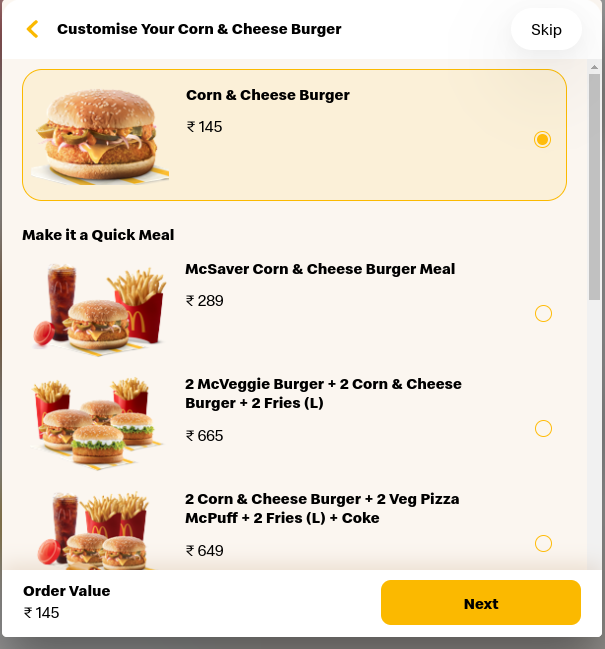
Upsell nudges the shopper toward a better version of what they are already considering, more capacity, a larger size, a premium tier. Done right, it frames the upgrade as more value rather than more spend: the larger bottle at a better per-unit price, or the bundle that costs less than buying the pieces separately. It is the highest-margin recommendation type because it raises order value on a purchase the shopper had already decided to make.
Popularity-based
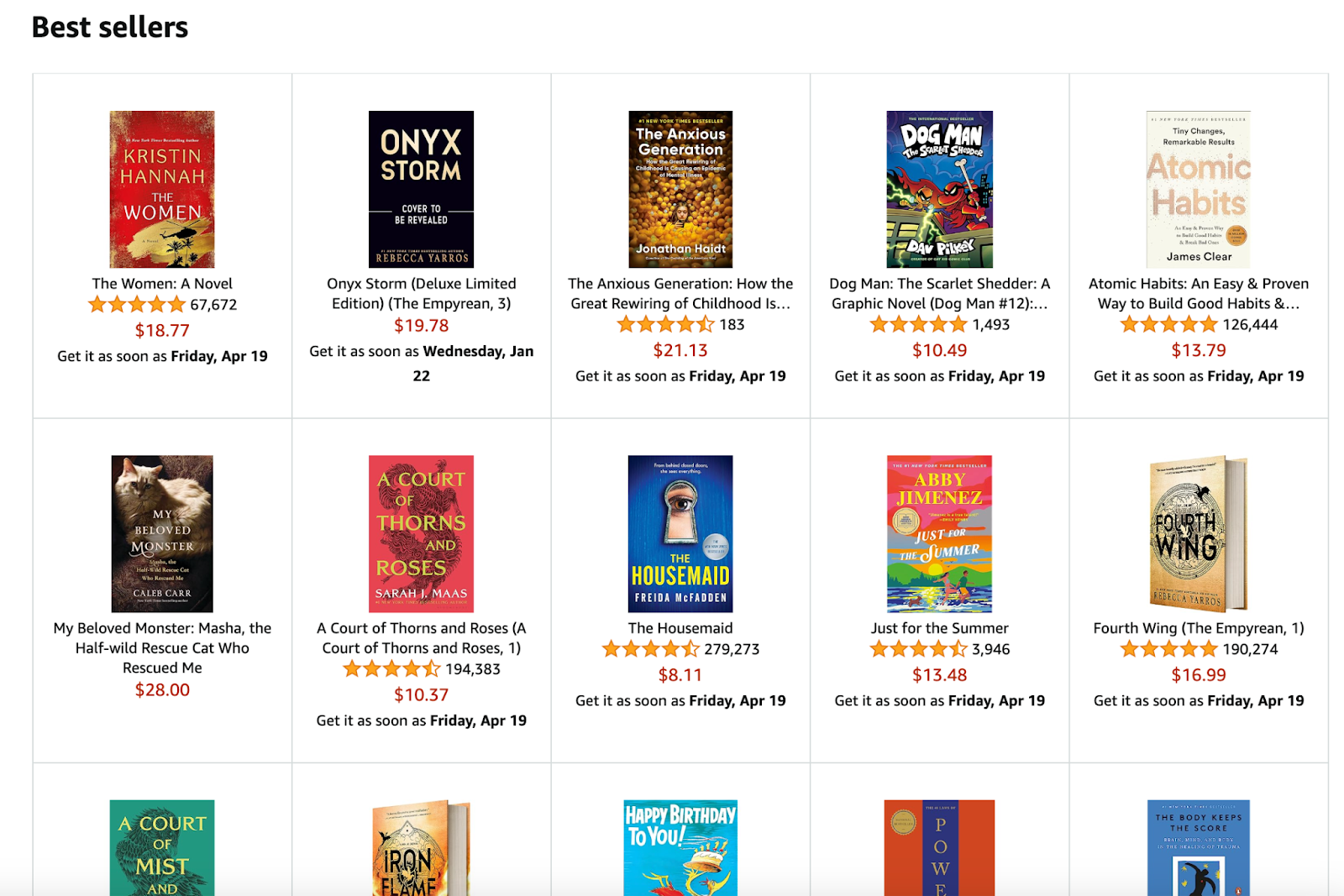
Best-sellers and trending products guide shoppers toward proven favorites, which is exactly what risk-averse and first-time buyers want. Popular items carry built-in social proof, and the data behind them doubles as a read on what your customers actually want.
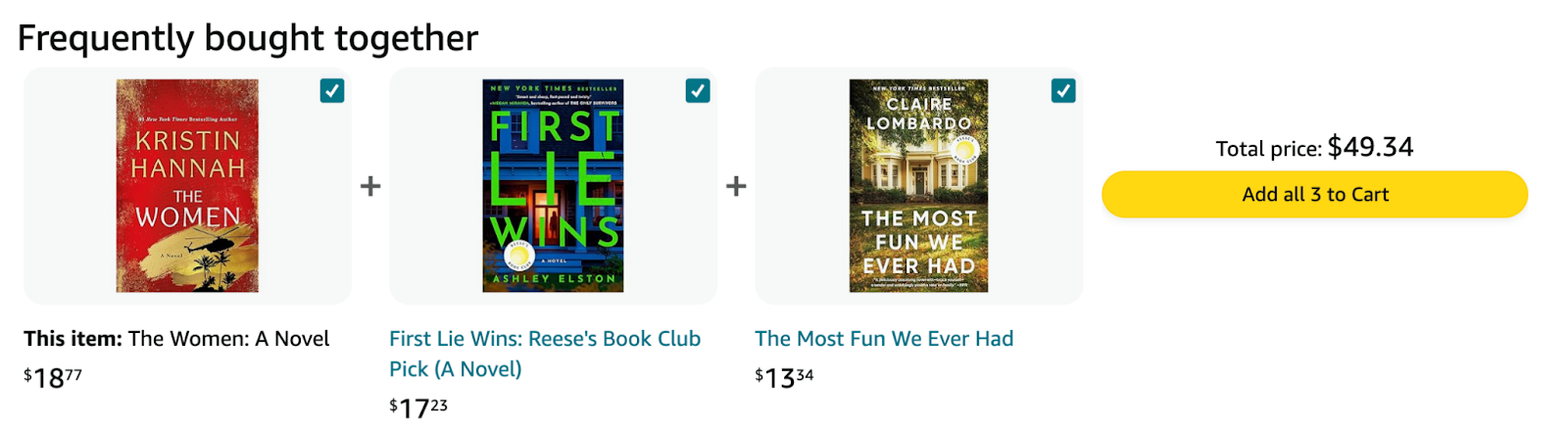
A simple example is Amazon’s book recommendations. Recommending books is uniquely difficult. A customer's tastes and preferences can be incredibly unique and diverse across a spectrum of genres.
Hence, Amazon often recommends books using popularity-based metrics.
Frequently bought together
Frequently bought together surfaces the items shoppers tend to buy as a set, the classic Amazon pattern. It is one of the most reliable ways to raise average order value and a natural starting point for building bundles.
Data-driven personalized recommendations
This is what most people picture when they hear "personalized recommendations": a feed built from the shopper's full behavioral profile rather than any single rule. It produces the most individual picks and the richest customer personas, and it sharpens as the shopper's history deepens. It is also the most demanding to run well, since it needs clean data and enough behavioral volume to be reliable.
Personalized product recommendation strategies for e-commerce
Switching recommendations on is the easy part. The work is deciding which signal to personalize on, for which shopper, at which moment. These are the plays that consistently earn their placement:
- Browsing-behavior recommendations. Use what someone is doing right now. A shopper who viewed three running shoes in one session is telling you exactly what to show next. Real-time session signals are the highest-intent data you have, and they solve cold starts for new visitors.
- Purchase-history recommendations. For returning customers, recommend based on what they actually bought, including replenishment timing. A skincare buyer who purchased a 30-day serum eight weeks ago wants a reorder nudge, not a first-purchase discount.
- Similar-shopper recommendations. Collaborative filtering at work: show what customers with overlapping taste bought. This drives genuine discovery instead of more of what they already found.
- Seasonal and time-based recommendations. Shift the mix by season, upcoming holidays, and time of day. The homepage a shopper sees the week before Black Friday should not match the one from quiet February.
- Cart and post-purchase recommendations. The cart is prime cross-sell real estate. The order-confirmation page is the most under-used spot in e-commerce: the shopper just proved they trust you, and most stores show them nothing.
- Recommendations in email and push. Recommendations do not have to live on-site. For brands with a mobile app, push notifications turn recommendations into a re-engagement channel you fully own, with no inbox filter deciding whether your message gets seen.
The stores that win do not run one of these. They layer them by funnel stage: behavior-based for new visitors, history-based for returners, cart-based at checkout, push-based for win-back.
Even strong recommendation logic underperforms if shoppers never see it. Placement often has a bigger impact on revenue than the algorithm itself.
Where to place recommendations across the customer journey
Map recommendations to where the shopper's intent actually sits:
- Homepage: trending and "for you" picks to orient the shopper fast.
- Category page: guide rather than list. The surface likely matches so visitors go deeper instead of bouncing.
- Product page: the workhorse. Cross-sell, upsell, and frequently-bought-together belong here.
- Cart: last-chance "almost forgot" items and low-friction add-ons.
- Order confirmation: the trust peak. Recommend the next purchase while goodwill is highest.
- Email and push: re-engagement, replenishment, and win-back off-site.
Recommendations should feel like a nudge, not a wall. Every extra widget competes with the thing the shopper came for, so relevance has to justify the space. When it does not, you are adding clutter and slowing the page, which on mobile is the difference between a sale and a bounce.
How to choose a personalized recommendation tool
The right tool depends on your catalog size, your data maturity, and where your shoppers actually buy. The options fall into four buckets:
|
Option |
Best for |
What you get |
Limitation |
|
Native platform apps |
Small catalogs, getting started |
Simple content-based recs, fast setup |
Rule-based, limited personalization |
|
Dedicated recommendation engines |
Growing catalog and traffic |
Collaborative filtering, cold-start handling, merchandising control |
Added cost, needs data |
|
AI personalization platforms |
Scale and lifetime-value focus |
Optimizes for LTV, cross-channel orchestration |
Needs clean data and volume to justify cost |
|
Branded mobile app (Appbrew) |
Mobile-first and app-native brands |
Owned surface, richer signals, native "for you" feeds, push as a rec channel |
Best fit when mobile is a major share of revenue |
The channel question matters more than most merchants think. Mobile web converts poorly compared to a branded app, and the strongest personalization on a leaky mobile-web experience still leaks. This is where a branded mobile app changes the math: an app gives you a fully owned surface with richer behavioral signals, native home feeds, and push as a recommendation channel. That is why app conversion rates run so far ahead of web:
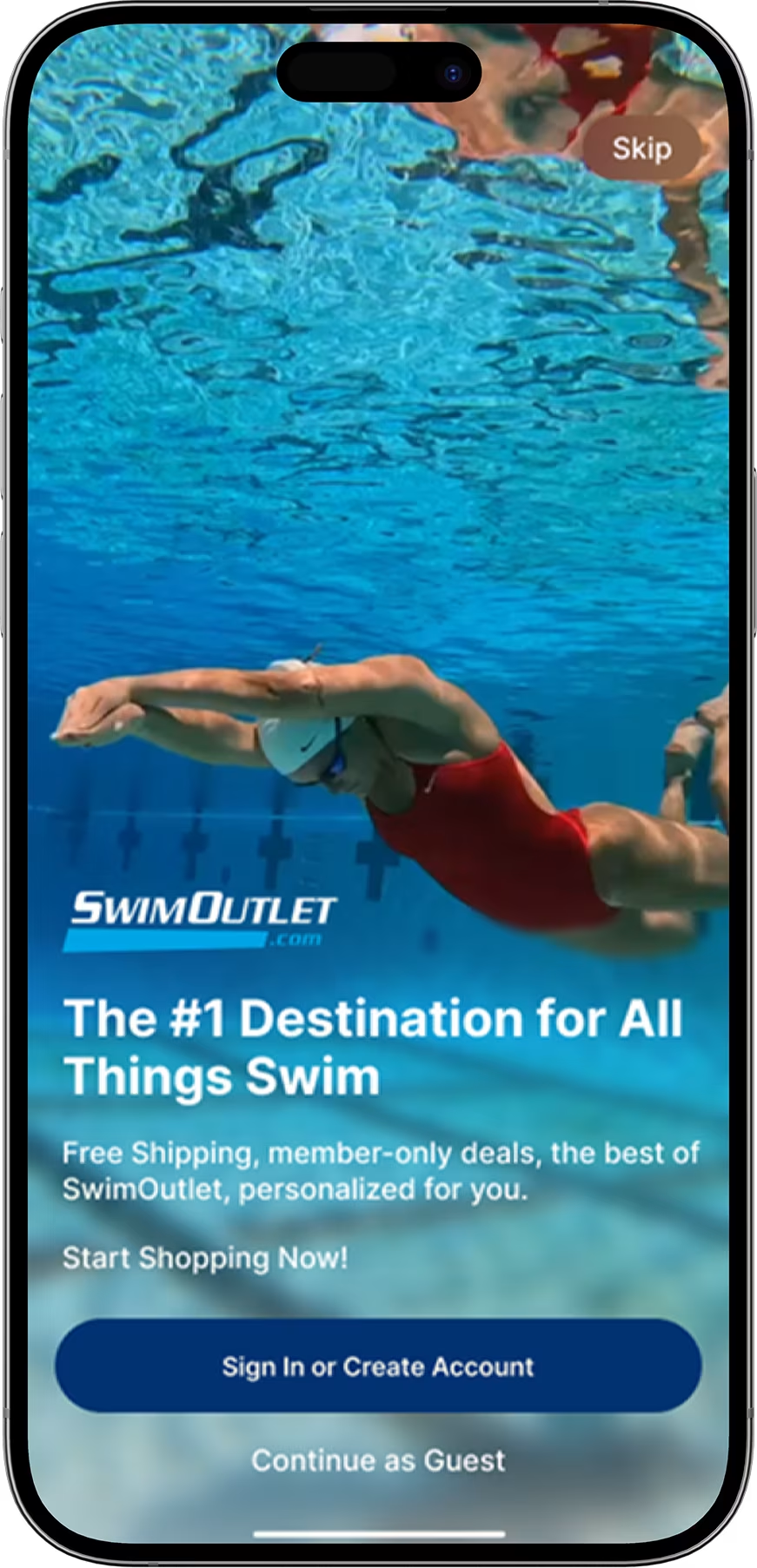
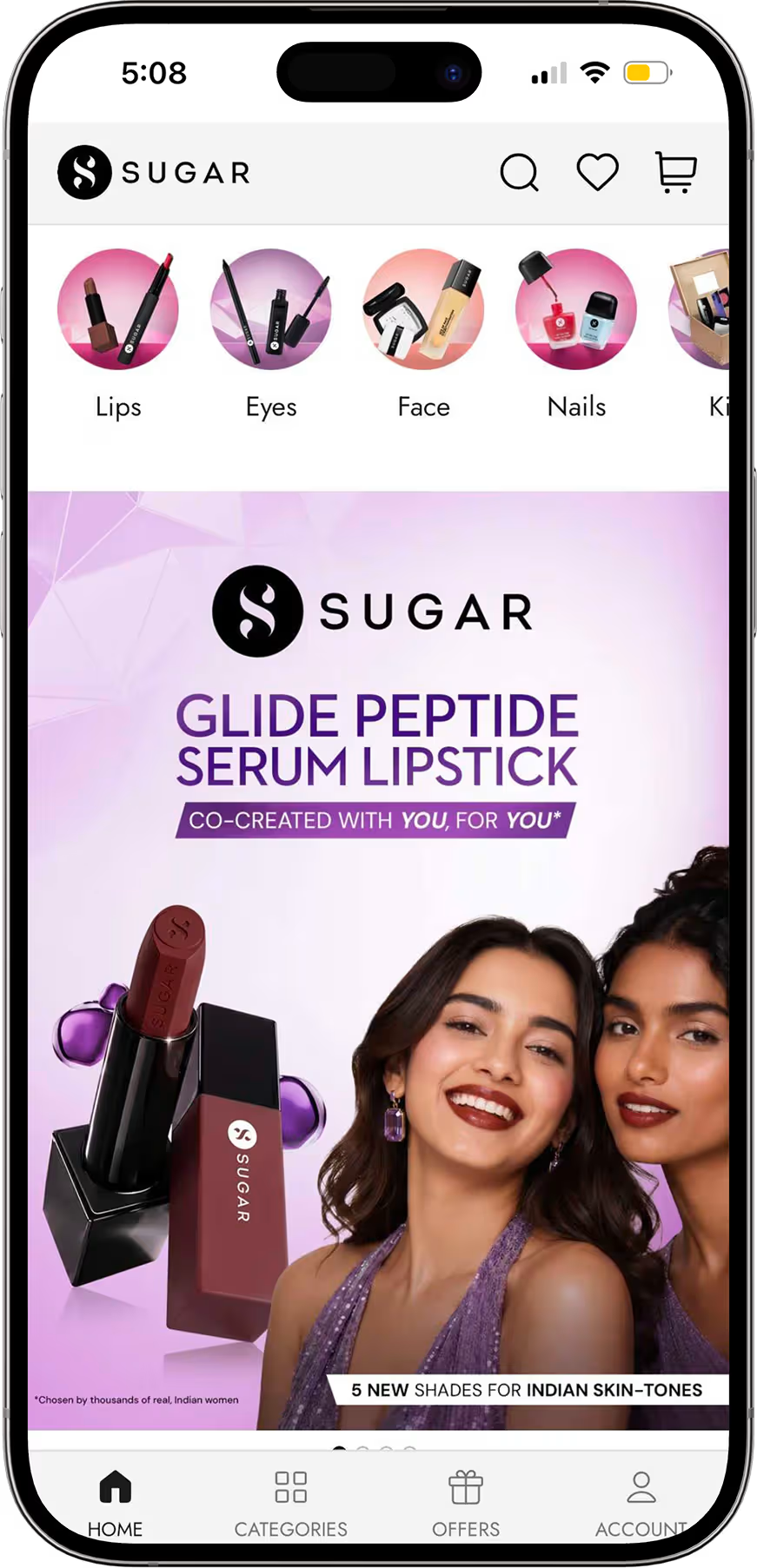
- SUGAR Cosmetics: 70% higher conversions on app than web, after rebuilding mobile around promotions, bundles, and personalized merchandising.
- Mixology: 2x conversion rate, turning offline strength into omnichannel growth.
- Kiyoko Beauty: 60% higher conversion rate on app versus web.
That is what Appbrew is built for: turning a Shopify store into an app where personalized recommendations run on a channel you control.
{{cta}}
Common mistakes that kill recommendation performance
Most recommendation systems fail for boring, fixable reasons:
- Launching without enough data. Collaborative filtering needs behavioral volume. Turn it on with a thin dataset and you get random-feeling recs that train shoppers to ignore the widget. Start with content-based and session signals, then layer collaborative in as data builds.
- Bad product categorization. If your catalog data is messy, every engine downstream inherits the mess, and a shopper gets a hiking boot recommended next to a dinner plate. Audit your taxonomy before blaming the algorithm.
- Stale recommendations. Showing someone the item they bought last week erodes trust fast. Recency rules matter.
- Over-stuffing pages. More widgets is not more revenue. Past a point, relevance drops and the page slows down.
- Never testing. Product recommendations are not set-and-forget. The stores that win test placement and logic against a control and tune continuously.
Conclusion
Personalized product recommendations are the difference between a store that shows everyone the same catalog and one that feels built for each shopper who arrives. The revenue is real, the expectation is already set, and the brands pulling ahead treat relevance as infrastructure rather than a widget. For most stores, the biggest opportunity is not a smarter algorithm. It is running personalization on a channel they actually own.
Ready to see what personalized recommendations in a branded mobile app could do for your store's conversion rate? Book a demo with Appbrew.
FAQs
How do personalized product recommendations work?
They combine shopper data (browsing history, past purchases, real-time session behavior) with one or more algorithms: collaborative filtering (what similar shoppers bought), content-based filtering (products with similar attributes), or a hybrid of both. The engine ranks products by predicted relevance for that individual and surfaces the top picks in a widget on-site or in messaging.
How do I personalize product recommendations in my e-commerce store?
Start with the data you already have. Use real-time browsing behavior for new visitors and purchase history for returning ones, then place recommendations where intent is highest: the product page, the cart, and the order-confirmation page. Add collaborative filtering once you have enough purchase volume for the patterns to be reliable.
What is the best software for personalized product recommendations?
It depends on catalog size and channel. Native Shopify apps handle small catalogs and simple matching, dedicated engines add collaborative filtering and merchandising control, and AI platforms optimize for lifetime value at scale. If most of your revenue is mobile, a branded app with built-in personalization will usually out-convert any web-only tool.
Do personalized recommendations actually increase sales?
Yes, and the effect is measurable. Recommendations account for up to 31% of e-commerce revenue in sessions where shoppers engage with them, and brands running app-native personalization have seen conversion lifts of 50 to 70% over web (Appbrew customer data). The size of the lift depends on data quality and placement, not just the algorithm.
What types of product recommendations should I use?
Cross-sell and frequently-bought-together for AOV, upsell for margin, popularity and recently-viewed for conversion, and data-driven "for you" feeds for discovery and lifetime value. Layer them by funnel stage rather than running a single type everywhere.