


.webp)
Compare the 10 best Tapcart alternatives for Shopify brands in 2026. Review pricing, features, integrations, support, and migration options.
Tapcart is one of the best-known Shopify mobile app builders. It offers an easy editor, unlimited push notifications, and a large integration ecosystem. For some brands, it remains the right choice.
But it isn't the only option, and in 2026 it isn't always the best-value one. Pricing across the category has shifted, native-app expectations have risen, and a wave of newer builders now compete directly on the things Tapcart merchants most often ask for: design flexibility, deeper integrations, and a mobile channel that actually grows past 2–3% of DTC revenue.
This guide covers the 10 best Tapcart alternatives and competitors for Shopify in 2026 based on app architecture, customization, Shopify integrations, pricing model, merchant support, migration experience, and the type of brand each platform serves best.
What Is Tapcart?
Tapcart is a Shopify mobile app builder that turns a Shopify store into branded iOS and Android apps without code. It launched in 2017 and became one of the first widely adopted no-code options for merchants who wanted a mobile app without hiring a development team.
Why brands look for Tapcart alternatives in 2026: Top 5 reasons
Across Shopify App Store reviews, G2 reviews and public merchant discussions, Tapcart customers repeatedly raise the same problems: rising costs, important features locked behind expensive plans, unresolved bugs, changing account representatives, and integrations that fail in critical workflows.
These problems become much harder to accept when you are paying thousands of dollars every year for a critical sales channel.
1. App revenue plateaus at 2 to 3 percent of DTC sales
One of the most common problems former Tapcart customers bring to us is an app that has stopped growing. The brand may have generated installs and sent regular push notifications, but the app still contributes only 2 to 3 percent of total DTC revenue. The problem is the lack of deeper segmentation, behavioral automation, personalization, and app-adoption strategies.
2. The design becomes difficult to differentiate
Tapcart’s App Studio makes it relatively easy to assemble an app using predefined blocks. That speed can also create a design ceiling.
Going beyond the standard components may require Custom Blocks and knowledge of HTML, CSS, or JavaScript. This means the no-code experience becomes less no-code when a brand wants a more distinctive interface or customer journey.
That limitation matters most for fashion, beauty, lifestyle, and premium brands whose visual identity is an important part of why customers buy from them.
3. Support can become a serious problem
Tapcart’s Shopify App Store reviews repeatedly mention slow bug fixes, poor account continuity, and problems getting clear answers.
Shopify merchant Hush.Shop reported dealing with five account representatives in one year and struggling to get help with cancellation. Another Shopify merchant, Olazion, said its app was submitted with technical problems and outdated screenshots.
These are not minor design complaints. They are problems that can directly affect your customers and revenue.
4. Advanced capabilities raise the price
Tapcart reserves testing, segmentation, conditional content, heatmaps, and several publishing features for its $1,250-per-month Scale plan. Brands should compare the plan containing their required capabilities, not only the advertised entry price.
5. Integrations may not work as promised
An integration logo does not guarantee that every feature will work inside your app. One Shopify apparel merchant reported rebuilding parts of its store around partners recommended by Tapcart. It later found that important parts of those integrations did not work correctly in the mobile app. The merchant said it felt stuck because it had already built an established app user base.
These reports do not represent every customer, but they show why you should test subscriptions, loyalty, search, accounts, product options, discounts, and checkout inside a working app before signing.
The 10 best Tapcart alternatives for Shopify in 2026
Before the detailed breakdowns, here's a quick view of all 10 platforms so you can narrow your shortlist by the criteria that matter most to you.
1. Appbrew
Best for: Scaling Shopify and Shopify Plus brands that want their app to become a meaningful revenue and retention channel.
Starting price: From $199/mo (Starter). Pro from $599/mo.
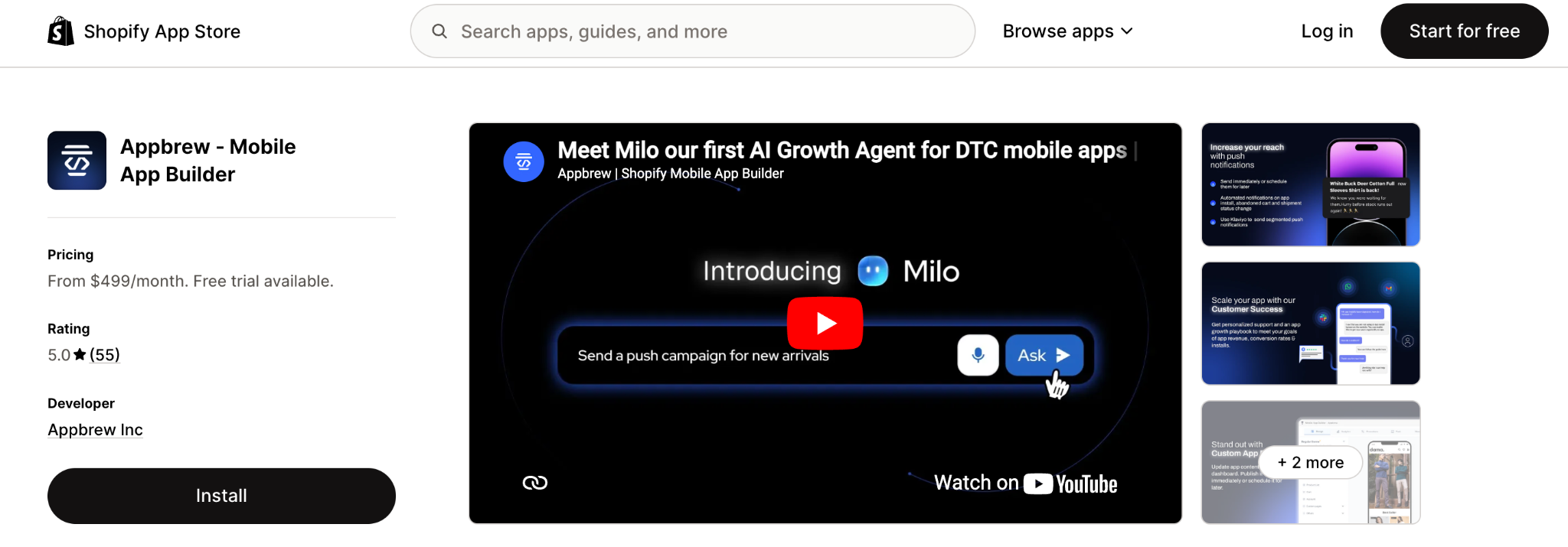
Appbrew is a native mobile app builder for Shopify, built on React Native, and it's designed around the problem most brands hit with Tapcart: getting the app past the 2 to 3 percent revenue ceiling.
More than 21 brands have moved from Tapcart to Appbrew. They tend to arrive with the same frustrations: an app stuck at a few percent of revenue, slow webview experiences, a design they could not make their own, or support that became harder to reach as they scaled. Kut from the Kloth, Copper Pearl, Pixi Beauty, and Distacart each switched to Appbrew for a version of these reasons.
Feature Standout
What sets it apart is Milo, an AI agent that lives inside the Appbrew dashboard and actually does the work rather than just advising.
- Milo edits app screens (homepage, product pages, collections, carousels, banners, badges), and you can drop in a screenshot of a layout you like and tell it to match.
- It writes and schedules push notifications with the deep link pointed at the right product, builds attribution-ready campaign links for Meta and Google install campaigns.
- Sets up promotions like cart goals and bundles, and answers questions about your funnel in plain language ("where are people dropping off?") without opening a BI tool.
Everything runs through your Brand Context, so the copy sounds like you and features products you actually sell. That's a meaningful step beyond Tapcart's AI, which is a separate $250-a-month add-on focused mainly on push, layered on top of a $500 base.
The other reason brands move here is architecture and cost together. Because the app is genuinely native rather than a webview wrapper, pages load faster and transitions feel like an app instead of a browser, which shows up in conversion. And the entry price is roughly a third of Tapcart's floor, with the personalization and A/B testing Tapcart reserves for its $1,250 Scale plan sitting lower in Appbrew's lineup.
Appbrew also supports 120-plus integrations, including Klaviyo, Recharge, Yotpo, Judge.me, Attentive. Brands migrating from Tapcart keep their app-store listings, ratings, and installed users when the existing developer accounts and bundle IDs are preserved.
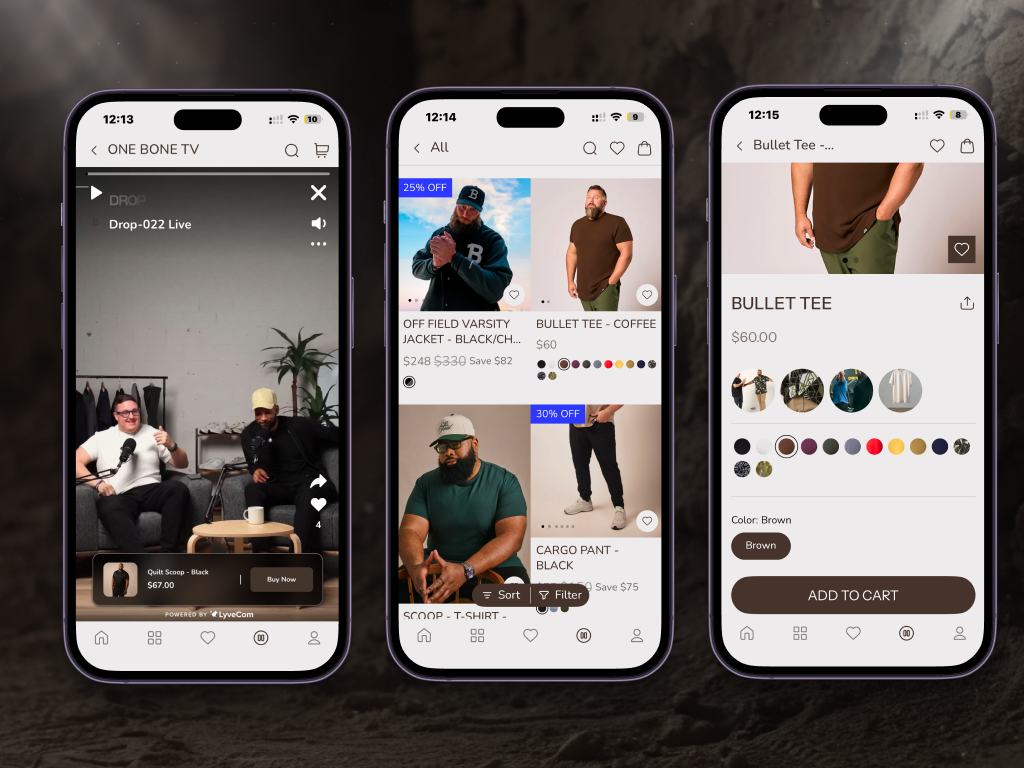
Video commerce: Native video shopping, shoppable reels, and interactive video feeds are built in. For fashion, beauty, and lifestyle brands using video as a key content format, this brings the functionality inside the app rather than relying on third-party embeds. It’s one of the best features if you want to get the most out of your eCommerce influencer marketing efforts.
What it does well:
- Genuinely native (React Native) performance, not a webview shell.
- Milo AI agent that builds screens, runs push, sets up promotions, creates campaign links, and answers data questions from inside the dashboard.
- Deep personalization and segment-level merchandising at accessible tiers.
- Strong push automation with two-way Klaviyo syncing.
- Entry pricing is around a third of Tapcart's, with advanced features lower in the lineup.
Trade-offs:
- Newer and smaller than Tapcart, so it has fewer total years in the market.
- Some advanced retail setups may want configuration help to get the most out of the CMS.
{{cta}}
2. MobiLoud
Best for: Established brands that want a fully managed app using their existing website and technology stack.
Starting price: From $1,499/mo (Business) plus a one-time build fee.
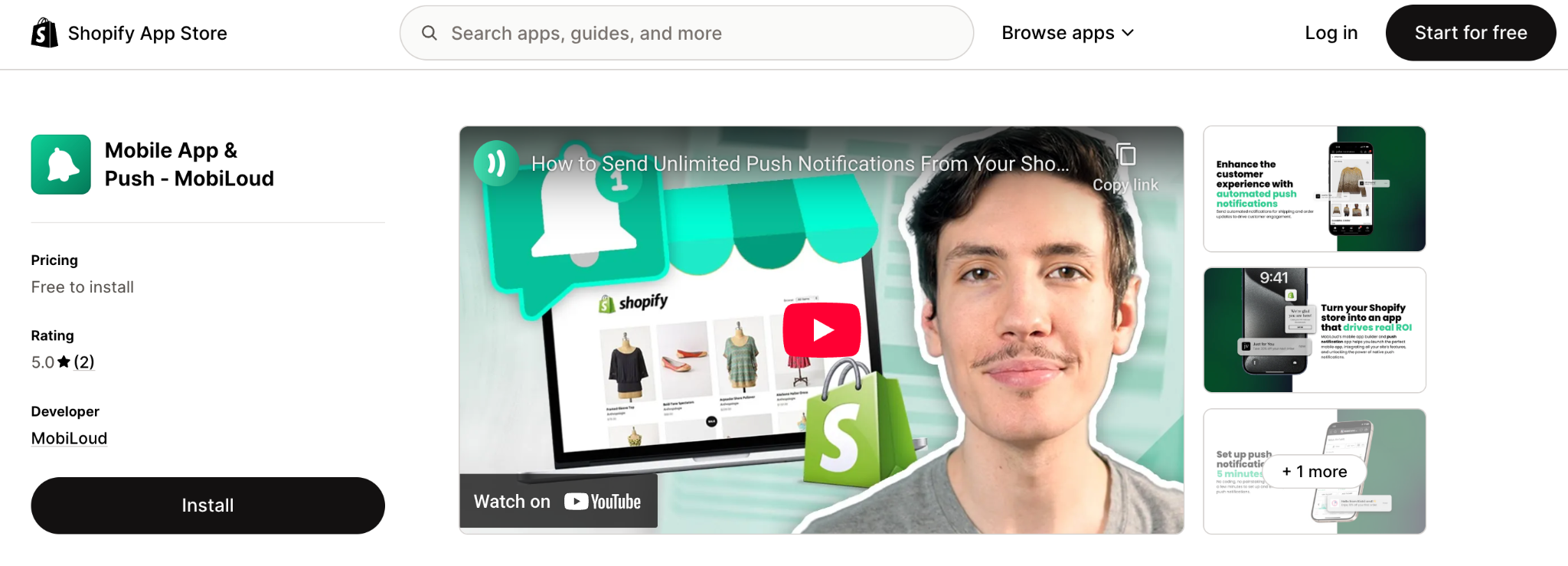
MobiLoud follows a different model from most Tapcart competitors. The app uses your existing website as its foundation, so web features, plugins, and custom functionality can carry into the app without being rebuilt in a separate editor.
Business includes up to 10,000 monthly active users. Usage above that costs $50 per additional 1,000 users. MobiLoud says apps typically launch in six to eight weeks. Klaviyo push, native SDK integrations, multi-region support, and an SLA sit on its custom Enterprise plan.
And at $1,499 a month plus a build fee, it's priced well above Tapcart's floor, aimed at brands that value the managed service over doing it themselves.
What it does well:
- Fully managed build, launch, and maintenance.
- Converts your existing site, so site features carry over without a rebuild.
- Works beyond Shopify (BigCommerce, WooCommerce) and supports multi-storefront brands.
Trade-offs:
- More web-based than a fully native platform, with less app-specific UX.
- Higher starting price plus a one-time build fee, and no built-in AI layer.
3. Superfans (formerly Vajro)
Best for: Community-driven brands built around loyalty, app-exclusive drops, and frequent engagement.
Starting price: From $1,000/mo, on a single Unlimited plan banded by your annual revenue (<$1M, $1M–$20M, $20M+).
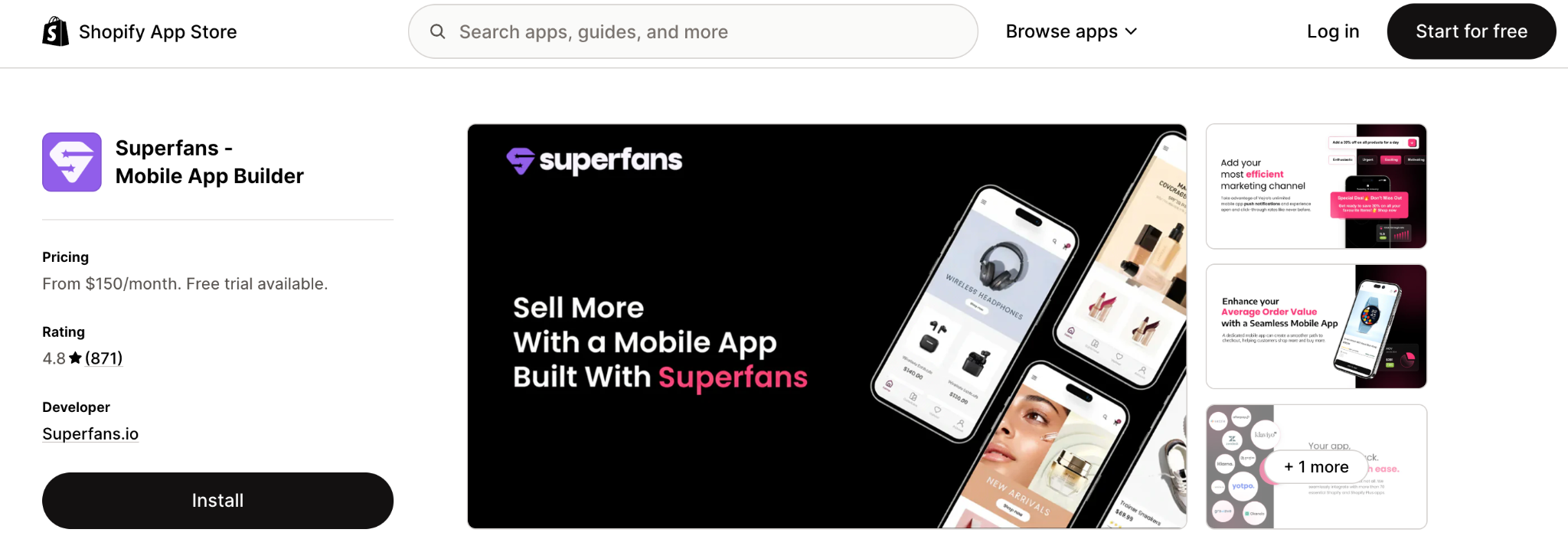
Superfans, recently rebranded from Vajro, is built around live selling, app-exclusive drops, and community features, which makes it a natural fit for brands whose mobile strategy is about superfan engagement.
Its pricing model is the standout: one Unlimited plan with every feature included, priced by your revenue band. That's the opposite of Tapcart's structure, where the analytics, segmentation, and AI you want tend to sit two tiers up or behind an add-on. For a brand that hates feature-gating, "everything included, priced to your size" is a better choice.
The flip side is that revenue-banded pricing can get expensive as you grow, and the entry point already sits at around $1,000 a month, roughly double Tapcart's floor. It's also lighter on the deep personalization and AI automation that Appbrew and Fuego lead with, so it's more about unlimited access to a solid feature set than about a system that optimizes the app for you.
What it does well:
- Live selling, app-exclusive drops, and community features out of the box.
- Single Unlimited plan with no feature-gating, plus a price-lock guarantee.
- Fast launch with a dedicated design manager.
Trade-offs:
- Revenue-banded pricing rises as you scale, starting around $1,000/mo.
- Lighter on deep personalization and AI-driven automation.
4. Plobal Apps
Best for: Promotion-heavy and push-driven mid-market brands that want an established platform with a lower entry price.
Starting price: From $199/mo, rising to around $799/mo on higher tiers, with a per-sale fee on lower plans.
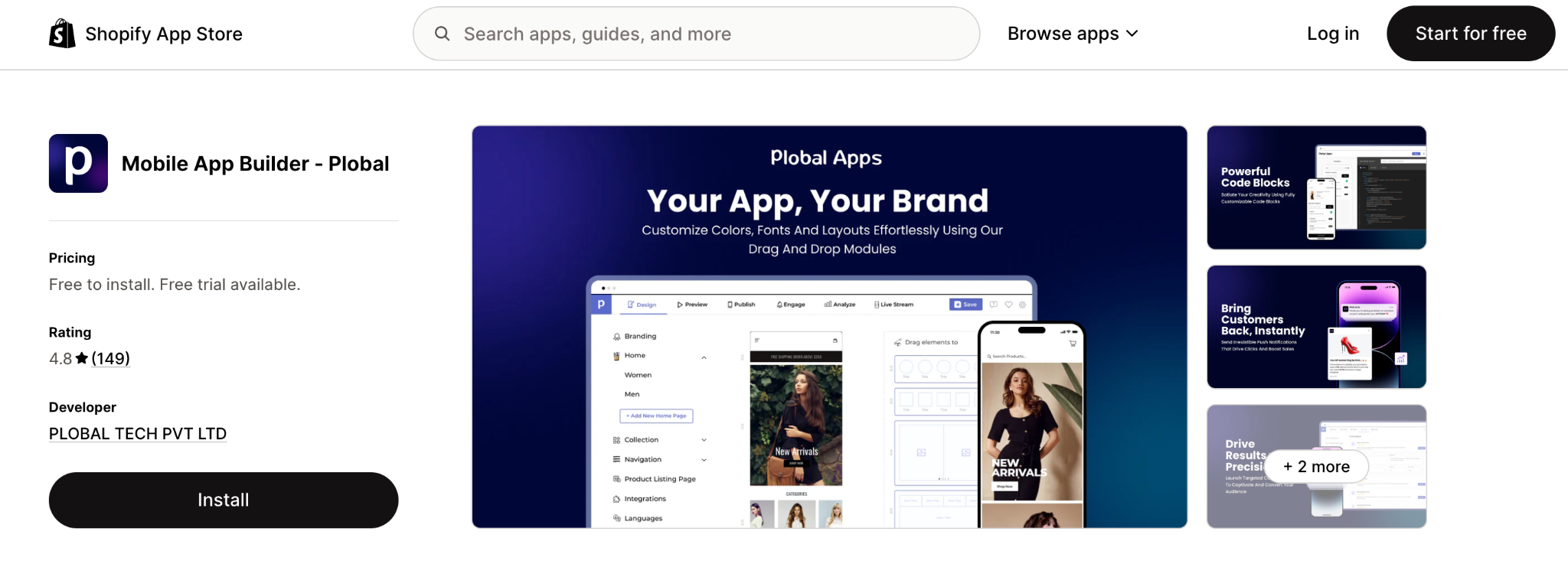
Plobal Apps is one of the well known names in the category, with a track record of push-driven growth and a heavy focus on after-launch performance: analytics, audience segmentation, and personalized notifications.
Plobal's lower tiers add a percentage of app sales on top of the monthly fee (reported at 2 to 3 percent depending on plan), which is exactly the kind of success fee Tapcart has moved away from. Some recent reviews also flag inconsistent support as the platform has scaled.
What it does well:
- Established platform with strong push and segmentation.
- After-launch focus on analytics and reactivation.
- Lower monthly entry price than Tapcart.
Trade-offs:
- Per-sale fee on lower tiers can exceed the flat cost of rivals as you grow.
- Reports of inconsistent support at scale.
5. Apptile
Best for: Brands using live video, social selling, and shoppable content as core acquisition channels.
Starting price: Pro from $249/mo, Plus from $499/mo (10% off annual).
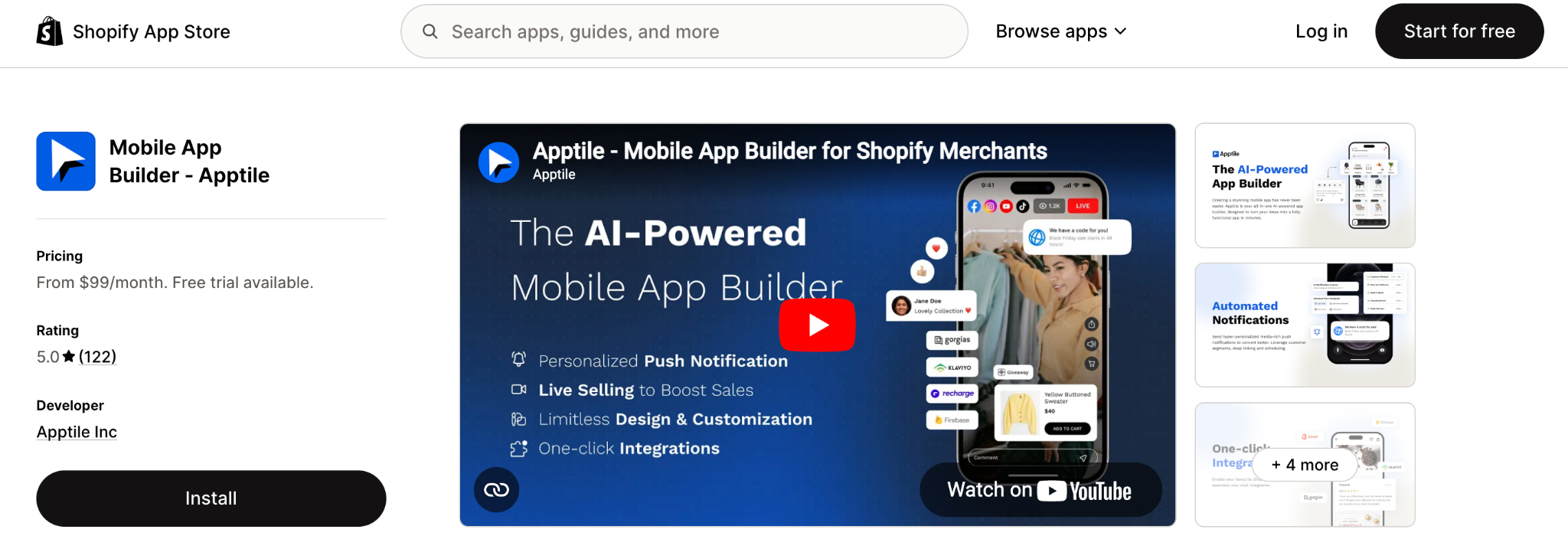
Apptile is a no-code native builder built around a flexible tile-based design system, but its real differentiator is live commerce. Native live video selling, multistreaming to Facebook, Instagram, TikTok, and YouTube, live tipping, and shoppable feeds are built in, along with AI-powered personalization tiles and AI "Pop Clips."
For a brand leaning into video and live shopping as a channel, that's functionality Tapcart simply doesn't offer.
The things to watch are the usage-based costs layered on top of the monthly fee. Live selling includes 50,000 viewer minutes a month, then charges per additional 1,000, and plans include 5,000 monthly active users with per-user averages above that.
For a smaller catalog brand not using live selling, a lot of what you're paying for goes unused, so Apptile makes most sense when video is central to how you sell rather than a nice-to-have.
What it does well:
- Native live video selling with multistreaming and live tipping.
- Flexible tile-based design system with AI personalization tiles.
Trade-offs:
- Usage-based fees for viewer minutes and monthly active users add up.
- Overkill if live and video commerce isn't central to your strategy.
6. Shopney
Best for: Smaller and mid-market brands that want strong design and in-app live chat without a big monthly commitment.
Starting price: Silver $149/mo, Gold $299/mo, Platinum $599/mo, Enterprise from $1,299/mo. No commission on sales.
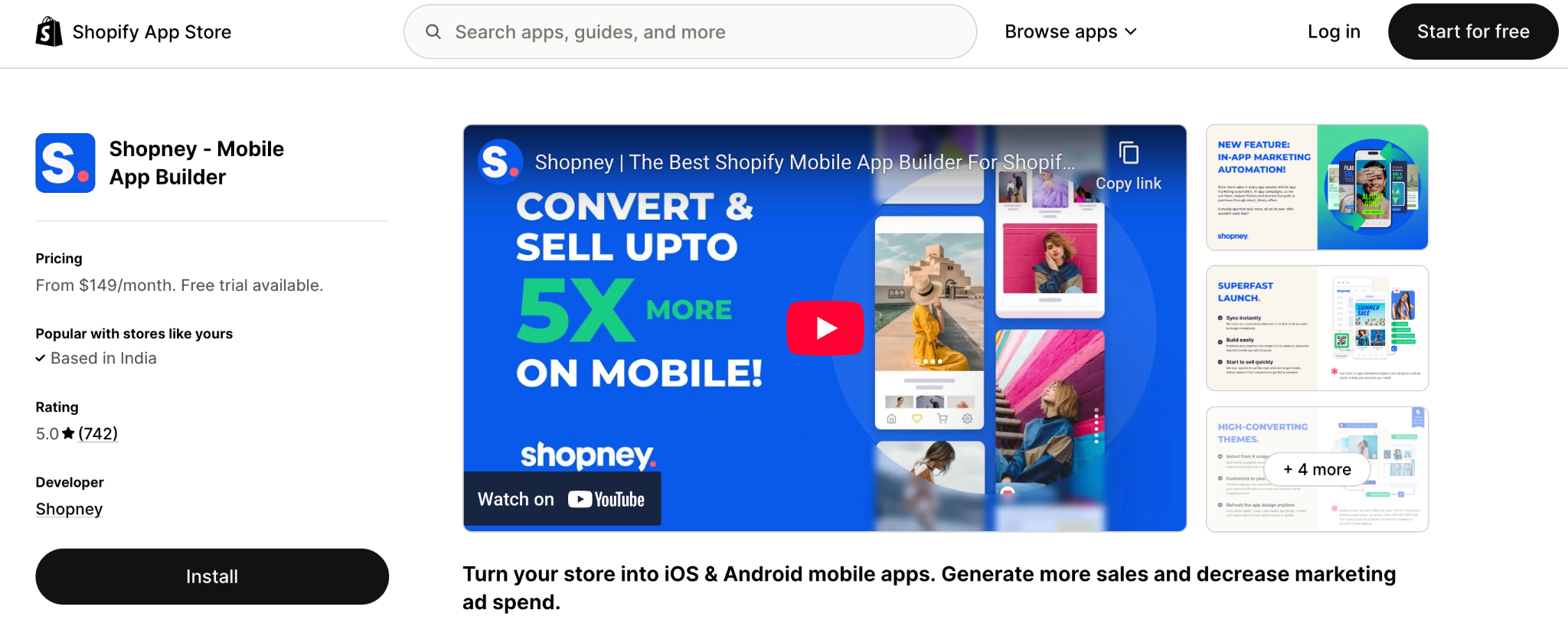
Shopney is a design-focused native builder known for polished themes and in-app live chat that lets you talk to shoppers inside the app. It markets itself on no commissions and no sales limits, and the $149 entry tier reads as one of the more affordable ways onto a native app.
The important caveat is where the features you'll actually want sit. The Silver tier covers the essentials, but segmented and AI push, live selling, and the integrations most growing brands rely on (Klaviyo, Rebuy, Nosto, loyalty, subscriptions) don't appear until the $599 Platinum plan.
The comparison may look like $149 for Shopney versus $500 for Tapcart. But if you need Shopney’s higher-tier integrations and features, you may need its Platinum plan. Compare the plan your store will actually use, not just the advertised starting prices.
What it does well:
- Strong design templates and genuine in-app live chat.
- No sales commission and no order limits.
- Low entry price to get a native app live.
Trade-offs:
- Key integrations and AI/segmented push are gated to the $599 Platinum tier.
- The entry tier is thinner than the marketing suggests.
7. MageNative
Best for: Cost-conscious stores that want an affordable native app from an established maker.
Starting price: From $99/mo (Starter), with Standard around $149/mo and Premium around $249/mo. No revenue fee.
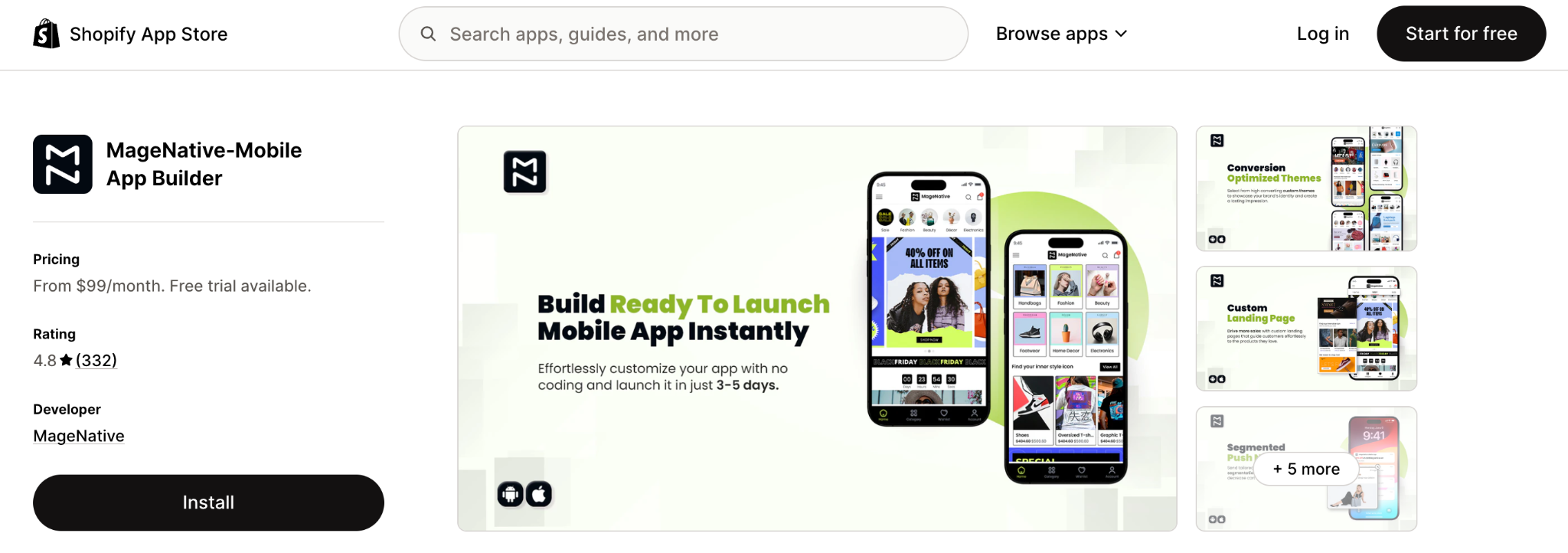
MageNative is a long-running no-code builder that turns a Shopify store into native iOS and Android apps at the budget end of the market.
It covers the essentials well: drag-and-drop building, push notifications, multi-language and multi-currency support, app-exclusive offers, and 40-plus integrations. If your goal is simply to get a solid native app live without a large monthly commitment, it does that for a fifth of Tapcart's floor.
What you give up at this price is depth. MageNative lacks the sophisticated personalization, segmentation, and conversion-optimization tooling that platforms like Appbrew and Tapcart build, so it's better understood as a dependable entry-level app than a system for growing the mobile channel into a major revenue line. For a small brand testing whether an app is worth it, that's a reasonable place to start.
What it does well:
- Affordable native apps from an established maker with a strong review history.
- Multi-language and multi-currency support for international stores.
- No revenue fee on top of the monthly cost.
Trade-offs:
- Shallow on personalization, segmentation, and conversion optimization.
- Better as an entry-level app than a growth platform.
8. Fuego
Best for: Shopify Plus brands wanting AI-assisted creation, community features, and developer extensibility.
Starting price: From $999/mo (core builder). The AI agent, A/B testing, segmentation and custom blocks are on custom-priced Enterprise plans.
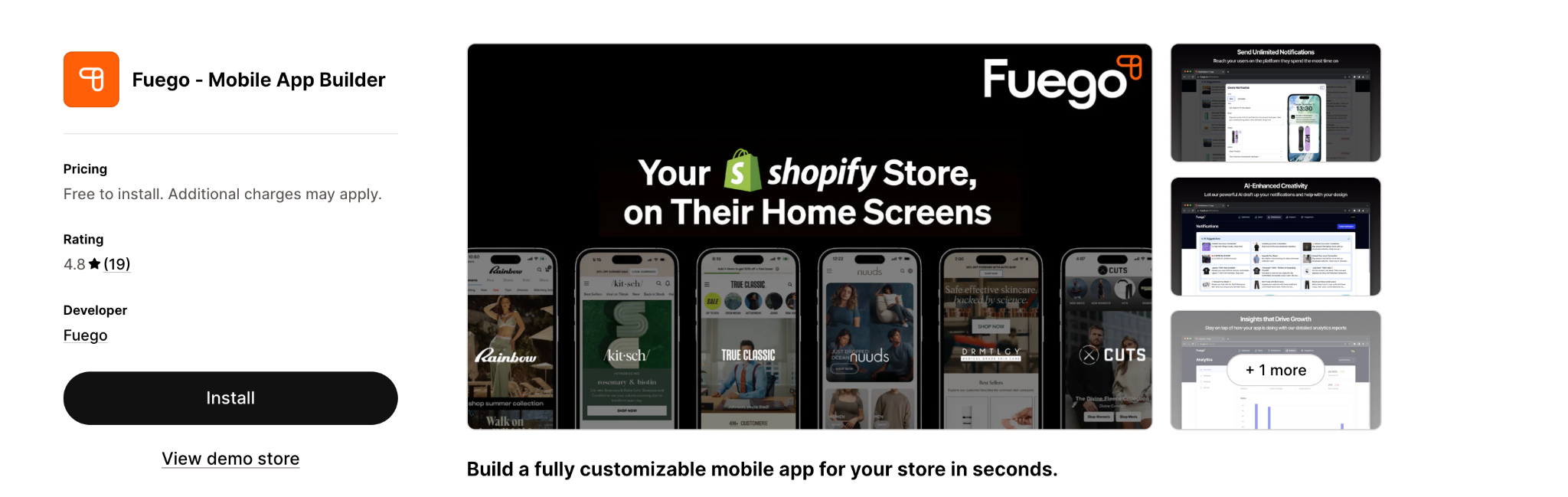
Fuego has strong AI-native options in the category, powering apps for well-known DTC names. Standout features includes, 100-plus template blocks, custom React Native blocks for deep customization, A/B testing, audience segmentation, Apple App Clips, community features, and an AI agent for app management plus AI-assisted screen generation.
That AI depth is its real edge over Tapcart, whose AI is a bolt-on add-on rather than integrated through the platform.
The obvious constraint is price. At $999 a month to start, Fuego sits at roughly double Tapcart's floor and about five times Appbrew's entry tier. That entry price covers the core builder only. The AI agent, testing and segmentation that make Fuego stand out require an Enterprise quote, so it firmly targets Plus and enterprise brands with the budget and the team to use the optimization tooling.
Integrations outside its ecosystem can also require custom development through those React Native blocks. For a brand that wants that AI-native power at a fraction of the cost, Appbrew is the closer-value comparison; for enterprises already sold on a premium managed setup, Fuego is a serious contender.
What it does well:
- AI-native platform with an app-management agent and AI screen generation.
- Deep customization via React Native blocks, plus A/B testing and segmentation.
- No transaction fees or annual contracts.
Trade-offs:
- High entry price ($999/mo), and its most advanced features need custom Enterprise pricing on top of that.
- Integrations outside its ecosystem may need custom development.
9. VennApps
Best for: Mid-market to enterprise brands that want a bespoke, fully managed native app with a dedicated designer, not a self-serve editor.
Starting price: Pro from $1,999/mo, Enterprise from $2,999/mo.
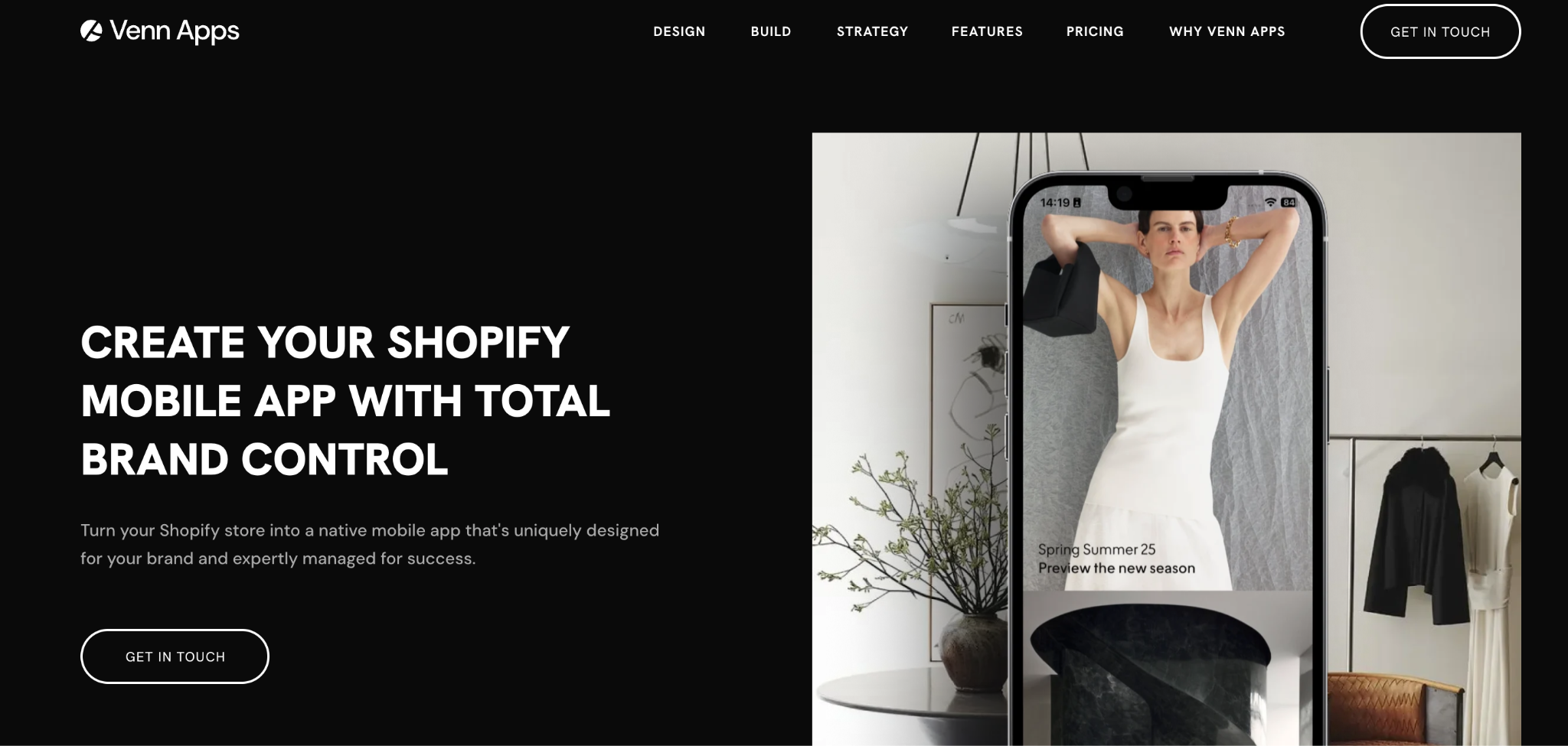
VennApps sits at the premium, done-for-you end of the market. Rather than handing you a block editor, it pairs you with a dedicated designer and builds a custom app with extensive design flexibility, real-time metafield mirroring so the app matches your site's functionality, unlimited integrations, and a strategic account manager.
For a brand whose whole edge is a distinctive, high-craft experience, that hands-on model is the opposite of Tapcart's self-serve App Studio, where going beyond the standard blocks means writing your own code.
The trade-off is straightforward: cost and commitment. At $1,999 a month to start, and $2,999 for enterprise, VennApps is the most expensive option on this list by entry price, several times Tapcart's floor.
There's also no built-in AI layer of the kind Appbrew and Fuego lead with, so you're paying for bespoke design and managed service rather than automation. It makes sense for brands that would otherwise hire an agency and want a managed middle path between DIY builders and a six-figure custom build.
What it does well:
- Bespoke design with a dedicated designer, well beyond template-based builders.
- Real-time metafield mirroring and unlimited integrations.
- Fully managed service with a strategic account manager.
Trade-offs:
- Highest entry price on this list ($1,999/mo), with real commitment.
- No built-in AI automation layer.
10. OneMobile
Best for: Newer Shopify stores wanting to publish an app with little upfront risk.
Starting price: Paid plans start at $99 per month.
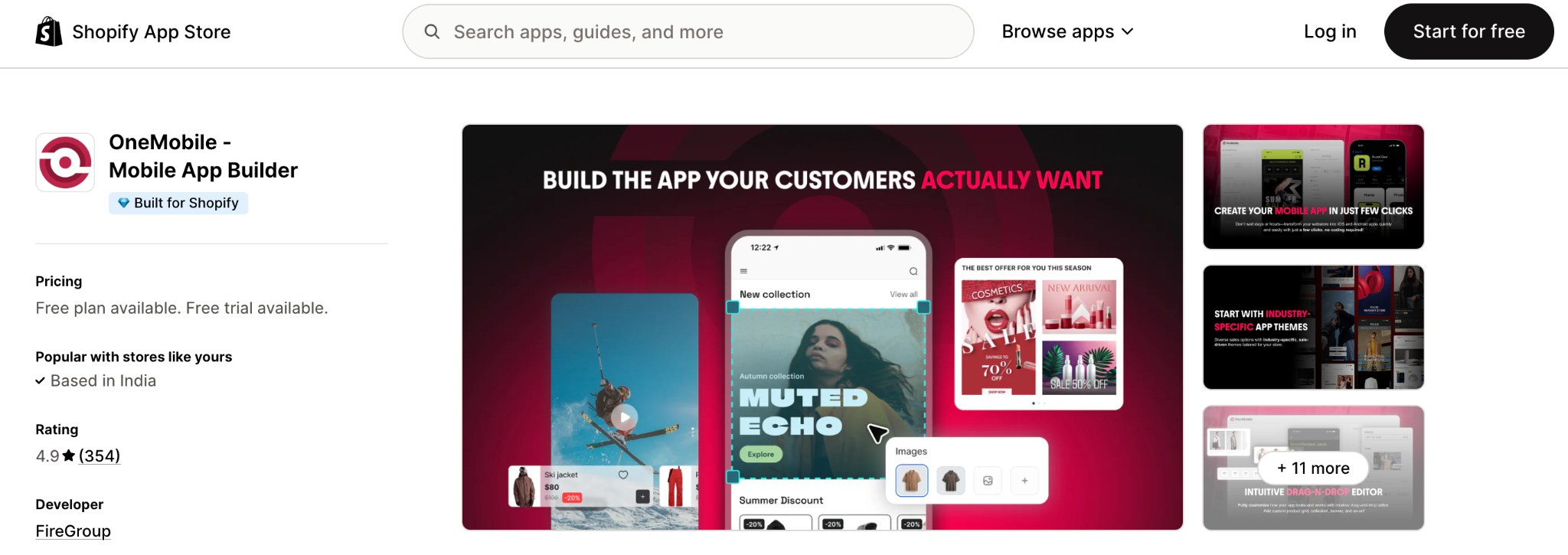
OneMobile offers a publishable free plan with one theme, five design blocks, one customizable screen, and default commerce screens. ScaleUp costs $99 per month and adds more themes, customizable screens, behavioral notifications, analytics, and wishlist functionality. BrandUp costs $299 per month, while Omni costs $990.
The important detail is the infrastructure fee. ScaleUp charges 2.9% per order after monthly app revenue exceeds $2,000. BrandUp charges 1.9% above $10,000, and Omni charges 1.2% above $100,000, subject to monthly caps.
What OneMobile does well
- Publishable free plan and a low-cost paid tier.
- Modern themes, shoppable video, and AI-assisted content.
- Behavioral push, analytics, and a growing integration library.
Trade-offs
- Revenue-linked infrastructure fees can make costs rise with app sales.
- Design blocks, screens, integrations, and support vary significantly by tier.
- Larger brands should model total cost rather than comparing base subscriptions alone.
How to choose the best Tapcart alternative in 2026
Start with the reason you want to leave Tapcart. Is it the price, limited customization, weak integrations, app performance, or poor support? That problem should guide your decision.
Use these five questions to compare your options.
1. Native or webview?
This is the one that shapes everything a shopper feels. A genuinely native app (like Appbrew's React Native build) loads faster and moves like an app; a webview wrapper is your mobile site inside an app shell, and users can tell. If speed and feel matter to your brand, confirm what you're actually buying, because "native" gets used loosely.
2. How deep does personalization go?
A single home screen for everyone is bare minimum. The question is whether you can show a different experience to a first-time visitor than to a high-LTV repeat buyer, and segment merchandising and push by behavior. This is usually the difference between an app that plateaus at 2 to 3 percent of revenue and one that grows past it.
3. What does push automation actually do?
Push is the main economic reason to have an app, so look past "we have push notifications." Can it fire on behavior (abandoned cart, back-in-stock, win-back), segment audiences, and sync two ways with Klaviyo? Broadcast-only push leaves most of the value on the table.
4. Does it fit your stack, and is that included?
List the integrations you can't live without (loyalty, reviews, subscriptions, your ESP) and check which tier they sit on. As the Shopney and Plobal examples show, the tools you need often live two tiers above the headline price, so compare the plan that fits your stack, not the entry plan.
5. What's the real total cost?
Add it up properly: base fee, any per-sale or usage fees, the tier that actually has your must-have features, plus the universal Apple ($99/yr) and Google Play ($25 one-time) costs. A flat plan and a "low base plus a cut of sales" plan can look similar until your app starts converting, at which point they diverge fast.
Answer those five honestly and the field narrows itself. You'll usually be left with two or three platforms worth a proper trial.
Will you lose users if you switch?
The fear that keeps most brands on a platform they have outgrown is migration risk. Losing installs, reviews, or customer data in the move.
A properly managed migration can preserve your Apple and Google developer accounts, bundle IDs, app-store listings, ratings, reviews, and installed user base. Existing users receive the rebuilt app as an update instead of downloading a separate app.
Customer and order data remains in Shopify. Push subscribers can also be retained when certificates, tokens, and notification infrastructure are transferred correctly.
The main work is rebuilding the design, integrations, analytics, and customer journeys on the new platform. Appbrew typically completes a Tapcart migration in three to four weeks, depending on complexity. Check your current contract and renewal date before scheduling the move.
For the complete migration process, read our Tapcart vs Appbrew comparison.
Who should stay with Tapcart?
You should stay with Tapcart if your app is already growing, your required integrations work properly, and the current cost makes sense against the revenue it generates.
Tapcart may still suit you if:
- Its standard design blocks give you enough control.
- You mainly need scheduled push campaigns.
- Your app does not require complex subscriptions, loyalty, or custom shopping flows.
- Your team is satisfied with its account manager and support.
- You can justify the Scale or Enterprise+ plan.
- Moving would cost more than the problems it solves.
Do not stay only because switching feels risky. Compare your app revenue, conversion rate, repeat purchases, support experience, and total annual cost with what another platform can provide. If Tapcart still performs well after that comparison, there may be no reason to move.
{{cta2}}
FAQs
What is the best Tapcart alternative?
It depends on the gap you're trying to close. For scaling Shopify and Shopify Plus brands that want deeper personalization and AI-driven automation at a lower entry price, Appbrew is the strongest all-round alternative. For live video selling, Apptile stands out; for a fully managed premium build, VennApps; and for the lowest entry cost, MageNative.
Is there a cheaper alternative to Tapcart?
Yes. Tapcart's entry plan starts at $500 a month (before its $250 AI add-on), and several alternatives start well below that: MageNative from around $99, Shopney from $149, Appbrew from $199, and Apptile from $249. Just compare the tier that actually includes the features you need, not only the headline entry price, since key integrations sometimes sit on higher plans.
How much does Tapcart cost in 2026?
Tapcart's Growth plan is $500 a month, Scale is $1,250, and Enterprise+ starts at $2,850. Its AI push and automation features are a separate $250-a-month add-on. All plans also require an Apple Developer account ($99/year) and a Google Play account ($25 one-time). Confirm current pricing on Tapcart's site, as it changes.
Can I switch from Tapcart without losing my app or users?
Yes. Because your app keeps the same Apple and Google developer accounts, existing users get an update rather than a fresh download, so your install base and store ratings carry over. Push subscribers transfer with the right setup, and your customer and order data stays in Shopify throughout.A typical rebuild takes three to four weeks, depending on complexity. Check your Tapcart contract's renewal date first, since annual terms can affect timing.
Are Tapcart alternatives native apps or webviews?
It varies, and it matters. Some platforms build genuinely native apps (Appbrew, for example, uses React Native), while others rely more on webview wrappers that render your mobile site inside an app shell. Native apps generally load faster and feel smoother, which tends to show up in conversion. Always confirm what a platform actually builds, since "native" is used loosely in marketing.
Do Tapcart alternatives work with Shopify Plus?
Most do, and several are built specifically for Plus and enterprise brands, including Fuego, VennApps, and Appbrew. If you're on Shopify Plus, check for the capabilities that matter at that scale: advanced segmentation, A/B testing, multi-store support, and the integrations your stack depends on.
How long does it take to launch a new app?
For self-serve builders, a straightforward app can be live in days to a couple of weeks. Fully managed builds take longer: MobiLoud, for instance, cites six to eight weeks.Migrating from an existing app usually takes three to four weeks for design and integrations, depending on complexity.