.webp)
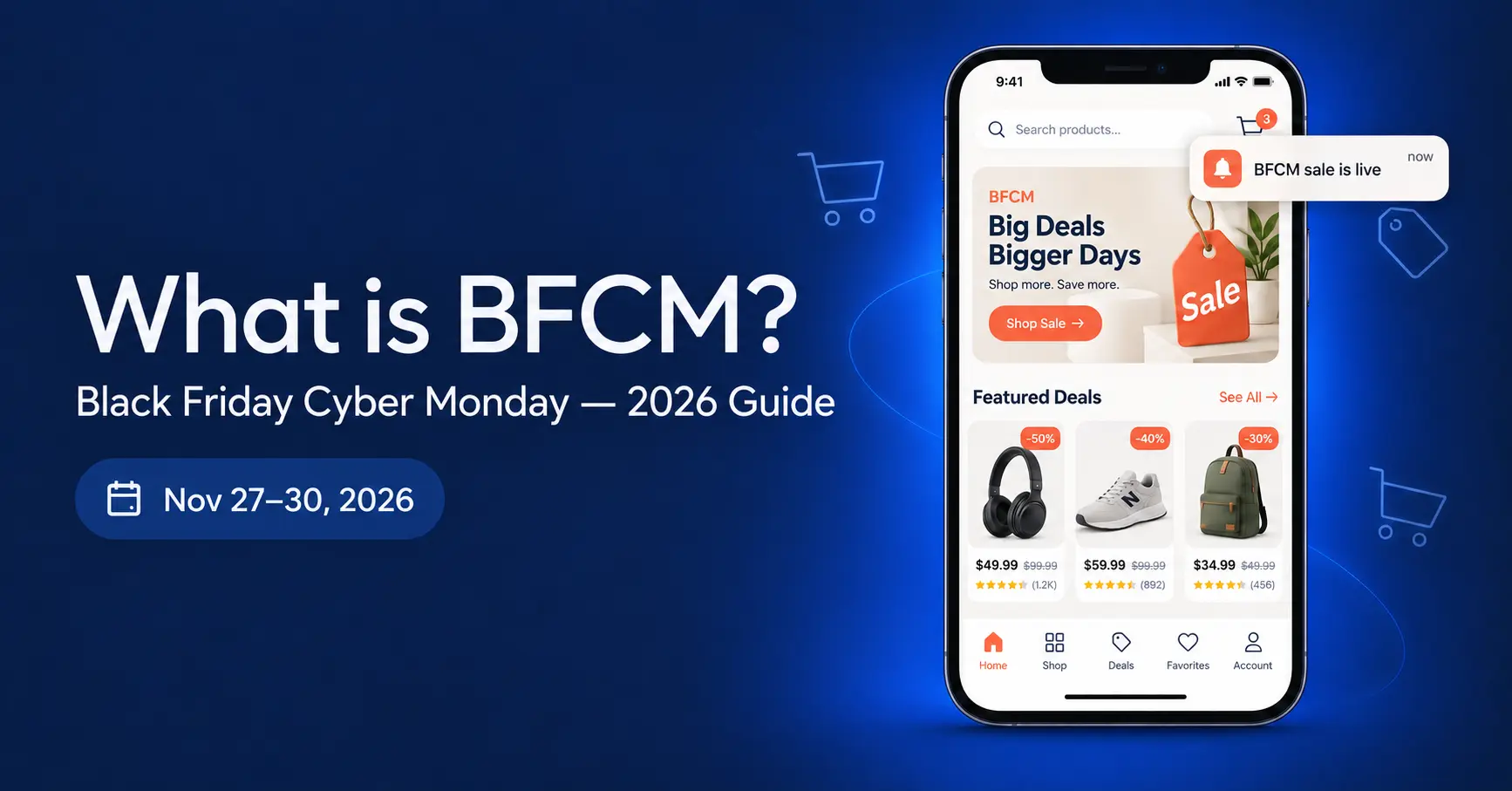
BFCM means Black Friday Cyber Monday, the four-day sales window after US Thanksgiving. Learn what it means, 2026 dates, and how Shopify brands win.
|
BFCM stands for Black Friday Cyber Monday, the four-day shopping window that runs from Black Friday (the day after US Thanksgiving) through Cyber Monday. The full stretch, including Thanksgiving, is often called Cyber Week. In 2026, BFCM runs November 27–30 and marks the start of the holiday shopping season. |
Before the internet, Black Friday was a doorbusting, in-store event. Today it's a global, mobile-first commerce moment. According to Shopify data, 28% of merchants say BFCM and the holiday season drive 30–50% of their annual revenue, and 8% say it's more than half.
For most brands, BFCM is the highest-stakes revenue window of the year, and the ones who win treat it as infrastructure they build toward, not a campaign they scramble to launch in November.
What does BFCM stand for?
BFCM compresses two originally separate retail events into one commercial concept: Black Friday, the in-store shopping surge the day after US Thanksgiving, and Cyber Monday, the online-focused sales day the following Monday.
Sitting in the middle is Small Business Saturday, often overlooked in planning but valuable for DTC and Shopify brands positioning against big-box competitors.
The bigger shift is that the event no longer starts on Black Friday at all. Major retailers now push discounts into early November, a trend the industry has started calling "Black November", and meaningful promotional traffic can begin as early as October.
When is BFCM 2026?
In 2026, Black Friday falls on Friday, November 27, and Cyber Monday lands on Monday, November 30. The core BFCM weekend runs November 27–30, but most retailers treat it as part of a longer Cyber Week that begins on Thanksgiving.
Here are the key dates for BFCM 2026:
|
Date |
Day |
Event |
|
November 26, 2026 |
Thursday |
US Thanksgiving |
|
November 27, 2026 |
Friday |
Black Friday |
|
November 28, 2026 |
Saturday |
Small Business Saturday |
|
November 30, 2026 |
Monday |
Cyber Monday |
Because of the "Black November" trend, promotional activity will almost certainly begin well before Black Friday itself, many brands launch early-access deals in the first two weeks of November, and some open discounts as early as October. If you're a Shopify merchant, treat late October as your live window, not your prep window.
Black Friday vs Cyber Monday: what's the difference?
Black Friday and Cyber Monday are closely linked, but they pull different shoppers in different states of mind.
Black Friday shoppers are often still in discovery mode. They browse, compare prices, build wishlists, and bookmark. The purchase intent is real but deferred. Your job on Black Friday is to capture attention and get into the consideration set.
Cyber Monday shoppers, by contrast, have already decided. They've watched the price across the weekend and come back to buy before the deal disappears.
Here's how the two days compare:
|
Aspects |
Black Friday |
Cyber Monday |
|
Shopper mindset |
Browse, compare, wishlist |
Buy with urgency |
|
Origin |
In-store doorbuster event |
Online-only sales day |
|
Traffic pattern |
Peaks mid-morning |
Peaks evening (8–10 PM EST) |
|
Cart behavior |
Higher abandonment, lower intent |
Lower abandonment, faster checkout |
|
Best channels |
Discovery: email, social, paid |
Urgency: push, SMS, retargeting |
Today the lines are blurred, many people shop online on Black Friday and keep going as Cyber Monday deals roll in. But each day still rewards a different offer and a different channel mix. If you're running identical campaigns on both, you're leaving conversion on the table on at least one of them.
For a full day-by-day playbook, see our Black Friday marketing strategy and Cyber Monday marketing guides.
5 BFCM trends 2026: how shoppers will buy
The four-day weekend still exists on the calendar, but shopper behavior has moved past it. Five shifts now shape how people find products, decide, and pay during BFCM. Each one changes what a Shopify brand should prioritize in 2026.
1. AI has become a discovery channel
Shoppers used AI to shop in 2025. AI-driven traffic to US retail sites grew 805% year over year. Shoppers who arrived from an AI service were 38% more likely to buy.
People now ask assistants to compare products, find deals, and check fit before they reach a product page. For 2026, your product data, reviews, and descriptions need to be readable by AI, not just by human browsers.
2. BNPL is now a mainstream payment method
Buy Now, Pay Later has become a primary way people pay. Cyber Monday 2025 drove $1.03 billion in BNPL purchases, or 7.2% of all online sales that day. Total November BNPL spend reached $9.0 billion, up 9.6% from the year before.
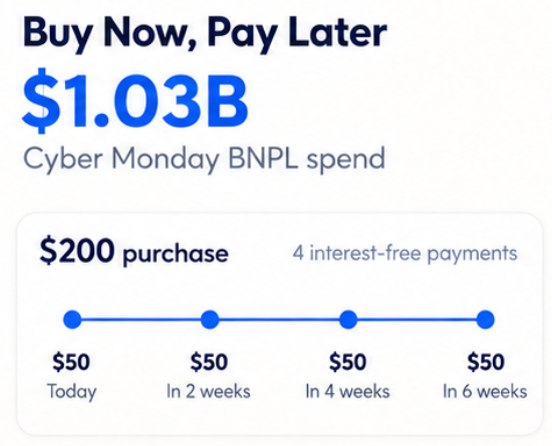
Most of it lands on orders between $100 and $300. That range is big enough for shoppers to feel the cost, but small enough that traditional financing does not fit. If BNPL is not visible on your product pages for higher-ticket items, you lose those conversions.
3. Discounts are shrinking, but spending is not
Brands cut back on blanket discounts and shoppers still bought. Average discount rates dropped from 29.1% the prior year to 26.2% in 2025.
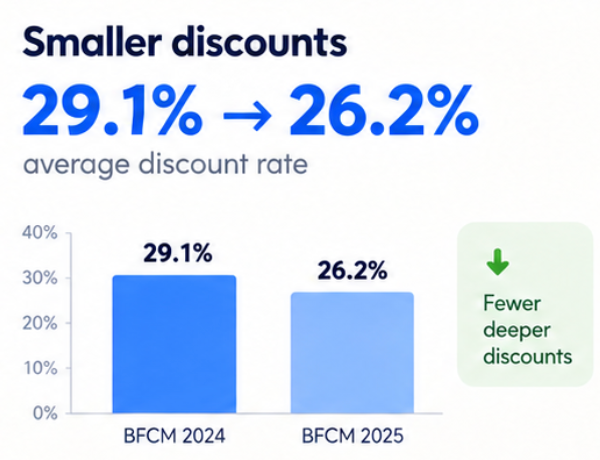
Loyal customers kept spending anyway. They responded to early access and personalized offers instead of deeper price cuts. This means relationship tactics like VIP access, bundles, and loyalty perks can protect your margin without hurting volume.
4. Repeat customers drive the growth
Acquisition keeps getting more expensive, so the brands that win rely on customers they already have. Repeat-shopper revenue is growing faster than total revenue. It came in 45% higher than new-shopper GMV during BFCM 2025.
BFCM is now a retention event as much as an acquisition one. The post-purchase window is where that value compounds, so plan your follow-up sequence before the sale, not after.
5. Consistency across channels is the baseline
Shoppers expect the same price and offer wherever they see it. Klaviyo's consumer research found that the biggest frustration when shopping a brand across different places is inconsistent pricing and promotions.
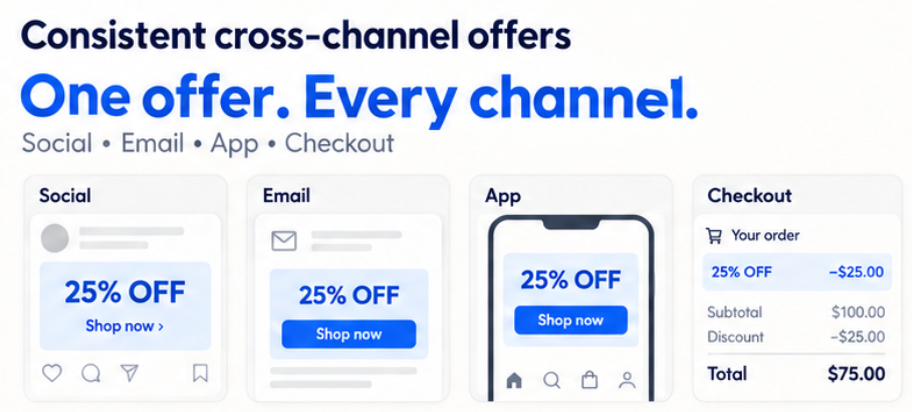
If an offer shows on social, people expect it to hold in email and at checkout. Fragmented, channel-by-channel promotions now cost you trust during Cyber Week.
5 Common BFCM shopper personas in 2026
Not every BFCM buyer wants the same thing. Some hunt for the deepest discount, others buy on loyalty alone. Recognizing which persona you are messaging helps you match the right offer to the right shopper. Here are the five most common types.
1. The deal hunter
This shopper is price-sensitive and focused on getting the best bargain. They compare prices across sites, stack coupon codes, and go for the deepest discounts they can find.
2. The early planner
The early planner starts weeks ahead. They build wishlists, track prices, and wait for early-access deals or previews.
Reward them with VIP early access and saved-item reminders, and you capture their spend before competitors open their sales.
3. The last-minute shopper
This buyer waits until late on Black Friday or Cyber Monday itself. They often need a nudge to act.
They respond to urgency: countdown timers, low-stock alerts, and cart-abandonment reminders.
4. The loyalist
Loyalists would buy from you even without a sale, but during BFCM they still look for a reason to feel valued. They want recognition, not just a discount.
Give them early access, a loyalty-only perk, or a thank-you offer.
5. The gift giver
Many people use BFCM to start their holiday gift shopping. The gift giver buys for others and wants good deals on the right presents.
They value convenience and inspiration: curated gift guides, bundles, and clear shipping cut-off dates.
BFCM by the numbers (2025)
The scale of BFCM is easier to grasp in figures than in adjectives. Here are the numbers from BFCM 2025, the most recent completed cycle, and what they signal for brands planning 2026.
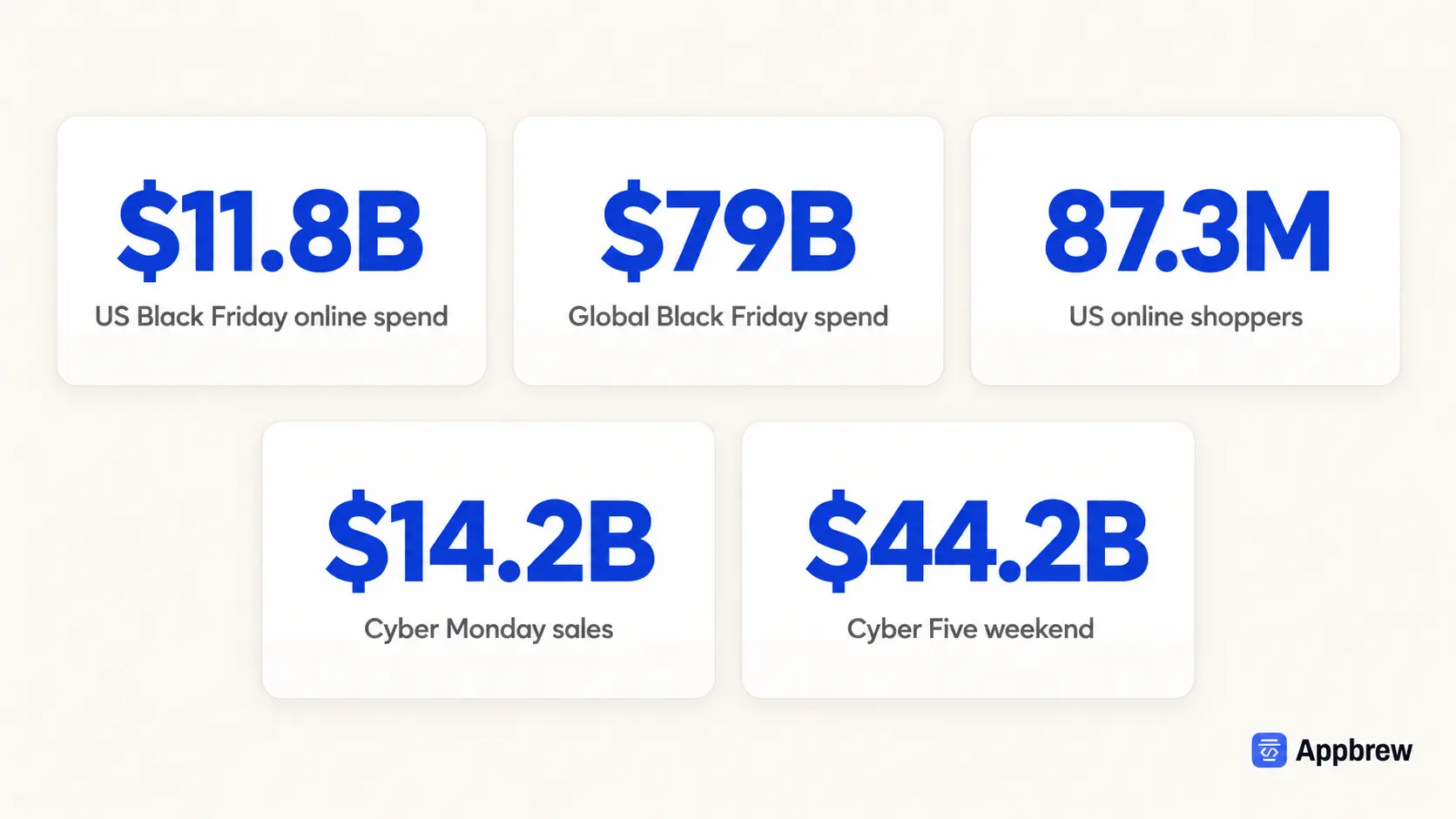
BFCM 2025 set records across every major channel:
|
Metric |
BFCM 2025 |
Change vs 2024 |
|
US online spend, Black Friday |
$11.8 billion |
+9.3% |
|
Global online spend, Black Friday (24 hrs) |
$79 billion |
+6.2% |
|
US online shoppers, Black Friday |
87.3 million |
+6.9% |
|
Cyber Monday US online sales |
~$14.2 billion |
+7.1% |
|
Cyber Five weekend, total online spend |
$44.2 billion |
— |
Source: Adobe Analytics and Shopify BFCM 2025 reports.
Cyber Monday held its title as the single largest online shopping day of the year. For a day-by-day plan to capture this demand, see our BFCM marketing strategies guide.
What the numbers say about 2026
A few patterns from 2025 matter more than the totals:
- Black Friday grew faster than Cyber Monday, at 9.1% versus 7.1%. Shoppers are moving major purchases earlier in the weekend, which strengthens the case for opening your offer before Black Friday.
- Shoppers bought slightly less per order. Units per transaction fell about 2% and overall order volumes dipped roughly 1% year over year, largely because of higher prices. Average order value held up based on what people bought, not how much.
- Three categories drove 57% of Cyber Monday sales: electronics (up 12.8%), apparel (up 5.2%), and furniture (up 5.4%). If you sell in these categories, secure inventory early, because stock moves fast.
- Cross-border demand was strong. About 16% of Shopify orders were international, led by the UK, Australia, Germany, and Canada. If you have considered selling abroad, the demand is already there.
Data: Adobe Analytics, Shopify, and eMarketer BFCM 2025.
Brand challenges during BFCM (and how to solve them)
The upside of BFCM is obvious. Executing when traffic spikes, inboxes flood, and everyone discounts at once is the hard part. Here are the five challenges brands hit most, and how to solve each.
1. Cutting through the noise
Every inbox and feed is saturated during BFCM. Standing out is harder than any other time of year.
- Test offers in summer so you know what works before the rush
- Turn off non-essential automations that add clutter
- Segment your list so messages match real behavior
- Lead with your strongest offer instead of burying it
2. Protecting margin while discounting
Deep discounts move volume but erode profit and cheapen premium brands. This is where a lot of BFCM revenue quietly disappears.
- Use tiered discounts, bundles, or a free gift instead of one deep sitewide cut
- A gift or bundle lifts perceived value and AOV without slashing margin
- Keep flash sales short to drive urgency while containing the discount
3. Handling the support surge
Sales spikes bring support spikes, and slow replies cost you the sale.
- Automate replies for the most common questions
- Offer self-service so simple issues never reach your team, freeing agents for complex cases
4. Turning one-time buyers into repeat customers
BFCM pulls in deal-driven shoppers who may never return. Keeping them is where the value is.
- Plan your post-purchase sequence before the sale starts
- Give new buyers a short break, then send a welcome flow, loyalty invite, and personalized thank-you
5. Measuring performance across channels
BFCM runs across email, SMS, push, paid, and social at once. Without clean attribution, you cannot tell what is working while you can still act on it.
- Track performance in one place, in real time
- Shift budget and messaging mid-weekend instead of reviewing after the fact
Brands that adjust on Saturday using Friday's data beat the ones that wait for the recap.
{{cta}}
How Shopify brands win BFCM: data from 250+ Shopify apps
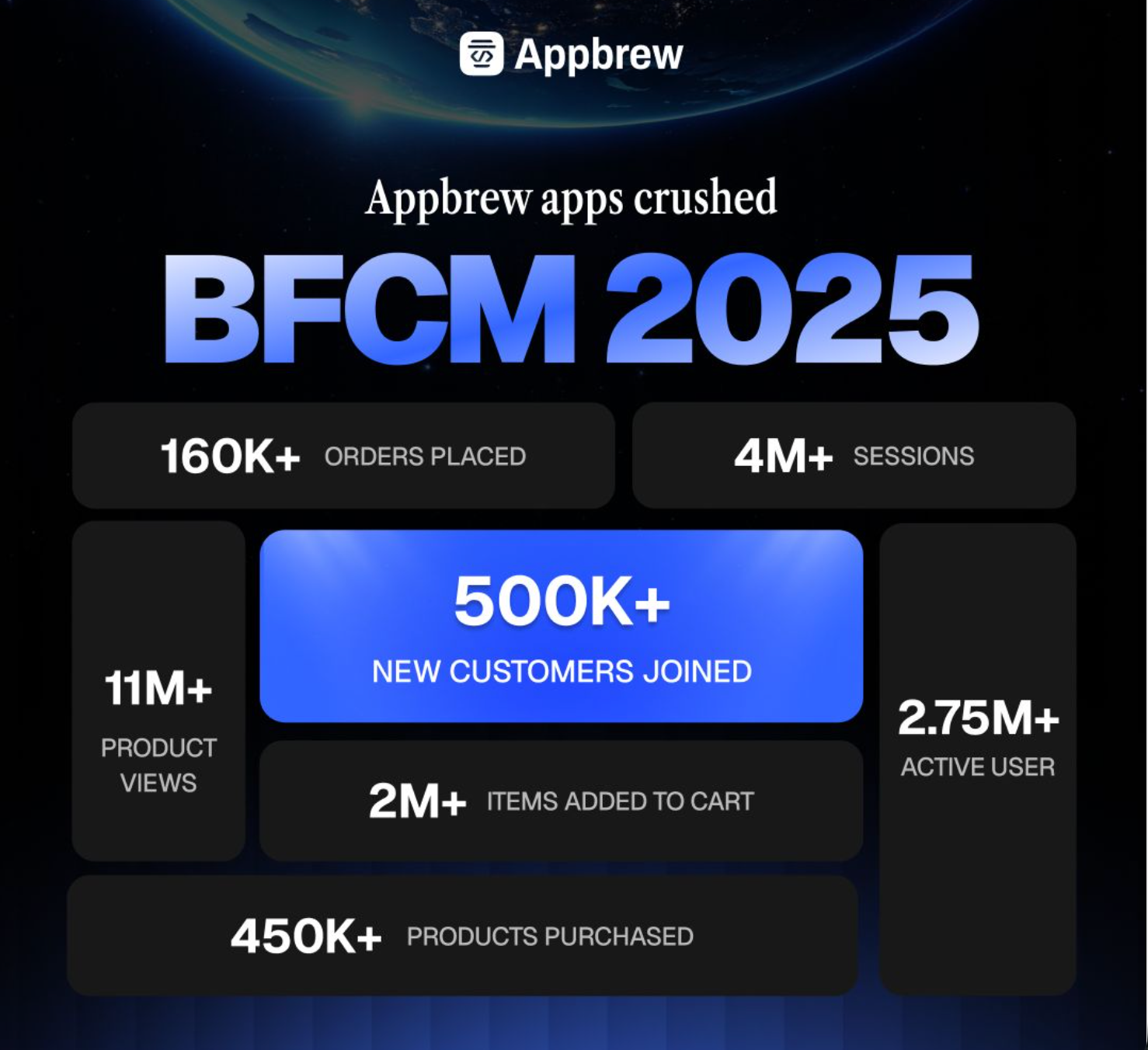
Over BFCM 2025, the brands running native apps on Appbrew had a big weekend. Across 250 brands, apps took 160K+ orders from 2.75M+ active users across 4M+ sessions, with 500K+ new customers joining. Here is what that data shows about how mobile performs during the rush.
The mobile app converts better when it matters most
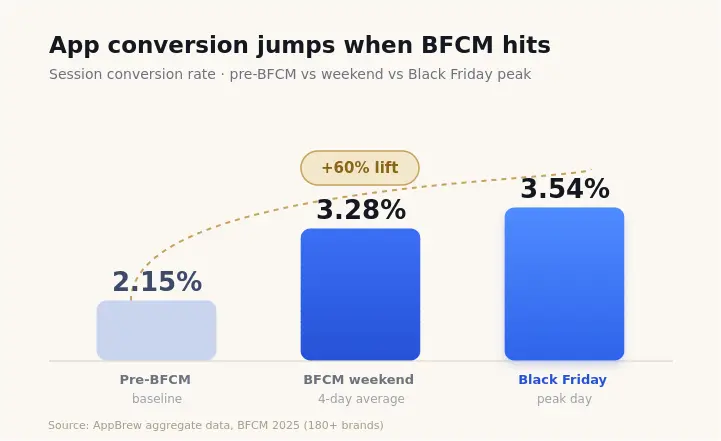
App sessions converted at 3.28% over the BFCM weekend, and peaked at 3.54% on Black Friday. Before BFCM, the baseline sat near 2.15%, so conversion jumped more than 60% during the event.
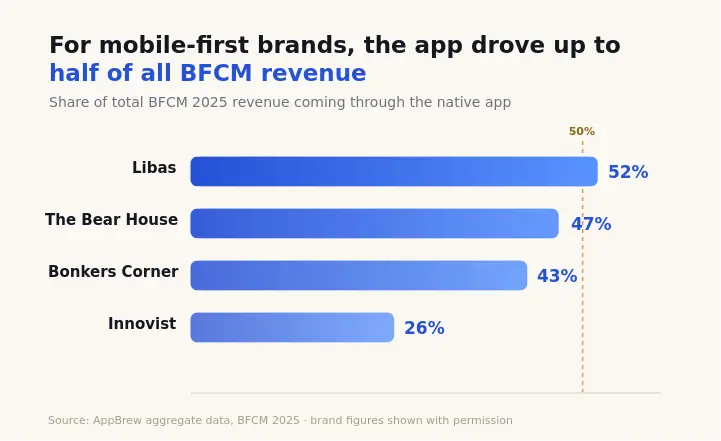
The app carried a big share of the weekend. Some saw it drive nearly half of all BFCM revenue.
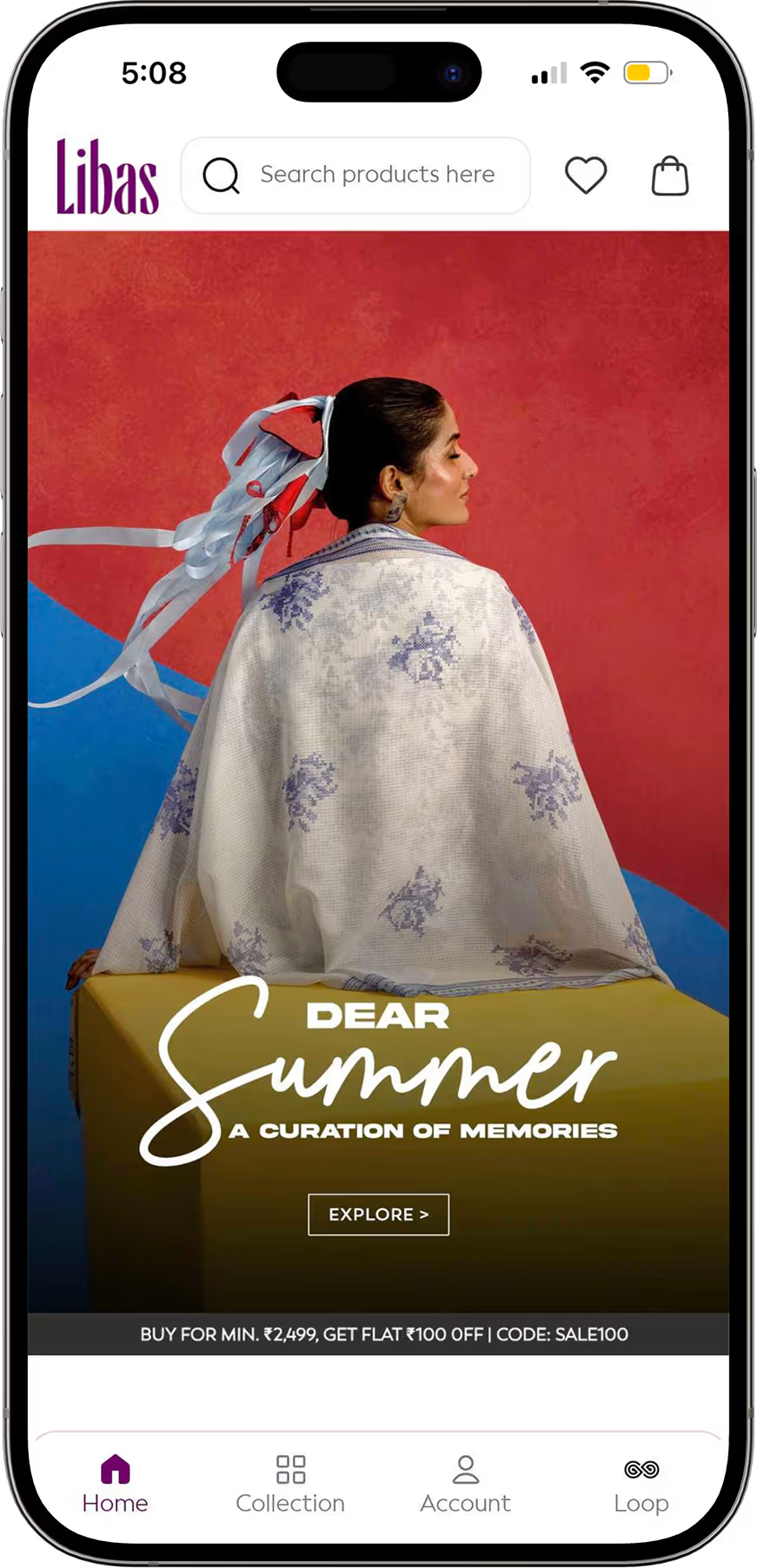
- Libas: 52% of BFCM revenue came through the app
- The Bear House: 47%
- Bonkers Corner: 43%
- Innovist: 26% (across 28,000+ app orders)
Source: Appbrew aggregate data, BFCM 2025 (Nov 28–Dec 1).
Push notifications were the highest-ROI channel
Push drove $363,000 in app revenue over the weekend, about 12% of all app sales, from a single owned channel with no ad spend.
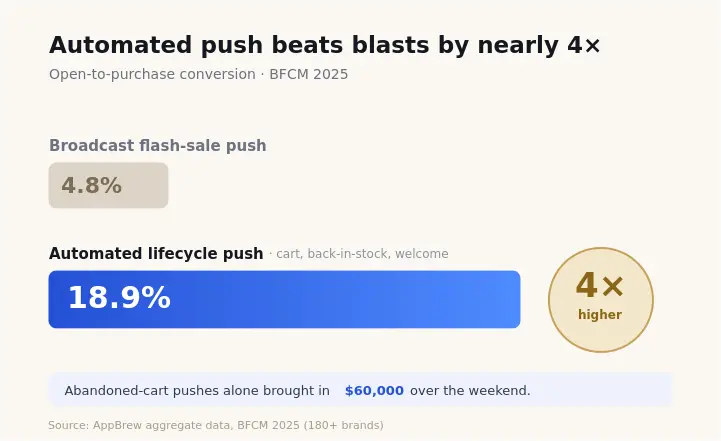
Appbrew's BFCM 2025 data shows automated push flows converted nearly 4× better than broadcast blasts (18.9% vs 4.8% once opened). Abandoned-cart pushes alone generated $60,000. The takeaway for BFCM 2026: your automated flows matter more than your blast campaigns.
Match the channel to the ticket size
App average order value ran higher on Black Friday itself, peaking at $20.23, up 11% over the weekend baseline. And on higher-ticket apparel brands, app AOV told a different story entirely. FableStreet saw app AOV of $47, well above the portfolio average.
Want the full playbook behind these numbers? See our BFCM marketing strategies guide, or book a demo to see what a native app could do for your BFCM.
Make BFCM 2026 your biggest yet
BFCM is a season that rewards the brands who prepare early, lead with mobile, and treat their repeat customers as the priority. The dates are set: November 27 to 30, 2026. The brands that start planning now are the ones who will be ready when the traffic hits.
If you want your app to carry more of that weekend, see how Appbrew helps Shopify brands win BFCM.
{{cta2}}
FAQs
When is BFCM 2026?
BFCM 2026 falls on November 27–30. Black Friday is November 27, and Cyber Monday is November 30. Promotional activity will almost certainly begin in early November given the "Black November" trend that has accelerated in 2024 and 2025.
What does BFCM mean on Amazon?
On Amazon, BFCM refers to the same Black Friday and Cyber Monday sales period. Amazon runs its own deals across these days, and many sellers time launches and discounts to match the wider shopping window.
Is BFCM only for big brands?
No. BFCM works for brands of any size. Small and mid-size Shopify stores often win by targeting loyal customers with early access, bundles, and personalized offers rather than competing on the deepest discount.
Is BFCM only for Shopify stores?
No. BFCM is an industry-wide event that applies to any ecommerce store regardless of platform. The term is used broadly across retail, though Shopify has popularized it within its own merchant community and publishes detailed BFCM data each year. Shopify merchants generated $14.6 billion over BFCM 2025 weekend, but that's one slice of a much larger global market.
How do I retain BFCM shoppers after the sale ends?
BFCM buyers are largely deal-driven and have a high churn rate without post-purchase engagement. The brands that convert them into repeat buyers do a few things:
- they send a meaningful post-purchase experience (not just a shipping confirmation)
- they offer a reason to return within the first 30 days (a loyalty reward, a product education sequence, an app-exclusive offer)
- they use behavioral data from the BFCM purchase to personalize future communication
App users are significantly easier to retain than email-only contacts because push notifications allow re-engagement without relying on inbox placement. According to McKinsey research, strong loyalty ecosystems drive up to 2.5x higher LTV, and app users exhibit 2x higher repeat purchase rates than mobile web visitors.