


.webp)
.webp)
Learn how top fashion brands use in-app push notifications to recover abandoned shopping carts, boost customer retention, and drive sales.
A shopper adds three items to her cart, gets a text from a friend, and closes the app. Without a push notification, that session is gone. With the right one sent 45 minutes later, it converts.
Fashion brands invest heavily in mobile experiences but lose most of that value at the cart stage. Abandonment rates consistently exceed 70%. Email is slow. SMS burns opt-ins fast. Push is the obvious recovery channel, yet most brands either underuse it or misconfigure it entirely.
This post maps out how fashion brands are structuring push programs to recover carts and build retention by covering timing, copy, personalization, and sequencing. You'll walk away with a repeatable strategy you can apply or pressure-test against your current setup.
TL;DR:
- Cart abandonment push notifications should fire within 30 to 60 minutes, not 24 hours
- The most effective fashion push sequences run 2 to 3 messages each, adding new information, not repeating the same ask
- Product imagery in push dramatically outperforms text-only in fashion, specifically
- Personalization beyond the item name, like size saved, low stock, and style match, meaningfully lifts conversions
- Retention-focused pushes (restock alerts, wishlist drops, loyalty nudges) matter as much as cart recovery
- Opt-in timing and framing determine whether your push program works at all
- iOS and Android behave differently; a single send strategy underperforms on both
Why Push Outperforms Other Channels for Fashion Cart Recovery
Here’s why push notification is one of the must have features for fashion and apparel brands and why it outperforms other channels for fashion cart recovery:
The Mobile-First Reality of Fashion Shopping
Fashion discovery has shifted decisively to mobile apps. Shoppers browse, save, select sizes, and build carts entirely on their phones, often across multiple sessions. That means cart abandonment in fashion is primarily a mobile problem and needs a mobile-first recovery channel.
Fashion apps also generate stronger intent signals than most categories. A shopper who has selected a size and dropped an item into the cart has made a series of micro-decisions, not just browsed. Recovering that session quickly matters more than recovering it thoroughly.
App push notifications have a structural advantage here. Abandoned cart emails arrive hours later, after the shopper has moved on or found the item elsewhere. Push fires in minutes, while the session context is still warm. That recency is the channel's core advantage. For in-app sessions, push should be the primary recovery channel.
Push vs Email vs SMS for Fashion Retention
Each recovery channel has a distinct cost, permission, and timing profile, and treating them as interchangeable is where most brands go wrong.
| Channel | Open Rate | Cost Per Send | Best Use |
|---|---|---|---|
| Push | High | Near-zero | Immediate recovery, behavioral triggers |
| Moderate | Low | Lifecycle sequences, longer-form content | |
| SMS | Very high | Per-message fee | Flash sales, urgent nudges |
The creative distinction matters as much as the economics. Duplicating email copy into push is one of the most common mistakes fashion brands make. Push is a different format, shorter, more visual, more immediate. Rich push that leads with a product image and a single CTA deep-linked to the cart outperforms a text-heavy message every time. In fashion, what the item looks like is half the conversion.
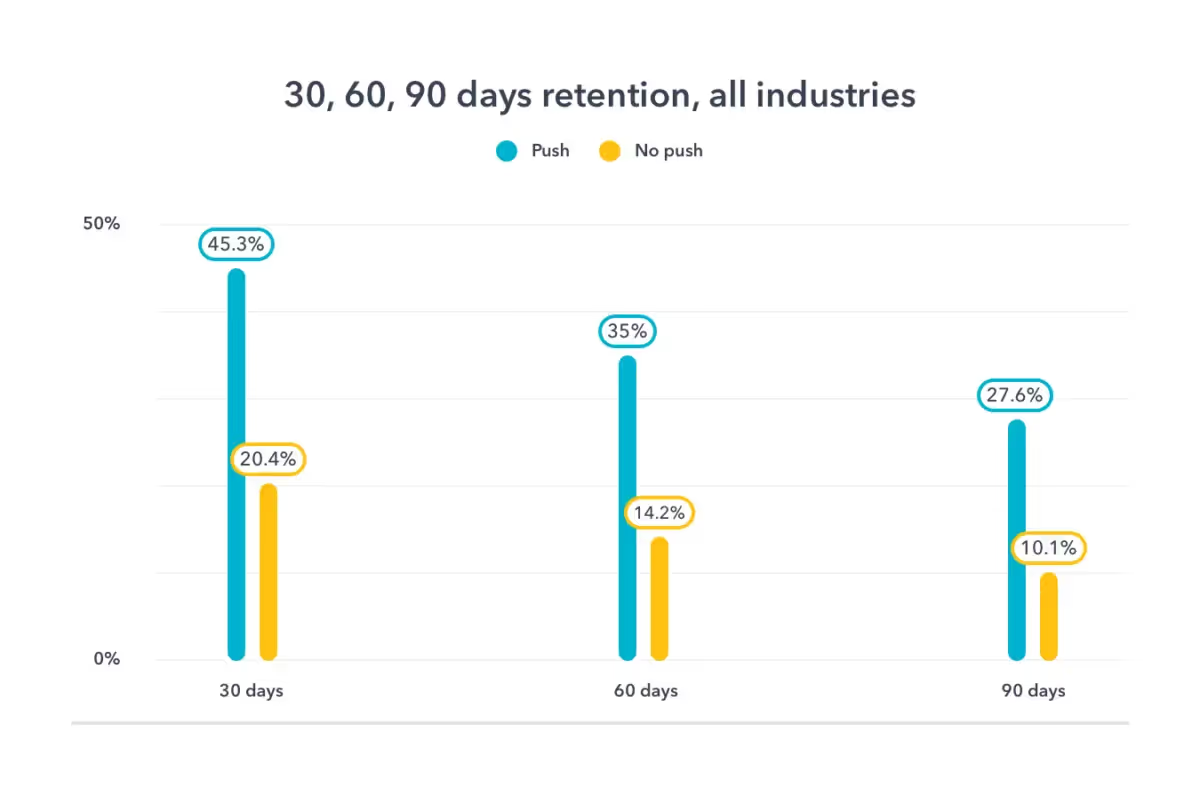
How Fashion Brands Structure Their Cart Recovery Push Sequences
Most brands have push enabled. Few have it structured. Here's how the best fashion brands build their cart recovery sequences from timing to copy:
Timing: When to Send the First Notification
The 30 to 60-minute window consistently outperforms same-day or next-day sends. The shopper still remembers what they were looking at and why that context is the asset, but that memory fades fast.
Session type matters. An explicit cart add warrants an immediate trigger. A mid-browse session without a cart add needs different logic, a wishlist nudge or a "you were looking at this" prompt, not a full recovery message.
Time of day plays a role, too. Evening sends between 7 pm and 10 pm outperform morning sends because fashion browsing skews toward leisure time rather than commutes. Timing is the highest-leverage variable in push performance. Get this right before touching copy.
Sequencing: How Many Pushes and What Each One Does
A two-to-three push sequence outperforms both single sends and aggressive multi-touch cadences. The key is that each message needs a distinct reason to exist.
- Push 1 Reminder (Within 30 to 60 minutes): No urgency. Show the item, reference it specifically, and deep-link directly to the cart. The goal is frictionless return, nothing more.
- Push 2 Signal (12 to 24 hours later, if no conversion): Add new information, like low stock, price movements, or style context ("pairs well with what you've bought before"). If Push 1 was a nudge, Push 2 is a reason.
- Push 3 Last chance (48 to 72 hours, optional): Social proof framing or final urgency. After this, suppress the sequence for a defined window. Don't keep pushing a dead session.
One critical exit rule: if the user returns to the app without converting, pause or exit the sequence. Sending cart recovery pushes to someone actively browsing is tone-deaf and drives opt-outs.
Copy and Creative: What Works in Fashion Push
Fashion push is short, product-specific, and visually anchored. iOS truncates titles at roughly 50-60 characters and bodies at 100. Every word earns its place or gets cut.
Reference the specific item, not a generic cart. "Your black wrap dress is still waiting" outperforms "You left items in your cart" because it recreates the moment of intent. Rich push images should show the exact variant the shopper selected. The wrong color creates doubt, not urgency.
On emojis: they fit casual and younger-skewing brands. They undercut credibility for premium positioning. Match brand tone, not industry convention. The push should feel like a helpful nudge from the brand, not a system alert from an automation tool.
Beyond Cart Recovery: Push for Retention and Repeat Purchase
Cart recovery is where most brands start with a push. It's not where the value ends. The brands with the strongest retention programs use push across the full customer lifecycle. Here's how:
Restock and Wishlist Alerts
Restock and wishlist alerts are the highest-intent pushes a fashion brand can send. The customer already signaled that the consideration is done. The push just closes the loop. When a shopper saves an item or adds it to a wishlist, that action becomes a trigger condition.
The moment that the item restocks or drops in price, a push fires. Timing precision matters: restock notifications should go out within minutes of inventory going live, not in a batch at the end of the day.
Limited SKUs sell out fast, and a restock push that arrives two hours late is a missed conversion. Permission is implicit in the wishlist action. These pushes are welcome, not intrusive, which is exactly why they convert.
Loyalty, VIP Drops, and Early Access
Retention push isn't just about reactivating lapsed users. It's about making loyal customers feel seen, and exclusivity is the mechanism that does that, not volume.
Fashion brands with strong app retention use early access as a push hook. A new collection preview sent only to high-frequency app users isn't just a notification, it's a membership signal. That distinction is what drives long-term opt-in retention.
Segmentation is what separates this from broadcast:
- Blast the full list with every new arrival: customers learn to ignore push
- Segment by category affinity, past purchase, and LTV tier: each notification feels curated, not generic
- Use early access drops as a push hook: sent exclusively to high-frequency users, the push becomes a membership signal, not a marketing message
Treat push like a membership benefit. The opt-in is the reward.
Re-Engagement Pushes for Dormant Users
A dormant user needs a different message than an active shopper, and in fashion, dormancy thresholds must account for seasonality. A summer shopper going quiet in October isn't necessarily churned. Pushing them with generic re-engagement push notifications is the fastest way to get a permanent opt-out.
What works instead:
- New arrivals in categories they've previously bought from
- Price drops on items they've saved or viewed repeatedly
- Loyalty point reminders with a concrete redemption prompt something to return for, not just a nudge to open the app
If a user hasn't responded after two re-engagement attempts, suppress them. Protecting opt-in rates matters more than squeezing out one more send to a cold segment. A permanent opt-out is a worse outcome than silence.
Building a Push Program That Doesn't Destroy Opt-In Rates
Mobile app push notification is only as powerful as the audience receiving it. Here's how fashion brands in Canada protect and grow that audience:
Getting the Opt-In Moment Right
Most fashion brands ask for push permission too early, before the user has experienced any value. A system prompt on first open, with no context, is the fastest way to lose the opt-in permanently.
Tie the permission ask to a moment of demonstrated value instead:
- After a wishlist add: "Get notified when your saves go on sale."
- After a first purchase: "Track your order and get restock alerts."
- After browsing the same category twice: "Be the first to know when new arrivals land."
iOS 16+ limits how many times a permission prompt can be shown. Brands that burn the ask on a cold first-open don't get a second chance. A contextual ask with a clear value statement isn't just better UX, it's the only reliable path to a healthy opt-in rate.
Frequency and Suppression Logic
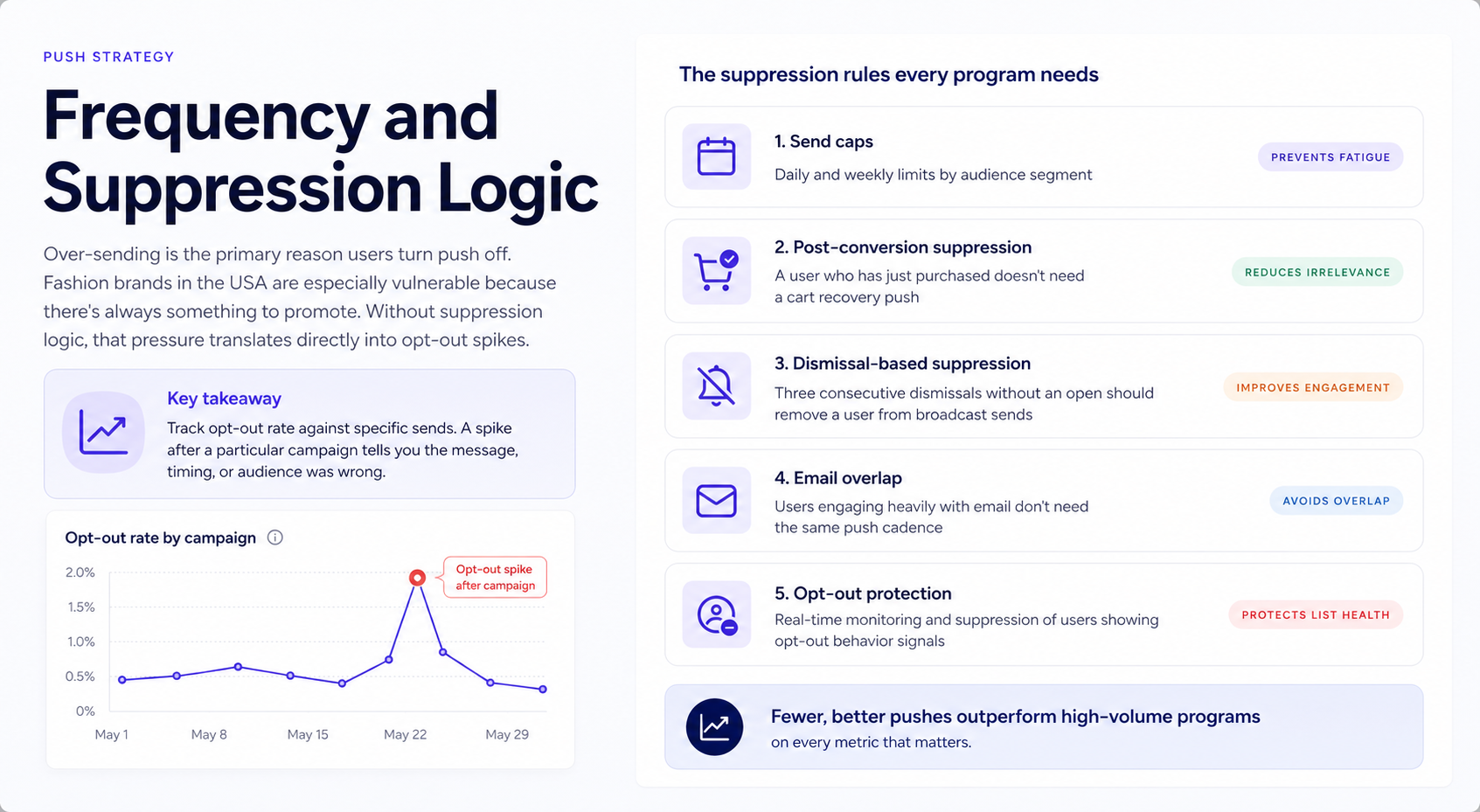
Over-sending is the primary reason users turn push off. Fashion brands in the USA are especially vulnerable because there's always something to promote. Without suppression logic, that pressure translates directly into opt-out spikes.
The suppression rules every program needs:
- Send caps: Daily and weekly limits by audience segment
- Post-conversion suppression: A user who has just purchased doesn't need a cart recovery push
- Dismissal-based suppression: Three consecutive dismissals without an open should remove a user from broadcast sends
- Email overlap: Users engaging heavily with email don't need the same push cadence
Track opt-out rate against specific sends. A spike after a particular campaign tells you the message, timing, or audience was wrong. Fewer, better pushes outperform high-volume programs on every metric that matters.
Practical Checklist: Auditing Your Push Setup
Five things to check this week if you run or manage a fashion app's push program:
- Check your cart push trigger delay: Log into your push platform and find the delay setting on your cart abandonment flow. If it's set beyond 60 minutes, change it today. That single adjustment will increase sales via push notification before anything else does.
- Open a cart recovery push on your own phone: If you don't see a product image and a direct link to the cart, your setup is incomplete. Rich push with the exact product and variant the shopper selected should be the baseline, not a nice-to-have.
- Test your post-conversion suppression: Abandon a cart, then complete the purchase. Check whether the recovery sequence stops. If it doesn't, you're sending cart pushes to customers who already bought. Fix the suppression logic before your next campaign.
- Check whether wishlist and restock alerts are running as separate trigger types: If they aren't live, set them up this week. A shopper who saved an item has already done the consideration work. That trigger is the highest-intent send in your entire push program.
- Pull up your push permission prompt and read it cold: Note when it fires and what it says. If it appears on first open with no value framing, rewrite the prompt and move the trigger to a post-wishlist or post-purchase moment. On iOS, you may only get one shot at this.
Conclusion
Fashion brands with low push opt-in rates or flat cart recovery conversion usually have a timing or segmentation problem, not a copy problem. The fix is to treat push as a real-time intent channel: triggered fast, sequenced with purpose, and suppressed when the timing isn't right.
Brands that do this well turn push into one of their highest-ROI retention tools, not just a cart recovery mechanism, but a channel that compounds across the full customer lifecycle.
If you're building or rebuilding your app's push program, Appbrew provides the trigger logic and segmentation controls to set it up with no engineering overhead.
Frequently Asked Questions
What is the best time to send a cart abandonment push notification for fashion brands?
Within 30 to 60 minutes of abandonment. Fashion purchase intent drops sharply after that window. A follow-up 12 to 24 hours later is appropriate if the cart is still live and the user hasn't returned.
How many push notifications should a cart recovery sequence include?
Two to three. The first is a reminder, the second adds urgency or new information, and the third is optional. Sequences longer than three typically increase opt-outs without meaningfully improving recovery rates.
How do I improve push notification opt-in rates for my fashion app?
Ask for permission after a value moment, like a wishlist add or first purchase, not on first app open. Frame the ask around a specific benefit, like restock alerts or sale access, rather than a generic system prompt.
What's the difference between cart recovery push and retention push?
Cart recovery targets users who added items but didn't buy, within a short window after they added items. Retention push targets active or lapsed users with wishlist alerts, loyalty nudges, or new arrival drops to drive repeat purchases regardless of cart activity.
Can push notifications hurt engagement if used incorrectly?
Yes. High send frequency, irrelevant content, and poor timing are the leading causes of opt-outs. Once a user disables notifications, that channel is permanently lost. Suppression logic and segmentation are what protect it in the long term.