


.webp)
.webp)

Reduce cart abandonment and recover Shopify sales with high-converting email, SMS, push notification, and checkout optimization strategies.
You're paying to send people to your store, and seven out of ten of them leave without buying. That's not a bad week or a rough campaign; that's the global average. The cart abandonment rate across ecommerce stands at roughly 70.19%, according to Baymard Institute's meta-analysis of 49 independent studies. On mobile, this figure climbs to 80%. Therefore, for any Shopify brand running paid traffic, that number carries a direct dollar cost.
Thankfully, a significant share of those abandoned carts are recoverable. Baymard estimates that $260 billion in lost orders across the US and EU could be recaptured annually through better checkout design and recovery strategies alone, without any additional ad spend, simply by fixing what already exists in the buyer journey. Sadly, most stores either do nothing or set up one discount email and call it a system.
In this guide, we cover what a real abandoned cart recovery strategy looks like, structured from the highest ROI interventions down to the tactics that raise your ceiling.
Key Takeaways
- The average ecommerce cart abandonment rate is 70.19% globally, rising to nearly 80% on mobile, making abandoned cart recovery one of the highest-ROI growth levers for Shopify brands.
- Most recoverable abandonment happens because of checkout friction, unexpected costs, trust concerns, or shopper distraction, not lack of purchase intent.
- The fastest way to reduce abandonment is by improving checkout UX through guest checkout, Shop Pay, mobile optimization, transparent pricing, and visible trust signals.
- A 3-step abandoned cart email flow consistently outperforms single-email recovery campaigns by matching messaging to shopper hesitation over time.
- SMS recovery campaigns work best for high-intent and high-value carts because of their extremely high open and response rates.
- Push notifications are one of the most underutilized recovery channels, especially for brands with mobile apps, since they enable instant re-engagement without relying on email inbox placement.
- The highest-performing Shopify brands use a coordinated multi-channel recovery flow combining push, SMS, and email with behavioral suppression logic.
- Brands using a native mobile app gain a structural advantage in abandoned cart recovery by owning the full re-engagement journey across checkout, push notifications, and repeat sessions.
What Is an Abandoned Cart?
An abandoned cart is when a shopper adds products to their cart or starts checkout but leaves before completing the purchase. Unlike browse abandonment, where a visitor only views a product page and then leaves, cart abandonment signals clear purchase intent, making these shoppers far more likely to convert. In Shopify, this is tracked as an “abandoned checkout,” giving brands visibility into their Shopify cart abandonment rate, dropped purchases, products involved, and customer contact details for recovery campaigns.
{{cta}}
Why Does Cart Abandonment Happen?
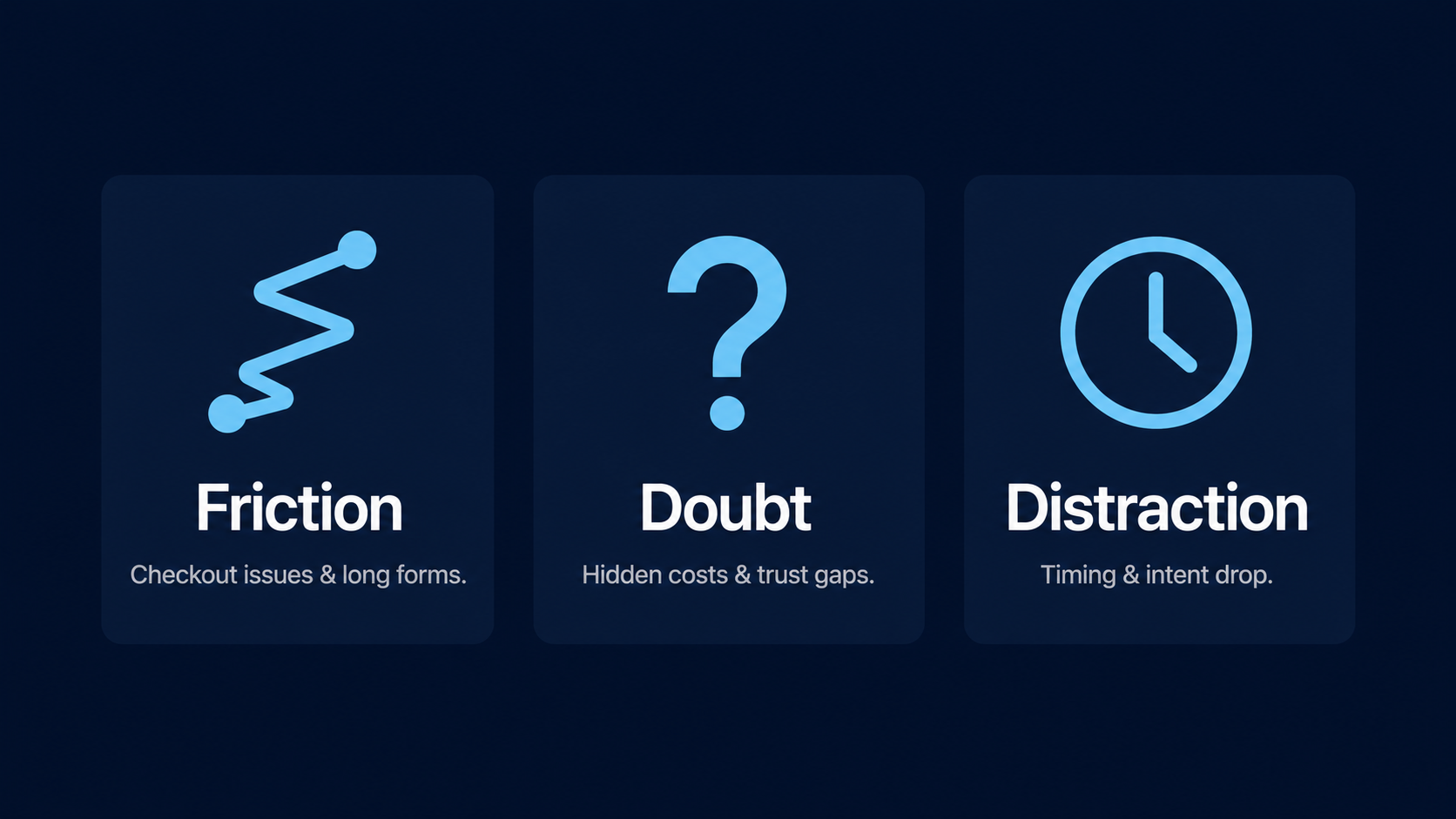
Not all abandoned carts are created equal, and treating them as a single problem leads to the wrong interventions. Baymard estimates that roughly 43% of abandoners were window shopping and had no real purchase intent to begin with. You can't recover someone who was never going to buy. The remaining 57%, though, left for a reason that's either addressable before the fact or recoverable after it. We cluster those reasons into three buckets.
Friction (Checkout Issues)
Checkout friction is the most preventable cause of abandonment, and most Shopify stores have more of it than they realise. The average ecommerce checkout has 5.1 steps and 23.48 form fields, whereas Baymard's UX research puts the optimal at 12–14 fields. That gap is where a large amount of revenue quietly disappears.
The specific offenders are mandatory account creation before purchase (cited by 26% of abandoners), slow page load on mobile, and a checkout flow that was never tested on a real phone. Mobile is where this matters most: 80% of carts are abandoned on mobile devices, and a checkout experience that wasn't designed for a small screen compounds every other friction point already on the list (for a deeper look at mobile conversion rate optimization, see our full guide). The friction on apps is inherently lower than mobile web, as the former is designed for a mobile screen experience.
Doubt (Trust, Pricing, Shipping)
The single biggest driver of cart abandonment is a cost surprise at checkout. According to Baymard's 2025 consumer research, 48% of abandoners cited unexpected extra costs as the reason they left, be it shipping fees that only appear at the final step, taxes added as a separate line, or handling charges that never appeared on the product page. The psychology here is straightforward: the shopper mentally committed to a price before reaching the checkout. When the actual total is higher, it feels like a bait-and-switch, and the most common response is to close the tab.
Trust is the secondary issue. On less familiar Shopify stores, shoppers will pause at checkout if there's no visible evidence that the store is legitimate: no recognizable payment badges, no visible SSL, no return policy, no reviews near the payment section. That hesitation rarely gets verbalized but it shows up in the data. Building trust and community in eCommerce is often a goal founders discuss, but don’t really achieve.
Distraction (Timing, Intent Drop)
Some shoppers were convinced to complete a purchase, but were interrupted by either a phone call, a meeting, a child in the next room, or they were mid-comparison-shop and hadn't made a final decision yet. This category of abandonment has nothing to do with your store's failures. It's about how people actually browse online. It's also the category that recovery sequences are specifically designed for. You're not arguing someone back from a "no." You're reminding someone who said "yes" and got pulled away before they could finish.
Tier 1: Reduce Cart Abandonment (Highest ROI)
The cheapest abandoned cart recovery is the one that never happens. Before investing in recovery campaigns, it's worth fixing the structural reasons people are leaving in the first place. The ROI on this tier is the highest because checkout improvements compound across every visitor, not just the subset you can re-reach via email or SMS afterwards.
1. Remove Checkout Friction
The most direct path to a lower abandonment rate is a shorter checkout. For Shopify stores, that means two changes that should already be in place. First, enable guest checkout. Forcing first-time buyers to create an account before purchasing is one of the most common and avoidable conversion killers in ecommerce with 26% of shoppers citing it as the reason they leave. Shopify's customer account settings let you switch this off in under a minute.
Second, enable Shop Pay. Shop Pay's one-tap checkout pre-fills shipping, billing, and payment information for any shopper who's previously purchased on any Shopify store, a network of over 150 million buyers. Stores using Shop Pay report conversion rates up to 50% higher than standard guest checkout (Shopify, 2024), with an even larger lift on mobile.
Beyond those two, the most honest test for checkout friction is to run through your own checkout on an actual phone, not Chrome's mobile preview, but a real device on a cell connection, as a first-time visitor with no saved credentials. Most merchants who do this find real gaps and significantly improve eCommerce mobile conversions.

2. Show the Full Cost Upfront
If the shipping fee only appears at the final checkout screen, you're creating your own abandonment problem. The fix is not complicated: surface shipping cost, tax estimates, and any additional fees as early in the buyer journey as possible. A shipping calculator on the cart page handles this cleanly, and Shopify themes support it either natively, or via Shipping Rates Calculator apps.
The goal is that there's no number on the order confirmation screen that the shopper hasn't already encountered. One additional tactic worth testing is a free shipping progress bar in the cart (For example, "You're $14 away from free shipping"). This reduces abandonment while also increasing AOV, making it one of the few checkout fixes that improves two metrics simultaneously.
3. Add Trust Signals at Checkout
The checkout page is the moment of maximum trust anxiety, particularly for customers who haven't bought from you before. They're entering card details on a page they've never seen. The question is what surrounds that form.
A quick audit worth running:
- Are your payment provider logos visible (Visa, Mastercard, PayPal, Shop Pay)?
- Is there an SSL indicator?
- Is your return policy findable without leaving the page?
- Is there a review or testimonial anywhere near the payment section?
None of this requires a redesign since most Shopify themes have footer or sidebar areas in checkout where these elements can be placed. The standard to hold yourself to is whether a complete stranger would feel confident completing a purchase on the page you've built.
Tier 2: Recover Intent (Baseline Recovery)
Once you've addressed the structural causes of abandonment, the next layer is reaching the shoppers who had real intent but didn't complete. This is where your recovery sequences come in. The distinction that matters here is between running a recovery message and running a recovery sequence. A single email or text underperforms a properly timed multi-step flow on every metric, but most brands stop at one.
4. Set Up a 3-Step Email Recovery Flow
Email is the baseline recovery channel for most Shopify stores, and for good reason. Abandoned cart emails generate $5.81 in revenue per recipient (Klaviyo Benchmark Report, 2024) and open at roughly 39%, nearly double the open rate of standard promotional emails. The problem is that most stores set up one email and call it done, which leaves a significant portion of recoverable revenue untouched.
A three-step flow, timed correctly, is the industry standard:
|
|
Timing |
Job |
|
Email 1 |
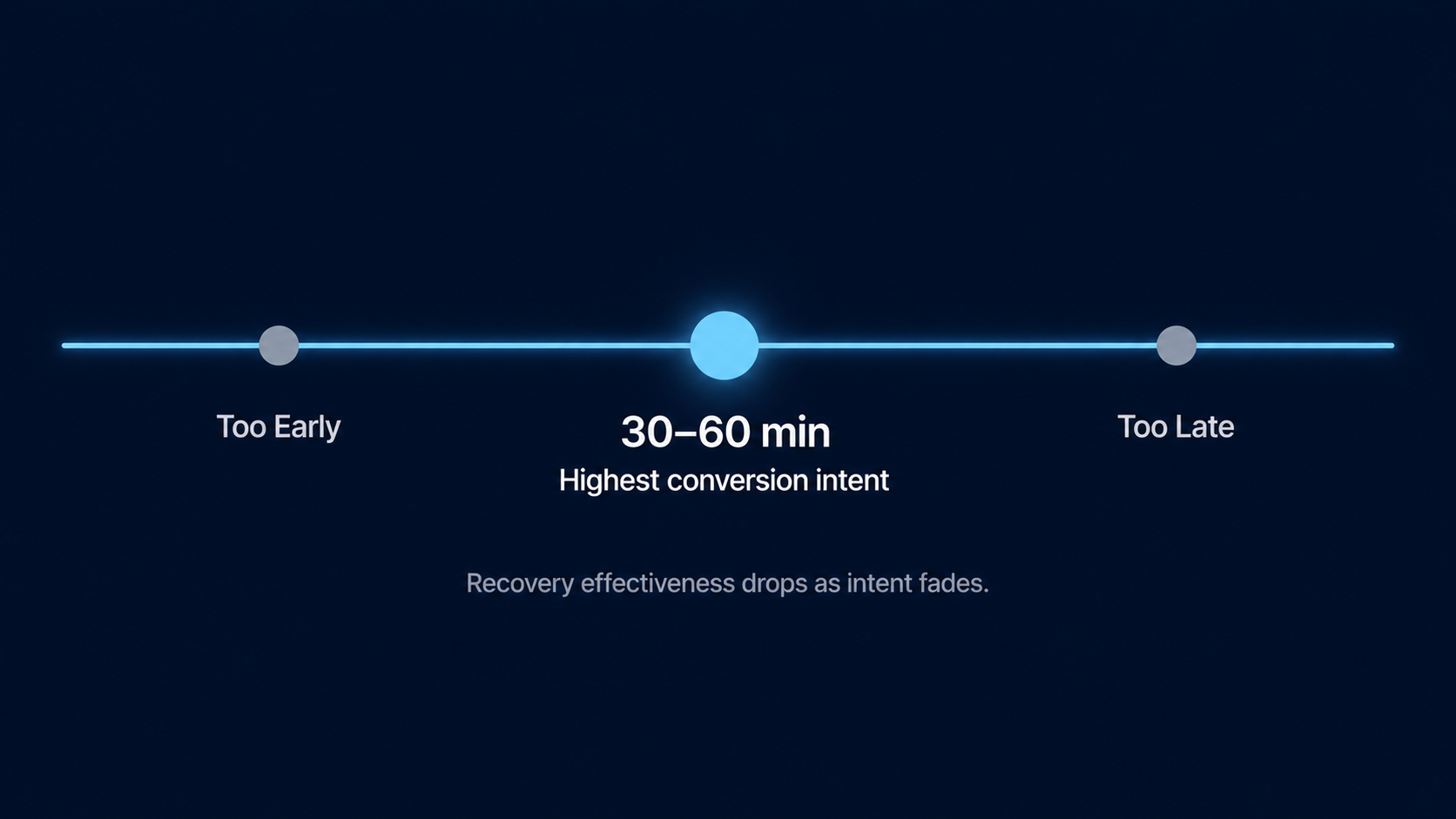
30-60 minutes post-abandonment |
Low-pressure reminder: Direct link back to cart, no discount. |
|
Email 2 |
24 hours post-abandonment |
Address hesitation: Add social proof, reviews, or product details. |
|
Email 3 |
72 hours post-abandonment |
Introduce urgency: Incentive or discounts if cart value warrants it. |
Email 1 is responsible for the majority of recoveries. Most abandoners in the distraction category convert here because they only needed a nudge back. Keep it short, keep it direct, and do not offer a discount. Discounting on first contact trains your customers to abandon deliberately to trigger the offer, a bad habit that compounds over time. Save the incentive for Email 3, and only trigger it for shoppers who haven't already converted. Both Klaviyo and Omnisend integrate natively with Shopify and can have this flow live in under an hour.
5. Use SMS for High-Intent Abandoners
SMS is the highest open-rate channel available to ecommerce brands, with the average text message opened within 3 minutes of delivery. Well-executed SMS cart recovery sequences recover 15–25% of abandoned carts (Postscript, 2025), compared to 3–5% for email alone.
The constraint is consent: you can only text shoppers who have explicitly opted into SMS marketing, which most stores collect via a checkout phone field or a site pop-up. If your SMS subscriber list is thin, growing it is a higher-leverage activity right now than optimizing message copy.
SMS performs best for three specific segments:
- High-value carts where the recovery revenue clearly justifies the per-message cost
- Mobile abandoners who are still on their phones when the message lands
- Low email engagement contacts who consistently don't open your email flows
A single SMS within 30-60 minutes of abandonment is the most effective structure. A second message at 24 hours can add incremental recovery, but a third risks opt-outs. Attentive's research shows opt-out rates increase substantially after the third SMS in a sequence. Additionally, keep the message short with the product name, a direct link back to cart, and one line of copy.
6. Use Push Notifications
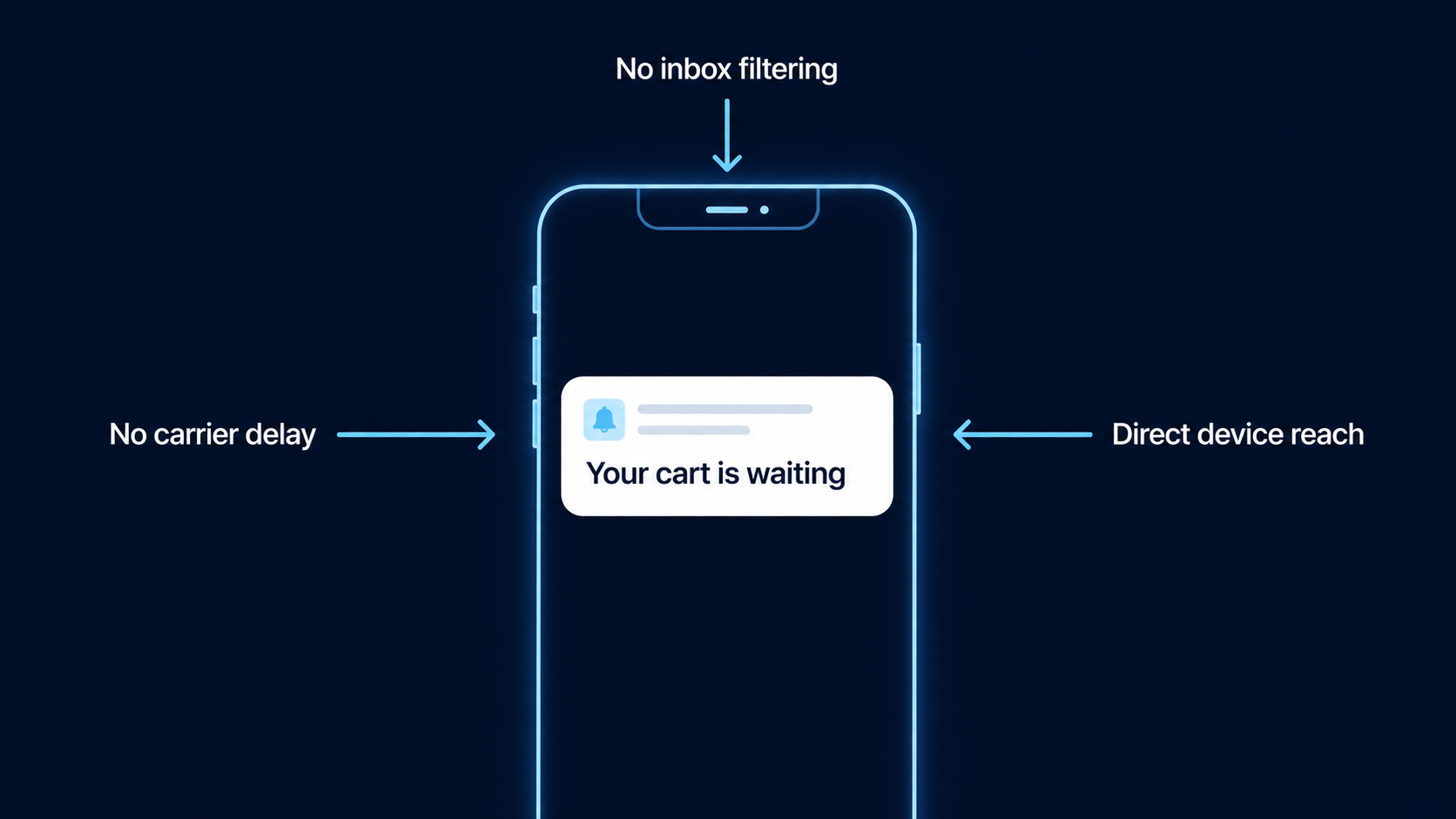
Push notifications are the most underused channel in abandoned cart recovery, and the case for them is stronger than most merchants realize. Push averages a 50% open rate and 10% click-through rate, compared to 39% open and 21% CTR for abandonment emails (Mobiloud, 2025). They're faster to act on, cheaper per send, and don't require an email address.
A shopper who installed your app but never submitted contact details is unreachable by email and SMS but is fully reachable via push. That opens up a recovery path for a segment that sits entirely outside your CRM. It reaches shoppers on the device they browse on, inside an experience you fully control, without depending on inbox placement or carrier filtering. Don’t have one? No problem! You can turn shopify store into mobile app in just days, not weeks, with Appbrew to unlock unlimited push notifications.
For stores without a branded mobile app, web push is available on desktop and some Android browsers, though opt-in rates are considerably lower and delivery is less reliable. Timing logic is the same as email: first push within the first hour, low pressure, direct link to cart without any discount yet.
{{cta2}}
Tier 3: Increase Your Recovery Ceiling (Your Edge)
Running email, SMS, and push as three separate, disconnected sequences is better than running one channel, but it still leaves recovery on the table because it doesn't account for how individual shoppers actually behave. One customer opens every text but hasn't touched an email in six months, while another has push disabled but checks email first thing every morning.
When each channel runs independently, you either miss shoppers entirely or message them three times in two days through overlapping flows, which erodes trust faster than it recovers carts.
7. Build a Coordinated Multi-Channel Recovery Flow
A coordinated flow sequences the channels based on shopper behavior, not just time delays. The structure that works:
- Touch 1 (30-60 minutes)- Push or SMS: Lead with the highest-engagement channel. If a shopper has both push and SMS enabled, push goes first since it's zero marginal cost, immediate, and non-intrusive. If only SMS, send a single text. Keep the copy short: the product, the cart link, a low-key reminder.
- Touch 2 (24 hours)- Email: Email has the most real estate. Use it for the job that requires more space: product imagery, customer reviews, a reminder of your return policy, or a specific callout of the item left behind. This is where you address hesitation, not just remind.
- Touch 3 (48–72 hours)- Push or SMS: This is the final touch. If the cart value justifies it, add an incentive here. Single-use discount codes outperform generic offers because they feel exclusive and can't be shared on coupon aggregator sites. Keep the message tight with the product name, price, and one reason to act now.

The critical mechanic that makes this work is suppression. As soon as a shopper converts, they exit the remaining flow. If they buy after Touch 1, Touches 2 and 3 are suppressed automatically. This is set up with behavioral conditions in Klaviyo's flow logic or your push provider's automation settings. Without suppression, you're sending "come back and buy" messages to people who already bought, one of the fastest ways to earn an unsubscribe. The flow works because it follows the shopper, not a clock, and the channel that reaches them is the one they actually use.
For Shopify brands with a branded mobile app, this flow has an additional structural advantage. The app is the only channel where you own the entire arc: the checkout experience, the push notification, and the re-engagement, without depending on inbox placement, carrier filtering, or a third-party algorithm determining whether your message gets shown. Every recovered cart is a shopper you've already paid to acquire, which is why lowering your customer acquisition cost with a mobile app starts with not losing the ones you've already won. Appbrew builds native mobile apps for Shopify brands and integrates directly with Klaviyo, Attentive, and Yotpo, so the recovery stack runs as a single coordinated system rather than three tools operating independently.
How to Measure Abandoned Cart Recovery Performance
Setting up the strategy is the first step, but knowing whether it's working is the part most brands skip. The metrics worth tracking are specific, not aggregate campaign revenue, but per-channel and per-message performance that tells you where the flow is winning and where it's leaking.
- Recovery rate: This refers to the percentage of abandoned carts that result in a completed purchase. A single-email setup typically lands at 3-5% while a three-email sequence gets you to 5-8%. A coordinated multi-channel flow reaches 12–18%, and anything below 3% is a signal to audit checkout friction before adding more recovery volume.
- Revenue per send: This refers to how much each message generates on average. Klaviyo's 2024 benchmark puts abandoned cart emails at $5.81 per recipient. SMS typically runs lower per send but generates faster revenue per contact given its response speed.
- First-message conversion share: This is the percentage of total recoveries that happen after Touch 1. If most recoveries come from the first message, later touchpoints may be redundant or reaching people who weren't going to convert regardless.
- Opt-out rate: Particularly relevant for SMS. If opt-outs are climbing after specific messages, the copy, timing, or frequency is off. Keep this below 3.5% for a healthy list.
Pull these numbers per channel, per message, and per flow step, not as aggregate totals. Aggregate totals are useful for reporting, but don’t allow you to pinpoint where the problem actually is.
Conclusion
The stores with the highest recovery rates aren't necessarily the ones with the biggest lists or the largest ad budgets. They're the ones who've fixed the checkout issues that create avoidable abandonment, built a sequenced multi-channel recovery infrastructure, and matched the right channel to the right moment in the shopper's decision window.
The gap between where most stores are and what's actually recoverable is large, and it closes faster than most operators expect once the right structure is in place. If you want to add a branded mobile app to your recovery stack and close the channel gap that email and SMS alone can't cover, book a demo with Appbrew.
Frequently Asked Questions
What is a good abandoned cart recovery rate?
Most stores running a single recovery email see 3–5% recovery. A properly structured three-email sequence typically pushes that to 5–8%. Stores running a coordinated multi-channel flow with email, SMS, and push generally reach 12–18%. If your current rate is below 3%, focus on checkout friction before adding more recovery volume.
How soon after abandonment should I send the first recovery message?
Within 30–60 minutes for SMS and push, within 1 hour for email. Purchase intent decays quickly after a shopper leaves, and the majority of first-touch recoveries happen within three hours of abandonment. After 24 hours, you're dealing with a different kind of hesitation that requires different messaging.
Should I offer a discount in my abandoned cart emails?
Not in your first email. Discounting on first contact teaches shoppers to abandon deliberately just to trigger an offer. Hold the incentive until the third message, and only send it if the shopper hasn't already converted. When you do use a discount, dynamic single-use codes work better than generic offers since they feel more personal and can't be circulated on coupon sites.
Do I need a mobile app to use push notifications for cart recovery?
No, web push works on desktop and some Android browsers without an app. But opt-in rates for web push are significantly lower than for a branded mobile app, and delivery is less reliable. For the highest push engagement and a fully owned checkout-to-recovery experience, a native app is the more effective setup.
How do I set up abandoned cart recovery on Shopify for free?
Shopify includes a basic abandoned checkout email by default that activates automatically unless you've disabled it. For a full multi-step recovery flow, you'll need a paid tool like Klaviyo or Omnisend for email and SMS, and a push app or branded mobile app for push notifications. Shopify's default email is a starting point, not a strategy.