

.webp)
Explore 20+ FOMO marketing examples from real DTC brands, plus first-party data from 250+ Shopify stores on urgency tactics that drive conversions.
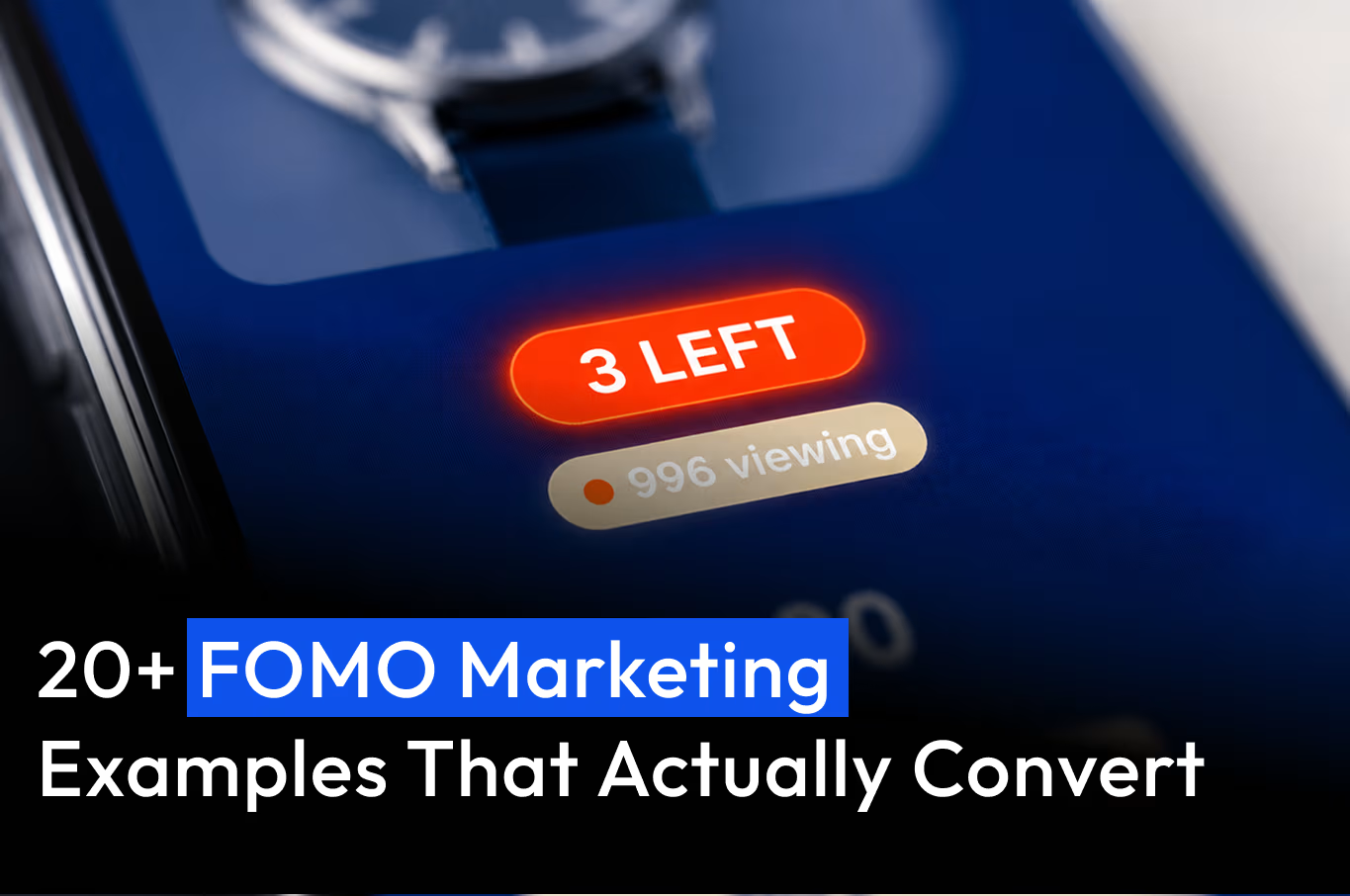
The first thing that comes to mind when I think of effective FOMO marketing is the notification that popped up while I was "just browsing" a pair of limited-edition sneakers: "996 people are viewing this item right now."
Suddenly, my casual scrolling turned into intense focus. Within minutes, I found myself entering my shipping address for sneakers I had absolutely no intention of buying when I woke up that morning, all because that little red "Low Stock" warning made me feel like I was going to risk losing it to others.
But that's the power of FOMO (Fear Of Missing Out) Marketing. It bypasses your rational brain and taps directly into your lizard brain's panic button. One minute, you’re convinced you don’t need more sneakers. The next, ‘Only 3 left!’ pops up, and suddenly, you want them. (In my defense, those sneakers did earn me serious compliments from my date. Thanks, lizard brain!)
The funny part is that the tactic itself wasn't particularly sophisticated. What mattered was that it felt believable. Except that same trick, copied onto a random product page with no real stock count behind it, barely moves the needle. I've watched it happen across the 250+ Shopify brands on Appbrew: a well-timed FOMO trigger converts at 3.5x the rate of a generic promo blast, and a lazy copy of the same tactic converts at almost nothing. The gap is whether the brand earns the moment or just borrows the words.
That's exactly what you'll see in these 20+ FOMO marketing examples. We will be breaking down real campaigns from DTC brands, why each one works, the psychology behind it, and where our first-party Shopify data says it actually moves conversions. By the end, you'll know which FOMO tactics create genuine urgency, which ones customers ignore, and how to use them without damaging trust.
TL;DR
- FOMO marketing uses urgency, scarcity, exclusivity, and social proof to make inaction feel costlier than buying.
- Behavior-triggered notifications beat broadcasts by a wide margin: back-in-stock alerts convert 3.5x better than a generic push.
- On product pages, countdown timers lift conversion 34% and low-stock counters 28% versus the same page without them.
- Exclusivity converts through identity, not discount: Nike's members get early access to the exact product everyone else eventually gets, and that head start alone justifies the membership.
- One rule governs all of it: the constraint has to be real. Fake a timer once and every future timer converts worse.
What the data says about FOMO on mobile
You're here for examples, but before you get to them: not all tactics below convert the same. A standard "new collection" broadcast push opens at 8.5% and converts 1.1% of sessions. A back-in-stock alert, sent only to customers who already wanted the item, opens at 22.1% and converts at 5.8%. Same channel, same phone, 3.5x the outcome.
The difference is that one message is noise and the other is information the customer asked for. Keep that distinction in mind as you read; it's the line between the examples that work and the ones that just look like they should.
Push notifications: behavior-triggered vs. generic broadcast
|
Notification type |
Open rate |
Conversion rate |
vs. broadcast |
Sample |
|
Back-in-stock alert |
22.1% |
5.8% |
3.5x |
45 brands, 31k+ events |
|
Abandoned-cart nudge |
18.4% |
4.2% |
2.1x |
102 brands, 18k+ sends |
|
Price-drop alert |
19.5% |
3.9% |
2.2x |
28 brands |
|
Wishlist / low-stock alert |
16.8% |
3.2% |
1.8x |
12 brands |
|
Generic broadcast (baseline) |
8.5% |
1.1% |
baseline |
150+ brands |
Product-page urgency features: conversion lift vs. feature absent
|
Feature |
Conversion lift |
Sample |
|
Countdown timer |
+34% |
42 brands |
|
Low-stock counter |
+28% |
65 brands |
|
Real-time social proof widget |
+12% |
18 brands |
Appbrew first-party data, aggregated and anonymized across the brand base, 2026. Conversion is orders attributed to a session within 24 hours of the notification, divided by total sessions.
Before we explore examples, let's talk about what FOMO marketing is and why it works better than we believe.
What is FOMO marketing?
FOMO marketing turns the fear of missing out into a purchase trigger. It uses urgency, scarcity, exclusivity, and social proof to make waiting feel more expensive than buying, so the customer acts now instead of adding your product to a mental "later" list that never gets revisited.
Marketing strategist Dr. Dan Herman first described the phenomenon in the late 1990s, and author Patrick McGinnis coined the acronym FOMO itself. Academics later defined it as apprehension that others are having rewarding experiences you're absent from (Computers in Human Behavior, 2013).
To understand it simply, remember when your mom said, "This is your last chance to grab the cookie before I give it to your sibling, Anna," and suddenly, that cookie became the most irresistible thing in the world? That’s FOMO marketing. It taps into your innate fear of missing out by creating urgency, scarcity, or exclusivity by making your product feel just as unmissable.
{{cta}}
20+ best FOMO marketing examples (and why they work)
Let's look at some real-life FOMO examples to learn how strategic timing, messaging, and design can turn regular scrolling and window shopping into that I must-have-it-now feeling and making an immediate purchase.
Scarcity: when supply is the trigger
Scarcity works because running out is a deadline you can actually see. A live low-stock counter lifts product-page conversion 28% over the identical page without one (Appbrew first-party data, 2026). Five brands, five ways to make "almost gone" feel real.
1. Low stock alerts - H&M

FOMO type: Product scarcity
H&M's "Last 2 pairs left in your size" alert on the product page turns your shopping from a leisurely activity into a now-or-never decision point.
This technique works because specific numbers create credibility through precision. The exact count feels like insider information rather than marketing language. It triggers what economists call "scarcity value". Our tendency to perceive limited items as inherently more valuable. Specifying "in your size" personalizes the scarcity, making it directly relevant to the individual shopper.
2. Exclusive drops - Kith Sportswear

FOMO type: Scarcity + exclusivity
Kith doesn't release products, it orchestrates events. Their "Exclusive Drop" is an event for fans, who know that once these limited runs sell out, they're gone forever.
This works because it combines predictable timing with unpredictable content, creating a habit-forming experience. The specified quantity creates transparency around scarcity rather than vague claims of "limited supply."
The event builds anticipation and trains customers to be available at specific times, while the collection mentality taps into our completionist instincts. When products are positioned as part of a series, the psychological pain of having an incomplete collection drives repeat purchases.
3. Lightning Deals - Amazon
FOMO type: Time + inventory scarcity combined
Amazon's Lightning Deals show three signals at once: a live countdown timer, a discounted price, and a progress bar showing what percentage of the deal has already been claimed.
Lightning Deals also live in a dedicated tab that customers actively browse for time-sensitive offers. That means the buyer's intent is already different before they even see the product. They're not browsing casually. They're hunting before the window closes.
The lesson for DTC brands: stack your signals. A timer alone creates urgency. A timer plus visible depletion creates competition.
4. Back-in-stock alerts: Zara
FOMO type: Re-engagement scarcity
Zara's back-in-stock notifications are timed to go out fast, often with a mention of limited quantities, but the real FOMO driver isn't the notification itself. It's the previous sell-out.
When something is sold out once, the customer already has proof it was worth buying. Demand was validated publicly. The notification isn't persuading anyone. It's just opening a door the customer already wanted to walk through.
That's why back-in-stock campaigns consistently outperform standard promotional pushes on click-through and conversion. The audience opted in. They remember the regret. The notification resolves it.
5. Waitlist drops: Gymshark
FOMO type: Anticipation + pre-commitment
Gymshark opens waitlists before major launches, then notifies the list when the drop goes live. A waitlist converts a future launch into a present commitment: the customer has already raised their hand, and an open loop sits in their head until the drop closes it.
Signing up is free, which makes joining frictionless, but the psychological ownership it creates is anything but. We broke down their full playbook in our Gymshark marketing strategy teardown.
Urgency: when time is the trigger
Urgency compresses the decision window. In our data, an active countdown timer lifts conversion 34% versus the same offer without one (Appbrew, 2026). It's the biggest single lift we measure, and the easiest to destroy: the entire effect assumes the deadline is real.
6. Countdown timers - Essentials App

FOMO type: Time pressure + scarcity
The "Sale ends in 22:41:55" countdown timer is FOMO with a clear scarcity signal attached.
This approach works because it makes the passing of time visible and unavoidable rather than abstract. The ticking countdown creates a sense of immediate tension that can only be resolved through purchase. The customer must act now or lose the opportunity.
The time-bound nature of the offer triggers what psychologists call "loss aversion," where we feel the pain of losing something more strongly than the pleasure of gaining something equivalent.
By framing the sale as something that will disappear rather than something to be gained, it heightens emotional response. Customers aren't just getting a deal BUT they're avoiding the regret of missing one, making them feel relieved rather than just satisfied with their purchase.
7. Flash sales - Palmonas

FOMO type: Time scarcity
Palmona's "Buy 1 Get 1 Free" festival jewelry promotion came with no warning and vanished just as quickly, leaving customers talking about it.
This approach succeeds because unpredictability disrupts normal decision-making processes. The surprise element triggers dopamine release similar to receiving an unexpected gift, creating positive associations with the brand.
The short timeframe forces quick decisions that bypass logical comparison shopping. The psychology at work makes customers feel like they've discovered something special rather than being marketed to.
8. Offers on bundled products for a limited time - Savana

FOMO type: Value scarcity
Savana's "48 hours only: Buy 1 Get 1 Free, Buy 2+ items and save 25%, 30% on 3+")" notification creates FOMO not just about the time limit but about the value opportunity.
This approach works because it exploits what behavioral economists call "transaction utility" that is the perceived value of getting a good deal separate from the product's actual utility. The tiered structure creates a "threshold effect" where customers calculate the marginal cost of adding items against increasing discount percentages. This bundle approach also satisfies our brain's preference for simplified decision-making.
9. Multi-tiered sale events- Karma AND Luck

FOMO type: Time limitation
Karma and Luck's approach to clearance sales is like a Russian nesting doll of FOMO. They segment their clearance by category (Women's, Men's, Home Decor) while simultaneously running a "Buy 1 Get 1 Free" promotion on ceramic items. It's not just one sale; it's sales inside of sales. FOMO-ception, if you will.
This layered approach is effective because it creates multiple psychological triggers at once. The segmentation makes every offer feel personally relevant rather than generic. The stacked promotions exploit what behavioral economists call "value perception bias".
Exclusivity: when access is the trigger
Exclusivity converts through identity, not price. The customer isn't buying a discount, they're buying proof of status, and the fear isn't missing a deal. It's being on the outside. Five brands, five access gates.
10. Exclusive early access for members - Nike

FOMO type: Exclusivity
Nike sells the thrill of being first. The push notification "You've got early access to the Air Jordan 4" isn't just an announcement; it's an invitation to an exclusive club. You're not just buying sneakers; you're buying bragging rights too.
This approach works because it triggers our deep psychological need for status and recognition. Giving someone "early access" turns the purchase from a simple transaction into a reward for loyalty.
The time limitation creates urgency while the exclusivity factor satisfies our desire to be part of a select group that others can't access. It's a powerful emotional trigger that makes rational price considerations secondary to the social capital being offered.
11. Tiered early access - Sephora
FOMO type: Status-based exclusivity
Sephora's Beauty Insider program gives Rouge members first access to new launches, sale events, and limited-edition sets. The program has three public tiers: Insider, VIB, and Rouge. Every tier can see what the one above it gets.
That visibility is intentional. Lower-tier members aren't just excluded from early access. They know exactly what they're missing and exactly how much they'd need to spend to reach it. The FOMO operates in both directions: non-members want what members have, and lower-tier members spend more to move up.
The model works best when the product genuinely warrants it. If a "limited-edition" item is still available weeks after the exclusive access window, the exclusivity becomes fiction. Sephora keeps the stakes real by actually limiting inventory.
12. App-exclusive discounts - 310Nutrition

FOMO type: Channel exclusivity
310Nutrition's "Flat 25% off on First App Order" creates FOMO about the shopping channel itself.
This approach succeeds because it creates an alternative value system that makes competing on product price unnecessary. By establishing price disparity between platforms, it frames app usage as "smart shopping" rather than brand loyalty. The significant percentage difference creates a "switching incentive" strong enough to overcome the friction of downloading an app.
This technique effectively uses immediate financial incentive to build long-term behavioral change, setting up ongoing capture of valuable customer data and direct marketing access that benefits the company well beyond the initial discount cost.
13. New deals for first-time buyers - DermaClara

FOMO type: One-time opportunity
DermaClara's "Get Flat 30% off on all products for first-time users" creates a unique FOMO situation that you can only be a first-time customer once.
The clear percentage establishes a concrete value proposition that helps overcome initial purchase hesitation. The all-encompassing nature of the offer eliminates decision paralysis by extending equal value to any product selection.
Also Read: How Dermaclara Personalized Every Customer Experience with AI-Powered Concierge
14. Free product on 1st order - Minimalist Skincare

FOMO type: Freebie limitation
Minimalist's offer of a "Free Light Fluid SPF 50 Sunscreen on your first order" creates a unique FOMO opportunity.
This technique works because unlike percentage discounts that require mental calculation, a free product has transparent, tangible value. By giving a complementary product as the gift, it encourages proper product usage and increases the likelihood of positive results from the purchased items. The trial nature of the gift also serves as a low-risk introduction to additional product lines, setting up future purchases.
The psychological reward of getting something extra creates positive associations with the initial purchase experience, increasing the likelihood of repeat purchase.
Social proof: when other people are the trigger
Social proof works because a crowd is evidence. In our data, real-time social proof widgets lift conversion 12%, the most trust-dependent number in our benchmark set (Appbrew, 2026): the lift is real when the numbers are real, and it inverts the moment customers suspect they aren't.
15. Showcasing real-time purchase/in-cart activity - Snitch

FOMO type: Social validation
Snitch app notifications like "297 Units sold in last 7 days" or "This product was purchased 3142 times today" turns us to believe that if that many people want it, it must be good, right?
This approach is effective because the real-time nature creates a sense of marketplace momentum without explicitly claiming limited quantity. This technique is particularly powerful because it sidesteps consumer skepticism about marketing claims by instead showing objective user behavior data.
The implied competition creates purchase urgency without the negative reactions sometimes triggered by explicit "limited quantity" messaging.
16. Real-time demand signals - Booking.com
FOMO type: Social proof + implied scarcity
Booking.com doesn't tell you a room is running out. It tells you 14 people are looking at it right now. It tells you 9 others booked this property today. It lets you connect the dots yourself.
This is more effective than explicit scarcity claims because it doesn't feel like marketing. It feels like data. And the conclusion the customer reaches on their own, "someone else is probably going to take this," lands harder than anything a brand could say outright.
The viewer count also introduces a competitive frame. You're no longer choosing whether to book. You're deciding whether to compete.
For eCommerce, this translates directly: showing real-time purchase activity or "X people viewing this" on a product page shifts the psychological context from shopping to not losing. That's a fundamentally different decision mode. Now imagine combining this FOMO marketing tactic with your eCommerce influencer marketing campaigns; the results will be mind-boggling.
17. Review depth plus stacked offers - Adidas

FOMO type: Information advantage + value exclusivity
Adidas goes beyond standard product ratings by showcasing detailed metrics like Comfort, Size, Width, and Quality sourced from thousands of real customer reviews to help shoppers make informed decisions coupled with a FLAT 40% OFF Sale and an extra 15% discount for ADIClub Members.
This approach works because it simultaneously addresses both rational and emotional purchase barriers. The specific review categories eliminate key decision uncertainties that prevent online purchases (Will they fit? Are they comfortable?), converting hesitation into confidence. The thousands of review sources creates statistical credibility that generic star ratings lack. By layering this decision support with a substantial base discount, it creates a powerful "why not now?" moments where waiting feels financially irrational.
18. Native offers, not pop-ups: SUGAR Cosmetics
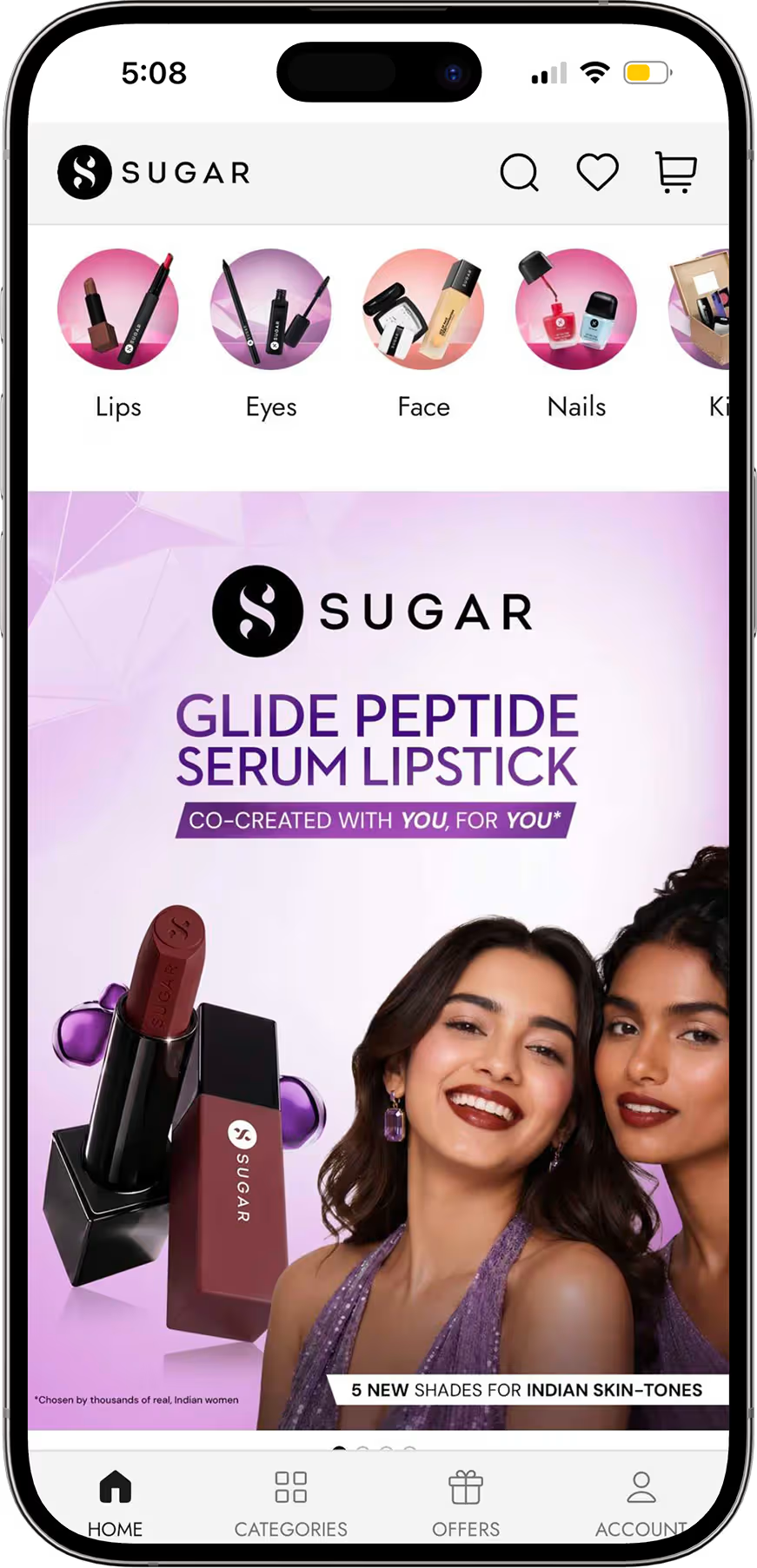
SUGAR Cosmetics ran the counter-play, and it belongs in this list precisely because it looks like the opposite of FOMO tactics. When SUGAR rebuilt their mobile experience on Appbrew, they removed intrusive promotional pop-ups entirely and moved offers into a native, browsable surface inside the app, leaning on bundles and kits to raise value perception instead of shouting discounts.
The outcome: conversion up 70%, AOV up 33%, and the app now drives 36% of their total DTC revenue. The lesson for every brand reading this: FOMO is a spice, not a meal. When urgency is woven into a premium experience instead of interrupting it, the whole funnel converts better.
Gamified progress: when almost-there is the trigger
Progress mechanics run on the endowed-progress effect: once people can see how close they are to a reward, abandoning the progress feels like a loss. That's FOMO pointed at something the customer has already half-earned.
19. Spending threshold rewards - Snitch

FOMO type: Achievement unlocking
Shitch Fashion App creates a unique form of FOMO by showing how close you are to unlocking free shipping or an additional discount offer on cart page like "SHOP FOR 1002 MORE TO APPLY FLAT 20% OFF" more to receive free express shipping!".
This approach is effective because it changes shopping from a simple exchange into a goal-oriented game with clear achievement metrics. The messaging utilizes the "endowed progress effect," where seeing advancement toward a goal increases motivation to complete it.
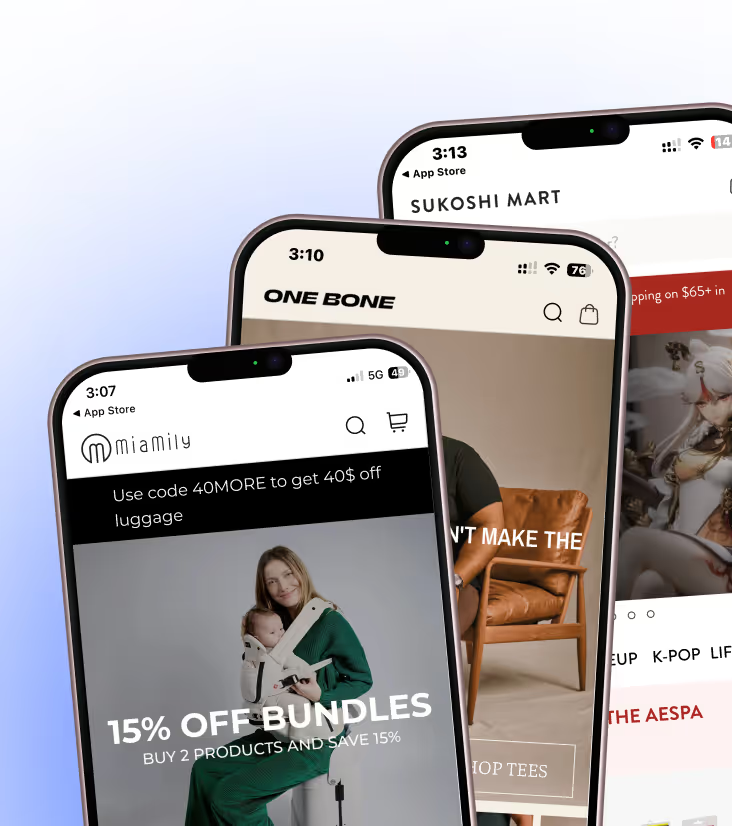
20. Gamified rewards - Sukoshi Mart

FOMO type: Status and progress
Sukoshi Mart turns shopping into a game with messages like "10$ off - Blue - Make 6 purchases!"
By quantifying exactly how close customers are to the next reward level, it creates what psychologists call "completion proximity" that is the increased motivation when a goal seems within reach.
The mechanic pays: Sukoshi Mart lifted AOV 15% with this system, per Coey C., their Director of eCommerce.
21. Cart-hold timers: ASOS
ASOS reserves cart items for a limited window and shows the clock: "We'll hold these for 30 minutes." Read carefully, because this is FOMO framed as a favor. The brand isn't pressuring you, it's protecting your claim, temporarily. The customer feels ownership of items they haven't bought yet, and the ticking clock threatens something that already feels like theirs. Loss aversion does the rest.
Behavioral re-engagement: when their own intent is the trigger
This is the category most FOMO articles skip entirely, and it's where the strongest numbers live. Re-engagement FOMO doesn't manufacture desire, it returns the customer to desire they already expressed. In our data, abandoned-cart nudges convert 4.2% of sessions, 2.1x the broadcast baseline, and wishlist-triggered alerts run 1.8x (Appbrew, 2026).
22. Inventory-aware cart recovery: Freakins

FOMO type: Informational scarcity
Freakins craft personalized FOMO triggers targeted at items you've already shown interest in. Their "The jeans you've been eyeing are back in stock" combines product availability with social proof.
The personalization makes customers feel remembered and valued rather than mass-marketed to. Mentioning specific numbers of viewers creates a sense of competition without explicitly stating scarcity. It takes over our brain's tendency to assign higher value to things others want. A cognitive bias called "social proof heuristic."
23. Wishlist price and stock alerts: the quiet compounder
A wishlist is the customer writing your targeting list for you. Every item on it is a declared intent with no deadline, and alerts supply the deadline: the price dropped, or stock is running low. Price-drop alerts open at 19.5%, 2.2x the broadcast baseline (Appbrew, 2026), because the message is personal, factual, and time-bound all at once.
Most Shopify brands collect wishlists and never activate them. That's a pile of declared demand sitting idle.
How to measure whether your FOMO tactics are working
Measure each tactic against the mechanism it uses, not against a vague "sales went up." Three instruments cover everything above.
1. For notifications
track open rate, click-through rate, and attributed conversion, defined as orders within 24 hours of the notification divided by sessions. Compare each triggered type against your own broadcast baseline. If your back-in-stock alerts aren't clearly outperforming your generic pushes, the trigger timing or the copy is broken, because the intent gap alone should produce a multiple.
2. For on-page urgency features
A/B test the page with and without the element, and read conversion rate, add-to-cart rate, and AOV. Never eyeball this one. Seasonality and traffic mix will lie to you; a controlled split won't.
3. For sale events
Plot the purchase curve across the event window. A healthy urgency event shows a pronounced final-hours spike. A flat curve means customers didn't believe the deadline, and that's a credibility problem, not a discount problem.
Then benchmark against the tables at the top of this post. That's what they're for.
4 FOMO mistakes that train customers to ignore you
Every tactic above has a failure mode, and all four failure modes are the same failure: the constraint wasn't real.
1. The timer that resets tomorrow.
The 34% countdown lift assumes the deadline exists. Run an "ends tonight" sale that reappears every morning and customers learn the truth within two exposures. From then on, every timer you show converts worse than no timer, because you've converted urgency into a running joke.
2. "Limited stock" on items that never run out.
Scarcity claims are verifiable, and customers verify. This is why inventory-linked scarcity beats copywritten scarcity: when the counter pulls from live Shopify stock data, the number is never fiction, and the one time an item actually sells out, every future low-stock alert gains credibility.
3. Urgency on every single push.
Send seven "LAST CHANCE" broadcasts a week and you get the 8.5% open rate the average broadcast earns, then less. Urgency is a contrast effect. It only registers against a baseline of calm, which means your ordinary messages are what make your urgent ones work.
4. Copying the tactic without the constraint.
A waitlist for a product with unlimited stock, an "exclusive" offer everyone receives, a "members-only" drop with open membership. Customers can't always articulate why these feel off, but they feel it, and the feeling is called desperation.
Is FOMO marketing worth it? An honest answer
Yes, when the constraint is real, and the size of the yes is in the benchmark tables above. A triggered, truthful scarcity message multiplies conversion because it's genuinely useful information delivered at the moment it matters.
It is not worth it as a permanent volume knob. Habituation kills overused urgency, and the emotional residue is real: consumer research has found FOMO-heavy marketing leaves significant shares of shoppers feeling envy and jealousy toward the experience (Citizens Relations). A brand that makes customers feel bad on the way to checkout is borrowing revenue from its own retention curve.
The brands in this article stay on the right side of that line the same way: the deadline is real, the stock number is real, the exclusive is actually exclusive. Truth is the whole trick.
How Shopify brands run all of this on autopilot
Everything above shares a dependency: timing. A back-in-stock alert is worth 3.5x a broadcast only if it fires the moment stock returns, to exactly the people who asked. No marketing team does that manually at scale, which is why the strongest FOMO programs run on infrastructure, not effort. That's what Appbrew is built for.
Countdown timers that sync to your actual promotions
Appbrew's countdown timers pull directly from your promotion schedule and display to the second on any product page, collection banner, or cart screen. When a customer is already considering a product and sees "Offer ends in 02:17:43," the decision compresses. They stop comparing. They stop tab-switching. They act or they don't.
For flash sales tied to a specific SKU, you can attach the timer at the product level so it only appears where it's relevant, not sitewide where it dilutes the signal.
Low-stock alerts pulled live from Shopify inventory
Low-stock counters and sale countdowns pull directly from your Shopify data, so the scarcity your app shows is always true, which is the entire reason it keeps converting.
For products that genuinely move fast, this single eCommerce app feature can visibly accelerate sell-through. Customers know other people are buying. The number proves it.
Push notifications timed to the moment of highest intent
Appbrew's push notification builder lets you segment by behavior, purchase history, wishlist activity, or cart status, so you're not blasting your whole list with the same message and hoping someone bites.
A customer who viewed a product three times but didn't buy gets a "Back in stock, only 4 left" push. A customer who abandoned checkout yesterday gets a "Your cart is about to expire" nudge with the current inventory count attached. A loyalty member gets early access to a flash sale 2 hours before it opens to everyone else.
Each of these is a different message, to a different person, at a different moment. That's what separates FOMO campaigns that convert from ones that generate unsubscribes.
{{cta2}}
Wishlist-based FOMO triggers
When a wishlisted item drops in price, goes low in stock, or goes on sale, that's the highest-intent notification you can send. The customer has already done the deliberation. They already want the product. The only thing that stopped them before was price, timing, or hesitation. Your notification resolves one of those, right now.
Appbrew connects wishlist data to your notification workflows so these alerts fire automatically. No manual exports. No cross-referencing spreadsheets. When the trigger condition is met, the push goes out to every customer who saved that item, with a direct link to the product page.
Flash sale landing pages built for urgency
Running a flash sale without a dedicated landing page is like setting a deadline and burying it in fine print. The urgency exists. The customer just never feels it.
Appbrew lets you build flash sale pages inside the app that lead with urgency: the timer up top, the discounted price visible without scrolling, inventory counts on each product tile. The layout is designed so that the first thing a customer sees when they tap the notification is the reason to act now, not a standard product grid with a sale badge they have to look for.
You can pin these pages to the app's home screen for the duration of the sale, making them the default entry point for any customer who opens the app during the promotion window. When the sale ends, the page comes down. Everything resets. No cleanup work on your end.
App-exclusive offers and drops.
Early-access windows, first-order offers, and app-only pricing run natively, the same mechanics Nike and Sephora use, without a development team. This is how Karma and Luck, DermaClara, SUGAR, and Sukoshi Mart run the examples you just read.
Social proof widgets that show demand in real time
Telling customers a product is popular is less convincing than showing them. Real-time purchase data does that without requiring any explicit claim about scarcity.
Appbrew's social proof widgets surface activity like "94 people bought this in the last 24 hours" or "Currently viewed by 17 people" directly on product pages. The customer sees demand without being told what to conclude. They connect the dots themselves, and that conclusion lands harder than anything in your copy.
Analytics that show you which FOMO tactics are actually working
Running FOMO campaigns without measuring them is how you end up doing the same things every quarter and wondering why results plateau.
Appbrew's analytics give you campaign-level and feature-level data: which push notifications drove the most opens, which product pages with countdown timers converted at a higher rate, which low-stock alerts recovered the most revenue, which flash sales brought in new app installs versus reactivating lapsed buyers. That data tells you where the urgency is landing and where it isn't.
The goal isn't to run every FOMO tactic at once. It's to find the two or three that resonate with your specific audience and build those into every campaign. The analytics tell you which ones those are.
Also Read: 2x your eCommerce App Installs: A 2026 Launch Checklist for Shopify Businesses
5 FOMO marketing best practices for DTC brands
While FOMO is powerful, wielding it requires finesse. Here's how to use it without coming across like that friend who's always exaggerating about how "amazing" their weekend was:
- Tie every scarcity claim to live data. Inventory-linked counters and synced timers can't drift into fiction.
- Trigger on behavior, not on calendar. The benchmark gap between triggered and broadcast messages is the whole opportunity.
- Ration urgency. Reserve it for moments that deserve it, so it still registers when you use it.
- Let deadlines die. When the timer ends, the offer ends, visibly. The discipline is what makes the next deadline believable.
- Pair every "why now" with a "why this." Urgency closes sales that desire opened; it can't do both jobs alone.
Want to turn casual browsers into instant buyers? Implement these FOMO tactics in your eCommerce DTC app today and watch your sales and conversions soar!
And if you want each of these features in your Shopify mobile app, book a demo today!
FOMO marketing FAQs
Or, as marketing gurus call it, "FOMO FAQS." Because marketing loves acronyms almost as much as it loves creating artificial scarcity.
What is FOMO marketing?
FOMO marketing uses urgency, scarcity, and exclusivity to move buyers toward faster decisions. It works by making the cost of inaction feel higher than the cost of purchasing. Common tactics include countdown timers, low-stock alerts, limited-time offers, exclusive access programs, and real-time social proof.
How do I build a FOMO marketing campaign?
Start with what's genuinely limited: inventory, time, or access. Choose tactics that match the real constraint. If you have 10 units left, a stock counter makes sense. If you're running a 24-hour flash sale, a countdown timer does the work. The best FOMO campaigns feel informative, not pressuring.
How do I test FOMO marketing effectiveness?
A/B testing is the baseline. Run a product page with urgency elements against one without. Measure conversion rate, average order value, and add-to-cart rate. For notifications, compare open and click rates between campaigns with urgency framing versus those without. The tactics that work for your audience will surface quickly.
Does FOMO marketing work on mobile?
It works better on mobile. Push notifications let you reach customers at the right moment rather than waiting for them to visit. Countdown timers and stock alerts on a mobile app create urgency at the point of highest intent. DTC brands that run FOMO campaigns through a dedicated mobile app typically see higher conversion rates than those relying on email alone.