

.webp)
Best Buildfire alternatives for Shopify in 2026. Compare top mobile app builders and find the best choice for growth-focused brands.
You went looking for a mobile app builder, found Buildfire, and it checked a lot of boxes on paper. Drag-and-drop editor, iOS and Android support, no coding required. You signed up, built something, and then hit the wall. The Shopify plugin is shallow. The app feels slow. The plan you're on limits downloads to 100. And customer support takes days to respond.
Buildfire wasn't built for ecommerce. It was built for anyone with a mobile app idea. For Shopify brands that need mobile to actually drive revenue, that generalist approach costs more than it saves. This post breaks down the best Buildfire alternatives for ecommerce and Shopify brands in 2026, what each one is actually good at, and how to pick the right one before you commit.
Let’s dive right in!
What Buildfire Is (and Where It Falls Short for Ecommerce)
Buildfire is a no-code app builder that works across dozens of industries including events, fitness, education, and ecommerce. That breadth is its identity. You pick your industry, choose from around 12 templates, and start assembling your app using a plugin marketplace.
For ecommerce brands, Shopify support exists as a plugin. Not as a native integration. Not as a core product assumption. As something you add on.
That distinction matters a lot in practice.
1. Pricing that doesn't scale well
Buildfire's MVP plan starts at $100/month and limits your total app downloads to 100. The Growth plan at $159/month removes the download cap but keeps the same plugin restrictions. Users on Capterra consistently note that similar quality builders cost half as much, and that unlocking meaningful features requires jumping to significantly more expensive tiers.
2. Performance issues that reviewers flag repeatedly
Multiple users on SoftwareAdvice and G2 note that the app can be slow to load, and the Buildfire team has acknowledged in some cases that there's no fix available. For ecommerce, where a one-second delay in page load meaningfully drops conversion rate, that's not a minor complaint.
3. A generalist architecture working against you
Buildfire's plugin-based approach means you assemble commerce features from separate pieces: products here, cart there, payments somewhere else. The result is a shopping experience that feels like it was bolted together rather than designed for how people actually buy on mobile. Deep Shopify syncing, loyalty integrations, subscription management, and behavioral personalization all require custom work that Buildfire wasn't built to handle out of the box.
For brands building their first test app on a tight budget, Buildfire can work. For Shopify brands that want mobile to be a real revenue channel, the limitations add up quickly.
The Best Buildfire Alternatives for Ecommerce & Shopify Brands
Here are the best Buildfire alternatives you can consider to turn your Shopify store into mobile app:
1. Appbrew (Best for Shopify Brands Serious About Mobile Revenue)
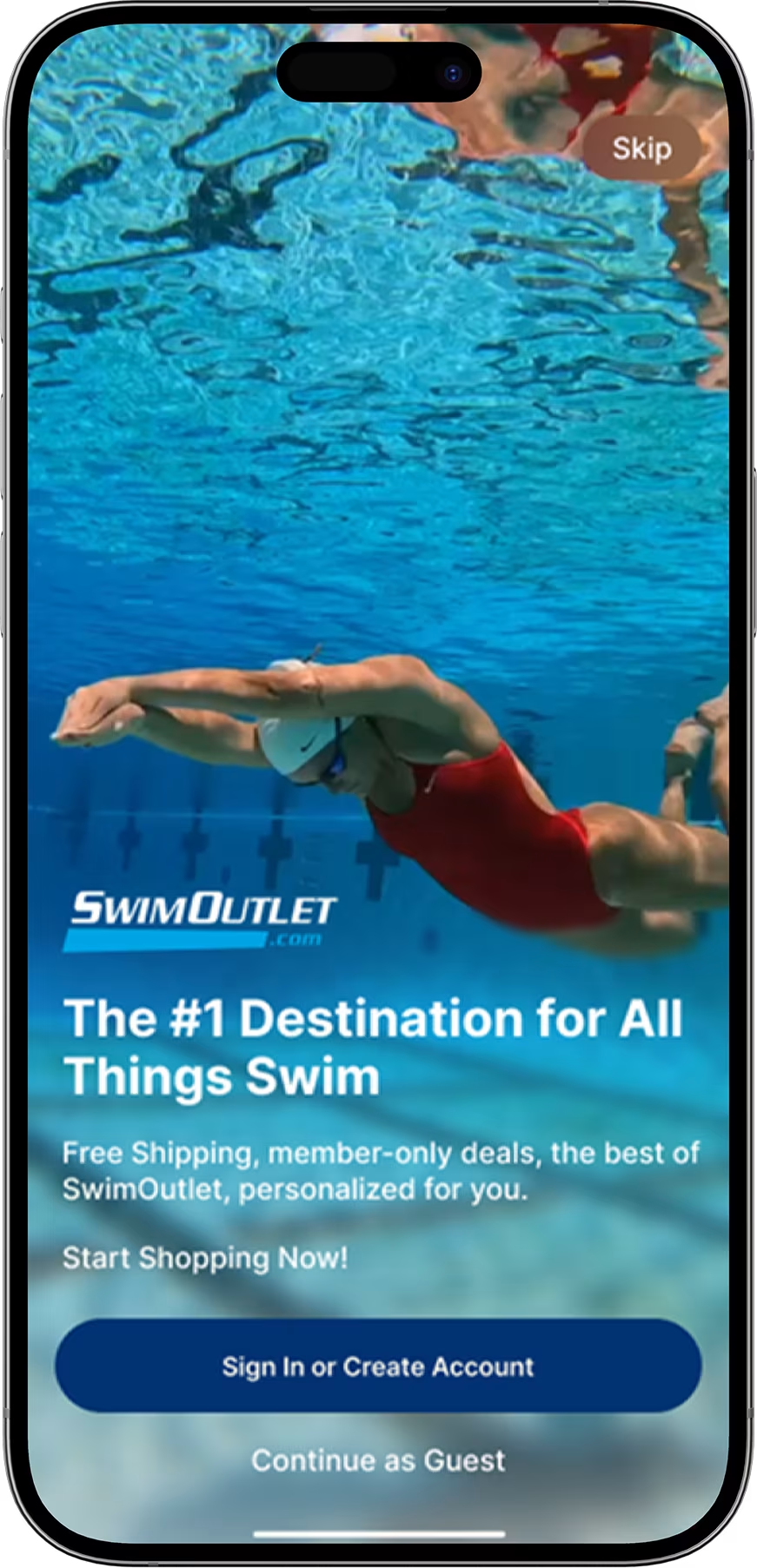
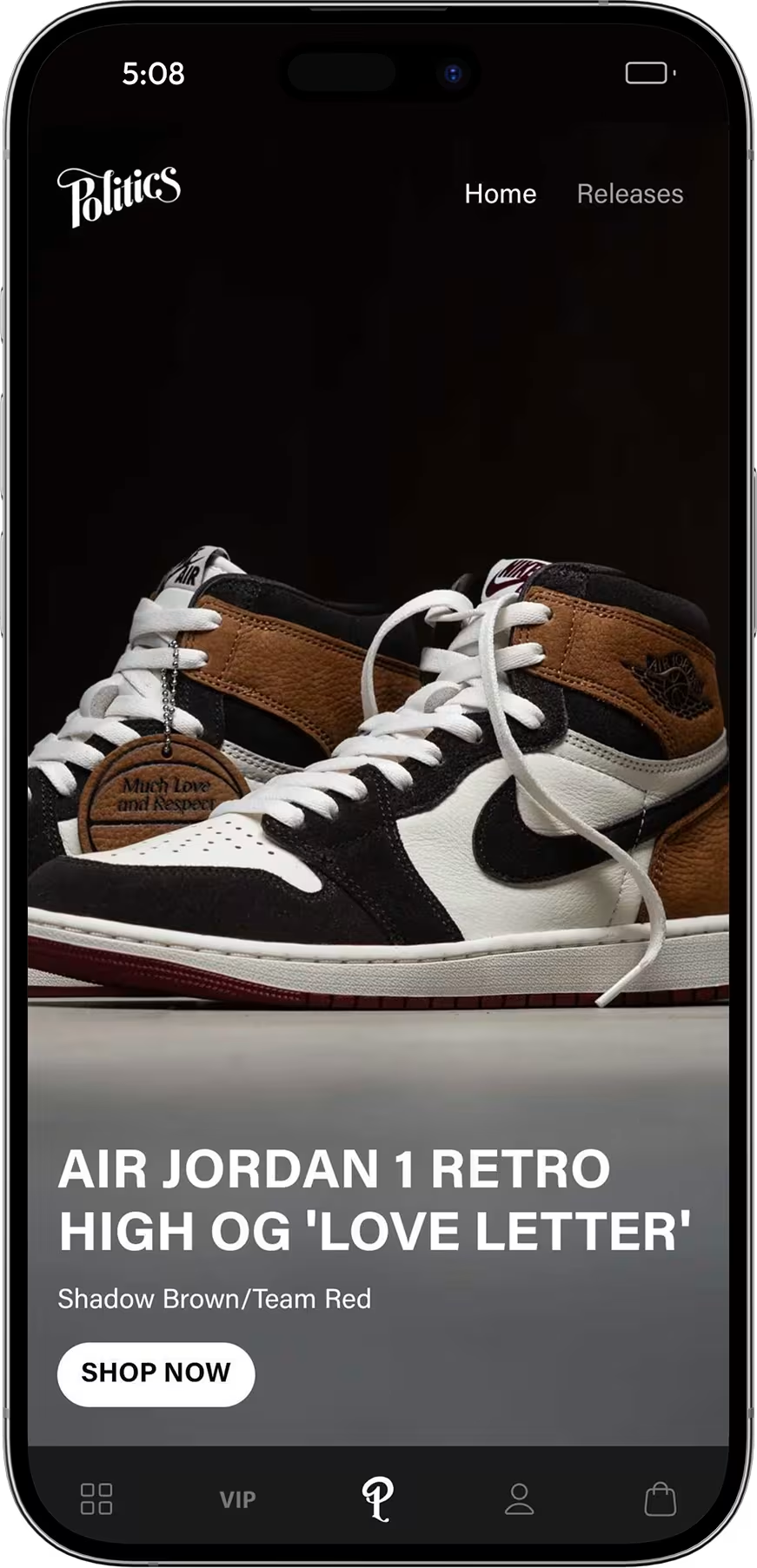
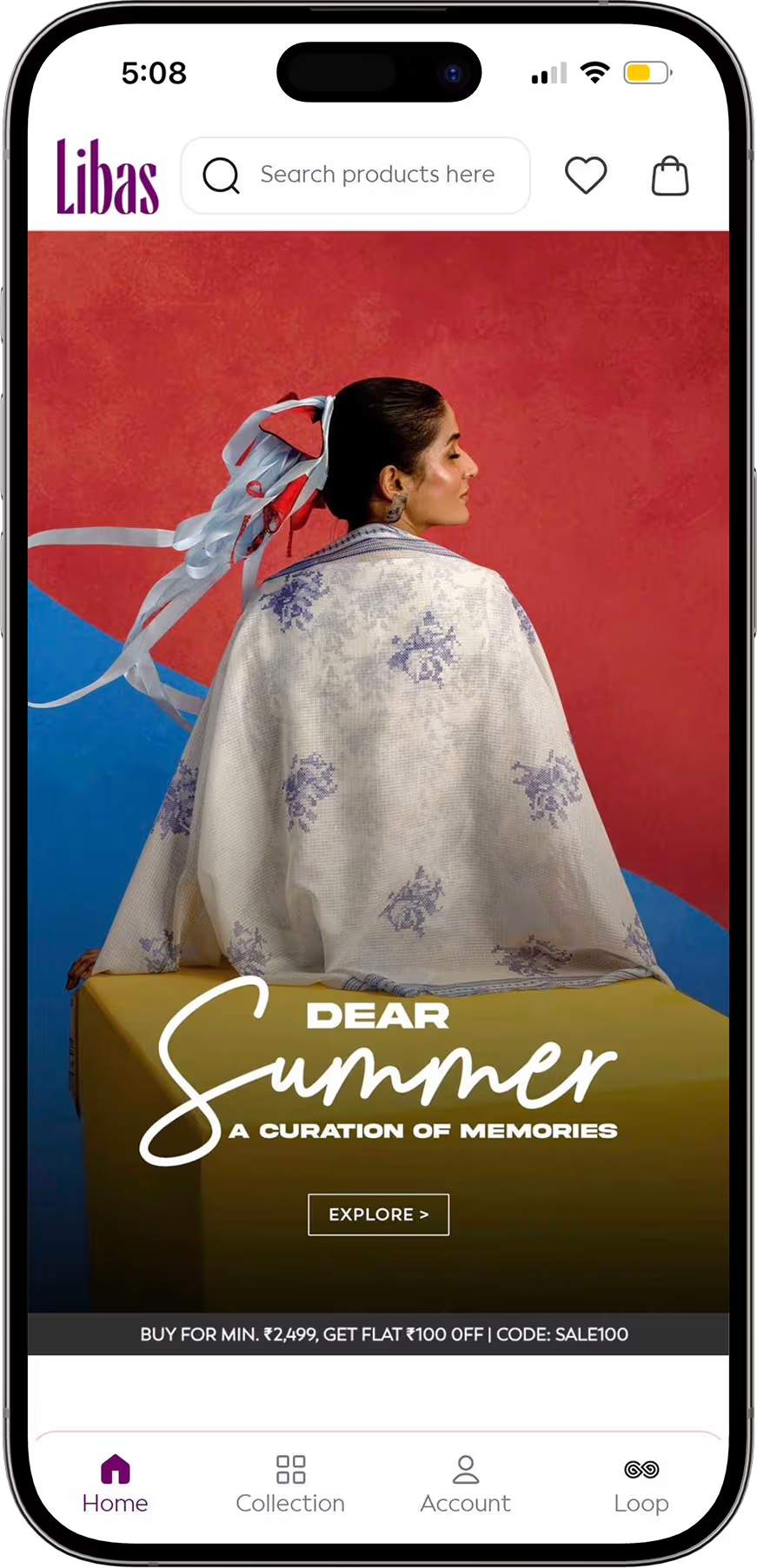
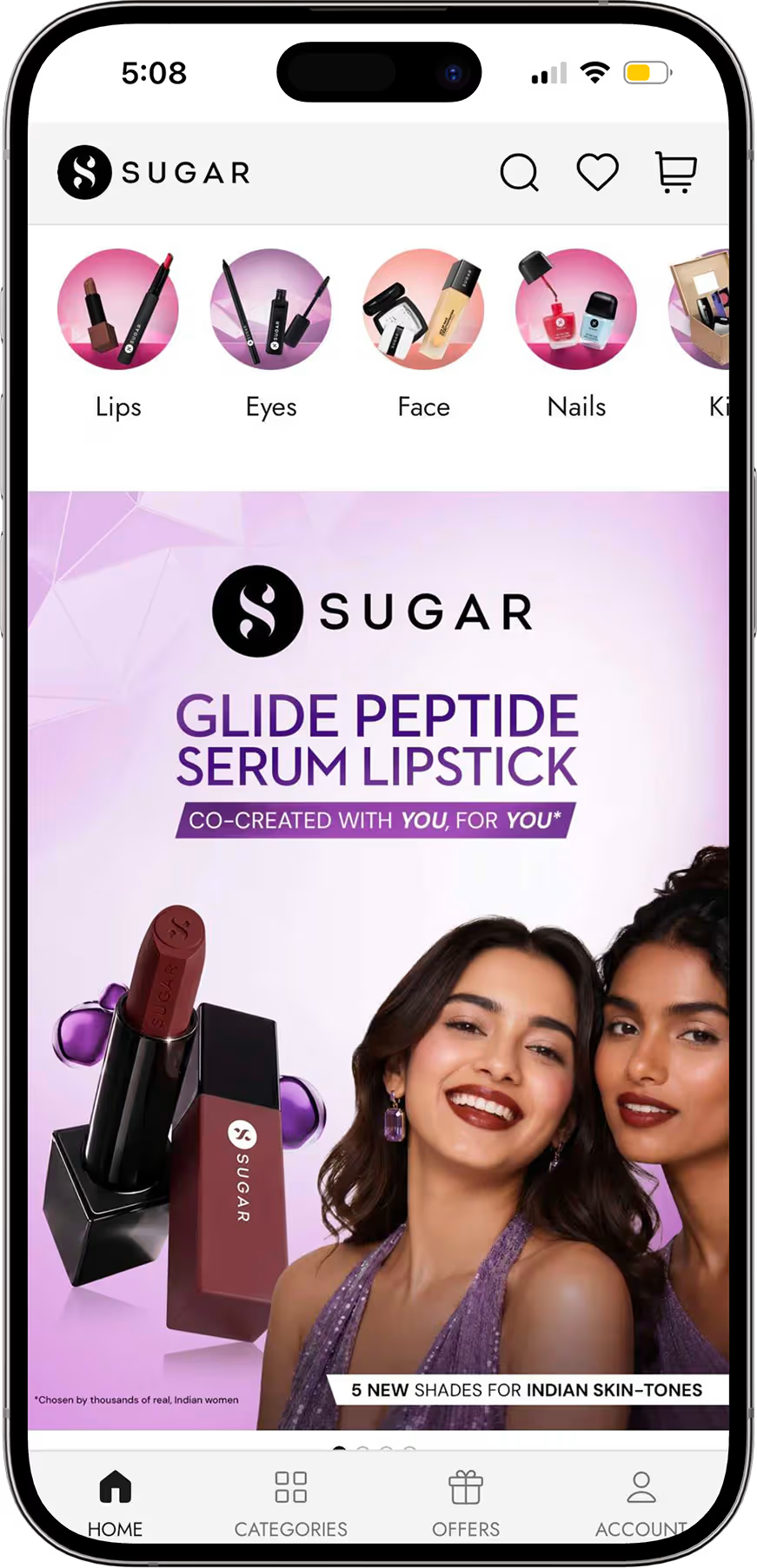
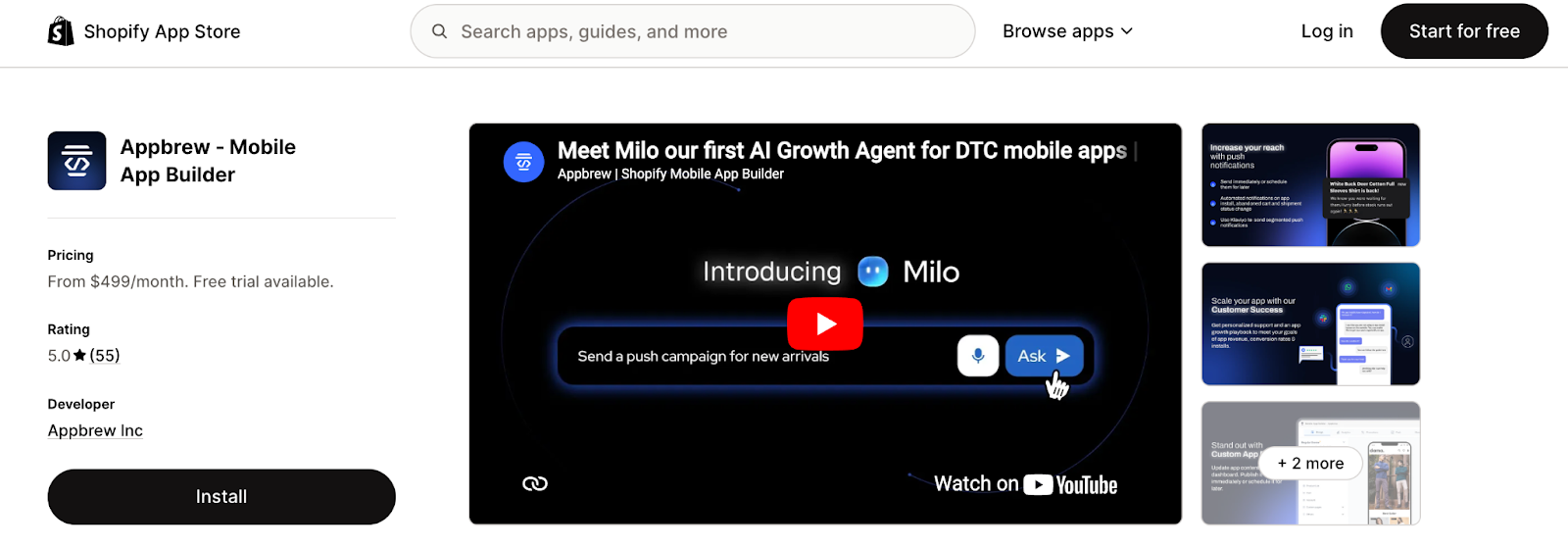
Appbrew is one of the best Shopify mobile app builders, purpose-built for Shopify and Shopify Plus brands that want mobile to outperform their mobile website on every metric that matters: conversion rate, average order value, repeat purchase rate, and customer lifetime value. It's the sharpest contrast to Buildfire's generalist approach.
Native apps, not assembled plugins
Where Buildfire assembles an app from plugins, Appbrew builds a fully native iOS and Android app on React Native from the ground up. That's not just a technical distinction. Native apps load faster, feel smoother, and convert better than anything built on a plugin architecture or a webview wrapper.
Appbrew delivers sub-1-second load times and app sizes under 45 MB. Brands using the platform report conversion rates around 3x higher than their mobile website, with some Shopify Plus fashion brands attributing 60% of DTC revenue to the app channel.
Real-time Shopify sync that actually works
Products, inventory, pricing, collections, and promotions sync automatically from your Shopify store into the app. You're not managing two systems or manually updating the app when something changes in your Shopify admin. Everything flows through the integration natively, not through a plugin you configured.
Personalization built for ecommerce
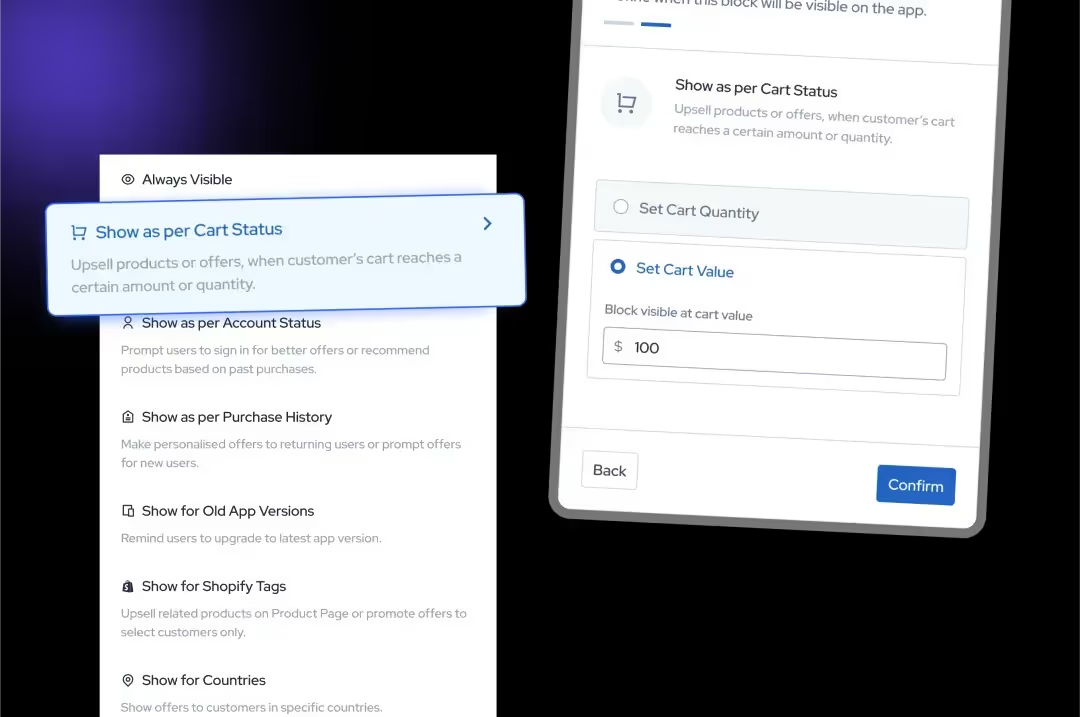
Appbrew's personalization goes well beyond showing different banners to different segments. You can show different layouts, themes, promotions, and product recommendations based on a customer's behavior, purchase history, Shopify tags, or location. A repeat buyer who's placed three orders sees a different home screen than a first-time visitor who came from a push notification.
This kind of conditional content is hard to build in Buildfire. In Appbrew, it's part of the core product.
Three AI layers most builders don't have
Appbrew ships two distinct AI products.
Milo is the AI growth assistant for your team. It drafts push notification copy, generates banner creative variations, and lets marketers describe personalization rules in plain English rather than building logic trees manually. If your team currently spends hours configuring campaign conditions, Milo removes most of that work.
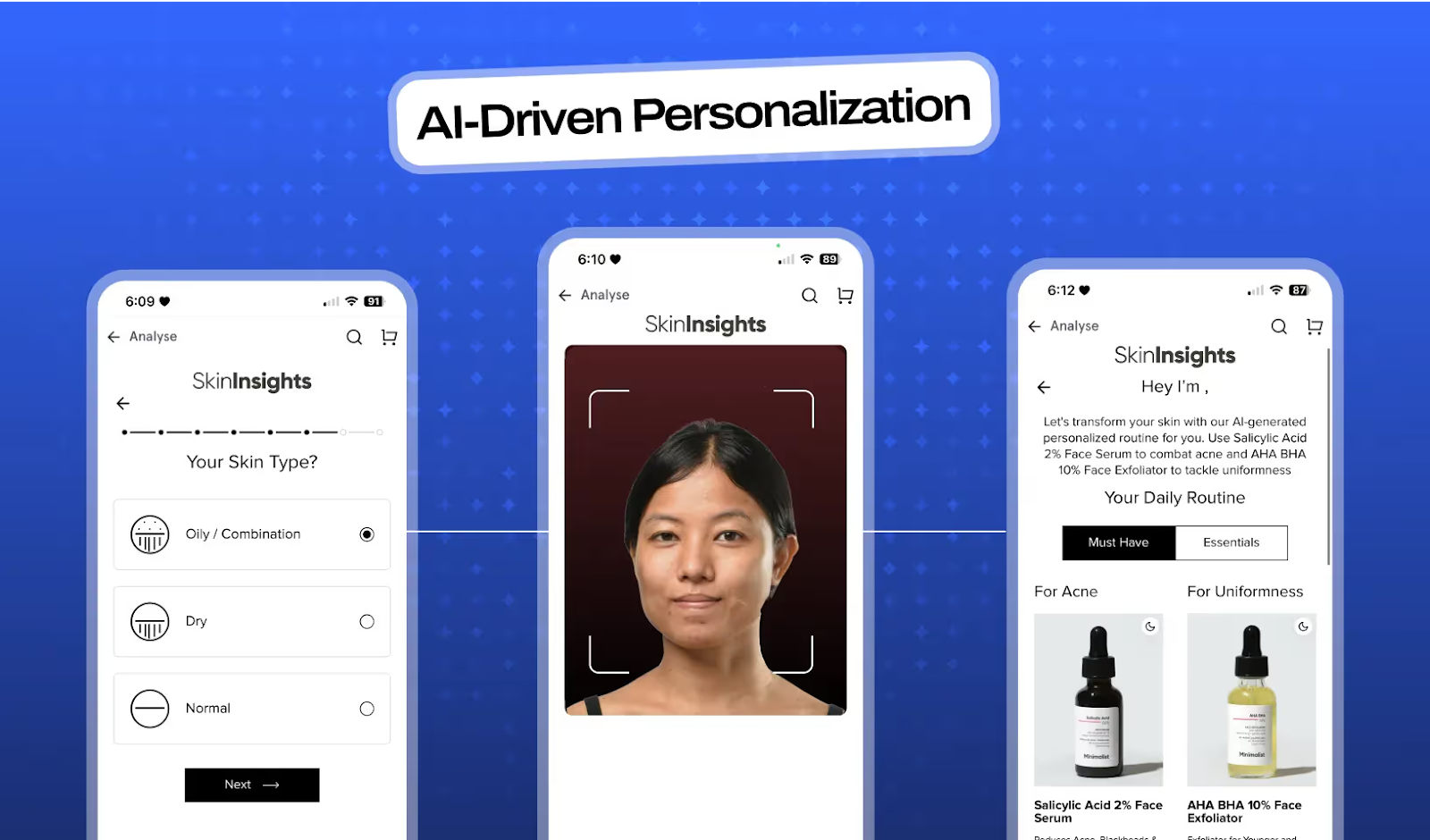
Concierge is the in-app shopping assistant for your customers. It handles conversational product discovery, size recommendations, and guided shopping flows inside the app. Beauty and skincare brands also get an AI skin analyzer that tailors product suggestions to individual customers based on their inputs.
AI Skin Analyzer is specifically for beauty brands. Customers upload a selfie, the tool analyzes skin concerns, and it recommends matching products from the catalog. Brands like Minimalist use it to reduce purchase hesitation on skincare products where fit matters.
Push notifications as a revenue channel
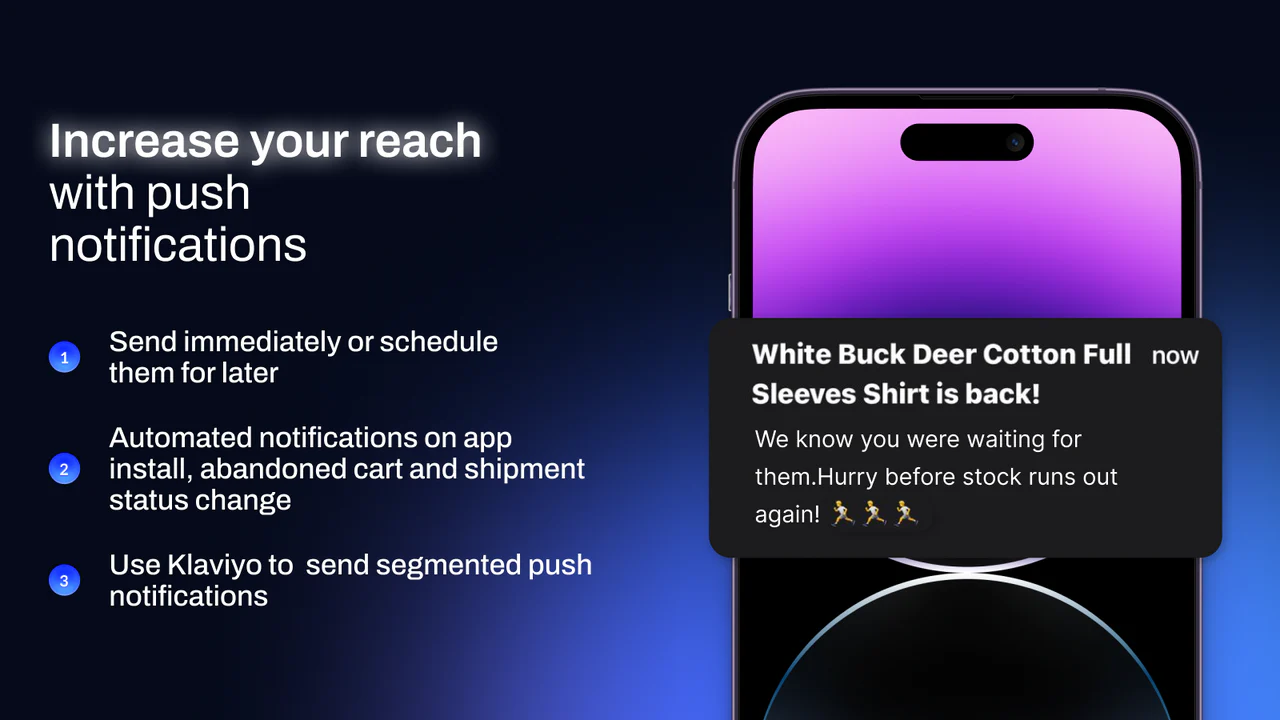
Buildfire supports basic push notifications with limits on monthly volume at lower tiers. Appbrew treats mobile app push notification as a first-class growth lever with unlimited pushes on Pro and Enterprise plans, no per-message fees, and automated flows for abandoned carts, back-in-stock alerts, order tracking, price drops, and re-engagement. Every push can deep link into a specific product, collection, or campaign landing page.
Segmentation covers new vs. returning customers, LTV tiers, product interest, browsing behavior, and more. Analytics track opens, clicks, and revenue attributed to each campaign so you know what's actually working.
Integration with your existing stack
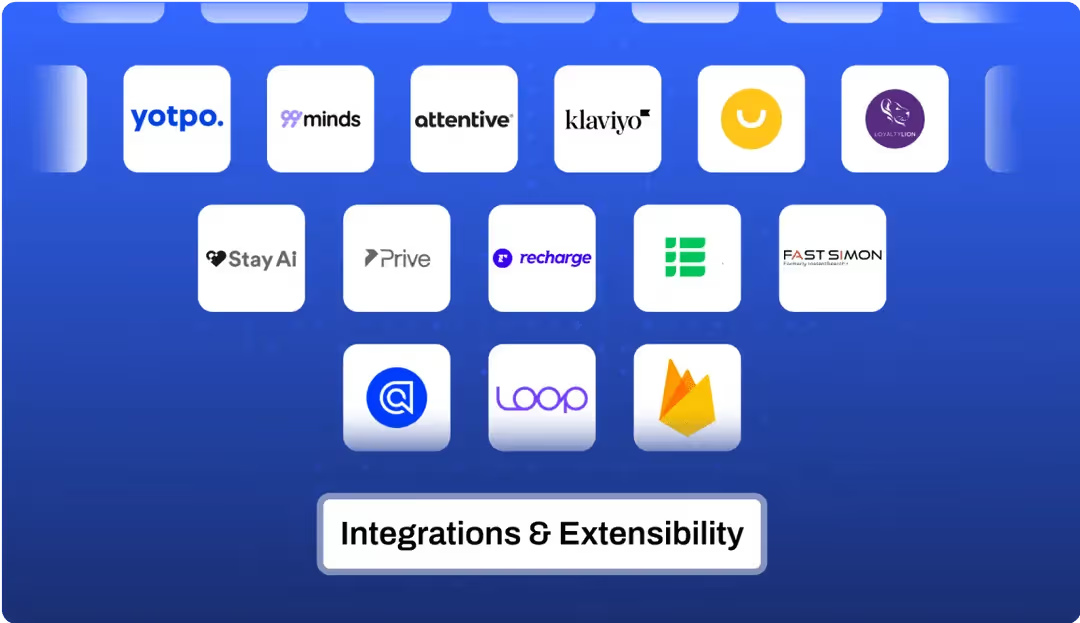
Appbrew connects natively with 100+ Shopify apps: Yotpo for reviews and loyalty, Recharge, Stay AI, and Prive for subscriptions, AppsFlyer, Adjust, and Branch for attribution, Klaviyo for cross-channel flows, and Meta and Google SDKs for ad retargeting and audience syncing. These aren't Zapier workarounds. They're native integrations maintained by the Appbrew team.
Compare that to Buildfire, where Shopify is one plugin among many and deeper integrations require custom development.
A marketer-first dashboard
The Appbrew dashboard is built so that a non-technical marketer can update banners, launch campaigns, schedule seasonal themes, and review performance without involving engineering. The initial app build is handled by Appbrew's team based on your brand guidelines, so you're not spending weeks trying to recreate your brand identity inside a template system.
Pricing
Pro plans start at $599/month with a 14-day free trial. Enterprise offers custom pricing for Shopify Plus brands and includes custom app design, metafield-based content blocks, subscription management, multi-currency support, user referral rewards, a dedicated account manager, and a direct Slack channel with the team.
For Shopify brands that want mobile to carry real commercial weight, Appbrew is worth a closer look.
2. Tapcart
Tapcart is one of the most recognized Shopify app builders and a credible alternative to Buildfire for brands that prioritize design polish and deep Shopify integration. Unlike Buildfire's plugin-based approach, Tapcart is built specifically for Shopify, so the integration is native and reliable.
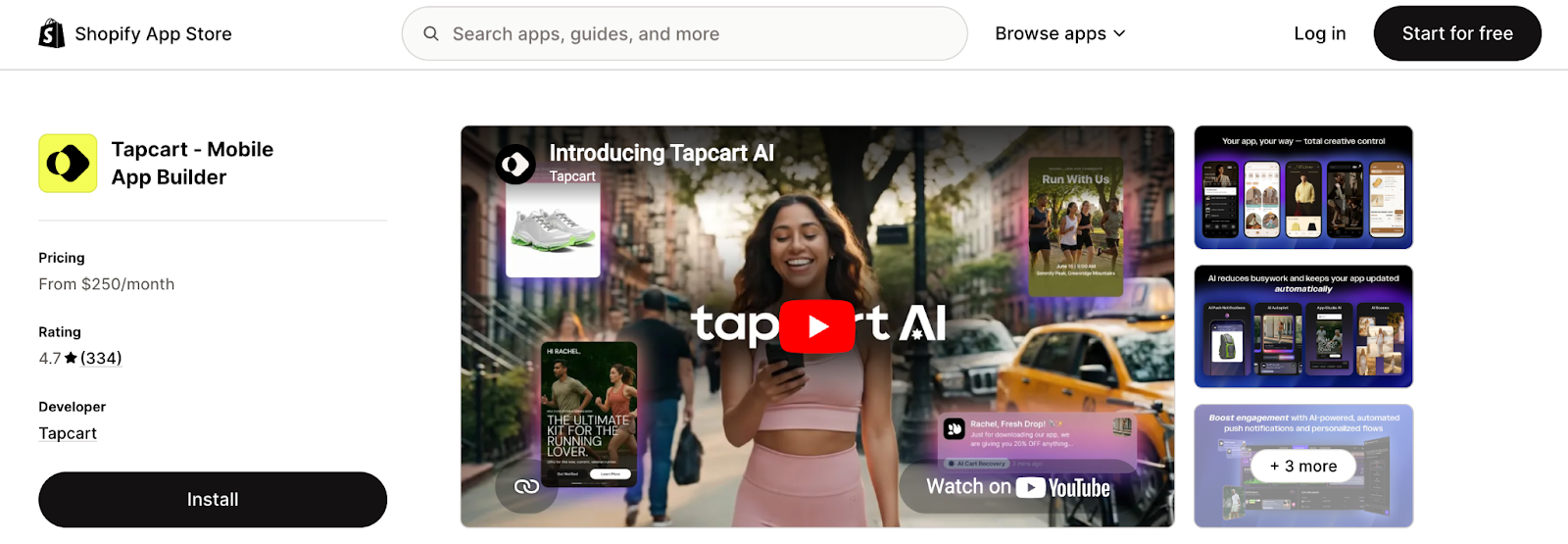
The strengths are real: a clean drag-and-drop builder, strong Shopify sync, and push notification capabilities that go well beyond Buildfire's basic setup. Tapcart also markets AI features for content and personalization, though users report that some of these are more surface-level than the marketing suggests.
The main consideration is cost. Tapcart's plans can climb to $2,000/month or more for enterprise-level features. For brands evaluating total cost of ownership, that's a significant number, especially if the AI and personalization features don't fully deliver on their promise.
Tapcart works well for mid-size Shopify brands that want a well-designed app and solid Shopify integration without needing deep AI, subscription management, or advanced behavioral personalization.
3. Shopney
Shopney is the budget-friendly end of the Shopify mobile app builder market. Plans start around $149/month, which makes it one of the more accessible options for stores earlier in their growth journey.
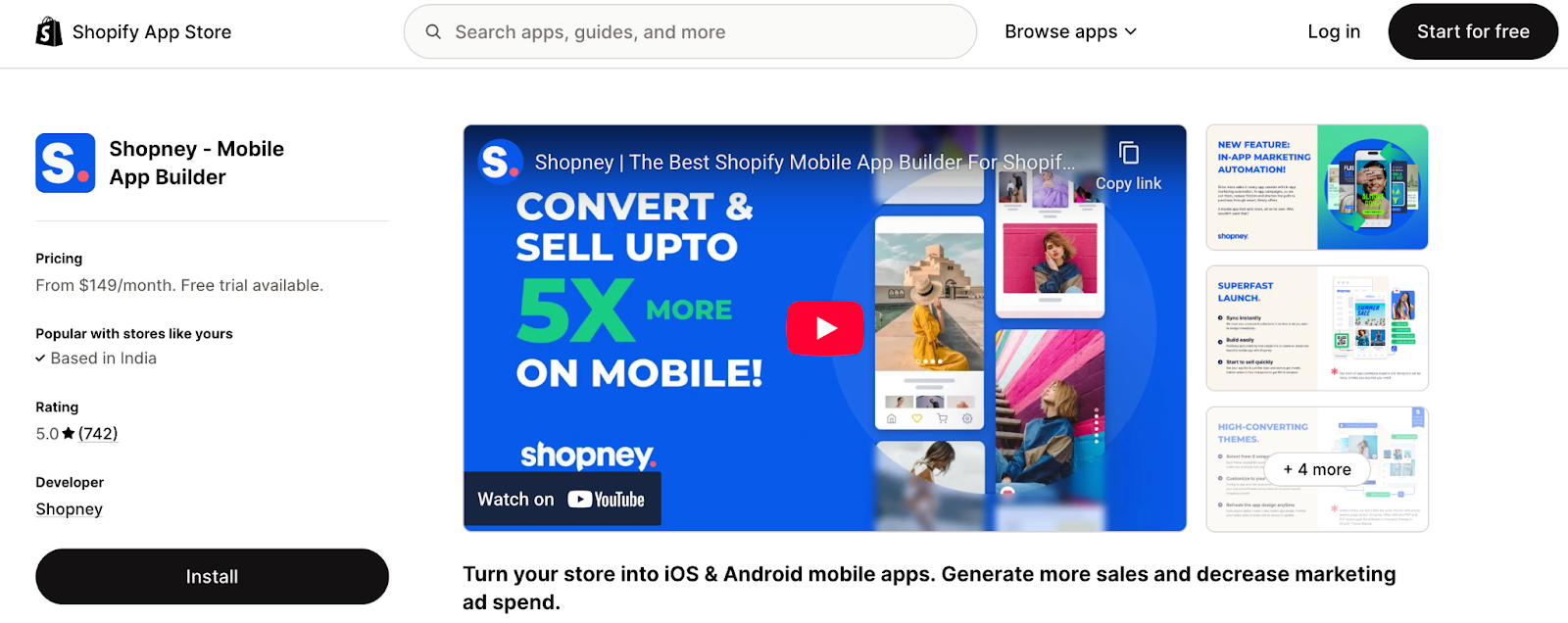
The core product covers the essentials: real-time Shopify sync, push notifications, in-app chat, and a drag-and-drop builder with standard design blocks. For brands that primarily need an app to serve their existing customer base and run basic push campaigns, Shopney gets the job done.
The limitations show up at scale. Personalization options are thin compared to Appbrew or Tapcart. AI features are minimal. Integrations with loyalty, subscription, and attribution tools are more limited. If your mobile strategy extends beyond basic push notifications and a branded storefront, Shopney tends to become a constraint before your business does.
4. Plobal Apps
Plobal Apps sits in the middle of the Shopify builder market with a strong focus on analytics and conversion rate optimization. It gives marketing teams more visibility into what's working inside the app than most builders in its price range, with funnel analytics, push performance tracking, and revenue attribution built in.
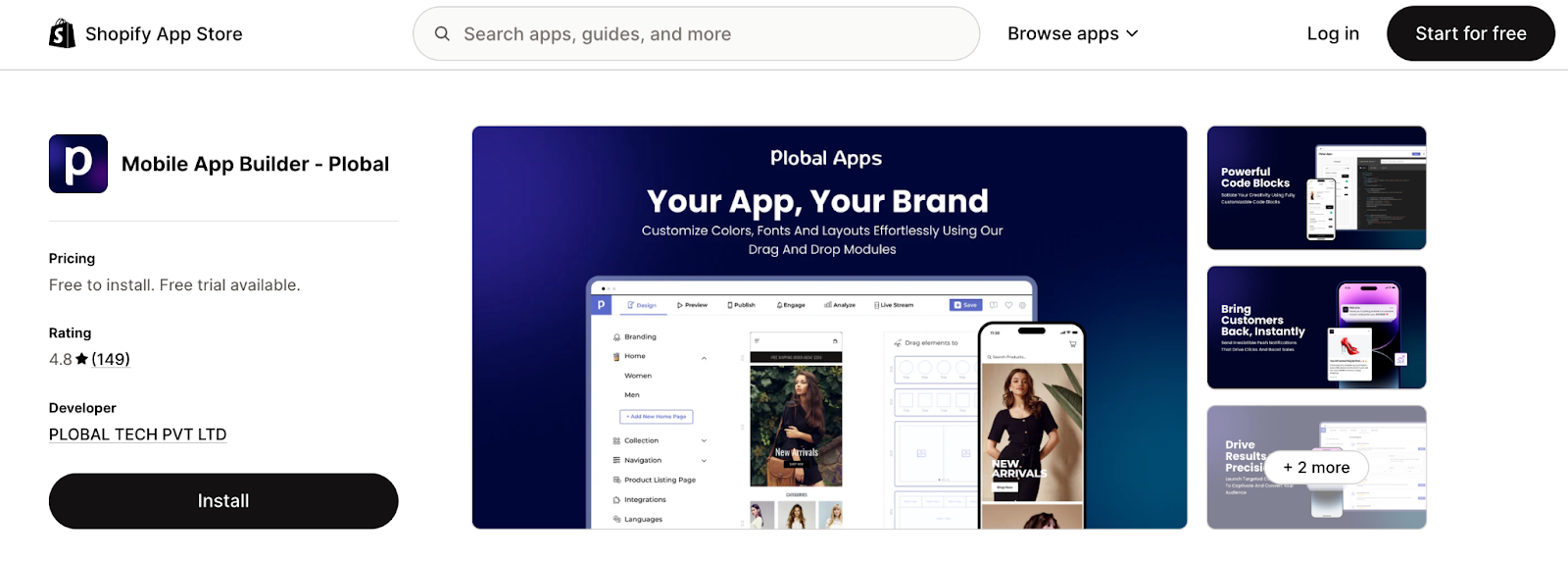
Plobal connects with Klaviyo, Recharge, Yotpo, and other Shopify-native tools and offers a drag-and-drop builder with solid customization options. Plans start at $199/month with more capable tiers running $499 to $1,199/month.
Where Plobal falls short is in AI maturity and deep personalization. If you want behavioral personalization that adapts the entire app experience by customer segment, you'll find Plobal's capabilities more limited than Appbrew's. For brands that want strong analytics and don't need AI-driven personalization, it's a solid choice.
5. MobiLoud
MobiLoud takes a completely different approach from every other builder on this list. Instead of building a new app from scratch, it converts your existing Shopify web store into a mobile app. Your website becomes the app, with native push notifications layered on top.
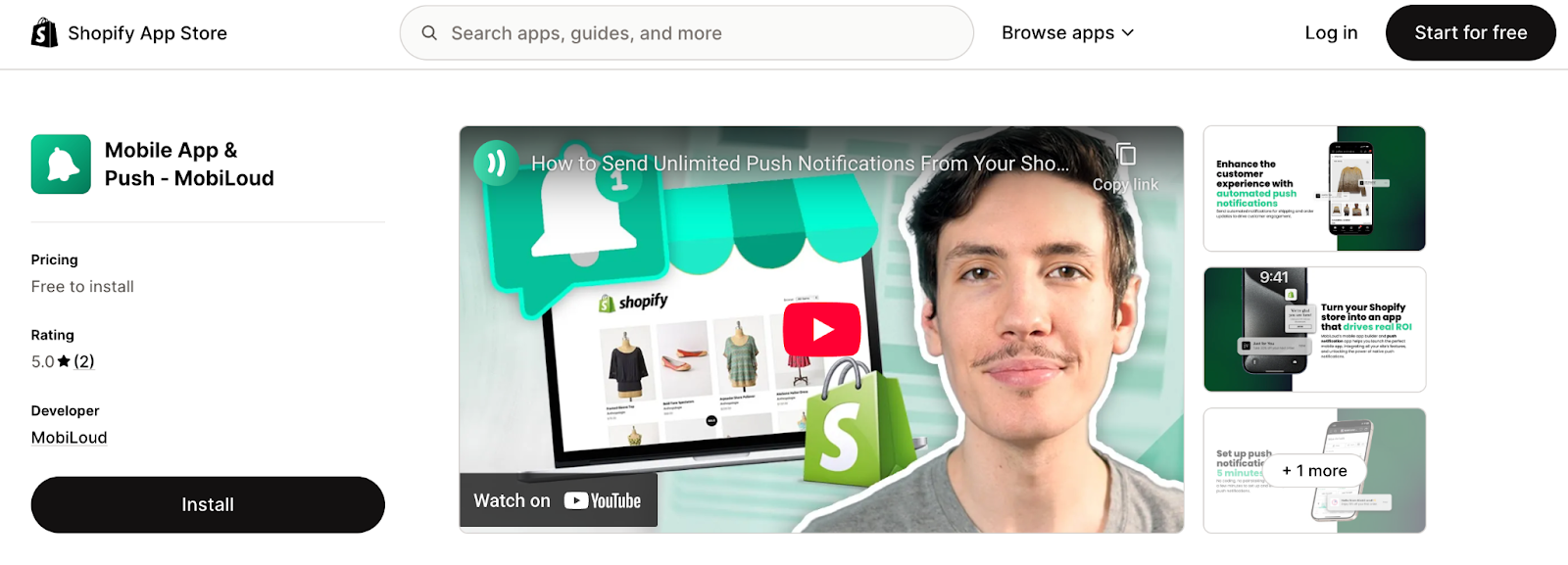
This approach has a real advantage: if you've already invested heavily in your Shopify theme and web UX, you don't have to rebuild anything. Any change you make to your website automatically appears in the app. MobiLoud handles the engineering and submission process, typically getting brands live within four weeks.
The trade-off is that your app inherits the performance characteristics and UX patterns of your website. You don't get the native speed benefits, mobile-first interaction patterns, or commerce-specific app features that a platform like Appbrew builds from the ground up. For brands where web parity is the priority and mobile-native performance isn't the goal, MobiLoud is a legitimate option.
6. GoodBarber
GoodBarber is a general-purpose app builder with stronger ecommerce capabilities than Buildfire and more design flexibility. It supports multi-language apps, push notifications, and has an ecommerce module with product listings, carts, and payment integration.
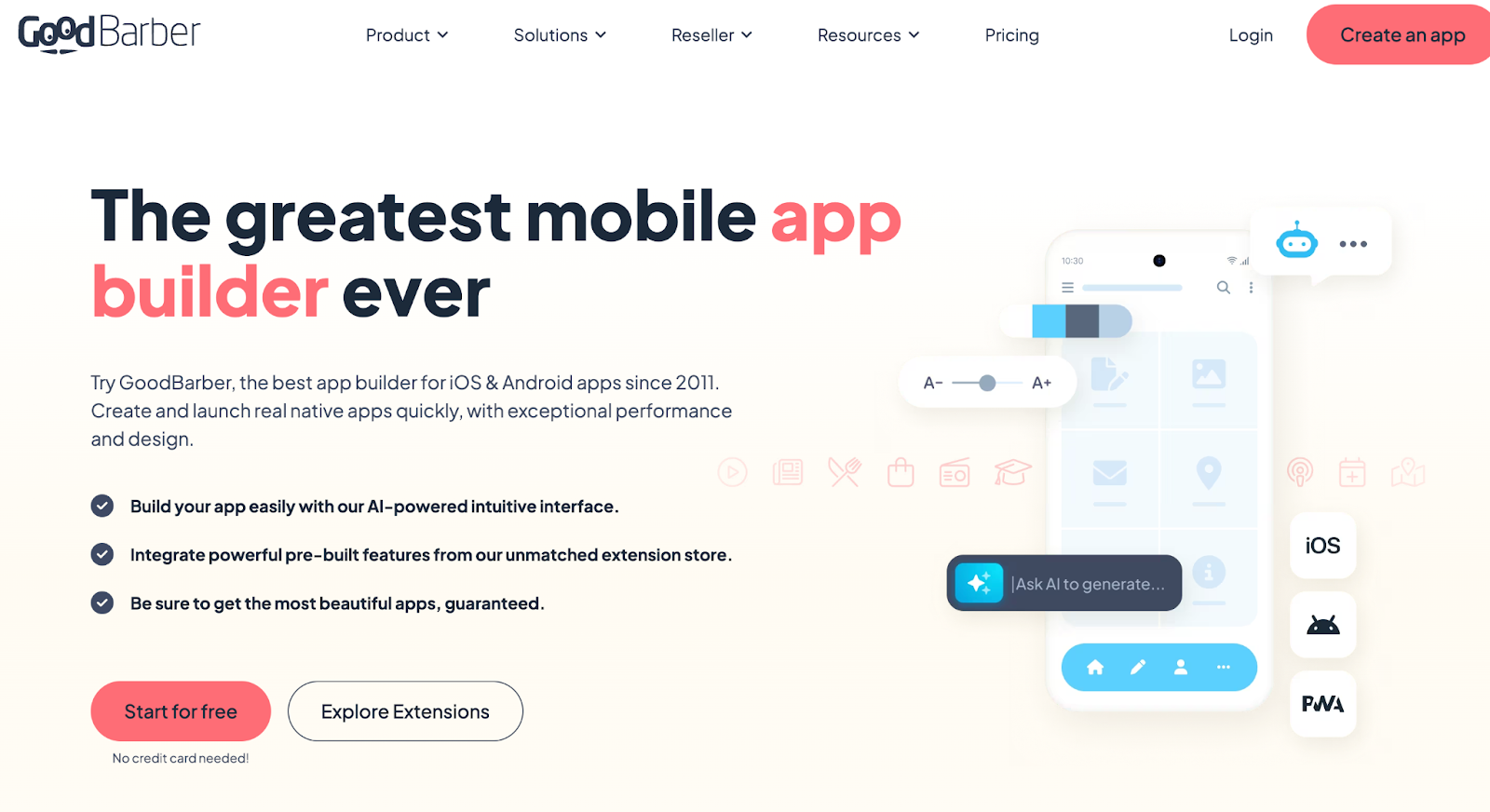
The positioning is similar to Buildfire in that it serves multiple industries and isn't Shopify-native. But GoodBarber's design tools are generally considered more capable, and users who've compared the two often prefer GoodBarber's interface.
For brands not on Shopify, or those that need a flexible app builder for a use case that doesn't fit Shopify-specific tools, GoodBarber is worth evaluating. For Shopify brands, the lack of deep Shopify-native integration remains a meaningful gap.
7. Vajro (now Superfans)
Vajro, rebranded to Superfans, starts at around $99/month and leans into community and live selling as its differentiators. If your brand uses live video commerce, community features, or creator-led sales as core parts of your marketing strategy, Superfans has more to offer in that direction than most alternatives on this list.
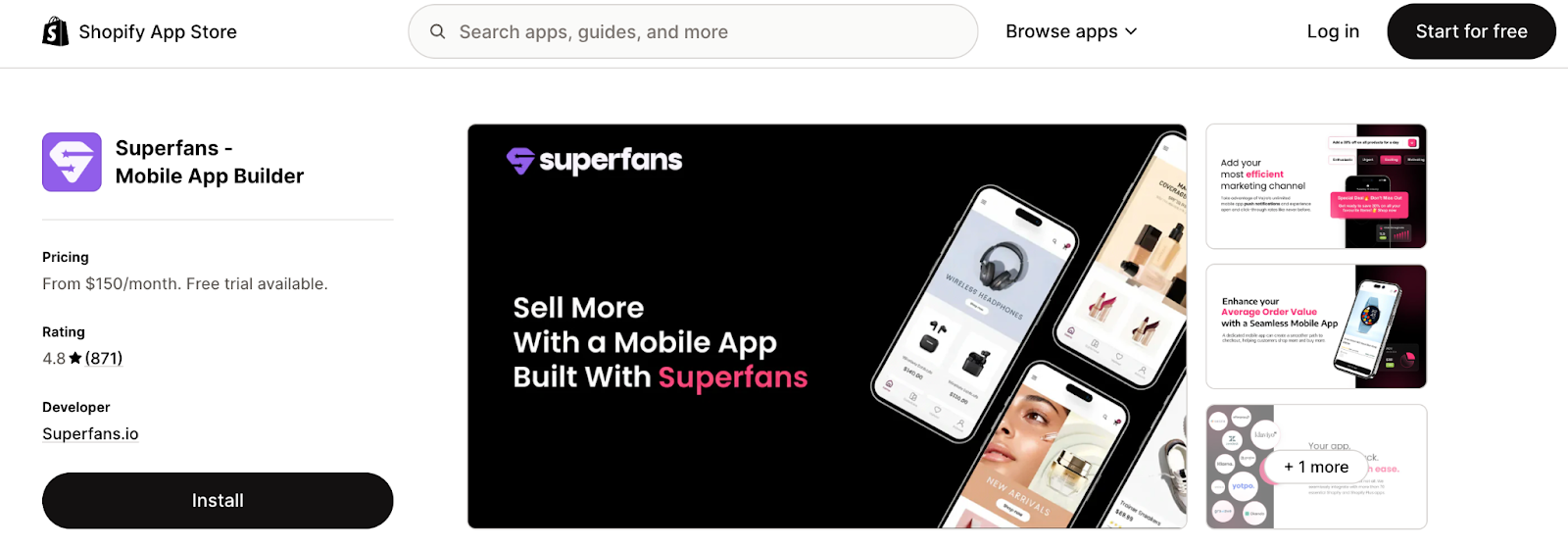
The ecommerce fundamentals are covered: Shopify sync, push notifications, and standard app design tools. Where Superfans is lighter is in deep personalization, advanced analytics, and the kind of AI features that Appbrew has built into its core product.
It's a reasonable option for brands at earlier growth stages or those where live selling is the primary use case. For brands focused on retention, LTV, and systematic personalization, the feature set feels thin.
How to Choose the Best Buildfire Alternative for Your Shopify Store
The right answer depends on what you actually need mobile to do.
Match the tool to your platform
If you're on Shopify, use a Shopify-native builder. Shopify-specific tools maintain integrations actively, support new Shopify features faster, and don't require you to configure your store as an external data source. Buildfire treats Shopify as one integration option among dozens. Shopify-first builders treat it as the only platform that matters.
Think about app architecture, not just features
Native apps built on React Native (like Appbrew's) perform differently than plugin-assembled apps or web-to-app conversions. Load time and interaction feel directly affect whether users come back. Ask builders what their architecture actually is, not just what the marketing materials say.
Match retention tooling to your business model
Subscription brands need native subscription management and integrations to Recharge or Stay AI, not a basic subscriptions plugin. Loyalty-driven brands need deep Yotpo or LoyaltyLion integration. Check whether the integration is native or whether it's configured through Zapier and likely to break.
Weigh implementation cost against team bandwidth
DIY builders like Buildfire require significant internal time to set up, maintain, and iterate. Managed platforms like Appbrew cost more per month but handle implementation and reduce ongoing operational overhead. If your team is already stretched, the cheaper platform often ends up costing more in practice.
Pressure-test the AI claims
Every builder is marketing AI features in 2026. The meaningful question is what the AI actually automates. Does it draft push copy or just suggest subject line improvements? Does it personalize the app experience by customer segment or just show you which banner performed better? Ask for a demo of the specific AI feature, not a slide about it.
Calculate total cost of ownership
Buildfire's $100/month MVP plan comes with a 100-download cap. A plan that looks affordable can become expensive fast once you factor in the tier upgrade you'll need to scale, success fees, and the internal hours required to build and maintain the app. Compare the real number, not the entry price.
The Bottom Line
Buildfire is a capable general-purpose app builder. For ecommerce brands on Shopify, "general purpose" is the problem. You need a platform that was built around Shopify's data model, the ecommerce customer lifecycle, and the retention mechanics that turn mobile apps into revenue channels rather than marketing checkboxes.
Of all the Buildfire alternatives in this list, Appbrew is the one designed to do exactly that. Native app performance, AI-driven personalization, a push notification engine built for retention, and a stack of native Shopify integrations that connects to your existing tools rather than replacing them.
If you're a growth-stage or Shopify Plus brand and mobile needs to drive real numbers, Appbrew is the platform built for that.
See what Appbrew looks like for your brand with a 14-day free trial on the Pro plan.