.webp)

The best AI tools for ecommerce in 2026, organized by category, from customer support and personalization to search and agentic checkout. Compare 30+ tools.
AI now touches product discovery, customer support, pricing, creative, analytics, and checkout itself, and the tools that do each of those jobs well have almost nothing in common.
75% of Shopify store owners already use AI tools, per a 2025 Shopify survey of established merchants. So “use AI” is no longer an edge, it's the baseline. The brands pulling ahead in 2026 are the ones who picked the right tool for a specific challenge and shipped.
This guide is built the way you actually make buying decisions, by the job to be done. Below are 30+ AI tools organized into 11 categories, each mapped to a specific part of your store, updated for the shift that redefined ecommerce in 2026: agentic commerce, where AI agents don't just recommend products, they buy them.
TL;DR
- Customer support is the most mature, fastest-ROI category. Personalization and search are where most stores leave the most revenue on the table.
- The biggest 2026 change is agentic checkout. Salesforce reported that AI and agents influenced roughly 20% of global retail sales over the 2025 holiday season, though far more in service than in completing purchases.
- Two open standards now route AI-driven purchases: the Agentic Commerce Protocol (OpenAI and Stripe) and the Universal Commerce Protocol (Google and Shopify). Most Shopify brands will need to be present on both.
- Your own app and site are the one surface where you keep both the sale and the customer data. On-property AI assistants and merchant growth agents are how brands are defending that ground.
How AI for ecommerce works: the 5 jobs it does
Strip away the branding and AI does five things inside a store. Every category below is a specialized version of one of them.
- It sells. Personalizes what each shopper sees and answers their questions in the moment.
- It serves. Resolves support tickets without a human.
- It creates. Produces product copy, images, and video at catalog scale.
- It prices. Tracks competitors and adjusts in real time.
- It reports. Turns messy cross-channel data into a plain answer.
Hold that map in your head as you read. If a tool can't tell you which of these five jobs it does better than what you already run, it's a demo, not a purchase.
Expert insight
"The people really at risk are the average Shopify ecommerce manager who are not immersing themselves in these new tools. In six months, there's going to be a new standard for expected output. If you're doing the bare minimum, you're about to be out of a job."
Nik Sharma, put the stakes for operators plainly: most are "behind where they should be, and running out of time to catch up," speaking on The Modern Supply Chain in 2026.
The 2026 shift: agentic commerce, AI agents, and agentic checkout
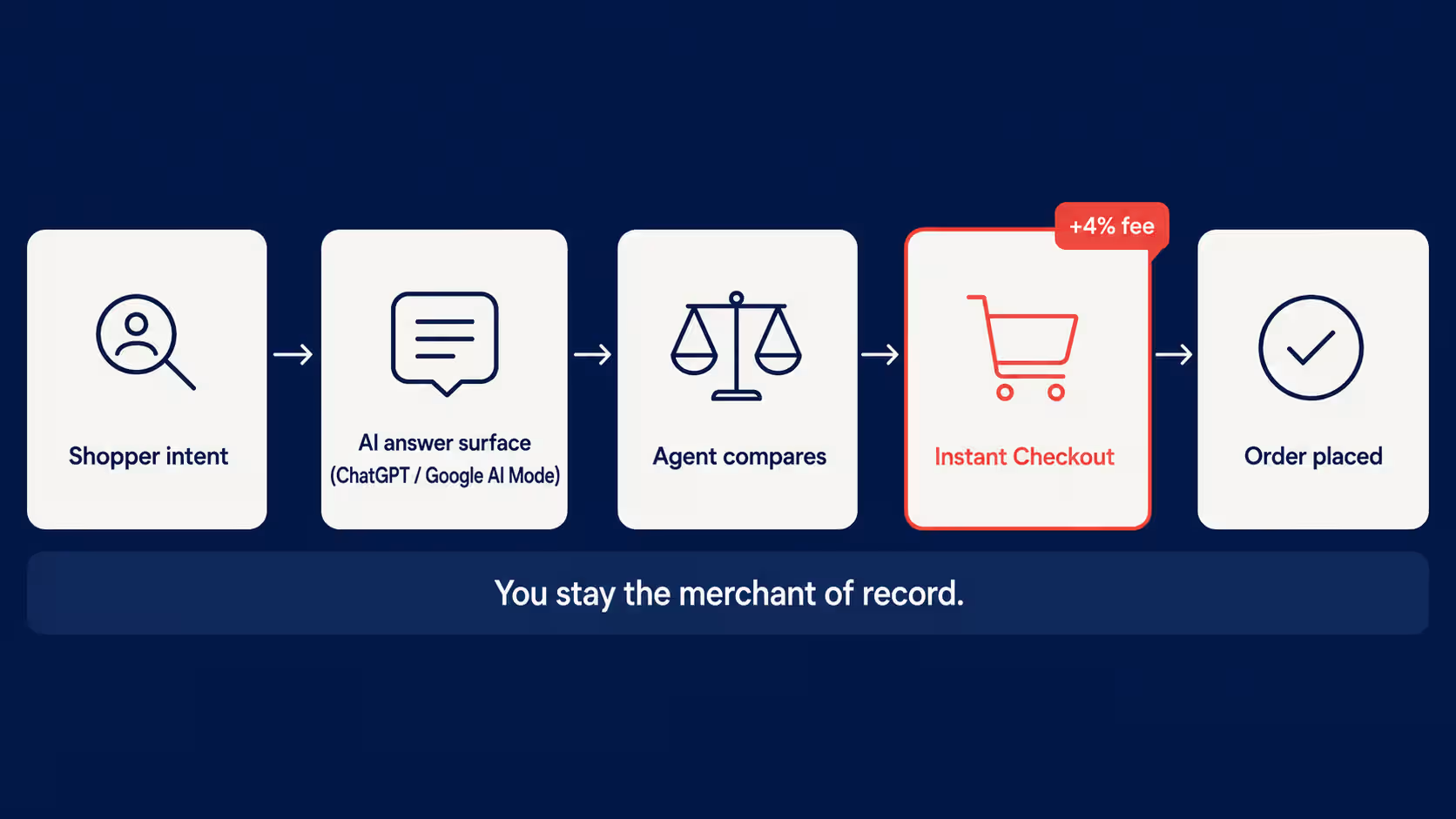
Agentic commerce is a model where AI agents complete shopping tasks, discovering products, comparing options, and checking out, on a shopper's behalf. For your store, it means a growing share of buying now happens on surfaces you don't own, like ChatGPT and Google's AI Mode, before a shopper ever reaches your site. For the full breakdown, see the agentic commerce journey from discovery to transaction.
Here's what actually matters for your store this year:
1. Checkout is moving into AI surfaces.
OpenAI and Stripe's Agentic Commerce Protocol (ACP) launched Instant Checkout inside ChatGPT in September 2025, starting with Etsy sellers and Shopify brands like Glossier, Vuori, and SKIMS. Google and Shopify followed with the Universal Commerce Protocol (UCP) at NRF in January 2026, bringing checkout into Google AI Mode and Gemini.
2. You'll likely need to show up on both.
ACP is built around conversational discovery. UCP is built around high-intent search. Being present on one does not cover the other, and both were designed to keep you as the merchant of record.
3. Clean product data is the real work.
On Shopify, most of the integration is handled for you. The failure point is stale inventory or pricing. A shopper sees a "sold out" banner and understands. An agent hits bad data, gives up, and quietly moves to a competitor. Bad data stops being a ranking problem and becomes a revenue problem.
4. Factor in the fee.
OpenAI charges merchants a 4% fee on completed Instant Checkout orders on top of standard payment processing, roughly $7.20 in combined fees on a $100 order. You win the sale, but you don't own the customer relationship that comes with it.
5. Don't over-invest ahead of behavior.
Salesforce found AI influenced about 20% of global retail sales over the 2025 holiday season, but shoppers used it far more for service than for completing purchases. Amazon sat out both protocols entirely, betting on its own ecosystem, where its Rufus assistant reached roughly 300 million users and drove an estimated $12 billion in incremental sales in 2025.
6. Own your own surface too.
The one place you keep both the sale and the data is your own app and site. Two forms of on-property agent are emerging.
The first is an in-app assistant that lets a shopper describe what they want in plain language, then finds it and walks them to checkout.
The second is a merchant-side growth agent that builds campaigns, personalizes the app, and pulls performance insights from a prompt instead of a dashboard, which is what Milo does. Both keep the customer, and the data, on ground you control.
What is GEO, and does it matter for your ecommerce store?
Generative engine optimization (GEO) is the practice of structuring your content and product data so AI answer engines like ChatGPT, Gemini, and Perplexity cite and recommend you. IIt's the discovery half of agentic commerce. Before an agent can buy from you, an engine has to surface you.
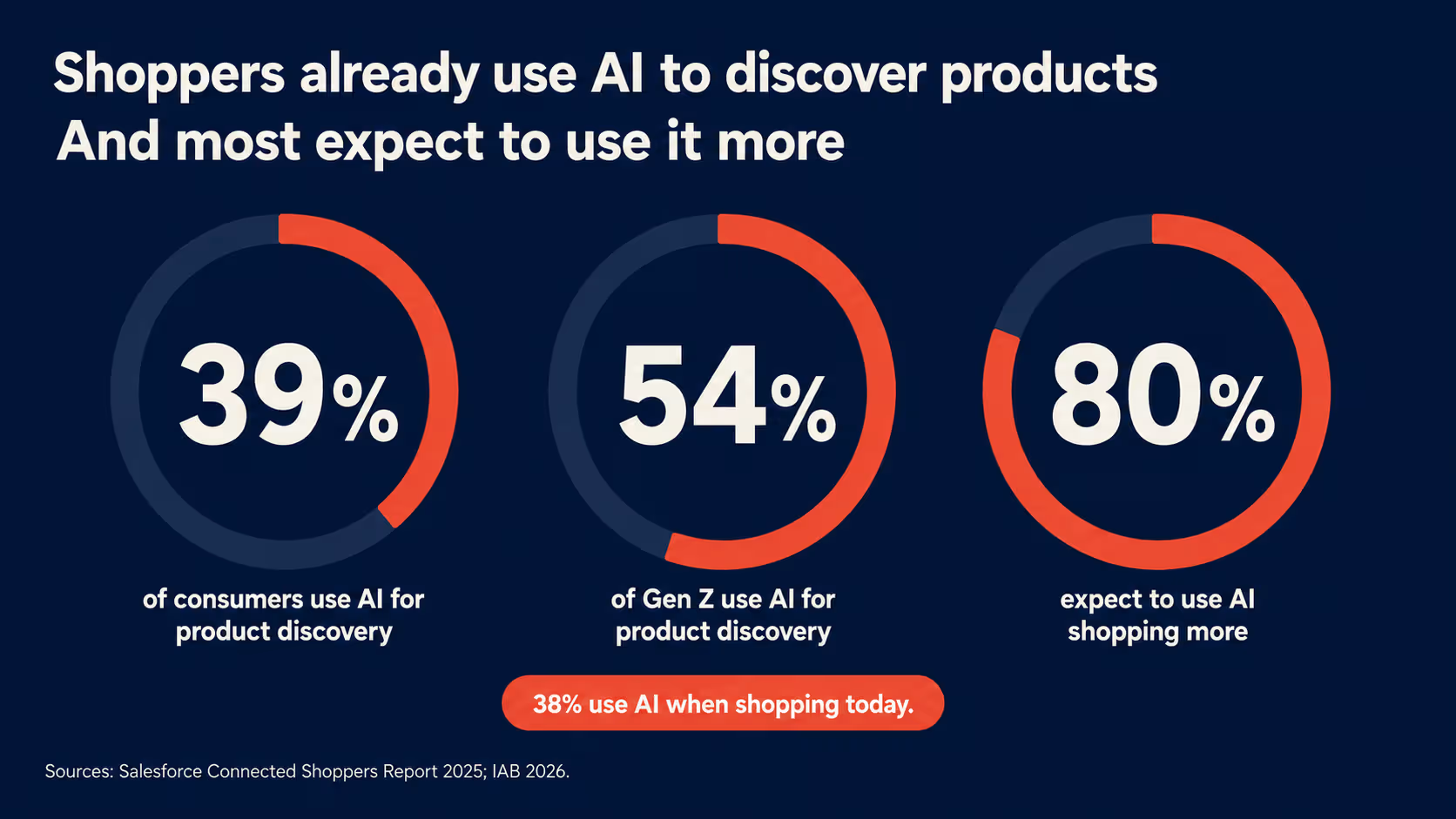
39% of consumers, and 54% of Gen Z, already use AI for product discovery, according to Salesforce's Connected Shoppers Report (2025). The Interactive Advertising Bureau put current usage at 38% of shoppers, with 80% expecting to use AI more, mostly to compare options and get decision support (IAB, 2026).
Expert insight
As shopping shifts from search to AI-generated answers, brands need to show up "not just in search engines, but in answer engines."
Sven Gerjets, CTO of Gap Inc., at Shoptalk 2026.
The mechanics rhyme with SEO but reward different things. AI engines pull from clean structured data, specific product descriptions, and content that answers a question directly in the first sentence. Vague marketing copy and thin category pages get skipped.
Three moves cover most of the upside.
- Keep your product feed accurate and richly attributed, because that's what protocols like ACP and UCP ingest.
- Syndicate reviews and specifics that engines quote as evidence.
- And write descriptions that state facts a machine can lift, not adjectives it will ignore.
GEO isn't a separate tool you buy. It's a discipline that decides whether any of the tools below ever get seen.
AI tools for ecommerce: 30+ best picks by category (2026)
Start with this map, then read the category that matches your current bottleneck. Pricing shifts constantly, so treat the notes as capability signals and confirm current plans on each vendor's site.
{{cta}}
1. Ecommerce AI tools for merchants: copilots and growth agents
This is the newest category and the one changing fastest. Instead of another dashboard, these are merchant-facing agents that run store and app operations from natural-language prompts.
1.1 Shopify Sidekick
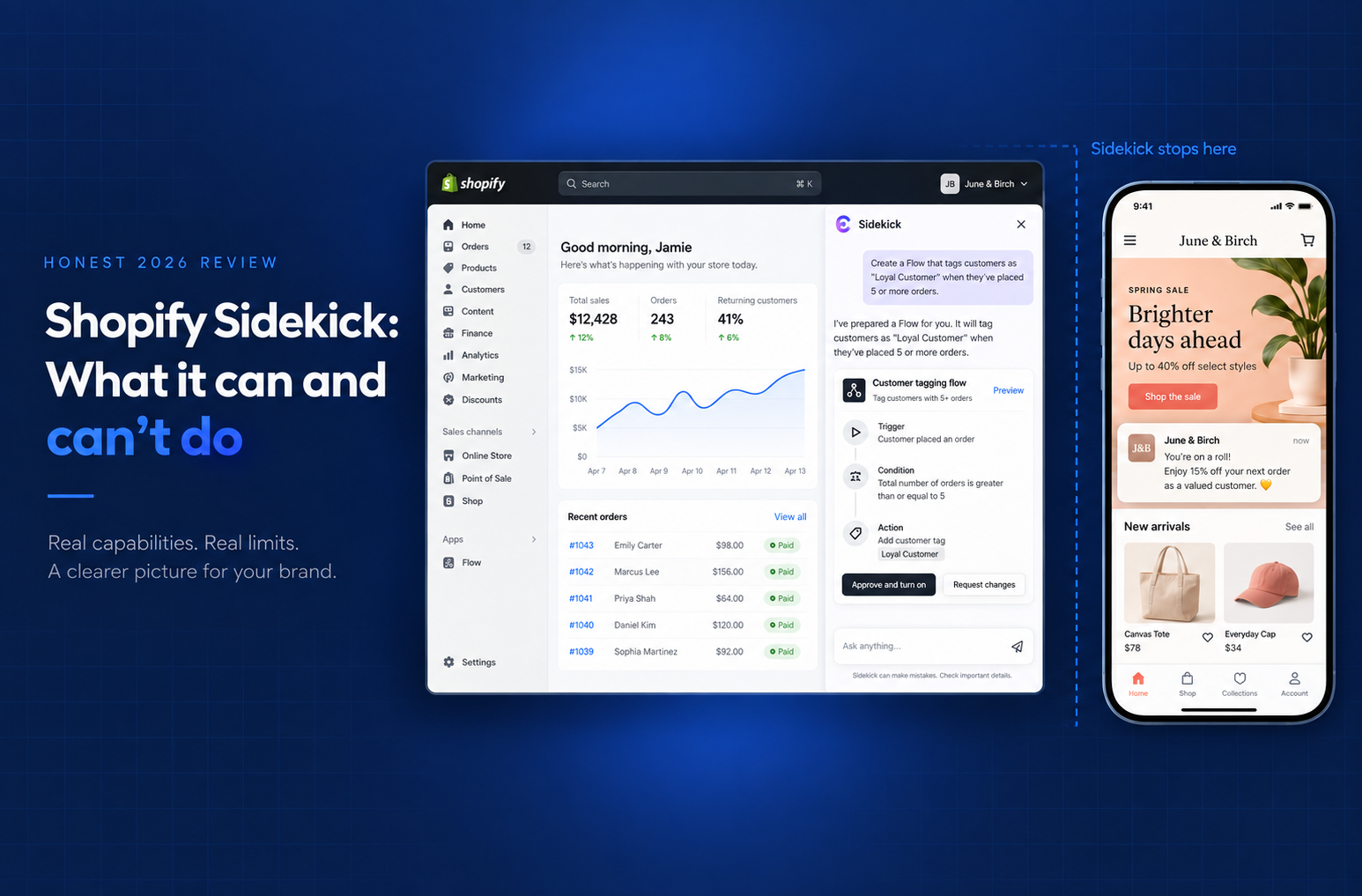
Sidekick is the native admin copilot that handles store tasks and answers operational questions in plain language. It has direct access to your Shopify data, so it can build reports, edit your store, and automate workflows without you leaving the admin.
- Best for: the free starting point for prompt-driven store operations
- Key AI features: conversational admin help, report generation, store editing, app building
- Pricing: free with your Shopify plan
1.2 Milo
Milo is the growth agent for brands running a mobile app. It personalizes app content, drafts and schedules push campaigns, spins up discounts and offers, and surfaces funnel leaks, all from a prompt instead of a settings screen.
You describe the outcome you want, Milo handles the execution logic, which is what lets a marketing team ship app changes without a developer in the loop.
- Best for: Shopify brands running a mobile app as a real conversion channel
- Key AI features: prompt-driven personalization, push campaign drafting and scheduling, offer setup, funnel insights
- Pricing: custom (book a demo to explore Milo)
1.3 Moby
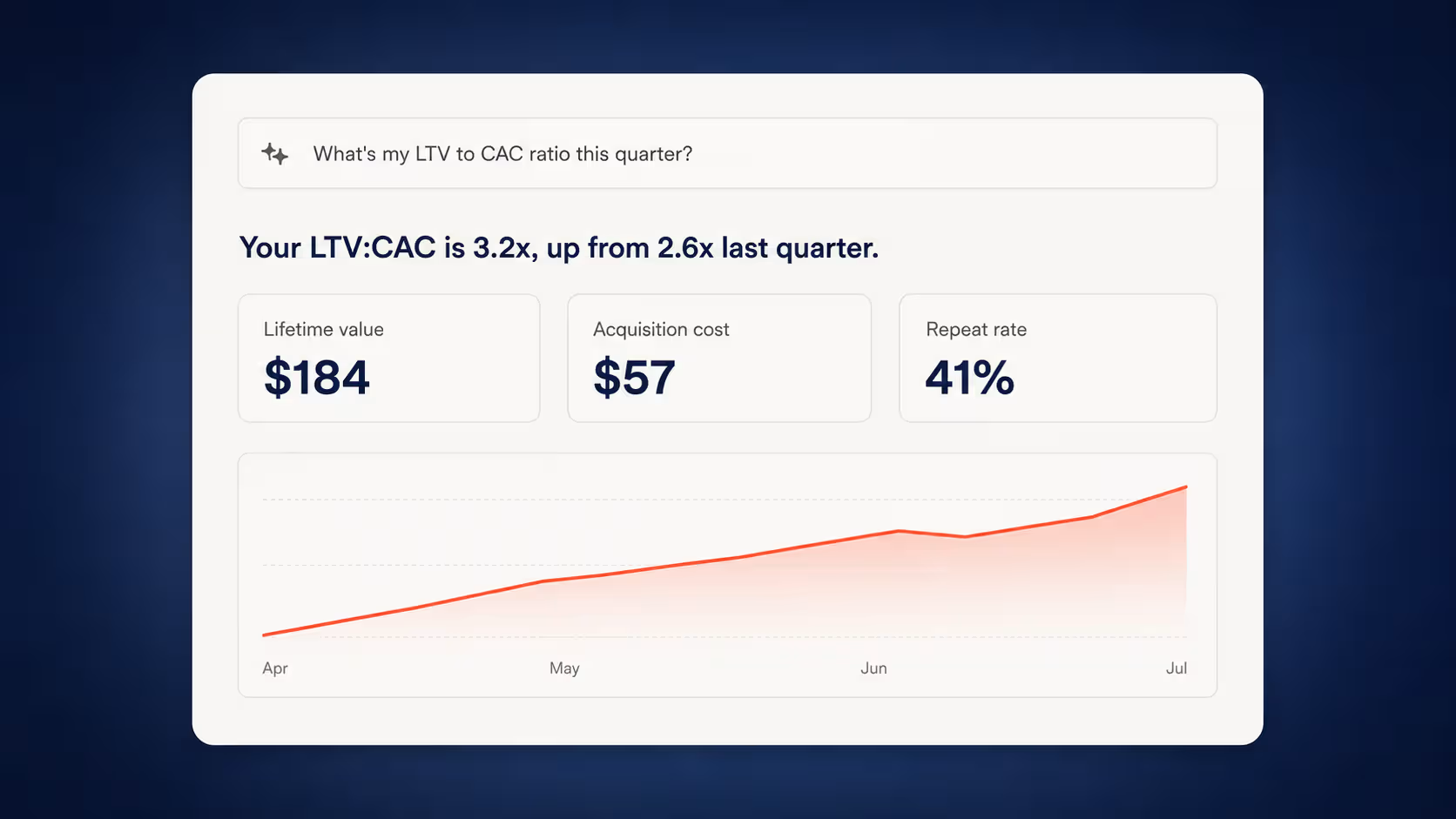
Moby, part of Triple Whale, is the data agent that answers analytics questions in plain English. Instead of building a report, you ask for the metric, and it comes back with the number and the context.
- Best for: brands that want to query their data without building dashboards
- Key AI features: natural-language analytics, forecasting, anomaly detection
- Pricing: included with Triple Whale subscriptions.
1.4 Octane AI
Octane AI runs the quiz side of merchant-facing AI. It builds conversational product quizzes that turn "help me choose" into a personalized recommendation and a captured zero-party data point you can market against later.
- Best for: brands using guided quizzes to personalize and grow their list
- Key AI features: AI quiz builder, zero-party data capture, personalized recommendations
- Pricing: from around $50/mo.
2. Ecommerce AI tools for customer support and service automation
This is the most mature AI category in ecommerce and usually the fastest payback. Modern agents resolve routine tickets end to end (order status, returns, sizing) and hand off cleanly when a human is needed.
It's not a small slice of the workload either: Salesforce found 30% of service cases are already handled by AI, a figure it projects to hit 50% by 2027.
2.1 Gorgias
If you run on Shopify, Gorgias is the helpdesk built for you. It ties every conversation to the underlying order, so your AI agent can act on the order (issue the refund, update the address, check tracking) instead of just describing it. That order context is what separates a real resolution from a deflection.
- Best for: DTC brands that want support tied directly to order and customer data
- Key AI features: AI Agent for autonomous resolution, order-aware replies, automation rules across chat, email, and social
- Pricing: Ticket-based, from $10/mo (Starter, 50 tickets), $60/mo Basic, $360/mo Pro, with AI resolutions billed separately.
2.2 Fin by Intercom
Fin resolves support conversations autonomously and charges you only when it actually closes one. If you're drowning in volume and want a number you can defend to finance, the per-resolution model means cost tracks value instead of headcount.
- Best for: high-volume support teams that want measurable deflection they can budget for
- Key AI features: autonomous resolution, knowledge-base answers, clean human handoff
- Pricing: outcome-based, billed per resolved conversation.
2.3 Tidio (Lyro)
Tidio is the one to test if you're a smaller store not ready for an enterprise contract. Its Lyro AI answers from your knowledge base and there's a genuine free tier, so you can see how much it deflects before you spend anything.
- Best for: small and mid-size stores automating support without a big commitment
- Key AI features: Lyro AI answers, chat automation, visual flow builder
- Pricing: free plan; Lyro AI add-on from $29/mo.
2.4 Yotpo
Yotpo earns a support slot because its AI works the post-purchase window, where a lot of tickets and a lot of repeat revenue actually live. It times review requests, reads sentiment, and turns loyalty and SMS into a retention channel rather than a cost center.
- Best for: brands leaning on reviews and loyalty to drive repeat purchases
- Key AI features: review-request timing, sentiment analysis, AI agents for onsite and content
- Pricing: paid tiers scale by order and message volume.
3. AI tools for ecommerce personalization and product recommendations
Personalization is where most stores quietly lose revenue. These tools read behavioral and purchase signals to decide what each shopper sees, from homepage blocks to "complete the look" bundles.
The appetite is there: roughly four in five consumers are comfortable with personalized experiences and expect brands to offer them (BCG, 2024).
3.1 Nosto
Nosto is the all-in-one pick when you want recommendations, segmentation, and merchandising under one roof instead of stitching three tools together. You feed it behavior, it decides what each shopper sees across the site.
- Best for: brands wanting recommendations, dynamic segments, and content personalization in one platform
- Key AI features: product recommendations, dynamic segments, content personalization
- Pricing: custom (quote-based)
3.2 Dynamic Yield
If your catalog lives and dies on testing, Dynamic Yield gives you experimentation depth smaller tools can't match. It's built for large catalogs that treat every homepage block as a hypothesis.
- Best for: large catalogs that run continuous personalization experiments
- Key AI features: algorithmic recommendations, A/B and multivariate testing, audience targeting
- Pricing: custom (enterprise)
3.3 Rebuy
Rebuy is the Shopify-native workhorse for the money moments: upsells, cross-sells, and the post-purchase page. If you want "customers also bought" logic that actually reads the cart, this is where most Shopify brands start.
- Best for: Shopify stores focused on AOV through smart upsells and bundles
- Key AI features: AI-powered recommendations, smart cart, post-purchase offers
- Pricing: usage-based, from around $99/mo
3.4 Wisepops
Wisepops handles the on-site attention you're already paying for: popups, embeds, and bars that adapt to who's looking. It's fast to deploy on an existing Shopify theme, which makes it a good first personalization win.
- Best for: capturing and converting on-site attention without a heavy build
- Key AI features: targeted popups, personalized recommendations, notification bars
- Pricing: free trial, then paid tiers by traffic
4. Ecommerce AI tools for email, SMS, and lifecycle marketing
Retention math is where profit lives. These platforms use predictive models to time and target lifecycle flows: abandoned cart, win-back, replenishment, and post-purchase.
4.1 Klaviyo
Klaviyo is the category default for Shopify email and SMS, and the reason is data. It has the deepest ecommerce data model of any email tool, which is what powers its predictive CLV and churn scoring.
- Best for: DTC brands that want predictive, data-rich lifecycle marketing
- Key AI features: predictive CLV and churn, AI-generated segments and subject lines
- Pricing: free plan up to 250 active profiles; Email from $20/mo (251 to 500 contacts)
4.2 Omnisend
Omnisend is the faster-to-launch alternative at smaller list sizes. You get email, SMS, and push with pre-built ecommerce automations, so you're not building flows from a blank canvas.
- Best for: stores wanting omnichannel automation without a steep setup
- Key AI features: pre-built automations, product recommenders, send-time optimization
- Pricing: free plan; paid tiers scale by contacts
4.3 Attentive
Attentive is the SMS specialist for brands where text is a primary revenue channel, not an afterthought. Its AI handles list growth, send timing, and message personalization at scale.
- Best for: brands making SMS a core revenue channel
- Key AI features: AI-driven identity and list growth, send-time optimization, personalized journeys
- Pricing: custom (quote-based)
4.4 Postscript
Postscript is the Shopify-first SMS platform a lot of DTC brands run alongside Klaviyo. Its AI copy and audience tools are built specifically around the Shopify customer object, so segmentation feels native.
- Best for: Shopify brands that want SMS built around their store data
- Key AI features: AI text generation, subscriber segmentation, automated flows
- Pricing: from around $100/mo plus usage
The mobile counterpart to email and SMS is app push, which routinely posts higher open and click rates than either. If that channel is on your roadmap, our guide to mobile app push notifications covers the campaign types and timing that actually convert.
5. AI shopping assistants: conversational ecommerce tools
These are shopper-facing agents that interpret intent, recommend products, and guide or complete a purchase in conversation. This is the on-property version of the agentic shift above, and it's where discovery is heading fastest.
5.1 AI Concierge
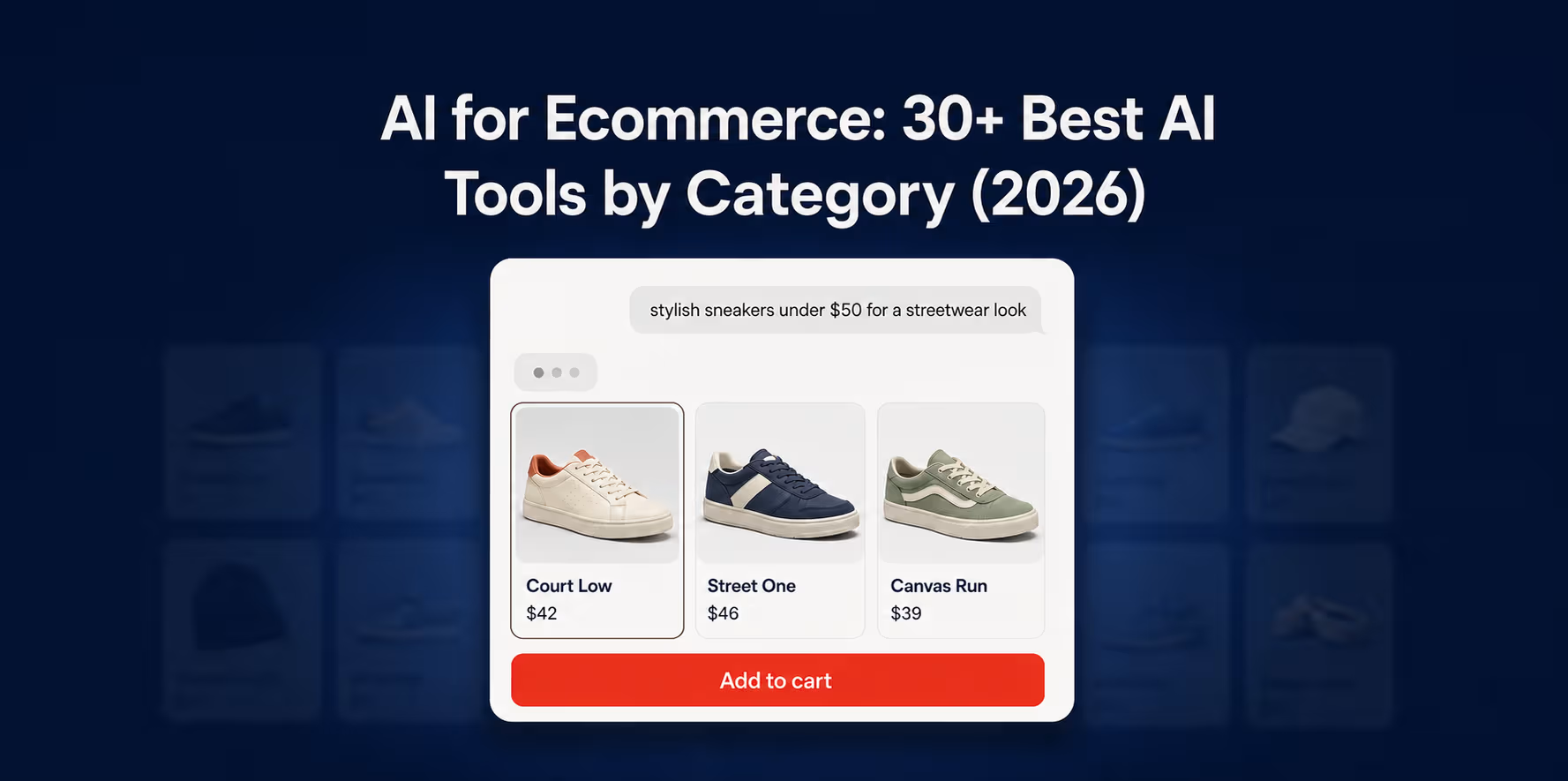
Picture a shopper typing "white sneakers under $50 for a streetwear look" and getting a ranked, ready-to-buy shortlist without touching a single filter. That's what an in-app AI Concierge does: it reads plain-language intent, asks clarifying questions, answers ingredient and sizing queries from your knowledge base, and lets shoppers edit their cart and check out inside the conversation.
It also handles the boring but constant stuff, order tracking, returns, and reorders, so a real share of support never becomes a ticket.
- Best for: brands with a mobile app that want guided, in-app shopping
- Key AI features: intent understanding, product Q&A, styling and bundle suggestions, in-chat checkout
- Pricing: custom
5.2 AI Skin Analyzer
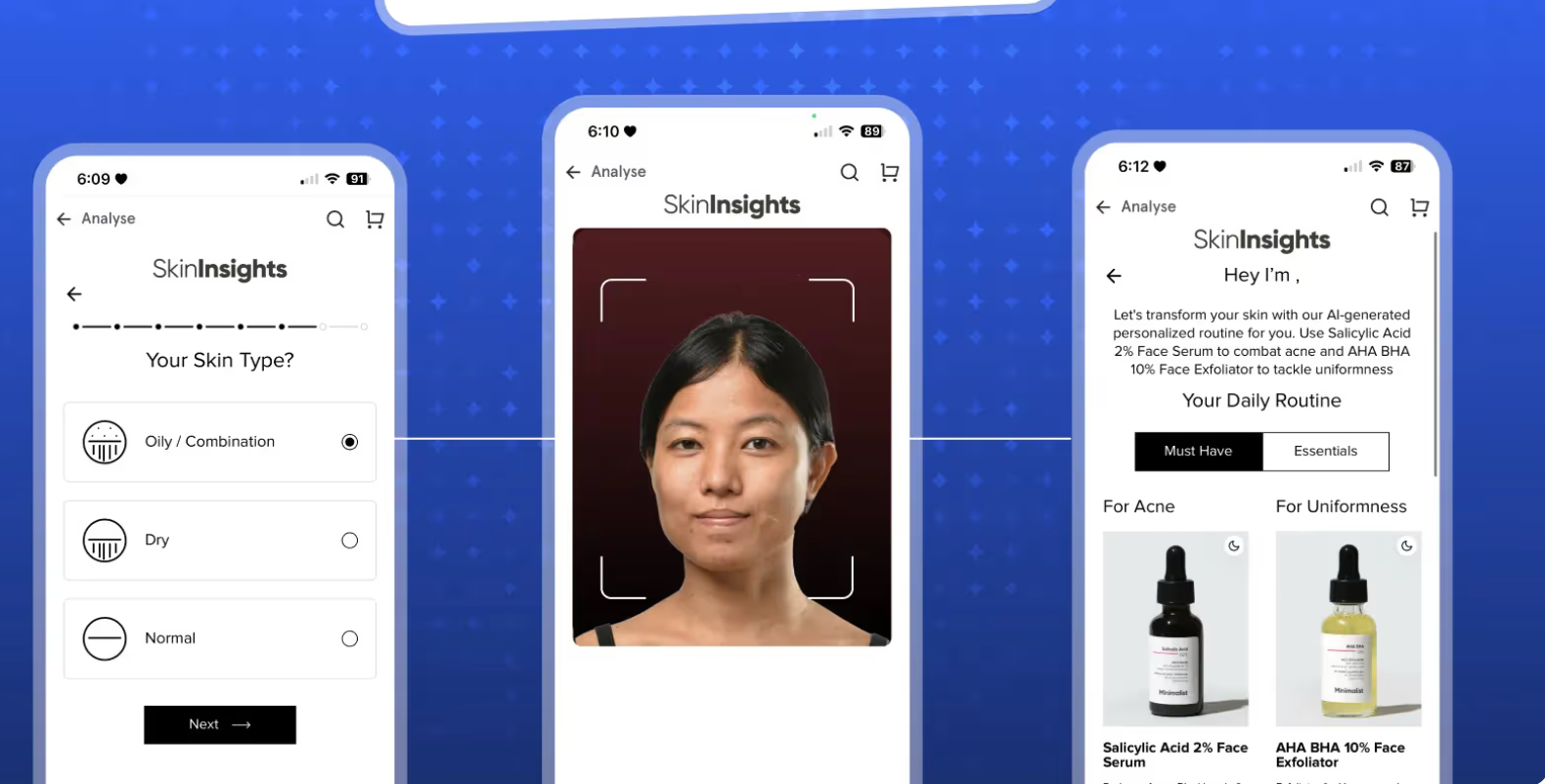
For beauty, skincare, and wellness brands, the AI Skin Analyzer removes the biggest reason shoppers hesitate: they're not sure a product is right for them. A customer completes a quick assessment or captures a camera scan, and the tool reads skin type and concerns, then populates a tailored routine with add-to-cart products.
Brands like Minimalist use it to cut purchase hesitation on products where fit matters.
- Best for: beauty and wellness brands reducing returns and purchase hesitation
- Key AI features: camera or quiz-based skin diagnosis, concern analysis, dynamic product routines
- Pricing: custom (book a demo)
5.3 Rep AI
Rep AI is the Shopify concierge that engages shoppers before they bounce. Instead of waiting to be asked, it reads browsing behavior and reaches out at the moment someone's about to leave, then guides them to the right product.
- Best for: on-site behavioral engagement and cart recovery
- Key AI features: behavioral triggers, guided selling, cart recovery
- Pricing: custom, scaling with store traffic
5.4 Zowie
Zowie blurs the line between answering a question and closing a sale. One assistant spans support and shopping, so the same conversation that starts with "where's my order" can end with a product recommendation.
- Best for: brands that want one bot for both service and sales
- Key AI features: intent detection, product recommendations, multichannel handling
- Pricing: custom (quote-based)
6. AI-powered mobile app builders for ecommerce
Mobile app conversion typically outpaces mobile web by a wide margin, which is why app builders now layer AI for personalization and push.
Native apps built on modern React Native builders regularly convert 3x to 5x higher than mobile web on the same traffic, alongside roughly 30% higher AOV and 6x higher LTV. This category compounds every other tool on this list, because the AI runs inside a channel you fully own.
6.1 Appbrew: an AI-native builder with Milo and AI Concierge built in
The most complete option here isn't a bolt-on. It's a no-code Shopify app builder where the growth agent (Milo) and the in-app shopping assistant (AI Concierge) ship inside the same stack, so the app and its AI layer aren't separate purchases.
Apps are built native on React Native, load in under a second, and the results show up in conversion data: Karma and Luck saw a 50% increase in conversion rate after moving mobile onto a dedicated app.
- Best for: Shopify brands turning mobile into their top-performing channel
- Key AI features: Milo growth agent, AI Concierge, AI Skin Analyzer, AI-personalized home screens, smart push
- Pricing: Starting from $499/mo, free trial available
6.2 Tapcart
Tapcart is the established, templatized builder with a long track record among high-volume Shopify brands. It's a solid choice if you want a proven platform, though the templated approach limits how deep your customization goes. Our Tapcart vs Appbrew comparison breaks down where the two diverge on performance and AI depth.
- Best for: larger Shopify brands wanting a proven, templatized app
- Key AI features: AI content and push features
- Pricing: Core from around $500/mo
6.3 Superfans.io (Vajro)
Vajro targets small and mid-size stores that want a quick app launch, with live-selling features aimed at smaller catalogs. It's a fast on-ramp if a full native build feels like too much for now.
- Best for: SMB brands wanting a quick app launch
- Key AI features: AI-assisted content, live selling
- Pricing: free trial, then paid tiers
6.4 MobiLoud
MobiLoud converts your existing Shopify site into an app by wrapping your web experience, which keeps your storefront and app in sync automatically. The tradeoff is that a wrapped app feels different from a fully native one, and that gap tends to show up in conversion.
- Best for: brands wanting their web storefront mirrored as an app with minimal rebuild
- Key AI features: automated web-to-app sync, push notifications
- Pricing: from around $200 to $350/mo
Before you pick a builder, it's worth seeing what the conversion lift actually looks like in practice. Our guide on turning a Shopify store into a mobile app lays out the numbers and the step-by-step, and our roundup of the best Shopify mobile app builders compares the field feature by feature.
7. AI tools for ecommerce search and product discovery
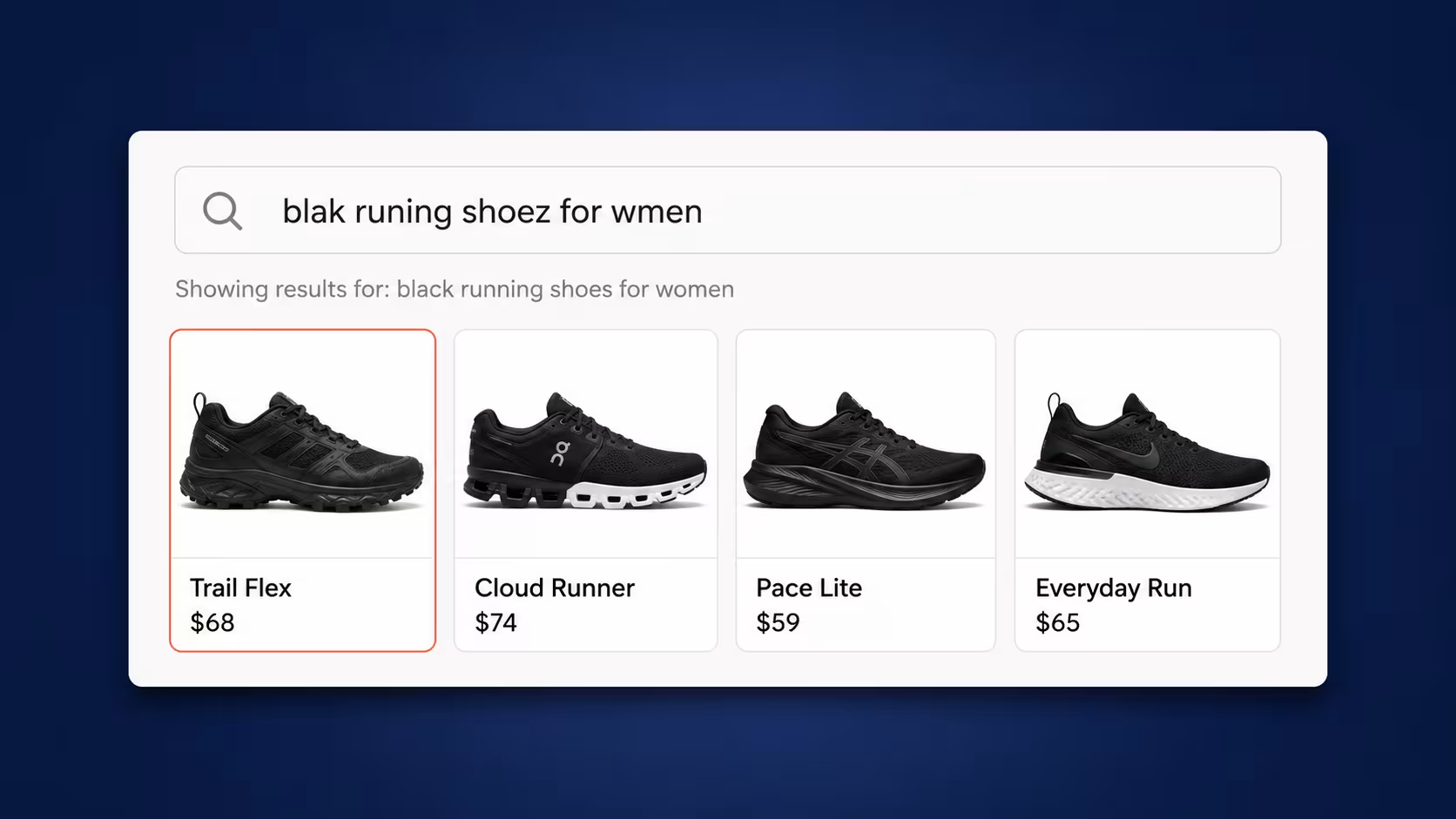
If shoppers can't find a product, no amount of personalization saves the sale. AI search uses semantic and behavioral signals to return relevant results even when the query is messy or misspelled.
7.1 Algolia
Algolia is the developer-friendly default for fast, typo-tolerant search you can ship quickly. Its AI ranking and autosuggest handle the "I don't know exactly what it's called" queries that kill conversion on weaker search.
- Best for: stores that want fast, relevant search without an enterprise build
- Key AI features: semantic search, AI re-ranking, autosuggest, personalization
- Pricing: free tier; paid usage-based
7.2 Constructor
Constructor ranks search and browse for revenue, not just keyword match. For large catalogs where search ordering directly moves money, that outcome-weighting is the differentiator.
- Best for: large catalogs where search ranking drives real revenue
- Key AI features: revenue-weighted ranking, autosuggest, browse optimization
- Pricing: custom (enterprise)
7.3 Bloomreach
Bloomreach pairs enterprise search with personalization and content on one engine, so the same intelligence that ranks results also shapes the marketing around them.
- Best for: larger brands wanting search and marketing on one platform
- Key AI features: semantic search, personalization, content management
- Pricing: custom (enterprise)
7.4 ViSenze
ViSenze lets shoppers find products they can't put into words. Visual search means someone can snap or upload an image and get visually similar items back, which is powerful for fashion, home, and anything style-driven.
- Best for: catalogs where shoppers search by image
- Key AI features: visual and multimodal search, similar-item recommendations, auto-tagging
- Pricing: custom (quote-based)
8. AI tools for ecommerce content and copywriting
Writing product descriptions, ad variants, and email copy across a full catalog is exactly the repetitive work generative AI absorbs well. Content is already the most common AI use case among store owners, with 69% using AI for content generation (Shopify, 2025).
8.1 Shopify Magic and Sidekick
Start here before you pay for anything. Shopify Magic writes product descriptions and store copy inside your admin, and Sidekick answers operational questions and takes action, all included with your plan. Zero setup, because it already lives where you work.
- Best for: the obvious free starting point before adding paid tools
- Key AI features: product description generation, image editing, conversational admin help
- Pricing: free with your Shopify plan
8.2 ChatGPT
ChatGPT is the flexible workhorse for the odd jobs no specialized tool covers: briefs, research, reworking a product page, drafting a launch email. Its range is the point.
- Best for: one-off copy, research, and problem-solving
- Key AI features: general-purpose generation, analysis, custom GPTs
- Pricing: free tier; Go $8/mo, Plus $20/mo
8.3 Jasper
Jasper is worth it when you're producing content at volume and consistency matters. Its brand-voice profiles keep hundreds of assets sounding like the same brand instead of ten different freelancers.
- Best for: teams producing large volumes of on-brand marketing copy
- Key AI features: brand voice profiles, templates, campaign workflows
- Pricing: Pro from $59/mo
8.4 Surfer
Surfer is the pick if organic search is part of your growth plan. It turns a target keyword into an optimized outline and draft, then scores your writing against what's ranking, so your blog and category content shows up.
- Best for: brands treating SEO content as an acquisition channel
- Key AI features: keyword research, AI content generation, on-page optimization, SEO audits
- Pricing: Standard from $90/mo
9. AI tools for ecommerce visual and video creative
Studio-quality product imagery and video used to require a shoot. These tools compress that into software you run in an afternoon.
9.1 Photoroom
Photoroom handles the daily grind of product images: background removal, batch edits, and AI-generated backdrops. The batch processing is what makes it fit a real catalog workflow instead of a one-off design task.
- Best for: cleaning and staging product images at catalog scale
- Key AI features: background removal, batch editing, AI backgrounds
- Pricing: free tier; Pro from around $13/mo
9.2 Midjourney
Midjourney is still the quality bar for generated imagery, which makes it the pick for campaign visuals and concepting where the look has to be strong.
- Best for: marketing visuals and creative concepting
- Key AI features: text-to-image generation, style control, upscaling
- Pricing: Basic $10/mo, Standard $30/mo, Pro $60/mo, no free tier
9.3 Runway
Runway turns static concepts into short-form video without a production budget. Generate from text or an image, restyle shots, and edit footage with text prompts, useful when you need motion for ads and social fast.
- Best for: brands that need video without a production team
- Key AI features: text-to-video, video editing, generative effects
- Pricing: free plan; Standard $12/mo
9.4 Flair.ai
Flair.ai places your actual product into generated lifestyle scenes, so you get staged shots without booking a studio. For brands that need on-brand product photography at volume, it's a real shortcut.
- Best for: lifestyle product shots without a studio
- Key AI features: AI backdrops, product staging, scene composition
- Pricing: free tier; paid plans
10. AI tools for ecommerce pricing and merchandising
Pricing is one of the most powerful levers in a store, and one of the hardest to manage by hand across a large catalog.
10.1 Prisync
Prisync tracks competitor prices and powers dynamic repricing rules without an enterprise contract. If you just need to watch and react to competitor moves, this is the straightforward pick.
- Best for: stores that need to monitor and react to competitor prices
- Key AI features: price monitoring, repricing rules, stock tracking
- Pricing: Professional $99/mo, Premium $199/mo, Platinum $399/mo
10.2 Competera
Competera optimizes prices for margin and demand rather than simply undercutting. Its models weigh elasticity and portfolio effects, so you're pricing for profit, not just matching the cheapest competitor.
- Best for: larger retailers optimizing beyond simple undercutting
- Key AI features: demand-based price modeling, elasticity analysis, portfolio pricing
- Pricing: custom (enterprise)
10.3 Intelligence Node
Intelligence Node delivers real-time competitive and assortment intelligence for larger retailers. If you're managing a deep catalog across markets, its assortment view is the value.
- Best for: larger retailers needing real-time competitive and assortment data
- Key AI features: real-time price intelligence, assortment analytics, MAP monitoring
- Pricing: custom (enterprise)
10.4 Wiser Solutions
Wiser combines online and in-store price intelligence with rule-based repricing, useful for brands that sell across channels and need one view of competitive position.
- Best for: omnichannel brands wanting unified price intelligence
- Key AI features: competitive price monitoring, dynamic repricing, market analytics
- Pricing: custom (quote-based)
11. Ecommerce AI tools for analytics and attribution
The last job is knowing what worked. These platforms consolidate fragmented channel data and answer questions about lifetime value, acquisition cost, and funnel friction.
11.1 Triple Whale
Triple Whale is the DTC standard for attribution and profitability, and its Moby agent lets you ask for a metric instead of building a report. For brands running paid media, it's the clearest read on what's actually profitable.
- Best for: brands running paid media that need clear attribution
- Key AI features: multi-touch attribution, profitability dashboards, the Moby data agent
- Pricing: paid subscription; custom at scale
11.2 Polar Analytics
Polar Analytics gives you unified cross-channel reporting without standing up a data warehouse. If you want consolidated dashboards fast and without engineering, this is the shortcut.
- Best for: teams wanting unified reporting without a data team
- Key AI features: pre-built dashboards, AI insights, cross-channel metrics
- Pricing: custom (quote-based)
11.3 Northbeam
Northbeam focuses on AI-driven multi-touch attribution for brands running serious paid media. When your spend is big enough that attribution accuracy changes decisions, its modeling earns its keep.
- Best for: brands with heavy paid media budgets that need precise attribution
- Key AI features: multi-touch attribution, media mix modeling, creative analytics
- Pricing: custom (quote-based)
11.4 Fullstory
Fullstory shows you the actual behavior behind a conversion number. Session replay and AI-driven friction detection surface exactly where and why shoppers drop off, so you fix the leak instead of guessing at it.
- Best for: finding where and why shoppers abandon
- Key AI features: session replay, funnel analysis, AI friction detection
- Pricing: free tier; paid plans custom
How to choose the right AI tools for your ecommerce store
The fastest way to waste money on AI is to buy a tool because everyone else is talking about it. Instead, treat AI software the same way you'd hire someone for your team. Start with the job you need done, then find the tool that's best at that job.
1. Start with one problem, not one tool
Don't start by asking, "Which AI tool should we buy?"
Ask what's slowing your business down today.
- Too many support tickets?
- Low repeat purchase rate?
- Poor product discovery?
- Hours spent writing product descriptions?
- Reporting spread across five different dashboards?
Once you know the problem, the right category becomes obvious.
2. Look for tools that work with your existing stack
An AI tool is only as useful as the data it can access.
If it can read your Shopify catalog, customer profiles, orders, and inventory, it can usually automate much more than a standalone tool that relies on manual exports. The less context you have to feed it, the better.
3. Ignore feature lists
Every vendor claims to have AI-powered recommendations, automation, or personalization.
Those aren't buying criteria.
Instead, ask what business metric the tool is supposed to improve.
- Support → Faster resolutions and lower ticket volume
- Personalization → Higher conversion rate and AOV
- Email → More repeat purchases
- Search → Better product discovery
- Analytics → Faster, more confident decisions
If you can't clearly define the metric before buying, you'll struggle to measure whether the tool was worth it.
4. Choose tools that save time today, not features you might use later
It's easy to buy software for the roadmap instead of today's business.
A tool that saves your team five hours every week is often more valuable than one with dozens of advanced AI features that never get turned on.
Start with quick wins, then expand your stack as new bottlenecks appear.
5. Think beyond today
AI is quickly becoming part of how shoppers discover products, not just how merchants run stores.
As agentic commerce grows, clean product data, accurate inventory, and structured product information will matter just as much as the AI tools themselves.
The stores that prepare this foundation now will be easier for AI assistants to recommend tomorrow.
AI for ecommerce: where to start in 2026
The honest answer is that no single tool wins, because AI does at least five different jobs in a store and no one product does them all well. What separates the brands pulling ahead is sequencing. They fixed the loudest problem first, measured whether the number moved, then added the next tool, instead of buying a stack they never fully turned on.
For most DTC founders, that path looks like this: automate support where the payback is fastest, then tighten retention with lifecycle marketing, then improve your on-property surface, your app, so the personalization and agents you invest in run on ground you own rather than on ChatGPT's terms. Get clean product data in place underneath all of it, because that's the input every agentic surface reads. The tools change every quarter. That order of operations doesn't.
If mobile is where you want to compound every tool above, Milo and AI Concierge ship inside one native app stack. See what it does for your store's conversion and LTV. Book a demo with Appbrew.
FAQs
What is the best AI tool for ecommerce?
There isn't one, because AI does at least five different jobs in a store. The best tool depends on your bottleneck: Fin or Gorgias for support, Klaviyo for retention, Nosto for personalization, Triple Whale for analytics. Diagnose the constraint first, then pick the category.
What AI tools are used in ecommerce?
The main categories are customer support (Fin, Gorgias), personalization (Nosto, Rebuy), email and SMS (Klaviyo), content generation (Jasper, Shopify Magic), search (Algolia), pricing (Prisync), analytics (Triple Whale), and mobile app growth agents (Appbrew Milo). Most stores run three to five of these, not all of them.
Is there a free AI tool for ecommerce on Shopify?
Yes. Shopify Magic is free and built into the Shopify admin for generating product descriptions and content. Several paid tools also offer free or low-cost entry tiers, including Tidio for support. Start with the native free options before adding paid layers.
What is agentic commerce?
Agentic commerce is when an AI agent completes shopping tasks for a user, including discovery, comparison, and checkout. In 2026 it runs on open standards like the Agentic Commerce Protocol (OpenAI and Stripe) and the Universal Commerce Protocol (Google and Shopify), which let shoppers buy inside ChatGPT and Google's AI Mode.
How is AI used in ecommerce mobile apps?
Two ways. Shopper-facing AI, like an in-app concierge, helps customers describe what they want and guides them to checkout. Merchant-facing AI, like a growth agent, personalizes app content and runs push campaigns from a prompt. Because app conversion usually beats mobile web, both compound quickly.
How much do AI ecommerce tools cost?
It ranges from free (Shopify Magic) to enterprise contracts (Dynamic Yield, Intelligence Node). Support tools increasingly price per resolution, marketing tools per contact or send volume, and agentic checkout adds a platform fee (OpenAI charges merchants 4% per Instant Checkout order).