.webp)
Steve Morales Scaled a Denim Brand from $20M to $50M
.webp)


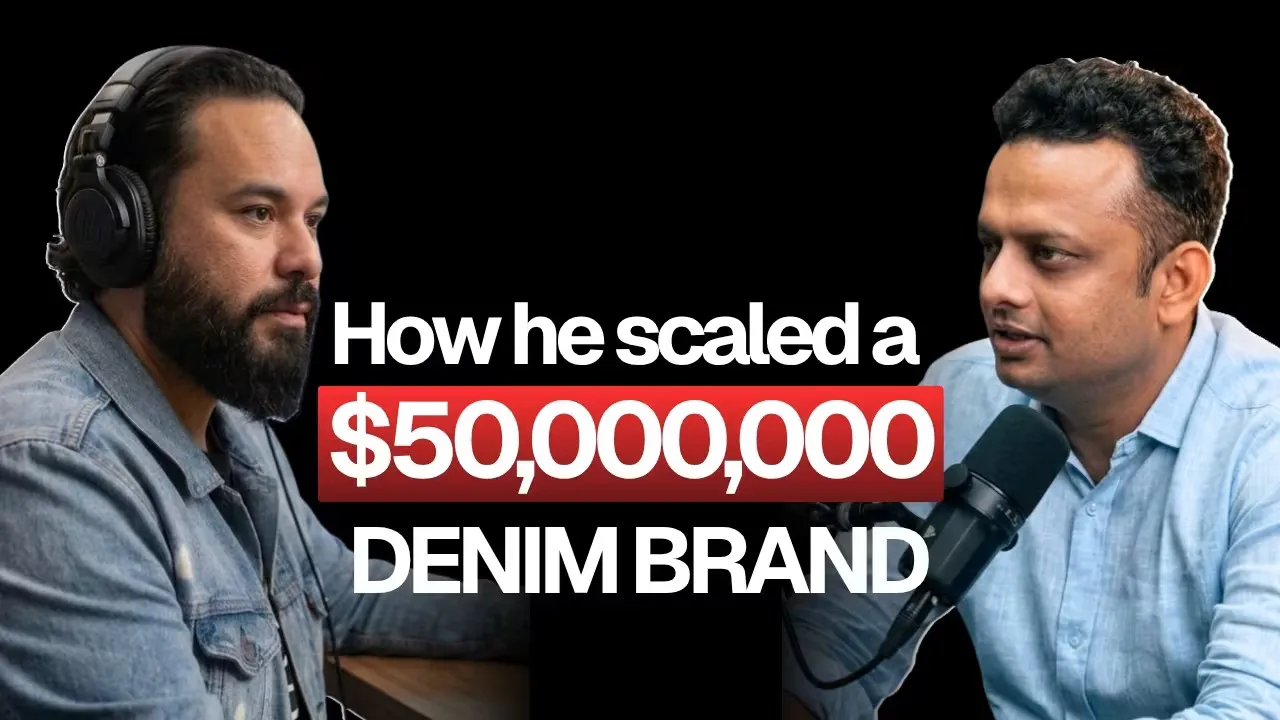
From managing street teams for My Chemical Romance at Warner Bros Records, to scaling Kut from the Kolth from $20M to $50M while cutting the team in half, Steve has spent 20 years learning one thing: the brands that last are the ones that win after the first purchase.
About this episode
Most marketers today are obsessed with one thing. Getting customers. Steve Morales thinks that is exactly why most brands stop growing.
In this episode of Brewed, Steve shares what 20 years across the music industry, Warner Bros Records, the Bob Marley Estate, and some of the fastest growing apparel brands in the world has taught him about growth, retention, and what actually drives revenue.
From building fan communities on MySpace before community was a buzzword, to discovering that the 7 to 14 days after someone buys is your most fragile and most valuable window, this conversation is for founders, marketers, and DTC operators who want to build brands that actually last.
What you will learn
- Why emotional connection beats product features every time
- What building a fan base for My Chemical Romance taught him about brand building
- How he scaled Kut from the Kolth from $20M to $50M with half the team
- The 7 to 14 day retention window most brands completely ignore
- Why app customers have 10x the LTV of web-only customers
- The truth about TikTok Shop profitability that most brands do not want to hear
- How to use customer service calls to fix retention before it breaks
- What separates the brands that survive the next 20 years from the ones that disappear
The complete breakdown
1. The career arc: From Warner Bros to Kut from the Kloth
Steve Morales did not plan to be a marketer. He was weeks away from finishing a computer science degree when a project manager left Warner Bros Records and an opportunity came up. He took it.
What followed was a career that moved across industries the way most people move between jobs. Not by applying. By building relationships.
At Warner Bros, he managed street teams for a relatively unknown band from New Jersey. He watched My Chemical Romance go from playing to 50 people in a room to selling out stadiums. What he learned in that process was not specific to music. It was about emotional connection.
"Whether it be music or fashion, it is really about an emotional connection. If you can tap into what excites people and speak their language, it really could go far."
Every role that followed came through a relationship, never an application. The Bob Marley Estate. Major apparel brands. And eventually Kut from the Kolth, where he has driven 50 percent year-over-year growth for two consecutive years.
2. The real growth engine: What happens after the first purchase
The dominant conversation in DTC marketing is about acquisition. Cost per click. Return on ad spend. New customer growth.
Steve's view is that brands which obsess over acquisition while ignoring what happens after the first purchase are building on unstable ground.
"If you're not building for LTV, you are building on a trap door."
The specific window that matters most is the first 7 to 14 days after someone buys. That is when loyalty is either formed or lost. Most brands have no structured plan for that window. They send an order confirmation, maybe a shipping update, and then wait for the customer to come back on their own.
Steve's approach is more direct. When Kut from the Kolth started seeing a rise in returns around new fit launches, his suggestion was not a tech solution. It was a human one.
"Let's just dedicate two customer service agents to calling all our customers. Let's also give them ten dollars off their next order for getting on the phone and talking to us."
The logic is simple. A customer who tells you why they returned something is worth far more than the return cost. The data they provide shapes every decision that comes after.
3. The truth about TikTok shop
Kut from the Kolth generates tens of millions of impressions on TikTok organically. Customers post try-on hauls without being asked. The community is active and engaged. By every standard metric, it is a brand that should have a TikTok Shop.
It does not have one.
"The hot take here is that no one makes money off TikTok Shop. 80 to 90 percent of your revenue is driven by affiliates and other creators. It does inherently have a much different P&L than your direct consumer does."
The economics do not work. The CFO keeps blocking it. And Steve is honest about the fact that they are likely to launch eventually, not because the numbers are there yet but because a competitor is starting to get traction and the pressure is building.
The more important point is the principle. Organic reach and revenue are not the same thing. A brand can have a massive presence on a platform and still not be able to make money selling there. Understanding the actual P&L of a channel before committing to it is the discipline that separates sustainable operators from brands chasing visibility.
4. The DTC vs Wholesale Civil War
Most brands that operate both a direct-to-consumer channel and wholesale partnerships know the tension. The two sides of the business have different incentives, different timelines, and different definitions of success.
Steve calls it a civil war.
"Wholesale versus direct-to-consumer is the civil war inside of a brand."
His framework for making them coexist: understand what each side is actually good at and stop asking them to do the same job.
Wholesale provides volume, reach, and help with minimums and margins. DTC provides speed, flexibility, and the ability to test new products and fits without the lead times and stakeholder approvals that wholesale requires. DTC is the intelligence channel. Wholesale is the distribution channel. When both sides understand that, the war becomes a partnership.
5. The App Channel Playbook
Steve's view on mobile apps is straightforward: almost every DTC brand should have one. The numbers support it.
Higher conversion rate than web. Higher average order value. No bots. Push notifications that are still free. And an LTV profile for app customers that is significantly better than web-only customers.
The insight that Appbrew's analysis of 2 million app users across fashion brands confirmed: the biggest LTV jump does not happen at the first purchase. It happens at the second.
"All the brands that send customers to an app for their second purchase, over the next 18 months, those customers' LTV is around 10x compared to any other cohort."
The timing question is equally important. Pushing someone to download an app before they have purchased is almost never effective.
"Right after that first purchase. They are here, they got the product, boom, get them into the app. That is where we have seen the most success."
The three metrics Steve watches after a Kut from the Kolth app launch: conversion rate higher than web, AOV higher than web, and monthly active users trending up consistently.
6. The 7 to 14 Day Window Inside the App
The first 7 to 14 days of a customer relationship is the most fragile window. The app experience during that period should not be generic.
A returning Kut from the Kolth customer has already given you data. They bought a specific fit. They have a purchase history. The app experience they see on day two should reflect what you already know about them, not present the same homepage a first-time visitor sees.
"Take advantage of that. Try to personalize the experience as much as possible."
Personalization at this stage does not require complex infrastructure. It requires using the data you already have, which most brands collect but do not act on in the first two weeks of a customer relationship.
7. What Separates the Brands That Survive
Looking 20 years forward, Steve's answer to what will separate the brands that last from the ones that disappear is not a specific channel or technology. It is a discipline.
"It is not rushing to things that are buzzwords or hot trends for the moment. It is really implementing technology in a way that continues pushing your business forward. The ones you know and trust are going to continue building a tool set and working with you. That is really what we are looking for in partners."
The brands that survive will be the ones that make thoughtful technology decisions, partner with people they trust, and build for long-term customer relationships rather than short-term acquisition metrics.
The complete episode transcript
Abhijeet: Welcome to Brewed — a podcast for e-commerce CMOs, brand builders, and marketers who want to know what really goes into building modern brands. Every episode brings you real strategies and honest stories from the people doing the work.
Most marketers today are obsessed with one thing: getting customers. But what if the real game isn't getting customers — it's what happens in the first few days after someone buys? Today's guest has spent over 20 years figuring that out. From building fan communities on MySpace before community was even a buzzword, to scaling a denim brand from $20M to $50M while cutting the team in half. He's doubled revenue at major apparel brands, 3X'd Kut from the Kloth in just two years, and works with companies spending anywhere from $100K to a few million a month on marketing.
What makes him different is how he thinks about growth — not as acquisition, but as retention. Today, we're going deep into powerful insights on LTV, emotional connection, and what actually drives revenue. Plus, we'll get into his journey from Warner Bros. Records to running growth for one of the fastest-growing DTC brands in fashion today.
I'm your host, Abhijeet, CEO and co-founder of Appbrew. We've helped 200-plus brands with their app journey. This is the Brewed podcast. Let's welcome Steve Morales.
Steve: Thanks for having me. Excited to be on.
Abhijeet: Let's start with your origins. You were weeks away from finishing your computer science degree when you dropped out to take a job at Warner Bros. Walk us through that moment — most people just finish the degree.
Steve: I'd started interning at Warner Bros. Records while going to college, also holding down a part-time job. I was 20, so I had the energy for it. When a project manager left, an opportunity opened up. Some people intern there for two, three, four years — especially in departments like A&R. But I was able to get a job offer relatively quickly, and it just felt like the right move.
I'd been studying computer science, but I'd also gone to a private high school where I learned it early — C++, JavaScript, Access databases — so I felt I had a solid enough foundation to take into the workforce. And working in the music industry had been a dream of mine. My father managed bands in the '80s, so I was always drawn to it.
Abhijeet: What was the role?
Steve: I started in grassroots marketing, which eventually fell under new media. Essentially, I was managing street teams — but through a web-based platform. I have a plaque here from My Chemical Romance that I worked with when I was an intern, before their major label debut. They were relatively unknown at the time, and I got to watch them grow in real time.
The role started as traditional street teams — handing out flyers and stickers after concerts. But with my technical background, I was able to bridge that into what we called E-teams. You might have 50,000 to 75,000 people in your network. If you can activate them on message boards, on MySpace, via email — you effectively have an army. We could get a lot more out of those relationships by leveraging them digitally.
Abhijeet: Your first band at Warner Bros. went from playing rooms of 50 people to selling out stadiums. What did building that fan base teach you — about people, and about yourself?
Steve: It really taught me that whether it's music or fashion, it always comes back to emotional connection. If you can tap into what excites people, speak their language, understand what's drawing them to something — it can go incredibly far.
I dug in to understand what was attracting fans to the band, used their language in everything we posted, and got them genuinely excited about it. That said, a lot of it was also just the band — right time, right place, great music, an amazing video that launched on MTV and blew up on TRL, a great radio department. It was a dream team firing on all cylinders. We supplemented that with an incredibly engaged community we were able to activate across the country.
Abhijeet: What was the hockey stick moment? Was there a single pivot point?
Steve: With them, it was actually a couple of back-to-back moments. Out of the gate, their first single — "I'm Not Okay" — really resonated, paired with an amazing video. Then they followed it up with "Helena," which people loved even more. It was emotionally rooted — it was about his grandmother, about loss — and another great video.
Then came The Black Parade, which was a moment for a lot of people. People still know those opening piano keys. Honestly, it was hard to identify just one hockey stick because it was more like a rocket ship — they just kept making the right moves, kept connecting, kept touring. It was multiple inflection points, one after another.
Abhijeet: You built communities on MySpace before "community" was even a buzzword. Tell us about that — how did you figure it out before there were any frameworks for it?
Steve: MySpace was really the first place where people could go and consume everything in one place — a music player, photos, information, all in one hub. And then there was a wall where fans could leave comments, say what their favorite song was, talk about where they were from. But what made it powerful was the shareability. Bands could post bulletins — it was a great marketing tool because there weren't many other ways to communicate at scale. And you'd watch it spread organically. It was a one-stop shop for a community that grew like wildfire.
What I noticed was that people loved interacting with each other, not just with the band. Give people a platform to express themselves and make it two-way — that's really where the energy comes from.
Abhijeet: Every role in your career — from music to Bob Marley's estate to fashion — came through relationships, never an application. What's your approach?
Steve: Just being authentic. And giving more than you take — that's probably my core principle. If everyone operated that way, the world would be a better place. After 23 years in the workforce, I've maintained relationships across multiple industries. I have a good rapport with people I worked with decades ago. And honestly, I'm now in the fortunate position where more people want to work with me than I'm able to take on.
Abhijeet: Tell us about the Bob Marley estate chapter.
Steve: That was a fun one. I was working with Ziggy Marley, who managed everything for the estate — he owned BobMarley.com — alongside his wife, a former William Morris executive who left to help run the estate with him.
What stood out personally was hearing Ziggy talk about his father. I'd lost my own father about two years earlier, so there was something very meaningful about listening to how he processed grief through his faith. Through his religion, they don't really acknowledge death as an ending — they don't celebrate it as a date of loss. Hearing him say he still speaks with his dad gave me a different perspective than I'd had before.
Beyond the personal piece, it was just a privilege working with such an iconic estate — a name that has transcended generations and always carried a positive message.
On a lighter note — Ziggy had written this comic book around a character called Marijuana Man. He decided to make an animated version and actually asked me to come in and record a part. I don't know if he didn't like my voice, but when it was released, he'd replaced me with Pauly Shore. I was a little disappointed, but honestly, pretty funny in hindsight.
Abhijeet: You've said throughout your career — from music to denim — that everything comes back to emotional connection. What does that actually look like when brands get it right?
Steve: It starts with authenticity. People can see through a lot of noise, especially now. One of my favorite campaigns ever was the Dove "Real Beauty Sketches." They sat people down with a forensic sketch artist and had them describe themselves — and then had a stranger who'd briefly met them describe them instead. The two sketches were completely different. More generous. More alive.
What does that have to do with soap? Nothing. But it made me want to go buy Dove soap. That's the power of it.
I think if you have something that genuinely helps people — makes their lives easier, brings them joy, makes them happier — you tie the story into that. Tell the story of why you started. Can people see themselves in you? Do they believe you care? If you can make that connection, it's very powerful.
Abhijeet: When you joined Kut from the Kloth, it was a $20M brand. You're now well on your way to $60–70M — over 50% growth two years running. What inefficiencies did you walk in and see?
Steve: There were quite a few. Having come from a competitor, I had a playbook ready to go. The biggest thing was the tech stack needed a significant upgrade. We brought in a new agency — Brand Co, who are still our agency of record — and they've been central to our growth.
But I want to be clear: the brand's foundation was already strong. They create amazing content. They create amazing product — the jeans are genuinely exceptional. Our designer is obsessive about fit to the point where she won't let us shoot early production samples, even if it would speed up the content process. It has to be true production. I respect that deeply.
So it was really about bringing in the right tech, the right partners. That's how I was able to grow this brand with less than half the staff — by pairing a lean internal team with world-class vendors and agencies. Built versus bought is a real question, and for us, getting into hyper-growth mode meant trusting the right partners.
Abhijeet: The brand drives tens of millions of organic impressions on TikTok — without even having a TikTok Shop. Most brands would have launched one by now. Why haven't you?
Steve: Not for lack of trying. The honest take: no one is really making money on TikTok Shop. We've been discussing it for over a year. We actually just had a major meeting about it again because we've seen a competitor really take off on the platform in the last four months — so we're going back and running the numbers.
The challenge is structural. A significant portion of TikTok Shop revenue — 80 to 90% — is driven by affiliates and third-party creators. That creates a very different P&L than your direct consumer business. And for us, the customers are already there organically. Millions of impressions. People are posting try-on hauls, linking their ShopMy and LTK profiles. The community is active. The pesky CFO just keeps reminding us that the channel math doesn't work yet.
We'll most likely be launching soon. It really comes down to profitability.
Abhijeet: Most of your revenue still comes through wholesale partners — Nordstrom, Dillard's. How do you balance growing DTC without creating friction in those relationships?
Steve: It's a true balancing act. I used to call it the civil war inside a brand — wholesale versus direct to consumer. But at a previous brand, I really figured out how to make them coexist.
It comes down to being open and communicative about each other's needs. Wholesale puts up huge numbers — and when we're working closely with them, it helps our minimums and our margins. On the DTC side, we can test new products, new fits, take risks that wholesale can't — because wholesale has long lead times, multiple decision makers, and you're operating within their constraints.
The relationship works when you understand what each side is actually good at. Wholesale gave us significant reach and brand exposure early — that absolutely contributed to our quick wins.
Abhijeet: You've said that if you're not building for LTV, you're building on a trap door. What does a business that truly builds around lifetime value look like, day to day?
Steve: It looks like putting real time and resources behind engaging your existing customer base. Understanding their wants and needs. Creating multiple touchpoints.
A concrete example: we're currently dealing with a higher-than-expected return rate on some new fits. My suggestion was to dedicate two customer service agents to actually calling customers — not just reading a dropdown return reason, but having a real conversation. Understanding what happened. And then giving them $10 off their next order as a thank-you for their time.
That's what building for LTV looks like day to day. Treating customers like they're giving you their hard-earned money — because they are. If you genuinely respect that, they come back.
Abhijeet: Do you think every serious DTC brand should have a mobile app today?
Steve: Almost every brand should. The proof is in the numbers — higher conversion rates, higher AOV, and push notifications are still essentially free. Across the board, the metrics through an app significantly outperform your website. No bots, more control. If you're genuinely building for LTV and retention, the app should be a no-brainer.
The one exception might be something that's truly a one-time purchase — no repeat business. But if you're building a brand meant to last, yes, everyone should have one.
Abhijeet: How do you think about push notifications relative to email and SMS? How does that user journey evolve?
Steve: We're in an era where you're genuinely fighting for inbox real estate — email, SMS, all of it. And with new iOS updates, that fight is only getting harder. Being able to reach a customer through push is a real advantage.
The mistake most brands make is treating the app download like a top-of-funnel conversion. Someone who hasn't purchased yet isn't looking for a new app. It's just not a natural first behavior. Where we've seen the most success is right after the first purchase — they've experienced the product, they're engaged. That's the moment to bring them into the app. And if you get them into the app for that second purchase, everything changes.
Abhijeet: That's interesting — we ran an analysis across around two million customers in the fashion segment, and what we found was that the second purchase is the inflection point. Brands that route customers to the app for their second purchase see those customers generate roughly 10x the LTV of any other cohort over the following 18 months. App customers also purchase about 20–30% more frequently than web-only customers.
Steve: Great to be validated there. That's exactly what we've experienced.
Abhijeet: You talk about the first seven to fourteen days of a customer relationship being the most fragile window. What should that experience look like inside a mobile app?
Steve: The advantage you have with a returning customer is that you already know something about them. For us, someone bought a specific fit — we offer that fit in multiple washes. So we can immediately personalize the experience around what we already know, rather than starting from scratch the way you do with a first-time site visitor. Take advantage of that data. Personalize early. That's where the loyalty starts to compound.
Abhijeet: When a brand launches an app, what metrics should they actually be watching to know whether it's working?
Steve: The usual suspects — conversion rate and AOV. But also monthly active users; you want to see that growing consistently. The core benchmark is simple: is your conversion rate in the app higher than on your site? Is your AOV higher? If both are true, the app is doing its job.
Abhijeet: Final section — looking ahead. If you had to pitch an AI-native product for marketing teams with billion-dollar potential, what would it be?
Steve: Billion dollars is a high bar — but I'd say it's in content generation, specifically around UGC. We're seeing user-generated content outperform almost everything else in Meta ads right now. And AI is making it possible to take one video shoot and spin out a hundred different versions — different models, different skin tones, different cultural backgrounds — all targeted to different audiences and demographics.
I follow someone on Instagram who can fully transform himself into a celebrity with a snap of his fingers. That kind of capability applied to brand content is enormous. You shoot the original, feed it as a seed prompt, and say: spin off five versions of this. Change the background, the model, the audience. Let the algorithm find what resonates. The brands that figure out how to operationalize that at scale are going to have a significant advantage.
Abhijeet: Two marketers you closely follow and admire?
Steve: I'd say Gary Vaynerchuk — and I'll admit, he annoyed me when he first came out. It felt like he was pitching himself as a motivational speaker. But I've seen him be right on a lot of things, and he's outlasted just about everyone else who was trying to do what he was doing. Right now, I find his thinking on live selling really interesting. He's been pushing it for over a year, and I think he's right.
Second is my friend George Davis, CMO of Cozy Earth. I heard him speak at eTail West and I was really impressed by how deliberately they're implementing AI across every division of the company — not just talking about it, actually ingesting it into how people work.
Abhijeet: Last question. Twenty years from now, when people look back at the brands that survived versus the ones that didn't — what separates them?
Steve: The ones that are embracing technology thoughtfully — not chasing buzzwords or hot trends, but actually implementing tools in ways that push their business forward and optimize how they operate. We're in a fascinating moment where some genuinely disruptive brands have emerged even in apparel — Quince, Comfy, Vuori. But beyond product-focused disruptors, I think the survivors will be the ones who leverage the right technology and partner with the right people.
Over the next few years, I expect even more consolidation in the vendor and tech landscape. The partners that will matter most are the ones you already know and trust — the ones that are continuing to build, continuing to evolve, and invested in your growth alongside their own.
Abhijeet: Steve, this has been a genuinely great conversation — a lot of learning for me personally. Thanks for being on Brewed.
Steve: Thanks for having me. Really enjoyed it.
.webp)

.webp)
%20(1).avif)
.webp)

.webp)
.webp)
.png)