
.webp)
How to Build a DTC Brand? Testing Demand Before Risk
.webp)


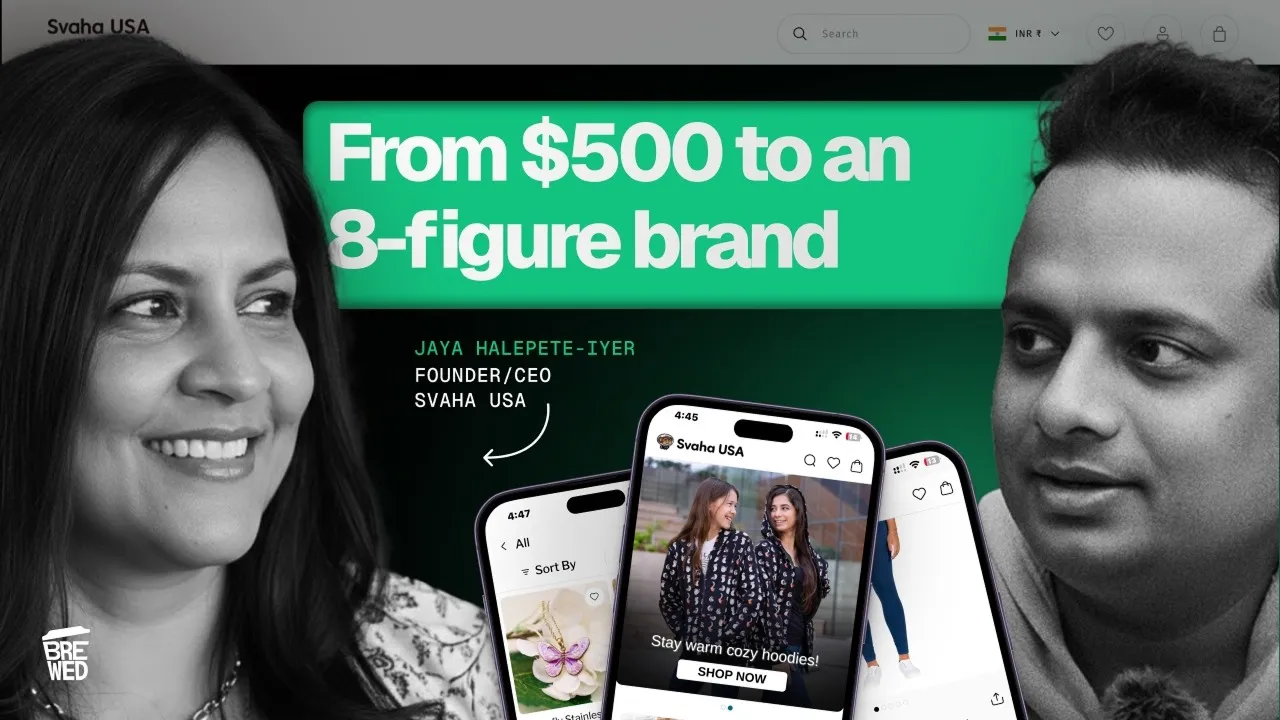
Jaya Iyer shares how a search for better STEAM clothing for her daughter evolved into Swaha USA, and what founders can learn about testing ideas, building with customers, and growing without losing flexibility.
About this episode
Jaya Iyer didn't set out to disrupt the kids clothing industry. She set out to find a space-themed dress for her daughter that didn't come in pink. When she walked into stores and couldn't find anything that wasn't built around gender stereotypes, she did what every good merchant does: she studied the gap, tested the demand, and built the product herself. Starting with five t-shirt samples, a $500 investment, and a Kickstarter campaign, she built Svaha USA into a mission-driven apparel brand serving scientists, educators, and families who want clothing that reflects what they actually care about.
In this episode of Brewed, Jaya breaks down how she validated a product idea with almost no capital, how a government march for science filled her shelves to empty in days, and why listening to customers has been the single biggest growth driver throughout ten years of building the brand.
This conversation is for founders who want to understand what truly organic growth looks like, DTC operators thinking about how to use AI and mobile apps without a large team, and anyone who has spotted a gap in the market and is wondering whether it's worth the leap.
What you'll learn
- The Svaha USA story: from a personal need to a mission-driven brand
- How to validate a product idea with $500 and a Kickstarter campaign
- From zero to first million: the organic growth framework that worked
- Movement marketing: how Svaha USA captured cultural moments at scale
- How a lean team and smart automation scale a fashion brand
- Two ways fashion brands can use AI to save time and grow faster
- The counterintuitive truth about mobile apps for DTC brands
- How to launch, pivot, and survive as a brand founder
- The broader lesson: listen to your customer before anything else
The complete breakdown
1. The Svaha USA story: from a personal need to a mission-driven brand
Walk into any kids clothing store in the US and you don't need to look at the signs. The colors and the prints tell you exactly which section is for girls and which is for boys. Blue and dinosaurs on one side. Pink and flowers on the other.
Jaya Iyer's daughter didn't want pink and flowers. She wanted space.
Jaya had spent years inside the fashion industry, from manufacturing and export houses in India, to fashion buying at Globus, to her PhD in consumer behavior at Iowa State, to buying geeky and science-themed apparel at ThinkGeek in the US. When she stepped back from work to be home with her kids, she carried all of that knowledge with her. And when she looked at what existed in the kids clothing market for a girl who loved science, she saw a gap that none of her professional background could explain away.
"I can't be the only mother who's feeling this. There are so many smart, educated women who want their girls to feel that they can grow up and be whatever they want to be."
That instinct, tested on Kickstarter for $500, became Svaha USA. Ten years later the brand serves scientists, educators, and families across the US and beyond, with clothing designed around the things people are actually passionate about rather than the stereotypes the industry defaults to.
2. How to validate a product idea with $500 and a Kickstarter campaign
Jaya had tried businesses before Svaha. A clothing line brought in from India that didn't sell. Another venture that also failed. The fear of investing money into something nobody wanted was real and informed by experience, not imagination.
So when the idea for Svaha came, she designed the test before she designed the product.
"Kickstarter basically almost tells you that there are more people who want this, or it tells you that nobody else cares. Maybe you don't want to do this."
Her investment to find out was $500. Five t-shirt samples printed at a local printer. A designer friend who made the graphics. A photographer friend who shot the campaign video. Her community, assembled for the purpose, producing a Kickstarter campaign at minimal cost and minimal risk.
The response told her everything she needed to know. Parents of girls who didn't want girly clothes wrote in. Parents of boys who wanted pink t-shirts with race cars wrote in. The gender stereotyping in kids clothing, she discovered, frustrated far more people than she had assumed. The Kickstarter raised $30,000 for the kids line. The women's line that followed raised $75,000.
More importantly, the model meant she never had to produce inventory that didn't already have a buyer. The money raised funded the first production. The production funded the next. The business paid for itself to grow.
"Really, I haven't invested money in the business. It's paid for itself to grow."
3. From zero to first million: the organic growth framework that worked
Jaya didn't build Svaha from a business plan. She built it by listening to what customers asked for and making exactly that.
The five t-shirts became girls dresses because girls wanted dresses. The girls' dresses became women's dresses because mothers wanted to match their daughters. The women's line sold at higher price points and accelerated revenue in a way the kids line alone couldn't. Every expansion came from a customer telling her what was missing, not from a top-down product strategy.
"The best thing that I would say I did was always listen to the customer. So I would keep taking customer feedback and giving them that."
The specific product decisions that came from listening turned out to be as important as the themes themselves. Pockets in every dress because customers wanted them. No tags because the tags irritated skin and damaged fabric when people cut them out. No buttons or zippers, making every garment sensory friendly for customers who needed that. None of these features came from a product roadmap. They came from what people kept saying.
The business crossed its first million dollars during the March for Science, a nationwide movement that emerged in response to concerns about science funding under a new administration. Every major US city held a march. Svaha's shelves went empty. Jaya hadn't planned for it. Nobody could have. But because the brand had been built around exactly the community that cared most about that moment, the demand found them.
"That is like one of the biggest jumps in my business. And after that is what helped us cross the million dollar mark."
4. Movement marketing: how Svaha USA captured cultural moments at scale
Svaha's biggest growth moments have not come from paid campaigns. They have come from being the right brand at the right moment when something in culture shifts.
The March for Science was the clearest example. But there were others. When the Mars Rover landed and deployed a parachute, Svaha had created a dress whose design matched the pattern of that parachute. Science publications wrote about the dress. The audience that cared about the Mars landing was exactly the audience that would buy from Svaha.
"When we created a dress for the Mars Rover landing, it was written about in a lot of publications because the design matched the design of the parachute that was used to land the Mars Rover."
The PR strategy behind moments like these was deliberate: pitch stories to publications whose readers overlap with Svaha's customers. Space.com. Science blogs. Publications that reach educators and researchers and science enthusiasts. The product was designed to be talked about in those spaces, and the press followed.
The Kelly Clarkson Show appearance took the brand to another level entirely, bringing national recognition to a product that had until then grown primarily through community and word of mouth. But the foundation of that growth was the same as it had always been: a brand so clearly aligned with a specific community that the community itself became the marketing.
"A lot of my regular customers ask us for business cards to be shipped with their dresses so they can hand them out to every person who stops them and asks where they got it."
5. How a lean team and smart automation scale a fashion brand
Svaha is a company that surprises people when they find out how small the team actually is relative to the size of the operation. Jaya's answer to that gap is deliberate investment in automation and delegation without micromanagement.
Every function that can be handled by the right tool is handled by the right tool. Picking, packing, and shipping runs on the best-performing app available for that purpose. Paid ads are managed by a freelance marketing team. Accounting goes to a freelance accounting firm. Design work is handled by freelance designers, which has the added benefit of bringing stylistic variety to the product line. The factories in India are managed through scheduled communication at night and early morning, aligned to their time zone.
What Jaya keeps for herself is oversight, product direction, and design briefing. She is the one who brings the idea. The network around her executes it.
"I don't micromanage. As long as the person is getting their work done, I just let them be. And that's what I think all the people who work for me really like."
The approach to time is just as deliberate. Jaya only works while her kids are in school. Once they come home, she is available to them completely. That constraint, rather than limiting the business, has forced an efficiency in how she works that she credits as one of the reasons the operation runs as well as it does.
6. Two ways fashion brands can use AI to save time and grow faster
Jaya has been incorporating AI into the business across multiple areas, but she is clear that the impact varies significantly depending on what you are using it for and who your customer is.
The first high-impact application is the customer-facing chat function. When a customer is on the website and has a question, they want an answer immediately. If they have to email and wait, they have moved on.
"People have very short attention spans these days thanks to social media. Having that chat function that can actually learn from you and be trained to answer customer questions as quickly as possible is one of the best ways to invest in AI."
The second application is planning. For a brand like Svaha, where cultural and scientific events drive real purchasing behavior, having a calendar mapped to relevant moments is a meaningful competitive advantage. Pi Day on March 14. Space milestones. Science awareness weeks. AI makes building and maintaining that calendar faster and more thorough than any manual process could be.
"If I could use AI to plan my entire calendar based on events so that I can make sure that I have a dress for that event for people to buy, those kinds of things, the planning part, I use AI for."
The one area where Jaya holds back is AI-generated creative for ads. Her customer base, she notes, is more skeptical of that than the general population. Knowing where your customer draws the line matters as much as knowing where the technology can help.
7. The counterintuitive truth about mobile apps for DTC brands
Jaya had the same intuition about the Svaha app that most non-consumable brand founders have: her customers buy once or twice, not monthly. Would an app actually do anything for a brand where repurchase cycles are long?
What she found changed how she thinks about the channel.
"When somebody is seeing that logo on their phone every time they open their phone, they are thinking, I like this brand, let me check it out."
The app isn't primarily a purchase accelerator for Svaha. It's a presence mechanism. A customer who has downloaded the app has made a small but meaningful commitment to the brand. And the push notification that comes through a few weeks later, announcing a new collection or a Pi Day sale, catches that customer at a moment when a website ad wouldn't.
"I realized that when people see a notification from us, they actually open it and see what we're talking about."
The caveat Jaya offers is honest: her customer base tends to skew slightly older in terms of app comfort, which affects the total addressable audience for the channel. But for the customers who do download it, the loyalty signal is clear and the engagement is genuine.
8. How to launch, pivot, and survive as a brand founder
Jaya's path from $500 Kickstarter to established brand was not a straight line. COVID removed the ability to get products at all. The response was not to wait. It was to find what was open and sell that instead.
When Indian manufacturing was unavailable, she looked at what China could supply. Not clothing, because she didn't have the right organic cotton supplier there. But bags, umbrellas, socks. Things people would still use at home. And when the N95 mask shortage became acute, she used her supplier network to source masks and ran a fundraiser on the website to donate them to hospitals.
"We started raising money on our website to get more masks and donate them to hospitals, which got us so much goodwill from people that we were trying to help in a very difficult situation."
The brand didn't grow that year. But it stayed alive and deepened relationships with a community that was already loyal. That is the pivot philosophy Jaya recommends to every founder: know when something isn't working, move without attachment to the original plan, and find what you can still do rather than waiting for conditions to return.
"You cannot be stuck in your thoughts. You have to be very open to new ideas and to changes that might make you more successful."
And for anyone still on the fence about starting: the fear of failure is not a reason not to try. It's just a feeling.
"If you believe you have an idea that is something people will actually be interested in, you have to give it a try. Because if you don't try, you'll never know."
9. The broader lesson: listen to your customer before anything else
The thread that runs through every decision Jaya describes, from the first Kickstarter all the way through ten years of building Svaha, is the same: she does not decide what people want. She asks.
The pockets in every dress came from customers. The removal of tags came from customers. The sensory-friendly construction came from customers. The women's line came from customers asking to match their daughters. The decision to expand into bags and accessories during COVID came from reading what was still possible to sell.
Every brand has access to this information. Most brands don't build the feedback loops that surface it consistently or don't trust what they hear enough to act on it.
"From the very beginning, I listened to the customer and gave them what they asked for. And I feel like that is what has been my growth factor."
The companies that launched alongside Svaha in the early wave of girls-in-STEM clothing are mostly gone. Jaya attributes Svaha's survival not to luck or timing but to the operational knowledge she brought and the discipline of customer-first decision making that she maintained throughout.
Ten years in, the approach hasn't changed. The product line has grown. The team has grown. The channels have expanded. But the question underneath every decision is still the same one she started with: what does the customer actually want?
The complete episode transcript
Abhijeet: Welcome to Brewed, a podcast for brand founders and marketers who want to know what really goes into building modern brands. Every episode brings you real stories from the people who are building and scaling brands. Today's guest is Jaya Iyer, a Washington-based entrepreneur. She's the founder and CEO of Svaha USA, a mission-driven apparel brand making themed clothing for kids and adults. Welcome Jaya.
Jaya: Thank you. Thank you for having me.
Abhijeet: I'd love to understand what is your story, and then we want you to dive into the brand story.
Jaya: So I was born and raised in India. I'm a military kid. I lived in so many different parts of India, which was amazing for me as a kid growing up. I was really interested in clothing from a very young age. I started with making clothes for my dolls when I was in about fourth or fifth grade. And my grandmother was a teacher in a tailoring college in the small town I'm from, called Haveri, in the northern part of Karnataka. So I think it was also in my blood in some way to be interested in clothing. I started learning from her. When I went to college, I wanted to study textiles and clothing, which is what I did for my undergrad and my masters at SNDT University in Mumbai. After that I started working in the apparel industry. First in a manufacturing setup where we made denim clothing for kids, which was really exciting. I learned so much about the whole manufacturing process. After that I worked for an export house, so I knew what it was like to make clothes for exports. Then I worked in retail at a chain called Globus, where I was the kids wear buyer. After that I decided I wanted to study more. I moved to the US, went to University of Georgia, did my masters in fashion merchandising. Then because I wanted to be in academia, I went to Iowa State University, got a PhD in fashion merchandising with a focus on consumer behavior. Right after that I started teaching fashion buying at Marymount University in the Washington DC area for five years. Then I took a break because I had my kids, and then I joined the industry again because I realized I did like working in the industry a lot more. I joined a company called ThinkGeek. I was the apparel buyer there, buying very geeky, nerdy, gaming, and science kind of t-shirts, dresses, and pajamas. That's how I learned how to work with an American consumer base. I did that for two years and then I really felt this desire to just be at home with my kids for a little bit. And while I was doing that is where my brand story starts.
Abhijeet: Especially for someone who has been pursuing academia and then moving to a business setup. I read about a story where you were looking for STEM clothing for your kids and that was a moment you figured out you cannot get the type of dresses you want. That was a kind of an aha moment. But what are the fears and the hard decisions as a mom and as someone with a career? What are the most difficult things when you started to figure things out?
Jaya: See, I had no experience of running a business. And Svaha USA was not my first business venture. When I was still studying, I said let me try bringing in some clothing from India and try to sell it. I created a line and brought it over. It was just some tops with embroidery and work on it, but it did not do well. I thought it was pretty, but not everybody else thought the same way. So it failed. After that I tried something else and that also failed. So I feel like the biggest fear, obviously, is the fear of failure. That is one of the main things that keeps people from venturing into businesses, because working for someone feels like the safe bet. You're going to get a salary at the end of the day. But for me, luckily, I felt like I had all the right background. I knew how manufacturing happens. I knew how importing something works. I knew what customers want because of my experience at ThinkGeek. So all of those things helped me get over that part of the fear, because at least I had the background and the knowledge. The second fear is the fear of investing so much of your money and then that money not coming back. When you start a business it does require some financial investment and not everybody has that. I was also one of those people who did not want to spend thousands and thousands of dollars only to take a risk, because I'm generally risk averse. I try to do things when I know something is going to go well. And there was also the fear from my own experience that just because I want something doesn't mean everybody else wants it. Will there be acceptance in the market for the product that I'm so passionate about? These were all the fears I had to deal with before I started. But I think once I had all that in my mind, I said the best way to go about this is to first test it. And Kickstarter is one of the ways that you can test with minimal investment, at least for clothing.
Abhijeet: We saw that for kids you raised about $30K on Kickstarter and for women you raised about $75K. For you, going from academia and offline fashion to reaching customers digitally must have been quite a journey. How was it figuring out demand digitally, and how did you get the idea of testing on Kickstarter?
Jaya: That's a very good question. Not everybody thinks about Kickstarter, especially for clothing. On Kickstarter you see more unique products. But I had a few friends who were my colleagues at ThinkGeek who had just raised over a million dollars on Kickstarter with a product they launched. It was an extremely unique idea. That's where I thought, okay, Kickstarter is a great way to get money before you even have to produce anything. Because the biggest thing is that you produce hundreds of pieces of something and then it doesn't sell. Then what do you do with it? Your money is stuck and you're stuck with a product nobody wants. So when I came up with this idea, when my daughter wanted to wear space-themed clothing and I couldn't find it for her, I said I can't be the only mother who's feeling this. Especially if you walk into a store in the US, you look at the clothes and you know that this is girls' department and this is boys' department just because of the colors and prints. And my daughter was not that kind of kid who wanted that girly clothing. I figured that I can't be the only mother. There are so many smart, educated women who want their girls to feel that they can grow up and be whatever they want to be. And the easiest way for me to test this would be through a Kickstarter campaign, because Kickstarter basically tells you whether there are more people who want this or whether nobody else cares. My investment at that time was very minimal because I started with just t-shirts. Getting five t-shirt samples printed at a local printer was not difficult. I had a friend who was a designer who made the designs. I had a friend who was a photographer who did the photo shoot and made the video. So I got my whole community involved. I probably spent about $500. That's how I started my business. And when I did the Kickstarter campaign, I got such positive feedback: yes, my daughter also does not like wearing girly clothes and I'm so happy you're making this. And it was not just for girls. What if a boy likes pink color but loves race cars? You will never find a pink t-shirt with a race car on it. But I made that happen. So it was just the whole gender stereotype that was quite extreme in the US market at that time. And luckily the money I raised with Kickstarter, I was able to produce whatever orders I had gotten and more. Then I was able to sell more, make more money, and just keep putting it back into the business. That way I didn't really need to invest as much money. Really, I haven't invested money in the business. It's paid for itself to grow.
Abhijeet: So this is a very interesting question. What was your framework for doing the first million dollars and how has that brand framework evolved over time?
Jaya: Obviously I wasn't planning for anything because I started the business because I wanted something and I saw more people who wanted that same thing and I made the product. But for me it has been really organic. The whole growth has been so organic. I started with five kids t-shirts. The next line I made, I said okay there are kids who like to wear dresses. So I added a product line of girls dresses. Then I had multiple customers reaching out to me saying I want to wear the same dress because I want my daughter to feel that my mother also likes dresses with dinosaurs on them. So that is so cool. So then I made a women's dress line, which was the second Kickstarter. And the women's clothing line is the one that really helped me grow the business a lot because kids dresses sell for less and adult dresses sell for more. The best thing that I would say I did was always listen to the customer. I would keep taking customer feedback and giving them what they asked for. For example, people absolutely love the fact that my dresses have pockets in them. And the fact that they are sensory friendly, which means they don't have a tag. A lot of people find tags very irritating. They irritate the skin and sometimes when you cut them out you damage the fabric. So none of my dresses have printed tags. We don't have buttons. We don't have zippers. All those features make a garment extremely sensory friendly. From the very beginning I listened to the customer and gave them what they asked for. And I feel like that is my biggest growth factor. The second thing is that the knowledge I have about apparel has definitely helped me. While I was running my Kickstarter campaign, there were four other companies that also launched similar product lines at the same time. Maybe because there was a lot of the girls in STEM movement going on then. But the fact is that many of those companies are not around today. And I am. And I feel like that is because I had the knowledge. I was not just a mom wanting to make her daughter happy by making her an astronaut t-shirt. And one of the biggest growth moments of my business, which I still clearly credit for the biggest jump in revenue, was the March for Science movement. People who were into science felt very worried about the importance that science was getting because of a new administration where science funding was being reduced. So there was this huge movement. Every big city in the US had a march for science. At that time my shelves were empty. There was nothing left because we didn't know this was going to happen. Everybody who was going to that march wanted to wear our dresses. And that is like one of the biggest jumps in my business. After that is what helped us cross the million dollar mark. And there's been no looking back since then.
Abhijeet: How did people discover you? What framework do you recommend for other fashion brand founders?
Jaya: One of the biggest ways my customers find out about my brand is really organic. It's word of mouth. Because when you wear a dress that is bright and has a unique design, people tend to ask you where you got it from. A lot of my regular customers ask us for business cards to be shipped with their dresses so they can hand them out to every person who stops and asks where they got the dress. So word of mouth is one of the biggest things. Second, for some time we had a PR person who was helping us reach out to small bloggers who would write about us and pitch our stories to publications that resonated with our customer base. We got an article written about us in Space.com, which really helped. Same thing happened when the Mars Rover landed on Mars and we created a dress for it that was written about in a lot of publications because the design matched the design of the parachute that was used to land the Mars Rover. PR is an important piece. We also try to partner with influencers on social media. Sometimes they want to design something for us. Sometimes they just want to wear our dresses because they love them so much they want to share with their followers. We have had some very popular influencers just asking us: I love your dresses, I want to promote this. We do social media ads too. We set aside a budget for Facebook, Instagram, TikTok, Reddit, and Google. We started focusing more on paid marketing in the last four to five years. Before that it was mainly PR and organic reach. And one of the biggest things that also helped was me being on the Kelly Clarkson Show. That was one of those moments that took us to the next level because it was national recognition for the brand.
Abhijeet: It seems like you've perfected the art of movement marketing. As a DTC founder with so many things on your plate, how do you divide your time and manage your team?
Jaya: It's not easy to find the perfect team. I have been through so many people who come and go. But when you find the right people, you want to keep them. You want to do everything that makes them never want to leave. The one thing I do is delegate and not micromanage. If I have given someone a task, I trust they'll get it done and I leave them alone. As long as the person is getting their work done, I just let them be. And that's what I think all the people who work for me really like. I have been lucky to have some core people who are so good that I don't need to question them. And when once in a while things go wrong and I do question them, they don't mind because they know it's not my norm. I'm not doing this every time. Having the right set of people that you can completely trust is what is really, really important. I have a very small team. It's difficult sometimes for people to believe the size of team that we have for the size of company that we are. But we have used a lot of automation and we have started using AI in our business. I'm constantly investing in things that I know will reduce the amount of time taken to do a task. Even simple things like picking from a shelf to ship something, I use the best performing app available for that because I want to make sure people are not wasting their time. In terms of dividing my time, I always keep a part of my morning to make sure that everything in the office is working properly. My customer service team, my marketing team, my merchandising, my photography, my warehouse people. I communicate with my factories in India at night when they are awake or early in the morning when they're available. I have freelancers doing a lot of the heavy lifting. A freelance marketing team handles all our paid ads. Freelance accounting because that's something I don't want to spend my energy on. And freelance designers, because then I get a variety of styles. I work with them on a regular basis, giving them the design ideas, and they create from that. I only work when my kids are in school. After they come back I'm available to them for whatever they need.
Abhijeet: What are the two functions where you think fashion brands can really leverage AI for maximum impact?
Jaya: I think one of the main things is that when a customer is on your website and has a question, they want answers right then. Because they don't want to wait to email customer service and wait for a response. By then they've lost interest in the product. People have very short attention spans these days. So I think one of the best ways to invest in AI is to have a chat function that can learn from you, be trained on your brand, and answer customer questions as quickly as possible. I know you can only train AI for so many things and there's still a human element required. But I feel like that's one of the best ways to invest in AI. And the second thing: I use AI a lot for planning. For my brand specifically, events like Pi Day on March 14 are a big deal. If I could use AI to plan my entire calendar based on events so that I can make sure I have a dress ready for people to buy on that day, those kinds of things. And even beyond events, just being able to research and plan your social media strategy. AI is amazing for that. It really is a time saver.
Abhijeet: What is a surprising story or counterintuitive learning you have about apps as a channel?
Jaya: The obvious thing is that when somebody sees that logo on their phone every time they open their phone, they think, I like this brand, let me check it out. So that was one of the main things. It helps build loyalty, which is what a lot of people get apps for. But the other thing is that people spend so much time on their phones right now. Us being able to give them that little nudge to go to our brand, we realized how much that actually helps in making people open the app. Because I have four pages of apps on my phone. The shopping app might not be on my main screen so I might not look at it. But if I get a reminder saying we have a new sale, I do tend to click on it, especially if I already have the app because I like the brand. It might not be top of mind always, but that little nudge makes people open it more and then obviously take a look. And when you look, you tend to think, okay, let me make this purchase. I feel like that really helped us. I do feel like my customer base is slightly older in terms of people who are comfortable with using apps, which might be a slight limitation. But having an app and being able to get more eyes on your products has just been incredible.
Abhijeet: As a founder, how do you juggle between the business and family? There must have been sacrifices.
Jaya: Yes, in the beginning it was not easy at all. I started with all the products being in the basement of my house because I couldn't afford a warehouse. My whole basement was divided by size with piles of t-shirts everywhere. My kids have seen me working really hard. Before Christmas, I was in the warehouse until midnight trying to ship orders because we didn't have a proper system in place yet. Things you cannot afford when you're early and budgets are tight. I would even go and pick up shipments, load boxes into my car, and bring them home. My kids have seen all of that. There have been times when my kids were unwell and home but I still had to go to the office, so I took them with me and made them sit in one corner while I got work done. You cannot be a founder and not do the heavy lifting. You have to do it in the beginning. And I think the only way you can survive through all of this is if you are able to do time boxing. I'm able to do that quite well because I set aside the time in my day where I will not be working. I make a to-do list at the beginning of the day and make sure all of it is checked off before I finish. That way you know you have been efficient. Those are the things that really help me, especially when you're starting out.
Abhijeet: What would be your advice to somebody starting a brand now?
Jaya: The first thing I always tell everyone is that if you believe you have an idea that is something people will actually be interested in, you have to give it a try. Because if you don't try, you'll never know. The fear cannot be a factor that stops you from trying something new. Have the faith. Believe that it will be something other people want and then go for it. Give it your all. The other thing is the ability to pivot. To say that something is not working, know that it's not working, and then be able to go in a different direction and see if something else works. For example, my business went through the whole challenges of COVID. We were not able to get products at all. But we were able to figure out what markets were open. When everything else shut down, China had opened. We started getting products from China that were not clothing. Bags, umbrellas, socks. Things people would still use at home. We also started raising money on our website to get N95 masks and donate them to hospitals, which got us so much goodwill from people. We were trying to help in a very difficult situation where our business struggled too because people don't need to buy clothes if they're not going out of the house. The ability to switch track so that we could still continue selling and still continue making something is very important. You cannot be stuck in your thoughts. You have to be very open to new ideas and to changes that might make you more successful.
Abhijeet: Any two founders or brands you really admire?
Jaya: There's one founder, her name is Bloggy Lattice. If you want to learn how to do social media well, you have to learn from that founder. It's all plain clothing but it's all made to meet a need. Somebody didn't find something and so she made it happen. And it resonates so much with the younger population, teenagers and people in their 20s. They absolutely love her products. I would say she is a social media marketing guru. I have never tried the product but I admire how well they do that. And when it comes to clothing and the ability to really get it right, obviously it's a much larger company, but it's called Boden USA. I think it's a UK-based company. The founder is Johnny Boden. The way they present their clothes on their website, the prints, the quality. They do everything right. I constantly look up to them for what else can I learn.
Abhijeet: What is your advice for SaaS founders and tech companies who are building for brands?
Jaya: There are so many apps that we use. The Shopify platform is built in a way that you end up having to use a lot of apps to meet your needs. But a lot of times the app developers don't understand the business and the challenges that a business has. They just feel like, we are providing the service. But there are so many small little things that are missing. As a tech person who wants to develop apps for a website, I think it's very important to work with or talk to a person who actually runs the business to understand the pain points. See all the possible scenarios that can come up. And if you're focused on, let's say, an apparel brand, then I think it's very important to understand the specific pain points of that category. So often we feel like, I wish this app also did this because it would make life easier, but it doesn't. I feel like to partner with a real company to develop something is very important because then you're really addressing all the pain points and you're going to be successful.
.webp)

.webp)
%20(1).avif)
.webp)

.webp)
.webp)
.png)