.webp)
Building a Size-Inclusive Brand that Fashion Ignored
.webp)


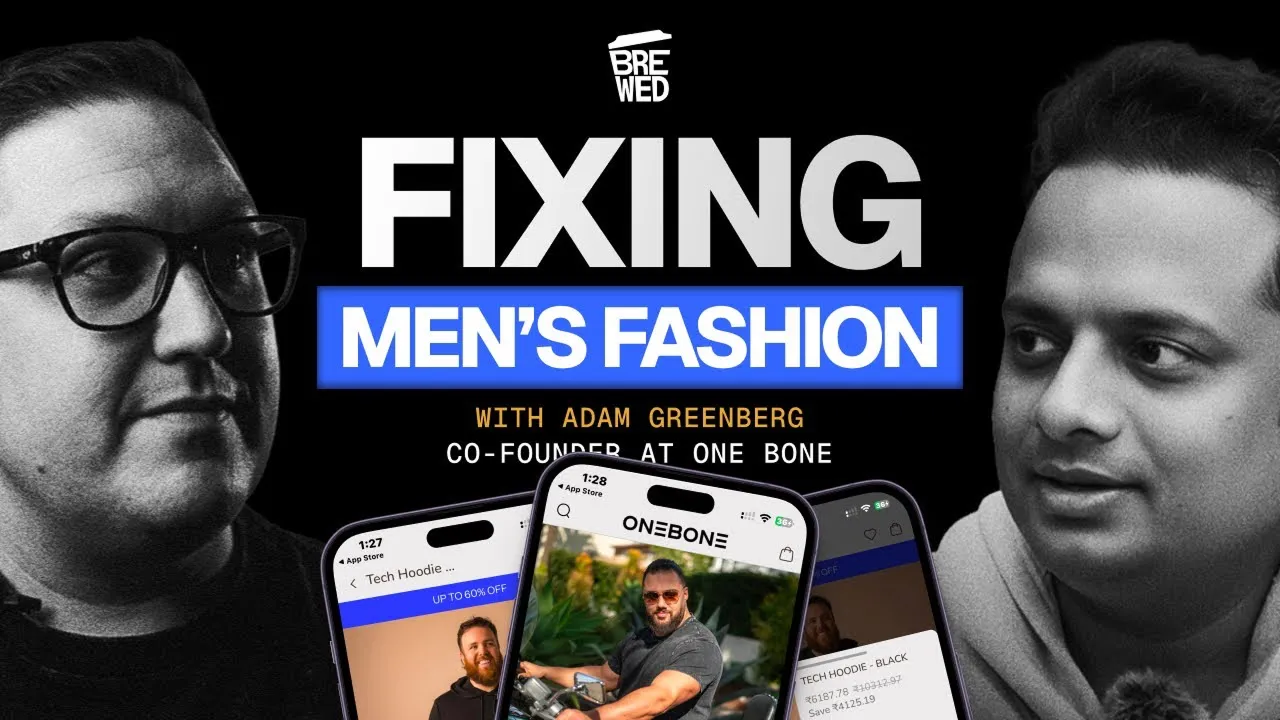
Adam Greenberg shares how a personal struggle with fit turned into One Bone, a size-inclusive apparel brand, and what founders can learn about community, experimentation, and building with conviction.
About this episode
Adam Greenberg is a Montreal-based entrepreneur, DJ, radio host, and co-founder of One Bone.
One Bone is a size-inclusive men's apparel brand built for the guy fashion forgot. What started as a custom clothing solution for a touring DJ who couldn't find clothes that fit on stage became a brand built around community, confidence, and radical inclusivity.
In this episode of Brewed, Adam breaks down how OneBone went from zero paid ads and 500 Instagram DMs to a brand that's changing how men feel about themselves. He talks about why perfection is the enemy of momentum, how a typo in an AI ad became a community-building moment, and why the most powerful thing an app can be is not a storefront but a hub.
This conversation is for founders who are tired of waiting until everything is perfect, brand builders trying to understand what real community looks like, and anyone who's ever felt invisible in a space that wasn't built for them.
What you'll learn
- The One Bone story: how a DJ who couldn't find clothes built a movement
- The gap fashion ignored: why size inclusivity is just inclusivity
- Why perfect is the enemy of done
- When typos build communities
- Apps as community hubs, not marketplaces
- The browsing behaviour that changes how you think about apps
- 500 DMs, zero ads: the pre-launch community playbook
- The customer story that defines what One Bone is really about
- Every loss is a win
The complete breakdown
1. The OneBone story: how a DJ who couldn't find clothes built a movement
There's a list of the highest-selling t-shirt sizes. It starts with large, then medium, then XL, then extra small, then double XL — and then it stops.
The guy who wears above a double XL doesn't appear on the list at all. He doesn't exist in the data, and for most of fashion history, he hasn't existed in the stores either.
Adam Greenberg is that guy. Six-three, around 300 pounds, touring as a DJ — and unable to find clothes that matched the confidence he had on stage. So instead of accepting the gap, he found a seamstress, had his own shirts and pants custom-made, and showed up on stage looking exactly how he wanted to look.
That personal solution became OneBone. Adam had the problem. Matt and Sam — childhood friends he'd grown up alongside for thirty years, whose father had been in women's plus-size clothing manufacturing since the late eighties — had the business instinct. The father saw Adam at an event, asked where he got his shirt, and heard the answer. His response was immediate: call me tomorrow.
A year of testing fabrics, developing fit patterns, and building the foundation of what OneBone would become followed that phone call.
2. The gap fashion ignored: why size inclusivity is just inclusivity
Before OneBone, Adam would walk through the mall, touch the clothes, and know immediately that none of them could fit him. Not as a guess — as a certainty. The specialty shops that claimed to serve bigger men weren't much better. The fit wasn't dialled in. The styling skewed either toward retirement or toward something a child might wear. There was nothing for the mid-thirties, mid-forties man who wanted to show up somewhere and be seen for the right reasons.
"How do you think a guy feels when they're not even on the list? They're not included in any way, shape, or form. It makes you feel worse about yourself. It lowers your self-esteem. It lowers your confidence level."
The vision behind OneBone isn't a product category. It's a correction. The clothing industry made a series of decisions about where sizing ends, and everyone above that line was quietly told they don't belong in fashion. OneBone's entire existence is a rebuttal to that decision — and the response from customers has made clear just how long people had been waiting for it.
3. Why perfect is the enemy of done
OneBone is going through a rebrand. New photography, new benchmarks, a new creative direction. And with that comes the pull toward getting everything exactly right before putting anything out. Adam's take on that instinct is worth internalising.
"If you're striving for perfection and you're only waiting for that, you're never going to put out anything. You're never going to release a product, create an ad, create a piece of content. Nothing will exist."
The goal of perfection is worth having. The insistence on achieving it before shipping is what kills momentum. The path to getting better is putting things out — and each iteration moves you closer to a level of quality that, by the time you reach it, will have been replaced by an even higher standard anyway.
The music analogy Adam keeps returning to is the right one. An artist in the studio can believe with complete conviction that a song is a hit. But they have no actual way of knowing. The audience decides. The audience shares it, or they don't. The same is true for content, for ads, for product decisions. You can have a strong instinct. The only way to find out is to put it in front of people.
"By the time you put those things out and achieve that level of perfection you had six months ago, your new level of perfection will be far superior."
4. When typos build communities
One of OneBone's ads — AI-generated, containing a typo — became an unexpected community moment.
Someone noticed the typo and called it out. Someone else responded: who cares about the typo? Have you tried the shirt? The shirt is incredible.
That exchange happened publicly, in the comments, in front of everyone watching.
"If you didn't have that typo, that interaction wouldn't have happened. Somebody wouldn't have hated on that. And then somebody who is essentially a brand ambassador wouldn't have chimed in and said: don't worry about the typo, get the shirt — because the shirt will change your life."
The typo didn't hurt the brand. It created a moment of authentic advocacy that no amount of polished creative could manufacture. Mistakes, handled correctly, are community-building opportunities. The only mistake that costs you is the one you never shipped because you were waiting for it to be perfect.
5. Apps as community hubs, not marketplaces
The way most brands think about their app: a faster, frictionless version of their website. A place to browse and buy. Adam thinks about it differently.
"To think that a customer is going and shopping from your brand every single day is completely out of the question. But to know and understand that somebody could be interacting with your brand every single day without it being intrusive — that's very cool."
A customer who opens the app to check what's new, to browse outfit inspiration, to see what the community is talking about — that customer is building a relationship with the brand that goes beyond transactions. The app becomes a destination rather than a checkout. And that distinction changes everything about how loyalty compounds over time.
For OneBone, the vision is explicit: the app as a 360-degree community hub, not just a marketplace. Push notifications that feel like a message from a friend, not a promotion. Content and community sitting alongside commerce. The kind of daily interaction that email and SMS can't achieve without feeling intrusive.
6. The browsing behaviour that changes how you think about apps
The metrics most brands expect from an app customer are intuitive: higher AOV, higher order frequency. Those are the standard assumptions.
What Adam didn't expect was the browsing — the regularity with which app customers open the app not to buy anything, but simply to check what's there.
"I think back 20 years to when I had those lists of blogs and websites that I'd get home from class and load up to check everything and see what's new. We've lost that to social media. But with an app, people are going and checking regularly — and I didn't anticipate that."
It reframes how to think about app value. The metric isn't just conversion — it's habitual engagement. A customer who opens the app three times a week without buying is building a relationship that eventually converts, and converts repeatedly. Optimising only for immediate purchase misses what the app is actually doing.
7. 500 DMs, zero ads: the pre-launch community playbook
In OneBone's first year, they didn't run a single paid media ad. Not one.
Instead, Adam sat on his phone every night — on the couch, in bed — and DMed people using hashtags like big-and-tall, size-inclusive, and offensive lineman. Not to sell anything. To ask a question: if something like this existed, would you be interested?
He added every yes to a notes list on his phone. Just Instagram handles. Nothing else. Six months later, that list had around 500 people. And throughout that time, Adam kept the conversations going — not about the brand, about whatever those people had posted. Building real relationships, not a mailing list.
"When we launched the brand, it was a no-brainer for them. They were already invested. They already knew a solution was coming. They weren't buying from somebody they didn't know or didn't trust — they were buying from people they had already spoken to."
The playbook for today is the same with one addition: TikTok as the megaphone. Post consistently, don't worry about the view count, and when a video breaks through, go and have those same one-on-one conversations with everyone who just found you.
"To me, that's how the world still goes round. Had I received a cold call or a cold email, would I have responded? Probably not. But if we end up in the same room at dinner, it's like — okay, now I know this guy. This is somebody I want to work with."
8. The customer story that defines what OneBone is really about
When asked for a customer story, hundreds came to Adam's mind immediately. Proposal photos on one knee in OneBone. Wedding days. Men holding their newborns in the hospital. All of them in OneBone because that's what made them feel most like themselves.
But one stands above the rest.
A mother sent OneBone an email. Her son — a young man in his thirties — had passed away. Getting ready to bury him, the family faced a decision about what he should wear. They decided against a suit. He was never a suit person. He was always in OneBone because that was what made him most comfortable.
They buried their son in OneBone.
"The concept that we changed this man's life — or a small part of it — giving him confidence and comfort on a day-to-day basis, so much so that his mom knew how important the brand was to him."
That's what size inclusivity actually means at its most fundamental level. Not a marketing position. Not a product category. A man who felt seen and comfortable enough in what he was wearing that his family chose it for the last time they'd ever dress him.
9. Every loss is a win
Every loss is a win. Not as a consolation. As an operating philosophy built on the recognition that losses contain information that wins don't.
"A win you can see and understand very clearly. A loss is a win also, if you frame it as such — if you learn from it and you progress from it."
Adam's broader advice for founders trying to balance a brand, a family, and a life is rooted in the same reframe. You can't have the confidence that you know how to do something you've never done before. But you can have the confidence that you're going to figure it out. That distinction — between competence and commitment — is what makes the impossible equation of a founder's life manageable.
Give yourself grace. Give yourself patience. Stop waiting to feel ready before you breathe.
And every lesson starts with an L.
The complete episode transcript
Abhijeet: Welcome to Brewed — a podcast for e-commerce CMOs, brand builders, and marketers who want to know what really goes into building modern brands. Every episode brings you honest stories and learnings from the people doing the actual work. Today's guest is Adam Greenberg, a Montreal-based entrepreneur wearing many hats — brand builder, entertainer, DJ, and radio host. He's the co-founder of OneBone, a size-inclusive men's apparel brand specialising in big and tall, but welcoming customers of all sizes. Welcome, Adam.
Adam: Thank you. Yeah, great to be here.
Abhijeet: Just take us through your week as a founder.
Adam: So the week as a founder — I'll take you into the personal life a little bit too. For the past two years I've tried to throw at least 20 minutes of yoga into starting my day. Get a little mental and physical moment for myself. Then the kids are up right after that, or during the yoga while I'm doing it in the living room. Hanging out with the kids, getting them ready for school, dropping them off, and then coming into the office. The week is constantly lots of different things coming at you — product, tech, overall business decisions. Right now it's myself and a few partners where we're all co-founder operators. The interest is to be working more and more on the business as opposed to in the business, but it's a lot of day-to-day hustling and bustling.
Abhijeet: Going back to the origin story — how did you, Matt, and Sam come together? How did you know this was the right team and the right idea?
Adam: Myself, Matt, and Sam have been family friends for about 30 years. We all grew up basically like brothers. Matt and Sam are actually brothers, but for myself we grew up together like brothers. For me, I was touring as a DJ and being a bigger guy — six-three, around 300 pounds — the ability to find clothing that fit well and also looked good was very hard to come by. Instead of piecing things together, I had a friend's mom who was a seamstress and worked on wedding dresses. She started custom making my own t-shirts and pants — things I was wearing on stage while telling everybody to put their hands in the air, and instead of my belly showing, I was fully covered. The clothing I was creating was matching the confidence I had on stage. I would have never turned this into a business. I would have just kept performing and custom making my own clothes. But Matt and Sam's father — who started in women's plus-size clothing in the late eighties — saw me at an event and asked where I got my shirt. I said I made it myself. He said: call me tomorrow. We spent about a year hitting the ground running, testing different fabrics, creating the pattern specifically for the guy who has been left out of fashion forever.
Abhijeet: You're the guy who brings in the philosophy — we're not a big-and-tall brand, we're a size-inclusive brand. Walk us through that.
Adam: The issue is, if you're shopping at the mall, you can find a hoodie, t-shirts, pants — because you're in the core sizes the mall represents. For myself, I can't go shopping at the mall. I used to walk through and just feel different clothes, knowing there was no chance I could fit into them, just to understand what I would like to be wearing. The specialty shops that claim to be for the guy left out of fashion — the fit isn't dialled in. The styling is either you have to dress like you're retired in Florida or dress like a kindergarten kid. There's no real product for the mid-thirties, mid-forties entrepreneur who wants to look stylish and show up wherever they are looking presentable. With size inclusivity — it's just inclusivity, period. I brought up that list of shirt sales by size. How do you think a guy feels when they're not even on the list? They're not included in any way, shape, or form. It makes you feel worse about yourself. It lowers your self-esteem and your confidence level. The vision is just inclusivity — putting a magnifying glass on somebody who's been left out for so long. And we try to do it with a lot of presence, making sure the guy feels seen for the right reasons.
Abhijeet: We work with over 200 brands and every founder is very particular about perfection. But we see that not-so-perfect ads often work great. You created an AI ad with a typo. How does that work?
Adam: We're going through a rebrand exercise — photographing our entire product line from a new benchmark. It definitely comes with a level of striving for perfection. But if you're going to wait for perfection, you're never going to execute anything. Nothing is perfect. If you're only waiting for that, you're never going to put out anything — no product, no ad, no content. Striving for perfection is a good goal, with the understanding that nothing is perfect. Sometimes leaning into that counter-perfection allows you to move through things quicker. Think about a song — an artist in the lab thinking it's a hit has no actual bearing on whether it is. It's the customer, the audience, who will define whether a song is a hit. They'll share it, or they won't. You have to start putting things out. By the time you achieve that level of perfection you had six months ago, your new level of perfection will be far superior.
Abhijeet: So basically: speed of iteration. The message lands with audiences rather than the typo.
Adam: Yeah, exactly. And mistakes are opportunities for community building. You'll have people who say there's a typo in your AI ad. But then you'll have a guy respond: who cares about the typo? Have you tried the shirt? The shirt is incredible. If you didn't have that typo, that interaction wouldn't have happened. Somebody who's essentially a brand ambassador wouldn't have chimed in and said: don't worry about the typo, get the shirt, because the shirt will change your life.
Abhijeet: What's your fundamental philosophy for content creation?
Adam: For the past seven and a half years that OneBone has existed, we've always been experimenting — seeing what works, pulling back, launching forward. We've tried more polished stuff, behind-the-scenes stuff, warehouse content, funny trending stuff. Now we're moving into a new chapter with an extremely dialled-in message that will repeat consistently rather than constantly guessing how to reach our core customer. The landscape is ever-changing — every day the algorithm changes, attention spans change. If you don't hop in and start creating and making mistakes, you're never going to know what fits for your niche. One line: put stuff out, don't be shy, don't be nervous, see what happens — and your next thing will inevitably be better than what you did yesterday.
Abhijeet: For apps as a channel — what's the most surprising learning for you as a founder?
Adam: We're excited to go on this journey with Appbrew — to make sure we're not only treating the app like a marketplace, but like a community hub. Somewhere the guy can go for outfit inspiration, to communicate with the OneBone team or the community itself, to consume content. To think that a customer is shopping from your brand every single day is completely out of the question. But to know that somebody could be interacting with your brand every single day without it being intrusive — that's very cool. You can open it up just to see what's new. That has been a core component to our business and is only going to become more robust.
Abhijeet: What's the one counterintuitive learning about the app as a channel?
Adam: The standard things I assumed — higher AOV, higher order frequency — those are intuitive. The counterintuitive piece is the constant browsing. Somebody opening up the app to check what's going on on a more regular basis. I think back 20 years to when I had those lists of blogs and websites I'd get home and load up to see what was new. We've lost that to social media. But with an app, people are going and checking regularly — and I didn't anticipate that. That would be the counterintuitive piece.
Abhijeet: What's the hardest part of being a brand founder?
Adam: You're constantly making educated guesses. I just finished reading Thinking in Bets and it talks about the differentiation between decisions and results. You're going to make good decisions that have bad results and bad decisions that have good results. My one piece of advice is to know and understand that you're going to make a series of decisions — they will have good or bad results — and that is the major learning curve for a co-founder trying to build a brand.
Abhijeet: OneBone operates in Canada and the US. How do you juggle both markets?
Adam: Before May 2nd, it was definitely a lot easier. We pick and pack everything from our warehouse in Montreal. Up until tariffs hit, the order of operations was roughly similar between Canada and the US. When that happened on May 2nd, it was day after day of changes — operations, logistics, policies, compliance. It made things far more intricate. Any business owner in multi-market knows they all act and behave differently. It's trying to run the same formula across markets with different complexities. 70% of our business is in the US. It's our core business. That's been a huge hurdle to navigate.
Abhijeet: What's the one experiment that worked like magic — the story you want to share with other founders?
Adam: It's that moment of experimenting with going all in. I was side-hustling entertainment. My partners were side-hustling OneBone while also maintaining roles in manufacturing. The experiment of: let's together go all in on this and see what happens. For co-founders who have jobs, have things they need to pay for, have to support a family — obviously you need to make the calculated decision. But I think that moment when you go all in on something you truly believe is solving a major problem for a core amount of people — that's an experiment I hope most founders get an opportunity to try.
Abhijeet: How will AI change brand building?
Adam: How we operate on the internet is going to change drastically. With the introduction of GEO and AEO and the importance of being visible in ChatGPT for shopping — all of these things are going to shuffle up the cards. I believe brands are going to have to create AI personas that become your first-person concierge for everything within the brand. For OneBone — if I created an AI agent, Adam, who took you through everything that is OneBone, whether through SMS, email, push notification, or in-app chat — it's just going to change so drastically how we interact with the internet. We're going to stop questioning what's real and just know it's all AI and human collaboration. That's going to be happening more and more.
Abhijeet: If you were starting day zero again, what would you do for community building — and what would you do differently?
Adam: A lot I would do similarly. In the first year of OneBone we didn't run a single paid media ad. I would sit on my phone every night and literally DM people using hashtags — big and tall, size inclusive, offensive lineman — even before we launched, asking: if something like this existed, would you be interested? The reaction was automatic. I added each person to a notes list on my phone — just their Instagram handles. Six months later, around 500 people had all said yes. And I kept those conversations going — not about the brand, just about whatever they'd posted. Building real relationships. When we launched, it was a no-brainer for them. They were already invested. They weren't buying from somebody they didn't know — they were buying from people they'd already spoken to. Today I'd do the same thing and supercharge it with TikTok — blast content consistently, don't worry about the views, and when that one video gets a quarter million views, go and create that same one-on-one interaction with every person who just found you.
Abhijeet: Share the one customer story you want the world to know.
Adam: Hundreds came flooding to my head — proposal photos, wedding days, men holding their newborns in the hospital, all in OneBone. But one stands out. We had an email from a customer's mother. A young guy in his thirties had passed away. She said they were getting ready to bury him and didn't feel comfortable putting him in a suit — because he was never in a suit. He was always wearing OneBone because that's what made him most comfortable. And they buried their son in OneBone. The concept that we changed this man's life — or a small part of it — giving him confidence and comfort on a day-to-day basis, so much so that his mom knew how important the brand was to him. Yeah. That definitely rocks me.
Abhijeet: If you had a blank canvas and unlimited resources, what would you paint?
Adam: If capital wasn't a thing and we had to impact the world — which is what we're striving to do, to be a more inclusive world — it would be to help influence all brands that provide clothing to change the way they see sizing. Who made the decision to make somebody feel there isn't even a word for their body type? If there was a way to make shopping experiences more inclusive — to understand the psychological impact of being labelled the way people are being labelled — that would be a pretty cool impact on the world. Every brand, fit-approved by OneBone. A sizing structure where I don't have to look at the top-selling t-shirts and be completely left out of the conversation. I would paint a red circle with a line through XL. It would be a thing of the past.
Abhijeet: What's your advice for balancing being a founder with everything else?
Adam: It's so hard. My therapist once said: you're starting a relationship as husband and wife, starting to be a parent, and starting to operate a business. Each one independently requires all of your time and attention. And here you are, spreading yourself across all three. Of course you're not going to have the confidence that you can do any of them — because you've never done any of them before. What you have to work on is having the confidence that you're going to figure it out. Give yourself some grace. Give yourself some patience. As founders with a hustle mentality, we don't give ourselves enough time to breathe. And I think the time to breathe is actually where the scaling happens. I don't give myself enough time to breathe. So I'm working on that.
Abhijeet: One line of advice for every founder.
Adam: Every loss is a win. A win you can see and understand very clearly. A loss is a win also, if you frame it as such and learn from it and progress from it. And one more I heard recently that I can't take credit for: every lesson starts with an L.
.webp)

.webp)
%20(1).avif)
.webp)

.webp)
.webp)
.png)