

.webp)
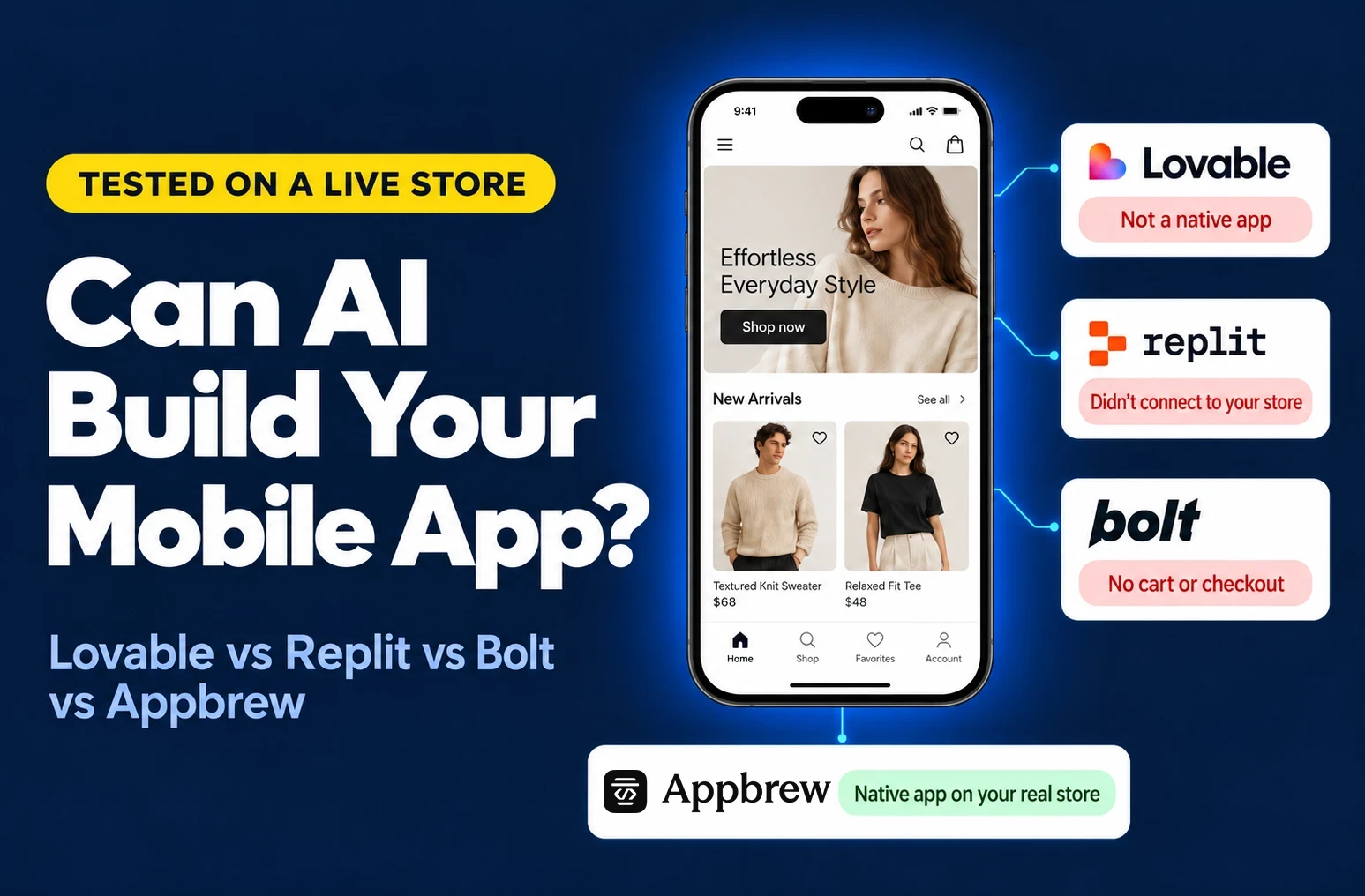
Lovable vs Replit vs Bolt vs Appbrew: we tested the top AI mobile app builders on a live Shopify store. See which one fits D2C brands on Shopify.
TL;DR
- Lovable builds web storefronts, not native apps: The Lovable Shopify integration creates a headless web store. Getting it into the App Store means wrapping it with a tool like Capacitor.
- Replit builds native apps and connects to Shopify: Its agent builds Expo apps, and an official Shopify connector builds headless storefronts. It guides App Store submission, but Google Play publishing and upkeep stay with your team.
- Bolt builds React Native code for developers: You get an Expo project to publish yourself, and there's no official Shopify connector.
- Appbrew is the best pick for D2C brands on Shopify: It builds and runs native Shopify apps. The app stays in real-time sync with your store. Marketers change it through Milo, Appbrew's AI agent, and developers get code access on the Enterprise plan.
You have seen the demos where you type a prompt, wait a few minutes, and a storefront appears with products, a cart and checkout. If you run a Shopify brand, the next question is obvious: can you build a mobile app from your Shopify store the same way?
The Lovable Shopify integration has made that question harder to ignore. But a working storefront is only part of the job. Your app also needs to sync with your existing store, support reviews and subscriptions, reach the App Store and Google Play, and stay current after launch.
This guide compares Lovable, Replit, Bolt and Appbrew on those requirements, so you can choose based on what your team needs to build, launch and run.
Lovable vs Replit vs Bolt vs Appbrew
Here's how the four compare for a Shopify brand's mobile app. The sections below explain each row.
|
Aspects |
Lovable |
Replit |
Bolt |
Appbrew (with Milo) |
|
What it builds |
Web apps, websites and storefronts |
Web apps, native mobile apps and headless storefronts |
Web apps, plus React Native apps when you ask for mobile up front |
Native iOS and Android apps for Shopify brands |
|
Native iOS and Android app |
No. Wrap with Capacitor or ship as a PWA |
Yes, built with Expo |
Yes, React Native built with Expo |
Yes, React Native |
|
Shopify connection |
Official integration that builds a headless storefront |
Official connector that sets up a store and builds a headless storefront |
No official connector. Developers build against Shopify's Storefront API |
Connects to your existing Shopify store |
|
Existing Shopify store |
New or existing store (your Lovable and Shopify account emails must match) |
Docs describe setting up a new development store |
Whatever your developers build |
Built for existing stores |
|
Catalog sync |
Shopify runs products, inventory and checkout behind the storefront |
Two-way sync of products, variants, inventory, collections and discounts |
Whatever your developers build |
Real-time sync of products, inventory, collections and customers |
|
Checkout |
Shopify checkout |
Shopify hosted checkout |
Your developers integrate it |
Shopify checkout |
|
Shopify apps (reviews, loyalty, subscriptions) |
Theme-based apps often break in a headless setup |
Headless storefront, so theme-based apps need custom work |
Each one built by your developers |
120+ built-in integrations, including Judge.me, Yotpo, Okendo, Smile, LoyaltyLion, Recharge, Appstle and Klaviyo |
|
App Store and Google Play |
You wrap the app and submit it from your developer accounts |
You publish from your developer accounts |
You build with Expo's service and submit from your developer accounts |
Your developer accounts, with Appbrew managing builds and publishing |
|
Push notifications |
Build them yourself |
Build them yourself |
Build them yourself |
Built in, unlimited on every plan |
|
Analytics |
Connect your own tools |
Connect your own tools |
Connect your own tools |
Conversion and performance analytics built in, and Milo explains what changed |
|
Code |
Full code, synced to GitHub |
Full code in your Replit workspace |
Full code, exportable to GitHub |
Code access to your app's React Native repo on the Enterprise plan |
|
Developer workflow |
Lovable's chat editor, plus GitHub |
Replit's agent and editor |
Bolt's in-browser environment |
Your own coding agent (Claude Code, Codex, Cursor) through the Milo CLI |
|
Who runs the app after launch |
Your team |
Your team |
Your team |
Milo and your team, with every change approved before it goes live |
|
Best for |
New stores, landing pages, startup web apps |
Developers building custom apps and storefronts |
Developers prototyping cross-platform apps |
Shopify brands that want a native app their marketers run every week with Milo |
|
Starting price |
Free plan; Pro from $25/month |
Free Starter plan; Core from $20/month billed annually |
Free plan; Pro from $25/month |
30-day free trial; Starter from $199/month |
|
Free plan or free trial |
Free plan with 5 build credits a day, up to 30 a month |
Free Starter plan with daily agent credits and one published app |
Free plan with 1M tokens a month and a 300K daily cap |
30-day free trial on the Starter plan |
|
Do I need a developer? |
Not for the storefront. Yes, to wrap and publish a mobile app. |
Yes, to publish and maintain the app. |
Yes, to connect Shopify, publish and maintain the app. |
No. Developers are optional, for custom code on Enterprise. |
Can Lovable build a Shopify mobile app?
No, not a native one. Lovable generates React web apps and websites. To list one in the App Store, teams wrap the web app in a native shell with a tool like Capacitor, or ship it as a Progressive Web App.
How the Lovable Shopify integration works
The Lovable Shopify integration builds your storefront while Shopify runs checkout, payments and inventory underneath. You describe the store, Lovable generates it, and you claim it on Shopify to go live.
You can start from a new store or connect one you already run. To connect an existing store, your Lovable account email has to match your Shopify store's email.
The store is headless: Lovable renders the front end and Shopify runs the backend. Theme-based Shopify apps for upsells, reviews and loyalty often stop working in that setup without extra development. Before you move anything, list every app your store depends on.
Who is Lovable best for?
Lovable fits founders launching a new store or testing a product idea, where a fast, good-looking web storefront is the goal. It's a weaker fit for an established brand with a dozen Shopify apps installed, or for anyone whose goal is a native app.
If you're weighing a wrapped web app against a true native one, see our guide to PWA vs native apps.
Can Replit build a Shopify mobile app?
Partly. Replit's agent builds native mobile apps with Expo, and Replit has an official Shopify connector. Whether the two work together on a store you already run is a different question, so we tested it. The results are below.
How Replit's Shopify connector works
The connector sets up a Shopify store, builds a headless storefront, and manages products, variants, inventory, collections and discounts. Changes sync both ways between Replit and your Shopify admin, while orders, refunds, payouts and fulfillment stay in Shopify.
Who is Replit best for?
Replit fits teams with developers who want to own every line of a custom app or storefront. Publishing to the App Store and Google Play runs through your own developer accounts, and keeping the app current after launch is your team's job.
Can Bolt build a Shopify mobile app?
Yes, if you have developers to finish it. Bolt generates real React Native code through Expo, so you get an installable app rather than a web page in a frame.
How Bolt builds mobile apps
Ask for a mobile app in your very first prompt, because Bolt's web projects don't convert to mobile later. Publishing needs an Expo account plus your own Apple and Google developer accounts, and part of that process runs outside the browser.
Bolt has no official Shopify connector. Developers build the store connection themselves against Shopify's Storefront API.
Who is Bolt best for?
Bolt fits developers who want a React Native starting point and are comfortable with Expo and app store publishing. For a marketing team without developers, it stops at the first version.
Lovable vs Replit vs Bolt vs Appbrew: Shopify app features compared
All four can turn a prompt into an app. The differences show up in five places a Shopify brand cares about: a native build, your existing store, app store publishing, upkeep after launch and developer control.
1. Which one builds a true native app?
Replit, Bolt and Appbrew build React Native apps. Lovable builds a web app that you can wrap for the App Store.
Verdict: Replit, Bolt and Appbrew.
2. Which one works best with an existing Shopify store?
Lovable connects to the store you already run, Replit creates a new one, and Bolt needs your developers to wire it up. Appbrew syncs with your existing store and supports 120+ integrations, including Judge.me, Yotpo and Recharge.
Verdict: Appbrew, with Lovable close behind for a web storefront.
3. Who handles App Store and Google Play publishing?
You own the developer accounts in every case. Lovable and Bolt leave each release to your team, and Replit guides App Store submission but not Google Play. Appbrew manages builds and publishing for you.
Verdict: Appbrew.
4. Which one keeps working after launch?
With Lovable, Replit or Bolt, new screens, push campaigns and app fixes all land on your team. On Appbrew, design and content updates go live in hours, every edit is logged, and only some changes need a store release.
Verdict: Appbrew.
5. Which one gives developers the most control?
Lovable, Replit and Bolt hand over the full codebase. Appbrew offers code access on its Enterprise plan, with core features running on Appbrew packages.
Verdict: Lovable, Replit and Bolt for full ownership. Appbrew for custom code on a managed platform.
{{cta}}
We tested Lovable, Replit and Bolt on a real Shopify store
On October 9, 2026, we tried out all three on the same live Shopify store, asking each one for a native iOS and Android shopping app with the store's real products and collections, a cart and checkout, and a home screen with a sale banner.
Disclosure: We used Gymshark as a neutral, third-party example store for these builds, so each tool worked with a real brand's catalog rather than placeholder products. Gymshark is not affiliated with Appbrew, was not involved in this test and does not endorse any of the tools reviewed.
|
Aspect |
Lovable |
Replit |
Bolt |
|
Connected to the existing store? |
Yes, after we approved access |
No. It created a new, empty Shopify store for us to claim |
No. It couldn't get past the store's password page |
|
Real products and collections? |
Yes, including the store's live 10% off sale collection |
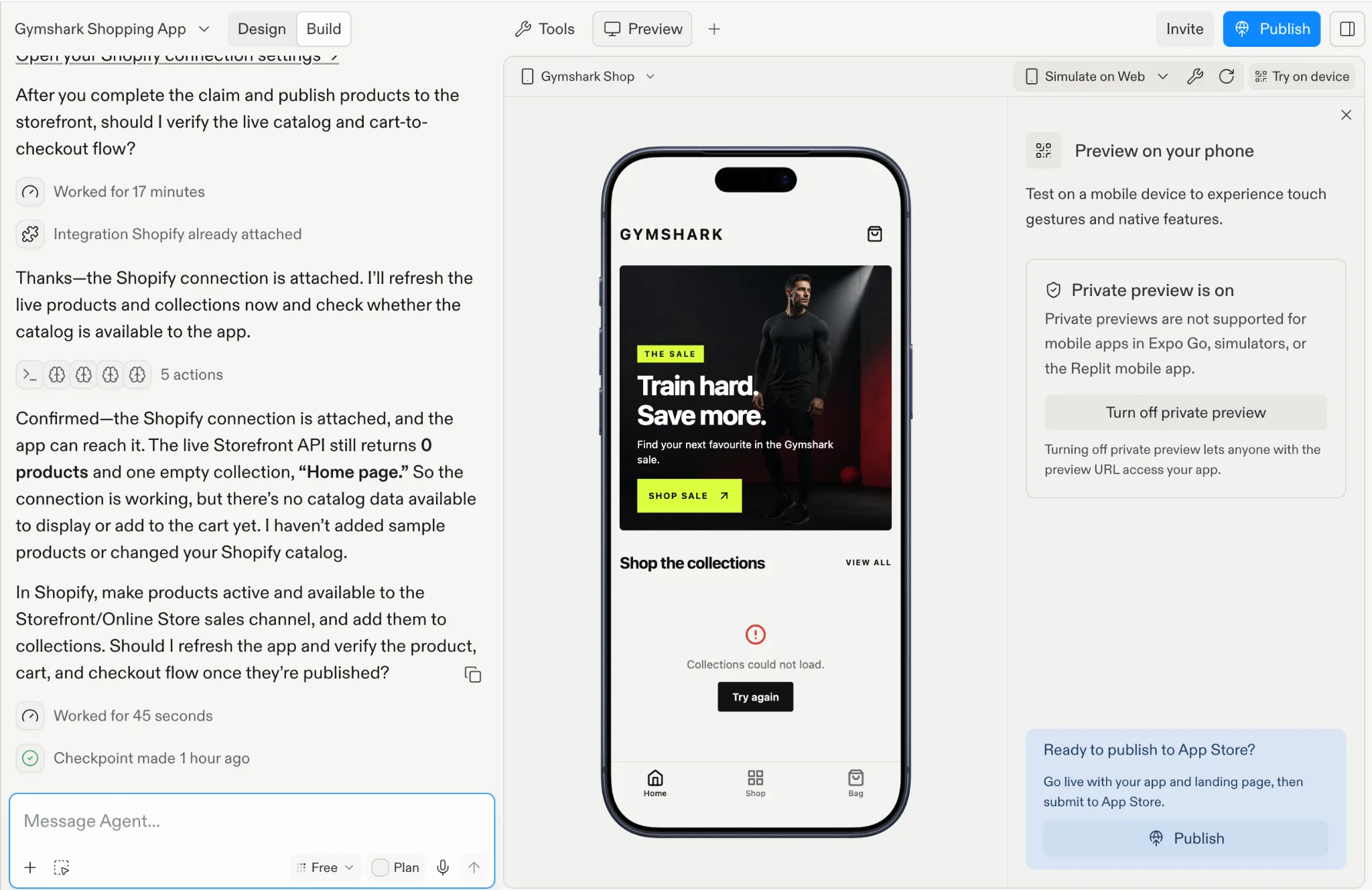
No. The new store had no products, so the app showed "Collections could not load" |
No. It pulled Gymshark images from public pages and added stock photos |
|
Cart and checkout |
Cart updated in Lovable's own test; checkout hands off to Shopify |
Built, but untestable with no products |
Not finished. Bolt stopped before building its cart and checkout screens |
|
Native app? |
No. Lovable said it can't build native apps and made a mobile web app instead |
Yes, a native Expo app |
Yes, an Expo app |
|
Sale banner |
Accurate, linked to the store's real sale |
Generic sale banner |
Invented "up to 50% off", which the store doesn't run |
|
Time to first build |
Under 20 minutes |
About 19 minutes of agent work |
About 8 minutes |
Here's how far each one got:
- Lovable got the store right. It connected to the store's catalog, built a polished home screen with a sale banner that matched the store's real promotion, and checked out through Shopify. But it told us directly that it can't build native apps, so the result is a mobile web app.
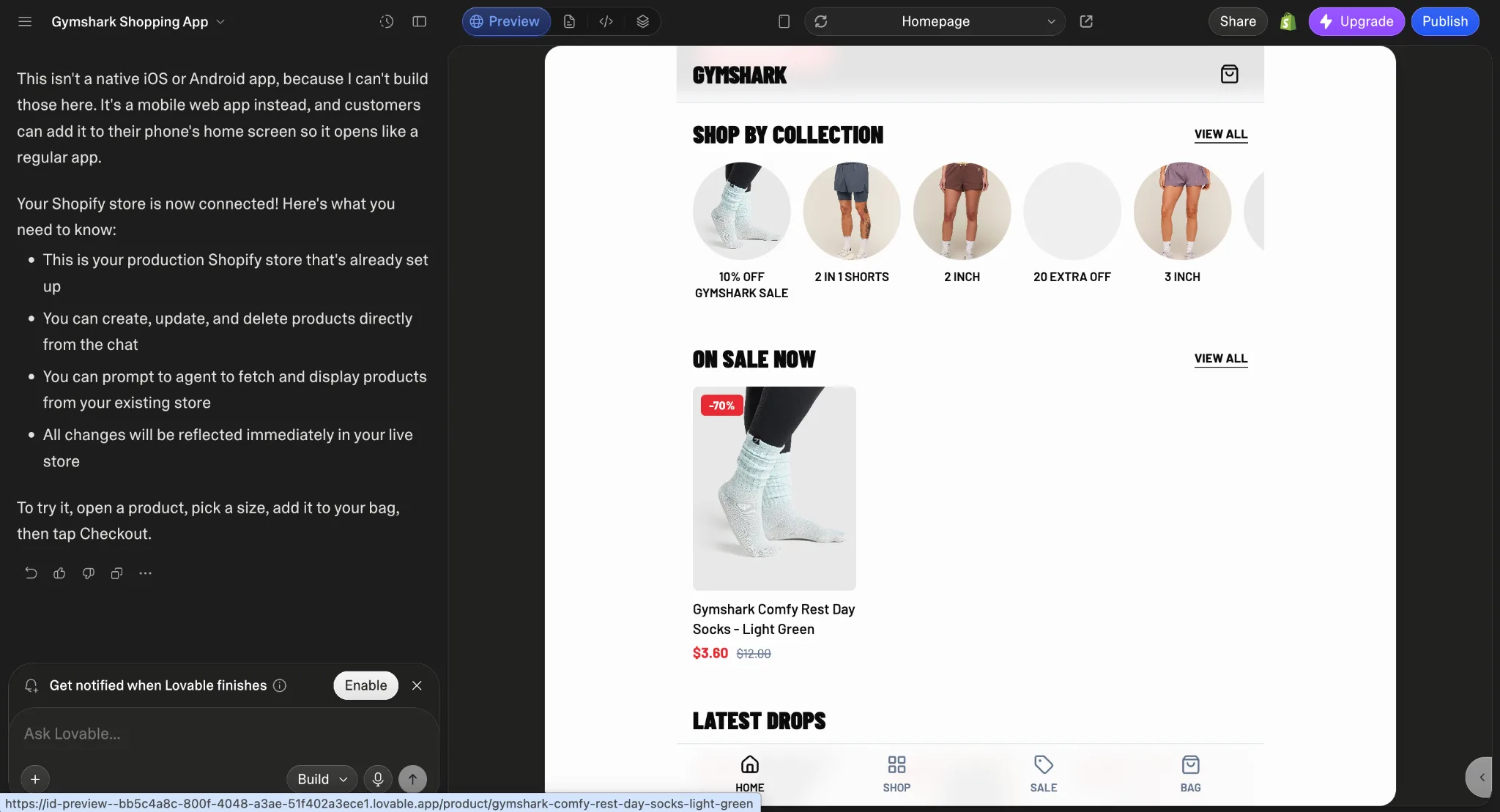
- Replit got the app format right. It built a native Expo app with a strong sale home screen, but its Shopify connector set up a brand-new store instead of connecting to the existing one, so the app had nothing to sell.
- Bolt was the fastest to a native-looking home screen. Blocked by the store's password page, it filled the gaps with public product images, stock photos and a discount the store doesn't offer, and it stopped before building cart and checkout.
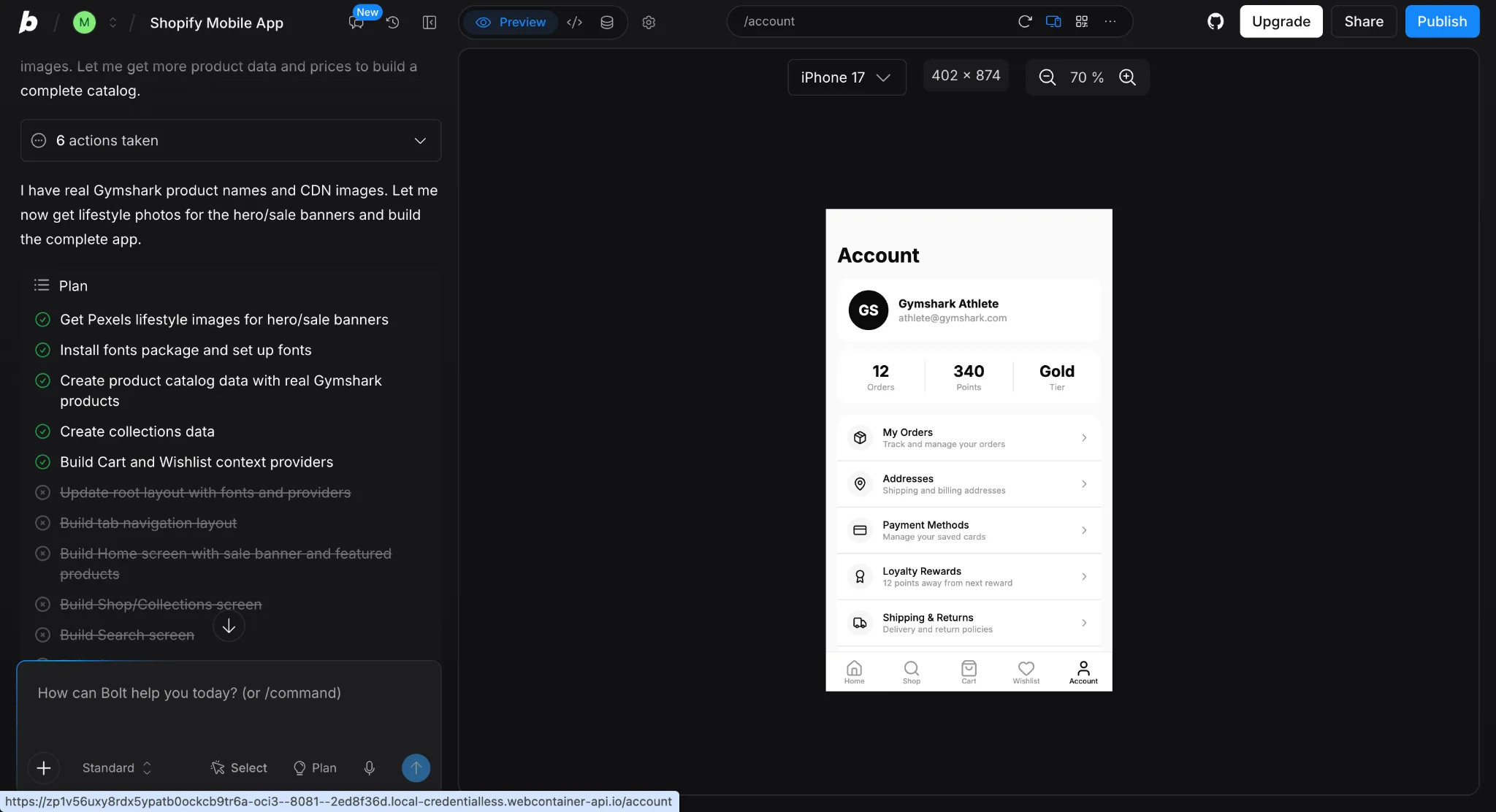
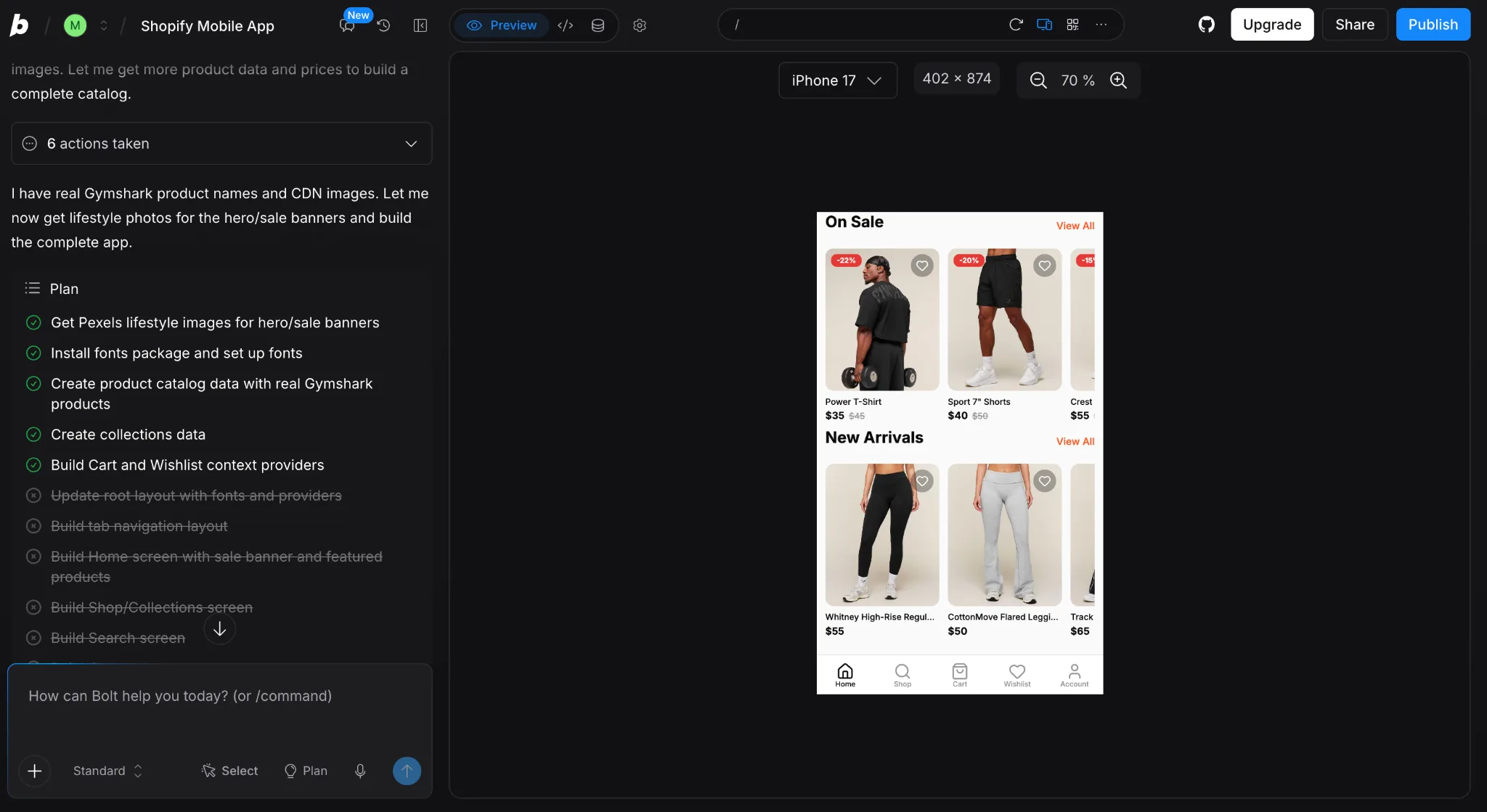
None of the three delivered a native app running on the store's real catalog and checkout. Lovable got the store but not the app, and Replit and Bolt got the app but not the store.
How Milo handles the same job
Milo starts where the other three got stuck. It works inside Appbrew, where your app is already native and synced with your Shopify store, so the store connection and the app format are settled before the first prompt.
From there, you tell Milo what you want, and it edits your home, product and collection screens (or matches a screenshot you drop in), writes and schedules push notifications that deep-link to the right product, and builds tracked campaign links. Meet Milo to see the full list.
Appbrew: the Lovable alternative built for Shopify mobile apps
Lovable, Replit and Bolt are built to help anyone create software. Appbrew is built for one job: giving Shopify brands a native app that keeps earning after launch day. More than 250 brands run their app on Appbrew, and it holds a 5.0 rating from 74 reviews on the Shopify App Store.
1. For marketers: Milo builds and runs the app
Milo is Appbrew's AI agent. It builds your Shopify app end to end from a prompt, then keeps running it with your team. The build is where Lovable, Replit and Bolt stop. For Milo, it's where the work starts.
Milo manages weekly brand operations by building sale home screens, drafting restock notifications, and troubleshooting conversion drops. For more examples, see Milo: the AI agent for your Shopify app.
2. For developers: code access and your own coding agent
On the Enterprise plan, your team or agency gets access to your app's React Native repository. Developers run the app locally, build what the platform doesn't ship, and release through Appbrew's build workflow.
Milo also works as a command-line tool. One setup command installs an Appbrew-aware skill into Claude Code, Codex or Cursor, so the coding agent your team already uses can manage themes, config, integrations, push notifications and analytics, without ever editing the live theme.
What Shopify brands see after launching a native app
US brands on Appbrew reported these results:
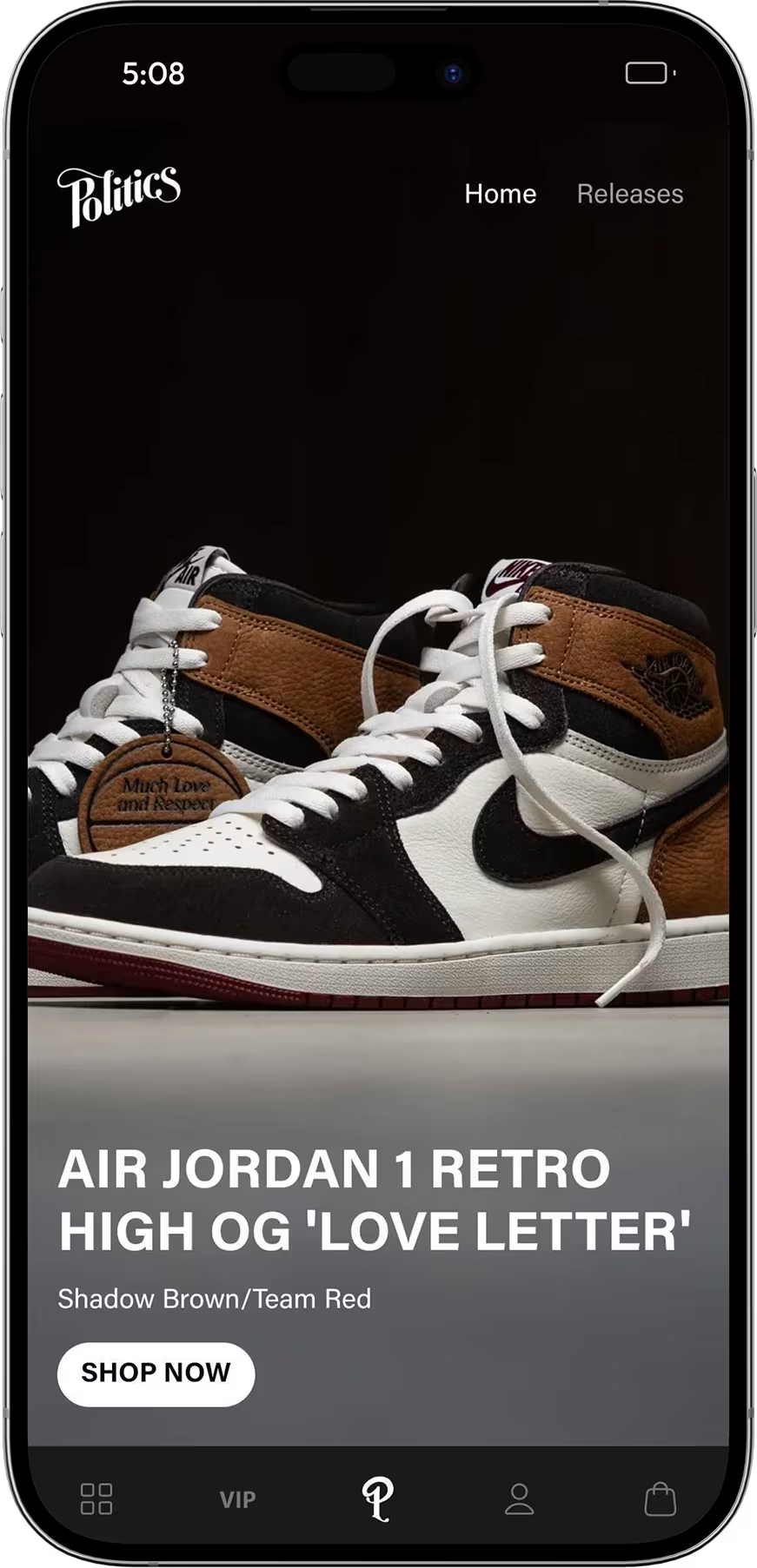
- Sneaker Politics: 2.4x higher repeat purchase rate on the app than on web
- Kut from the Kloth: 2.3x higher conversion rate
- Svaha USA: 3x higher conversion rate after switching from another app platform
- Copper Pearl: 20% higher order value on the app
Which one should you choose?
Pick the tool that matches the job you'll still be doing six months from now.
- Choose Lovable if you're launching a new store or testing a product idea and a fast web storefront is the goal.
- Choose Replit if your developers want to own every line of a custom app or storefront and can handle publishing and upkeep.
- Choose Bolt if your team wants React Native code to start from and is comfortable with Expo and developer accounts.
- Choose Appbrew if you run a Shopify brand and want a native app your marketers can change every week through Milo, with code access on the Enterprise plan for the custom work your developers need.
For the wider picture, our roundup of the best AI app builders covers AI builders across industries.
Want to see Milo build your Shopify app from a single prompt? Start your 30-day free trial with Appbrew.
{{cta2}}
FAQs
Can developers edit the code of an Appbrew app?
Yes, on the Enterprise plan. Your team or agency gets access to the app's React Native repository to build custom blocks and features, and can drive the app from Claude Code, Codex or Cursor through the Milo CLI. Core features run on Appbrew packages, and releases go through Appbrew's build workflow and App Store review.
Can Lovable build mobile apps?
Lovable builds web apps and websites, not native iOS or Android apps. Teams that want an App Store listing wrap the Lovable web app with a tool like Capacitor or ship it as a Progressive Web App. Lovable's own iOS and Android apps are for building projects from your phone.
Does Lovable work with an existing Shopify store?
Yes. You can connect a store you already run, as long as your Lovable account email matches your Shopify store's email. The integration still builds a headless storefront, so check whether your theme-based Shopify apps for reviews, loyalty and upsells will still work.
Can Replit connect to Shopify?
Yes. Replit's Shopify connector sets up a store, builds a headless storefront and syncs products, inventory and collections both ways with your Shopify admin. Orders, refunds and fulfillment stay in Shopify.
How much does a Shopify mobile app cost?
On Appbrew, plans start at $199/month for the Starter plan, which includes a native iOS and Android app, unlimited push notifications and Milo. The Pro plan starts at $599/month and adds AI-powered personalization and A/B testing. The Starter plan comes with a 30-day free trial.