.webp)
.webp)
From Postpartum to Profitable: How Cecilia Tsai Built Miamily
.webp)


Cecilia Tsai shares how a personal struggle with back pain became MiaMily, and why authenticity, community, and product innovation continue to drive growth.
About this episode
Cecilia Tsai didn't set out to build a brand. She set out to carry her baby without pain. After pinching a nerve while holding her four-month-old daughter Mia in Switzerland, far from family, with every carrier on the market making her back worse, she did what entrepreneurs do: she made her own. A friend's mom who sewed wedding dresses. A wider belt inspired by gym weightlifters. A prototype built for personal use that strangers kept stopping her to ask about.
In this episode of Brewed, Cecilia breaks down how a two-minute Kickstarter video sold 1,000 carriers across 33 countries before MiaMily officially launched, how COVID wiped out 70% of their revenue overnight and forced a complete DTC rebuild, and why the content strategy that turned Instagram Reels into a global growth engine came down to one simple idea: show your life, not your product.
This conversation is for founders trying to understand what authentic brand building actually looks like, DTC operators navigating the shift from retail to owned channels, and anyone who's ever solved a problem so personally that they became their own target customer.
What you'll learn
- The MiaMily story: from a pinched nerve to 190,000 customers across 20 countries
- How a two-minute Kickstarter video sold 1,000 carriers across 33 countries
- Branding philosophy: "My target audience is actually me"
- Show don't sell: the content strategy that built MiaMily's community
- When COVID took away 70% of revenue overnight
- App vs. website: why mobile converts 2x
- How MiaMily thinks about copycats and why they don't fight them
- From carrier to family travel brand: the product line evolution
- The broader lesson: sales is king
The complete breakdown
1. The MiaMily story: from a pinched nerve to 190,000 customers across 20 countries
There are baby carriers everywhere. There have been for decades. And almost all of them were designed with the same blind spot: they were ergonomic for the baby and completely ignored the person doing the carrying.
Cecilia Tsai found this out the hard way. A first-time mom, living as an expat in Switzerland with no family nearby, she pinched a nerve while holding her four-month-old daughter Mia and could no longer carry her without significant back pain. She went out and bought every type of carrier available. None of them helped. Most made it worse.
"How is it possible that a product made for parents is actually not ergonomic for the parents? They're always ergonomic for the baby, but it's not comfortable for the parent."
What followed was part improvisation, part necessity. Her family background was in manufacturing. Her uncle was in China. She had an idea: a hip seat built into the carrier, inspired by the thick protective belts weightlifters use to protect their lower back. She doubled the width of the waist belt from the industry standard to nearly 20 centimeters. She worked with a designer and a sample room and built a prototype, purely for personal use.
Then strangers at airports started stopping her to ask where they could buy it. That prototype became MiaMily. Today the brand serves 190,000 customers across 20 countries and has expanded from ergonomic baby carriers to viral ride-on luggage that holds up to 220 pounds, all designed around the same original idea: products built for the parent, not just the child.
2. How a two-minute Kickstarter video sold 1,000 carriers across 33 countries
Before MiaMily was a company, it was a hunch. Ten strangers stopping Cecilia and Alessandro at airports asking about a carrier they had made for themselves. A pattern that kept repeating until it was impossible to ignore.
Cecilia's background before Swiss private banking was in Hollywood film production. She knew how to make a video. She knew directors, crew, and product designers. And she knew about Kickstarter.
"There was really no commitment, no risk. You're just making a two-minute video. Let's see if there are pre-orders, then we can use the money raised to fund our first production."
They wanted to raise $25,000. Within five days, they had it. By the end of the 30-day campaign, they had pre-orders for nearly 1,000 baby carriers from 33 countries. The demand wasn't just validation. It was the business plan.
What followed was four months of learning international shipping, safety testing, packaging, and logistics the hard way. They had promised delivery in two months. They delivered in four. But the pressure of having real customers waiting with real orders taught Cecilia one of the most important lessons she would carry through the business: done is better than perfect.
"There were people waiting. It really forced us to not aim for perfection. We just had to get it done."
3. Branding philosophy: "My target audience is actually me"
Most brands approach content as a product showcase. Post the product, explain the features, promote the discount, repeat. Cecilia watched brands do this and thought it was boring. And more importantly, she knew it wasn't how she would want to be spoken to as a customer.
So she made a different choice. She started showing her life.
"I started sharing a lot of our personal life online. People who followed our Instagram could really relate to me as a mom. Brands who always just posted about their products and promotions were boring. You never know who the person behind the brand is."
The content wasn't scripted. It was a meal being cooked with the baby strapped to her chest. A tantrum handled on camera. Bedtime routines in Switzerland. The joys and the ugly sides of motherhood, shared without filter. And woven through all of it, naturally, was the carrier.
"Today I'm going to make dinner. The baby's crying. I put the baby in the carrier and now I'm cutting the onions. And you know, this is how I make my chicken curry."
The logic is simple and powerful. A parent watching that video isn't being sold a product. They're meeting someone they trust. And if they trust Cecilia as a parent, they trust the product she designed. The sell becomes almost incidental.
4. Show don't sell: the content strategy that built MiaMily's community
Cecilia's content philosophy predates reels, predates TikTok, predates the algorithm shifts that have made authenticity a buzzword. It was just her instinct: people come back to accounts that make them feel something, not accounts that promote at them.
Over eleven years, the tactics have changed. YouTubers, then Facebook creators, then Instagram, then Reels. MiaMily ran four separate Kickstarter campaigns and each one had a completely different marketing approach because the platform landscape had shifted that dramatically between each launch. But the underlying principle never moved.
"If you focus on product, people won't come back. You have to show them who you are, how you parent, how you live, how you host. The people who relate to you will trust you. And if they trust you, they trust the product."
The practical measure of whether this works: when 270 million people view a piece of MiaMily content, it's not because they were targeted with an ad. It's because the content earned its reach by being something people actually wanted to watch and share.
5. When COVID took away 70% of revenue overnight
Before the pandemic, MiaMily was primarily a retail brand. Target, Bye Bye Baby, Babies R Us, Walmart. Through a connection made by the father of a university intern who had been helping Cecilia pack orders for her Swiss mommy buying group, the brand had landed in every major US big-box retailer within its first year.
Then COVID hit. Roughly 200 Bye Bye Baby stores stopped ordering. Overnight.
"From one day to the next, they stopped ordering from us. We really had to think quick."
What Cecilia and Alessandro did next wasn't a pivot with a runway and a strategy deck. It was survival mode: learning Facebook ads from scratch, building out Google campaigns, activating email marketing, and leaning hard into the Instagram presence Cecilia had been building for years. The community she had cultivated by showing her life, not her products, suddenly became the most valuable asset the business had.
The lesson from that moment shaped how MiaMily has operated ever since: own your customer relationships. Retail is distribution. The brand is the relationship. When one goes away, the other has to carry everything.
6. App vs. website: why mobile converts 2x
Cecilia was sceptical about the app. MiaMily isn't a consumable brand. You don't buy a new baby carrier every month. The business logic that makes apps obviously valuable for skincare or supplements felt less clear for a brand where most customers buy once, maybe twice.
"I had my doubts about the app because we're not a brand where you constantly come back every month to purchase."
What changed her mind was the data.
"The conversion on the app is double the conversion we have on our website. People who take the time to download your app are definitely warmer leads and they are easier to convert."
The insight is straightforward once you see it: someone who downloads your app has already made a micro-commitment to the brand. They have given you a slot on their phone. That act of choosing is a signal that most website visitors don't send. And because the checkout experience on a native app is faster and more frictionless than mobile web, that warmer intent converts at a significantly higher rate.
MiaMily also learned that the way you treat app customers matters as much as the channel itself. App-exclusive promotions, early access, content that feels like it's for insiders. These are the things that give someone a reason to keep the app on their phone after their first purchase.
"You have to give people a reason why they want to keep you on their phone."
7. How MiaMily thinks about copycats and why they don't fight them
Going viral at the scale MiaMily has, millions of views on carrier content and 270 million on luggage content, has a predictable side effect: copycats.
Cecilia's first reaction when she saw the first MiaMily copy was surprise at herself for being almost flattered. If someone is copying you, you've made something worth copying. But the question of what to do about it is where the strategy gets interesting.
"I just don't really believe in spending money to fight these copycats. The decision was to dedicate the cashflow to growing the business."
Patents have limits. A competitor can change a zipper, add a pocket, and sidestep your IP protection. Legal battles are expensive and slow. And while you're fighting in a courtroom, the market keeps moving.
MiaMily's answer is product innovation. If you're always one step ahead, with better design, better functionality, better community, and a stronger brand, the copycat is always chasing something you've already moved past. The leader doesn't win by defending the old product. They win by making the next one.
8. From carrier to family travel brand: the product line evolution
Three years ago, MiaMily posted a piece of luggage content on Instagram. It went viral in a way that shifted the entire direction of the business.
The Rydon ride-on carry-on, a suitcase children can sit and ride on, rated to 220 pounds so parents can use it too, wasn't just a product launch. It was a category expansion that reframed what MiaMily is. Not a baby carrier brand. A family travel brand. Products designed around the real, specific, logistics-heavy experience of moving through the world with children.
"I really want to develop more products that can help parents travel easier."
The through-line from the original carrier to the Rydon to the daddy bag to the mommy bag is the same problem Cecilia started solving in 2014: the gear that exists for families was designed around the child's needs, not the parent's. MiaMily's entire product roadmap is a systematic correction of that oversight, giving parents functional and well-designed products they would want to use even without the kids.
9. The broader lesson: Sales is king
Cecilia's advice to every founder thinking about planning versus building, about getting the logo right before the product ships, about waiting for the perfect moment, is consistent and direct.
"Sales is king. If you can sell, everything else can follow."
The Kickstarter campaign wasn't perfect. The first production took twice as long as promised. The fulfillment across 33 countries with no shipping experience was a mess of learning. None of it mattered as much as having 1,000 real customers who had already paid for the product.
The business plan follows the sale, not the other way around.
There's a parallel Cecilia draws between running a brand and raising children that captures something real about what long-term success actually requires. In both cases, the challenges keep evolving. Every time you feel like you've mastered a phase, the next one arrives with a completely different set of demands. The brands and the parents that make it are not the ones who got everything right. They're the ones who showed up consistently, adapted without giving up, and kept going.
"The best businesses are those who persist. Those who just continue day by day and never give up. If you're in it for the long run, those are the businesses that really end up succeeding and lasting."
The complete episode transcript
Abhijeet: Welcome to Brewed, a podcast for DTC founders, growth marketers, and brand builders who want to know what really goes into scaling modern brands. Every episode brings you honest stories and real strategies from the people building brands. Today's guest is Cecilia Tsai, co-founder of MiaMily, a family travel brand that started with a pinched nerve and a prototype baby carrier. She launched the company in 2014 after suffering severe back pain while holding her first daughter Mia, and discovering that every carrier on the market was designed for the baby, not for the parent carrying them. Drawing on her background in TV production, Cecilia teamed up with her former crew to create a two-minute Kickstarter video that helped her sell 1,000 carriers across 33 countries before the company officially launched. Then COVID hit. 70% of MiaMily's revenue came from big box retailers like Babies R Us and Bye Bye Baby, and it disappeared overnight. Cecilia and her husband Alessandro rebuilt the entire business on Shopify, pivoted to DTC, and turned Instagram Reels into a growth engine that has taken them global. Today MiaMily has evolved from ergonomic baby carriers to ride-on luggage that can hold 220 pounds, serving families from infancy through childhood. Welcome to the podcast, Cecilia.
Cecilia: Thank you for having me. Super happy to be here.
Abhijeet: Take us back to the exact moment. You're with your baby. What were you doing and what did it feel like?
Cecilia: It all started when I became a first-time mom and I was home alone with my newborn. She was probably around four months old, Mia. I pinched a nerve and I could no longer really carry her. There was so much pain in my back. We were expats in Switzerland and we had no family around. So I was very desperate to find a baby carrier that could help me carry her. Alessandro was working as a hedge fund manager back then. I went out and bought every type of baby carrier possible and none of them made my back pain better. They actually made it all worse. And I asked myself: how is it possible that a product made for parents is actually not ergonomic for the parents? They're always ergonomic for the baby, but it's not comfortable for the parent. My family background is in manufacturing, so my uncle lives in China. I spoke to him and said I have this idea for a baby carrier. A hip seat built inside so the seat could actually support the baby's weight. I got inspiration from people who work out in the gym. They carry heavy weights and they wear this thick protective belt around the waist. And all the baby carriers on the market had a waist belt only this high. It just didn't provide support and was pinching into the back. So we doubled the width of the belt to about 18 to 20 centimeters. It started with these very simple concepts: I needed something to support the baby and I needed a wider belt to protect my lower back. From there we worked with a designer and a sample room and came up with a prototype that was purely for personal use. Before Mia turned two, she flew on 60 flights. We were determined to prove everybody wrong. When we were pregnant everybody said you're never going to travel again. So we really traveled a lot those first two years. I used our own prototype at airports, on planes, and people kept stopping us. Strangers kept asking: what is this baby carrier, where did you get it, what's the brand? We said there's no brand, we just made it ourselves. After about the 10th person stopping us, I looked at Alessandro and said, this could be a business idea. For people to want to stop a stranger to ask about a product, they must really want it. That's how it all started.
Abhijeet: Do you remember the first stranger who stopped you?
Cecilia: It was actually a grandma. She really loved the idea and thought it was so smart. She had never seen it before. She came up and asked: where can I buy one?
Abhijeet: From that point you met about 10 more people asking where you got it. Were you contemplating a business idea? What was the journey from those 10 people?
Cecilia: It definitely wasn't planned because I was actually really looking forward to being a stay-at-home mom. There was no intention to run a business. Before becoming a mom I was working at a private bank in Switzerland. Growing up in a family of entrepreneurs, I understood how tough it can be. So when I became a mom I was just really looking forward to being a stay-at-home wife and mom. But it's built in me: when I see an opportunity, it's too good to pass. So when so many people stop you, you ask yourself, could this be something? We were in LA at the time and before Swiss banking I was actually making movies in Hollywood. All my close friends were part of movie crews. Back then Kickstarter was very big and we decided, why not just make a two-minute video and see how people react to the product? There was really no commitment, no risk. You're just making a two-minute video. Let's see if there are pre-orders. We can use the money raised to fund our first production. I called up old friends, got a director, a product designer, we hired a model. I designed the production design, a warm living room studio. We rented a studio and filmed a two-minute video. Then we put it on Kickstarter. It was super nerve-racking. We wanted to raise $25,000 to fund the first production. Within five days we raised $25,000. Our campaign was for 30 days and by the end we had pre-orders for almost 1,000 baby carriers from 33 countries. It really blew our minds. But it also gave us the confidence to start because there was definitely a huge demand.
Abhijeet: Did you go to Shopify DTC immediately or did you start with offline retailers?
Cecilia: Once we finished the campaign, the next step was to fulfill all the pledges. 33 countries, we had no experience shipping to South Africa or Canada or Malaysia. It was a huge learning experience. We said we'd deliver in two months, which was very unrealistic. You need to go into production, I didn't calculate shipping time, I didn't calculate packaging time, and of course we had to do all the safety testing. In the end we fulfilled our pledges after four months. Because there were people waiting, it really forced us to not aim for perfection. We just had to get it done. And I think that is such a key point of running a business. Too many people get stuck in the planning phase. They want the logo perfect, they want everything perfect before they sell their first product. My advice to everyone who wants to run their own business: sales is king. If you can sell, everything else can follow. And that's what's so great about Kickstarter. It's led by orders. Once you've sold your first batch, it's so much easier for everything else to follow. From the thousand orders we received we could see that the majority came from the US. With my background being Taiwanese American and having lived in the US for eight years before Switzerland, I was much more familiar with that market. So we decided to focus on the US. We were very lean and we had an intern from the States who was studying at a university in Lugano. One day she said her dad was a serial entrepreneur who might be able to give us some advice. We had a chat with him and at the end of the call he was so interested in our story and loved the product so much that he wanted to invest. He became one of our first shareholders. Through his connection we were able to get into Target, Bye Bye Baby, Babies R Us, and Walmart. Within the first year we were in all the major big retailers in the US. We were profitable immediately from the first year and our sales grew exponentially every year.
Abhijeet: What was Alessandro's reaction through all of this?
Cecilia: He was also very surprised, like me, with the reaction from Kickstarter and the success we got. He was fully on board from day one and we really did everything together. His strength is people skills and connection. He's such a great salesperson. My role was product development and marketing. He handled sales, production, and finances. It was a really great partnership.
Abhijeet: You've worked in film production, then banking, then you're running a brand. How has that identity transition felt?
Cecilia: As a woman, your identity really changes when you become a mom. Before, your identity is really linked to your work. Since I became a mom, you're no longer putting yourself first. Your kids come first. There definitely was a period where I lost my identity. Running the business was a great distraction. It kept me so focused on keeping the kids alive and keeping the business alive that I didn't realize I had postpartum depression. I really struggled with that. In four years I was pregnant three times. It was a very, very hectic time. But now looking back, I feel like everything happened for a reason. I really identify as a mompreneur now. Running a family and running a business are quite similar. There's so much logistics and so many things to manage. As a mother you're always evolving. Once you've mastered a phase, your kids grow and new challenges show up. As a business it's the same. You hit your first million, you hit your first five million, each level has a completely different set of challenges. The constant is that there is always change. The best businesses are those who persist and continue day by day and never give up. As a parent you cannot give up. And the most successful businesses are the ones that keep going.
Abhijeet: How should another founder think about branding, especially in a category like baby care?
Cecilia: Creating the brand was very organic for us because the product was created out of a personal need. My target audience is actually me. I started sharing a lot of our personal life online and people who followed our Instagram could really relate to me as a mom. Brands who always just posted about their products and promotions were boring. You never know who the person behind the brand is. People are not going to come back to your account if you're only posting about product. My strategy was: I'm going to show them who I am as a mother, how I parent, how I host, how I live my life in Switzerland. The people who can relate to me and agree with my parenting, they love it. Today I'm going to make dinner, the baby's crying, I put the baby in the carrier and now I'm cutting the onions. This is how I make my chicken curry. People watching are like: I love how she is as a parent and I trust her. If they trust me as a parent, they also trust the product I'm designing. So then it's a much easier sell. Even when it's not related to the carrier, when I show how I handle a tantrum or how I put my kids to sleep, moms really relate with me because I'm showing the pretty and ugly sides of motherhood. That's what I credit our DTC success to during the pandemic.
Abhijeet: What happened when COVID hit?
Cecilia: Before the pandemic we were selling primarily to brick and mortar. We were in about 200 Bye Bye Baby stores. From one day to the next they stopped ordering from us. We really had to think quick. We started learning how to do Facebook ads, Google ads, shifting our marketing to online digital marketing. We started doing email marketing. And being very present and active on Instagram really helped bring that connection to our direct consumers. When you're small, we hired a friend who had experience in meta ads and our marketing director was also a friend of ours. We kept the team very lean and very close.
Abhijeet: How does the digital customer journey for MiaMily look today?
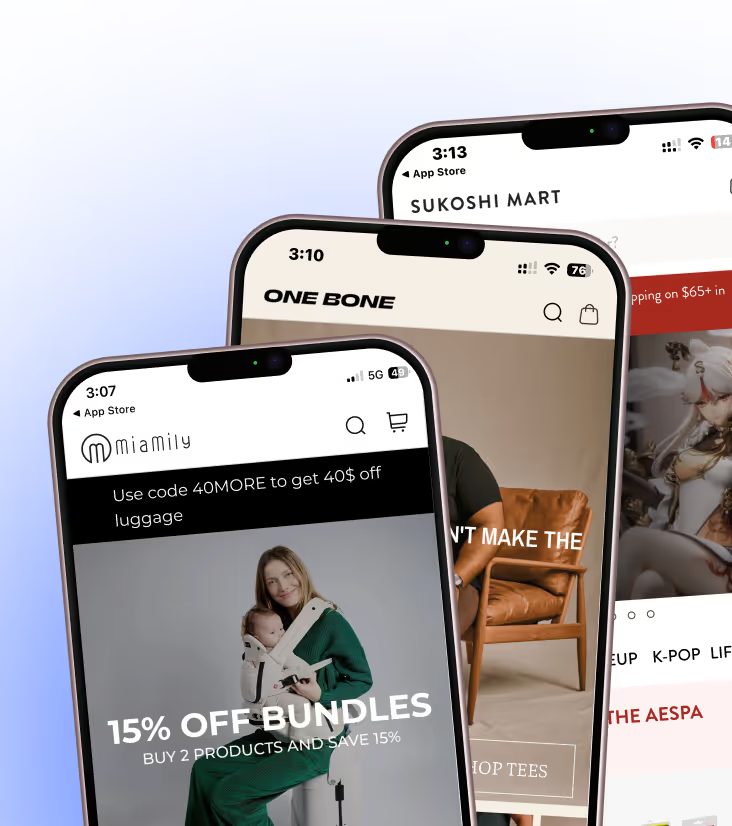
Cecilia: In the last 11 years, marketing has changed so drastically. When we started it was all about YouTubers and website blogs. Then Facebook. Then Instagram. We did four Kickstarter campaigns and every single time the marketing had changed. Nowadays the customer journey, they'll probably see an ad from us on Instagram or Meta, or they'll see a customer who organically posted on social media, or they'll see another parent using the product at an airport. That's the first touchpoint. From there they come to our website and we offer a welcome flow through email and SMS with different discounts. And we also have the opportunity to bring people to our app. From there they're getting retargeted with email, SMS, and push notifications until they make their purchase.
Abhijeet: What's your view on mobile versus app experience?
Cecilia: I also had my doubts about the app because we're not a skincare brand where you constantly come back every month to purchase. Our baby carrier, you use one carrier until the baby is four months, then another, and then they're out of baby wearing age. Same with the luggage, you buy one luggage for each kid. So you're not coming back every month. I feel like apps work so well if it's a consumable product. So I had my doubts. But when we started I was really pleasantly surprised that people would take the time to download the app and make that purchase just to have the convenience of an easier checkout. And having the app on their phone made it easier for us to communicate with them through push notification. We definitely do a lot of app-exclusive promotions. People who are app users get secret exclusive access. You have to give people a reason why they want to keep you on their phone.
Abhijeet: How would you measure app success from a founder perspective?
Cecilia: I'm definitely looking at how many people are downloading our app every month and the conversion rate. People who have downloaded the app, the conversion is double what we have on our website. That's very significant. People who take the time to download your app are definitely warmer leads and easier to convert. It's a very valid channel and it's all about making that client feel special for downloading the app and offering them little promotions to build brand loyalty.
Abhijeet: Share the one customer story for MiaMily that stands out.
Cecilia: Alessandro and I were on a family vacation in Hong Kong, just walking down the street, and we saw this mom wearing a baby carrier. We double-took. Oh my God, is that a MiaMily? This was quite early in our journey. It was indeed a MiaMily. We have a Swiss flag on the carrier. It was such a humbling and mind-blowing experience to see your product in the wild on someone you don't know. We're based in Switzerland and this was in Hong Kong. We went up to her and asked, sorry to bother you, but do you like the carrier? She went on and on about how much she loved it. We told her we were the founders of the brand. She was thrilled. We took photos. And even till today, 11 years later, when I see somebody using our product in the wild, it's just a super, super nice experience.
Abhijeet: You've had 270 million views on some posts and celebrities like Hilary Swank have used the luggage. How did the celebrity side happen?
Cecilia: Recently we gifted a luggage to Will Smith. We happened to be invited to his private concert through a friend and we brought a luggage. He was doing his European tour, so let's give him a luggage. That's how we got connected. We always give products to celebrities when there's a real connection. I don't like to randomly and blindly send products to celebrities because usually those don't end up anywhere and you basically lose a product. When there is actually somebody connecting you to the celebrity, it's more meaningful. From that event there were a lot of other celebrities, and that's how we were able to get luggages to them.
Abhijeet: How do you think about copycats as a founder who has invested so much in unique product design?
Cecilia: When we first saw the first MiaMily copycat, my first reaction was almost being flattered. You've got to be known for people to want to copy you. As a family brand, what we've learned is that if your product is good, copycats will follow. It's inevitable. I just don't really believe in spending money to fight them. We made the decision early on to dedicate the cashflow to growing the business. If you focus on product innovation and you're always one step ahead of the copycats, that's how you can be the leader of your industry and your category. It costs a lot of money to hire lawyers. We have all the patents on our products. But sometimes a patent can only protect you so much. If they change a zipper or add a simple pocket, your patent doesn't protect it. I much prefer to grow the business by investing in marketing, investing in branding, and coming out with better products for people to copy.
Abhijeet: If you imagine MiaMily 10 years down the line, what does it look like?
Cecilia: Three years ago we launched our luggage and it literally went viral. Every time we posted on Instagram there were millions of views. That really changed the direction of the business. We used to be purely a baby wearing brand and now we're more of a family travel brand. I really want to develop more products that help parents travel easier. This year we came out with a daddy bag that expands from 15 to 30 liters whenever you need extra storage, because when you're traveling with kids you always need extra space. And our mommy bag is a beautiful bag you'd want to use even without your child, a big tote with an organizer inside that's also a purse, with a strap that can be changed five different ways. When you travel you use the big tote, and when you arrive at the destination you take out the organizer and turn it into a crossbody or a clutch for dinner. We really want to invest in smart, functional products for parents traveling with their family. Right now we've reached 190,000 customers worldwide and we're in 20 different countries. I don't have a specific number for 10 years from now, but hopefully I'm on a beach in 10 years and I've sold the company.
Abhijeet: Two founders whose content you're inspired by?
Cecilia: The first is Silicon Valley Girl, Marina. She reached out to us in 2024 when she was traveling to Europe with her two kids and loved our luggage. Back then she was posting more as a mom with a language school business. Last year when AI became popular she really took the time to learn this craft and she's now one of the top AI experts in the world, invited to big events and growing so fast. Super inspirational to see how far she's come in just two years. The second is Space Gal, Emily. We discovered her during the pandemic. She's an astronaut engineer who had her own Netflix show and our kids loved watching her experiments at home. She wasn't picked up for a second season of Netflix so she did it on her own on YouTube and now she's super successful. She was the 100th woman to go into space. She's another mompreneur who shares her personal life, her successes, and her ups and downs with total honesty. I really relate to her. I reached out saying I'm such a fan and I'd love to gift you a luggage, and she's been part of our community since.
Abhijeet: Last question. What's your advice for SaaS founders who are building for brands like us?
Cecilia: Definitely the amount of features you offered and the pricing was super interesting, and giving us a trial period to test the service out was really key. There are so many offers in my inbox every day. I really appreciate services who offer a trial so you can actually see how the product works. And now with AI being so important, incorporating AI into your business is crucial. Your Milo feature where you can chat with an AI agent, instead of me trying to learn how to do the analytics, I just ask: how many downloads do I have, what promotions worked, what can I do to optimise my account? And all these suggestions come out. That was really cool. Before Appbrew we were working with Tapcart and the features you offered far outshine what Tapcart were offering at the same level. Even on your basic growth plan we were able to customise the PDP, add countdown timers for sales, add videos on our product page, lifestyle photos, testimonials. That is such an important part of the customer journey. With Tapcart we were not able to do that. Appbrew really helped us make the user experience so much better on the mobile app. One feature I would love to develop with you is a MiaMily travel concierge. We would love to offer a travel concierge in the MiaMily app where we can help families plan their trips and save their itineraries.
.webp)

.webp)
%20(1).avif)
.webp)

.webp)
.png)