


.webp)
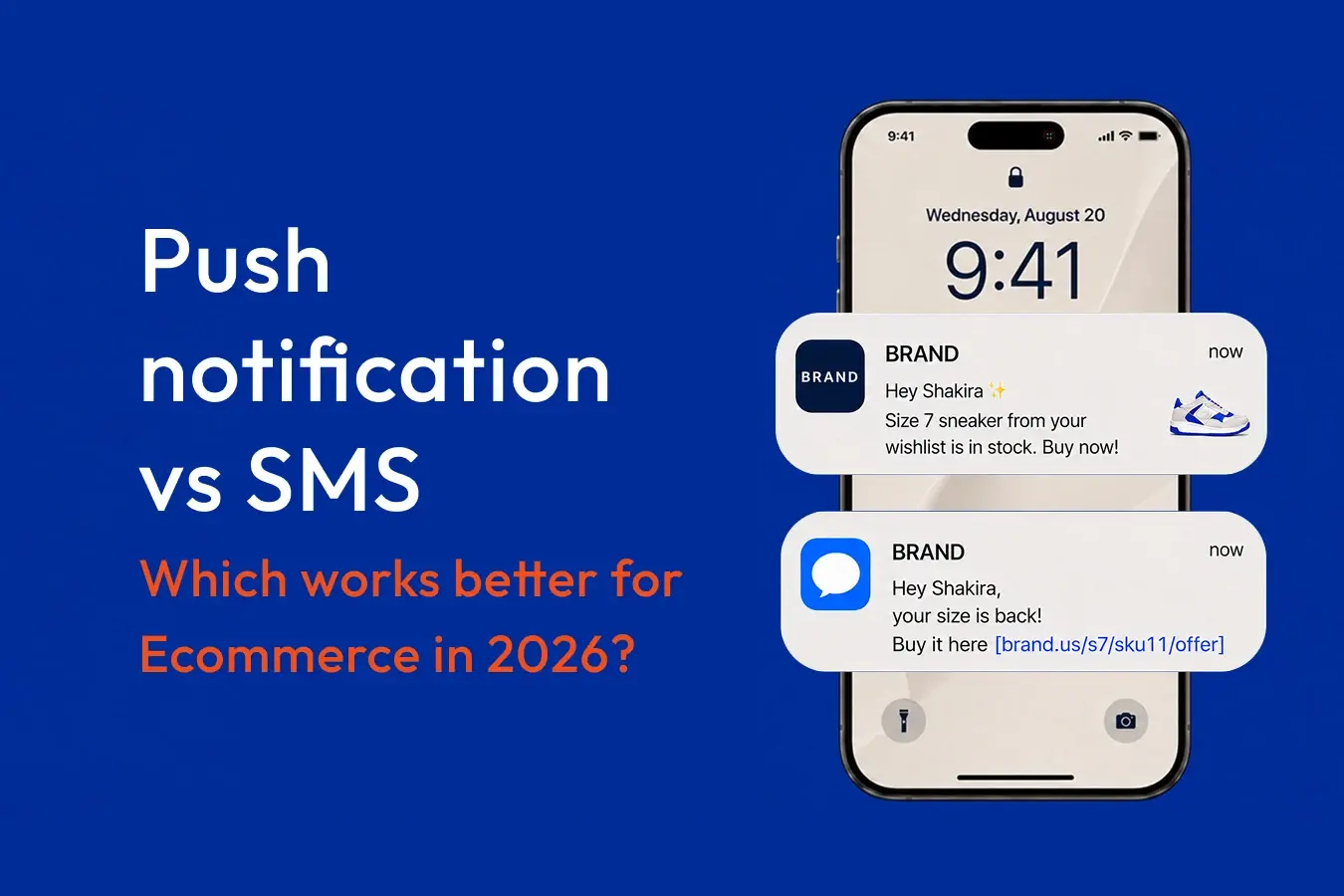
Compare push notifications vs SMS for ecommerce using 2026 data on cost, CTR, opt-ins and conversions across 3.5B sends, plus verified SMS benchmarks.
You have been told SMS is the highest-ROI channel in ecommerce. You have also been told push notifications are basically free SMS. Both claims get repeated so often that most ecommerce merchants never stop to check whether they are comparing the same thing.
They aren't. SMS and push solve different problems, cost wildly different amounts, and fail in completely different ways. Treating them as interchangeable is how brands end up with a $30,000 annual SMS bill and a push channel they never turned on.
This article breaks down how the two channels actually perform for ecommerce, using data from 3.5 billion push notifications sent across 250+ Shopify apps, and verified SMS benchmarks from Klaviyo, Attentive, and Omnisend. You'll leave knowing which channel wins for each use case, what each one really costs.
Key Insights
- Push wins on cost and conversion depth. Native app push has zero marginal cost and converts up to 23.9% of back-in-stock opens into purchases. SMS costs $150–$450 per 10,000 sends.
- SMS wins on reach and raw response. Near-universal ~98% read rates and no app install required, but every marketing text is regulated under the TCPA.
- Opt-in is the real dividing line. App push opt-in runs 65–75% across Appbrew brands. SMS captures 2–5% of web visitors.
- They aren't substitutes. SMS reaches anonymous mobile-web traffic; push is a lifetime-value engine for your repeat buyers. The brands that win run both.
- Overuse kills both. Consumers disable or delete apps that spam marketing pushes, and SMS fatigue is climbing. Frequency discipline matters more than channel choice.
What is an SMS notification in ecommerce?
In ecommerce, SMS notifications are split into two buckets.
Transactional messages cover order confirmations, shipping updates, and delivery alerts. Marketing messages cover promos, restocks, flash sales, and back-in-stock alerts.
In the US, marketing texts fall under the Telephone Consumer Protection Act (TCPA), which requires prior express written consent before you send a single promotional message. Transactional texts have more latitude, but the compliance line is strict and the penalties are real.
The appeal is reach. A text lands in the same inbox where people read messages from their family, and it gets read almost every time.
What is a push notification?
A push notification is a message delivered straight to a user's device by an app they've installed. It shows up on the lock screen or in the notification shade, and tapping it opens the app, often deep-linking to a specific product or cart.
Two differences matter for ecommerce.
- Web push comes from a browser and requires no app, but subscribers are fragile: clearing browser data or switching devices wipes them out.
- Native app push runs through Apple's APNs and Google's FCM. It requires a published mobile app, but it's durable, supports rich media, and delivers reliably to every device where the app is installed.
Push vs SMS: the core differences
The two channels diverge on five things that actually affect revenue. Here's the side-by-side comparison.
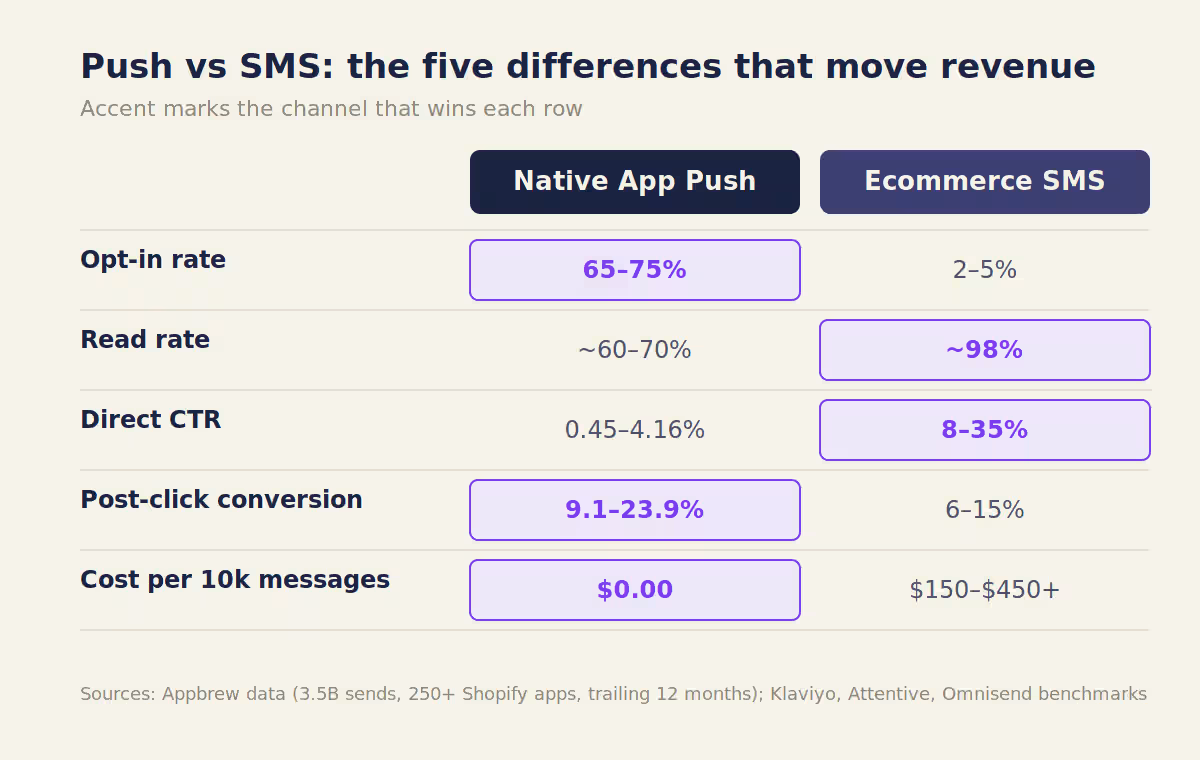
Push figures: Appbrew data across 3.5B sends, 250+ Shopify apps, trailing 12 months. SMS figures: Klaviyo, Attentive, and Omnisend published benchmarks.
Reach and opt-in pull in opposite directions
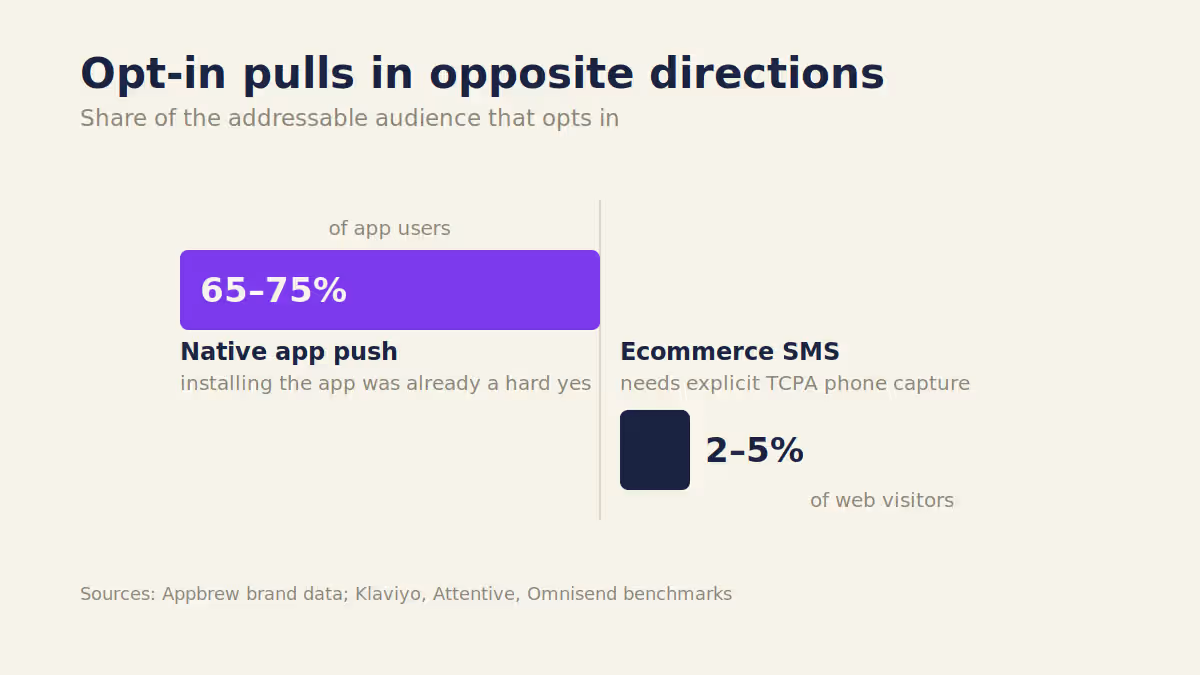
SMS can theoretically reach anyone with a phone, but you have to earn the number first, and most stores convert only 2–5% of web visitors into SMS subscribers. Push flips it. The audience is capped at people who installed your app, but 65–75% of them accept notifications because installing was already a hard yes.
Cost is where the gap gets absurd
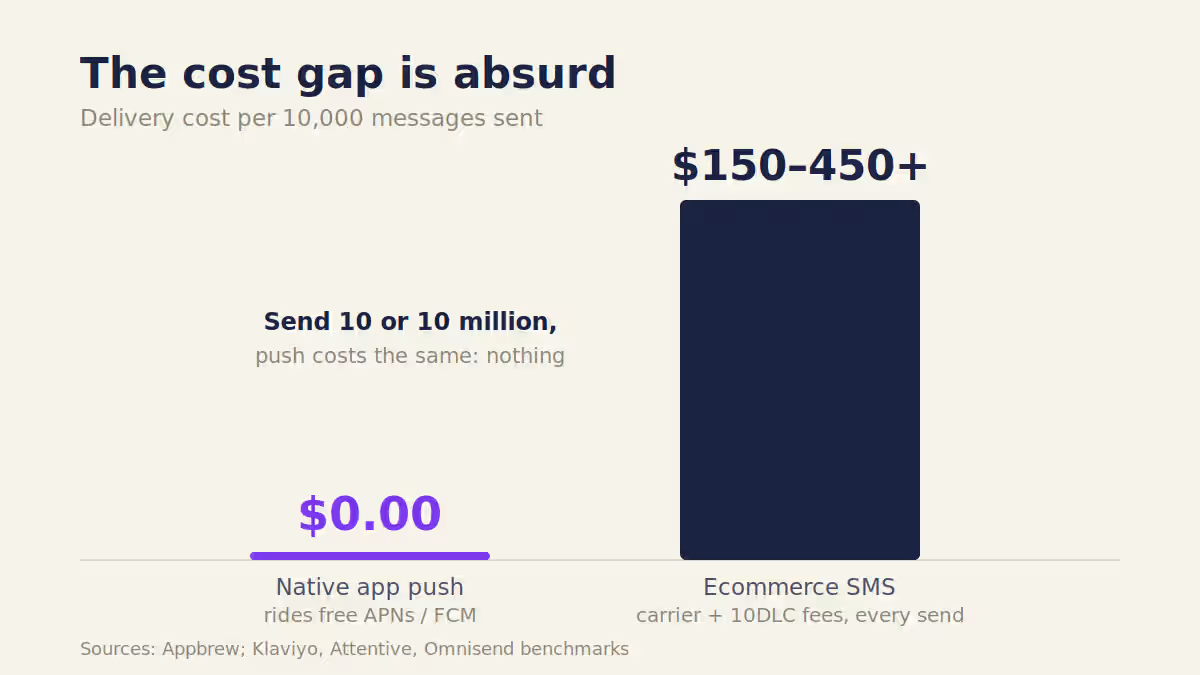
SMS pricing scales linearly with your list. Send more, pay more, forever. Native push has zero marginal cost because it rides Apple and Google's delivery infrastructure for free. Send 10 messages or 10 million, the bill is the same: nothing.
Interactivity favors the app
An SMS link kicks the shopper into a mobile browser, where they often hit a login wall or a slow-loading cart. A push notification deep-links into a native app where they're already signed in and Apple Pay or Shop Pay is one tap away. That single difference explains most of the conversion-rate gap. For a deeper look at how ecommerce brands can use mobile app push notifications to increase sales, see our complete guide.
The Data: Push vs SMS Performance in Ecommerce
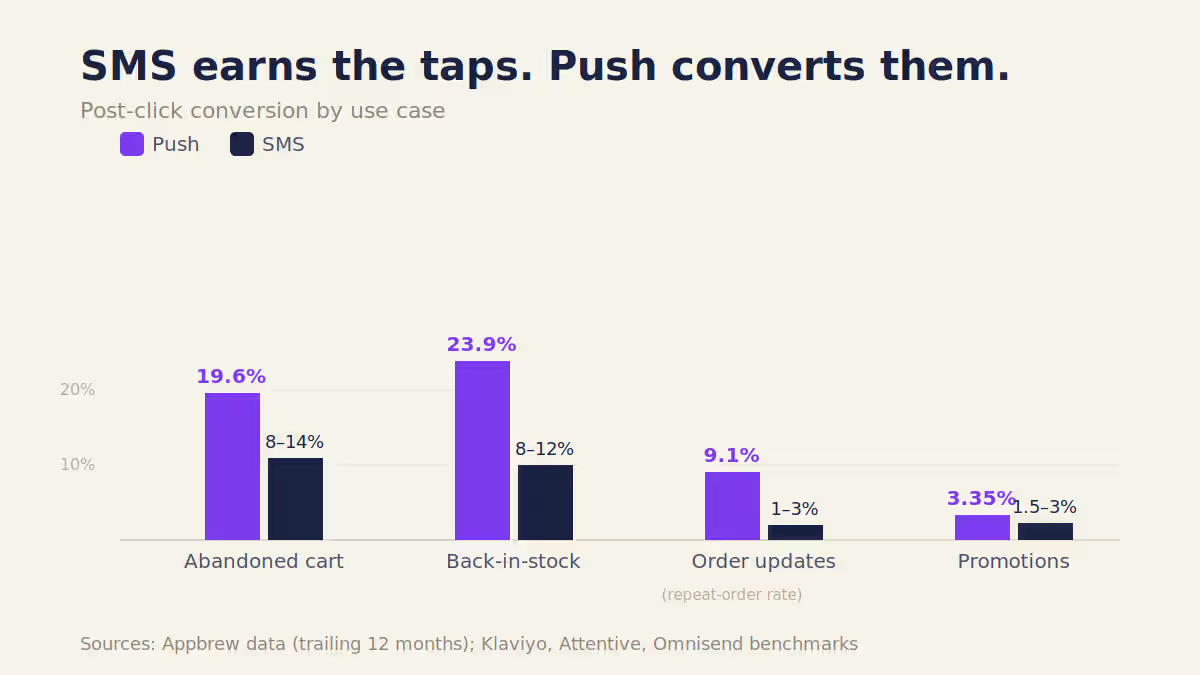
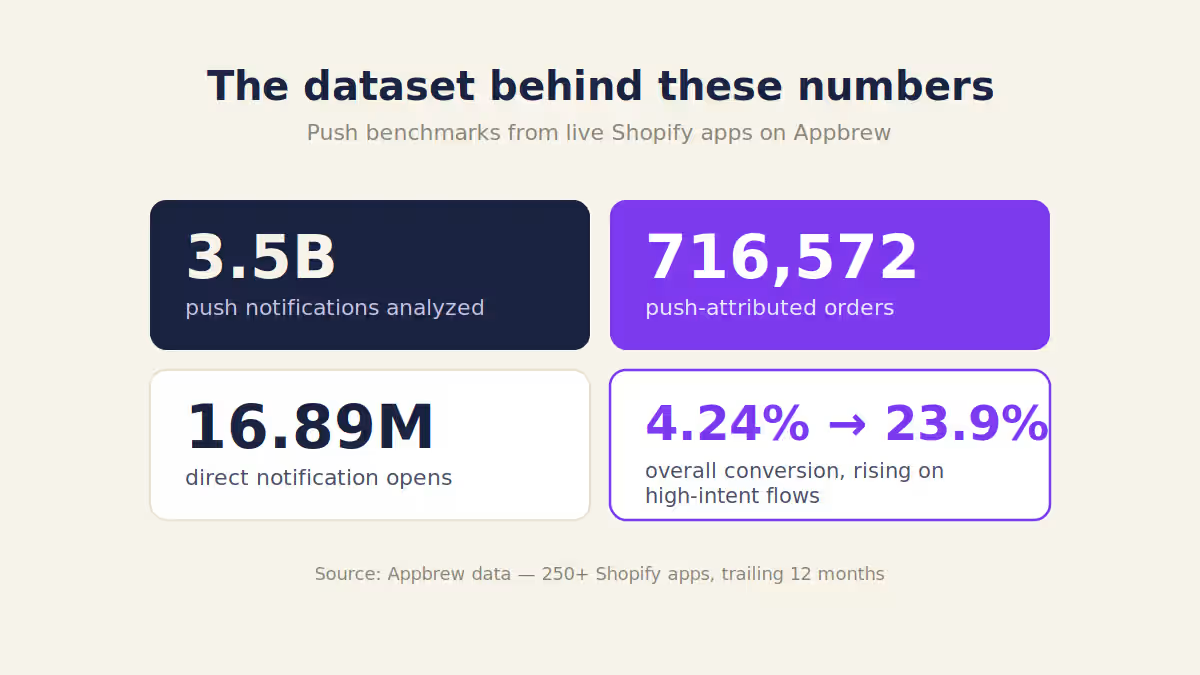
The "right" channel changes completely depending on what you're sending. Across 3.5 billion push notifications and 716,572 attributed orders on Appbrew-powered Shopify apps, one pattern holds in every use case: SMS earns more raw taps, push converts more of the people who tap.
Here's the whole picture at a glance, then the detail behind each row.
Abandoned Cart
- Push notifications recover carts at a 2.09% direct click-through rate, but 19.59% of the shoppers who tap go on to buy.
- SMS pulls a higher raw click-through (24–35%) with 8–14% of those clickers converting.
So SMS casts the wider net, while push converts roughly 1.5x more efficiently among people who engage, because the cart is already loaded inside the app with payment saved.
Back-in-Stock
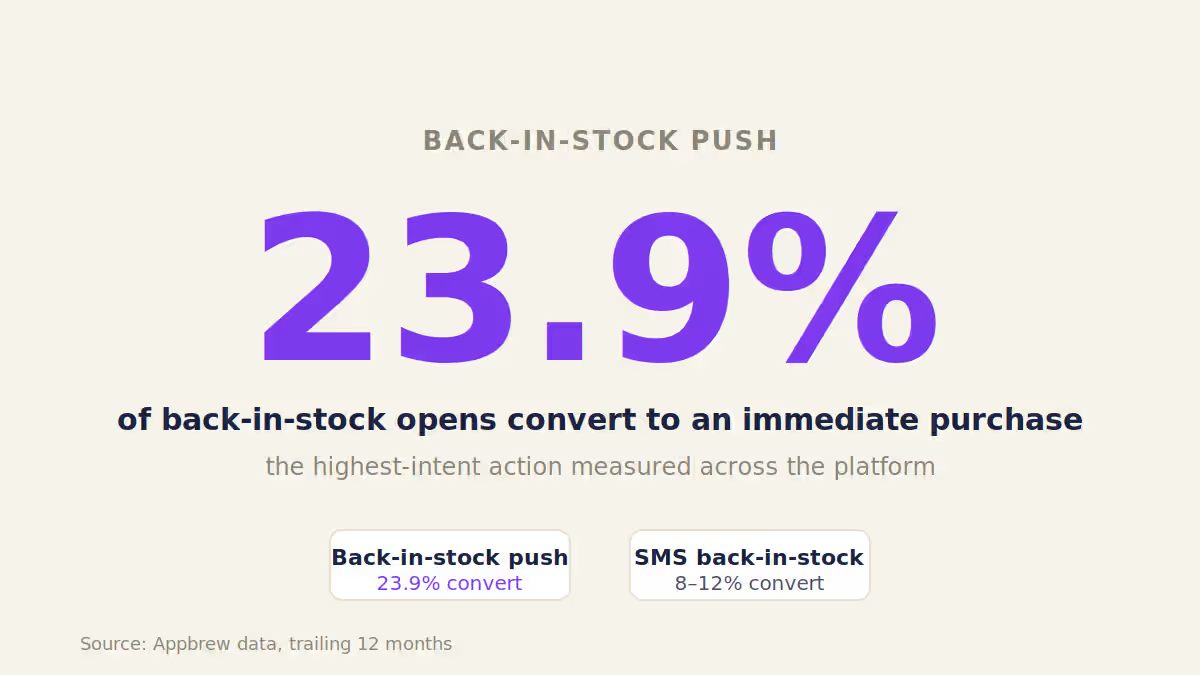
This is push's single strongest play. Back-in-stock notifications convert 23.93% of opens into immediate purchases, the highest-intent action measured across the entire platform. Someone who opted into an alert for a sold-out product, then got tapped on the shoulder the moment it returned, is about as close to a guaranteed sale as ecommerce gets.
SMS back-in-stock alerts perform well too (18–25% CTR, 8–12% conversion), but the deep-link straight to the product page gives the app version its edge.
Order Updates and Tracking
Order-update pushes hit a 4.16% direct click-through rate, the highest organic engagement of any automated flow. More interesting is what happens after the tap: 9.13% of those opens led to a follow-up order, generating 34,873 additional purchases from customers who came to check shipping status and left with something new in the cart.
SMS order updates get opened more (that ~98% read rate), but they drive far fewer re-orders (1–3%) because the text doesn't drop the customer into a browsable storefront the way the app does.
Distacart (San Jose specialty ecommerce) drove 106,391 page views and 142 repeat purchases off delivery-status pushes, converting shipping check-ins into re-orders.
Promotional Campaigns and Broadcasts
Broadcasts are where cost economics decide the strategy. Within the 3.5-billion-notification dataset, promotional broadcasts averaged a 0.45% direct tap-through rate, and post-click conversion 3.35%, generating over 516,000 orders. That click-through looks low next to SMS's 8–12%, until you factor in price.
Sending 10 promotional SMS campaigns a year to a 100,000-subscriber list runs $20,000–$40,000. The same 100 pushes to 100,000 app users costs zero. That's why SMS gets rationed to once or twice a week while push can run frequent, segment-specific drops without a finance conversation.
The takeaways that matter for your store
- Match the channel to the moment, not the other way around. Push owns triggered, high-intent flows (cart, restock, tracking). SMS owns broad reach to people who don't have your app.
- Push wins on unit economics every time. Zero marginal cost means you can send the campaigns SMS budgets force you to cut.
- Triggered beats broadcast, on both channels. A back-in-stock alert converts at 23.9%; an untargeted promo blast converts at 3.35%. Segmentation is where the money is.
- The gap widens with lifetime value. The more repeat buyers you have with your app installed, the more margin push leaves on the table if you're not using it.
In-app messaging vs push notifications
The primary difference between in-app messaging and push notifications is when and where the customer sees the message.
A push notification appears outside the app usually on the lock screen or in the device’s notification center. Its job is to bring an inactive or lapsed user back into the app. An in-app message appears only after the customer has opened the app. Its job is to guide, inform, or convert someone who is already active.
Push and in-app messaging should therefore be measured differently. Push performance is usually evaluated using opt-in rate, delivery, direct taps, and downstream conversions. In-app performance is better evaluated using message views, interaction rate, dismissal rate, feature adoption, and session conversion.
Are in-app messages better than push notifications?
Neither channel is universally better. Push notifications are better for re-engagement, while in-app messages are better for in-session guidance and conversion.
The strongest strategy uses them sequentially. A back-in-stock push can bring the shopper directly to a product page. An in-app message can then show available sizes, a loyalty benefit, or a complementary product after the shopper arrives.
How push and in-app messaging work together
.webp)
When to Use Which: A Decision Framework
Skip the "it depends" non-answer. Here's the actual logic.
Use SMS when:
- You need to reach mobile-web shoppers who haven't installed an app.
- The message is time-critical and universal, like a shipping alert or a same-day flash sale.
- You're early in retention buildout and don't have an app yet.
Use push when:
- You have a mobile app and want re-engagement that costs nothing per send.
- The action benefits from landing inside the app: cart recovery, back-in-stock, browsable promos.
- You're targeting repeat buyers whose lifetime value justifies owning the relationship.
Use both when: you're past roughly $1M in annual revenue and running structured retention. SMS covers the reach gap for anonymous and non-app traffic. Push carries the high-frequency, zero-cost load for your most valuable segment. The mistake isn't choosing wrong. It's choosing at all when you should be layering.
Do customers find push notifications and SMS annoying?
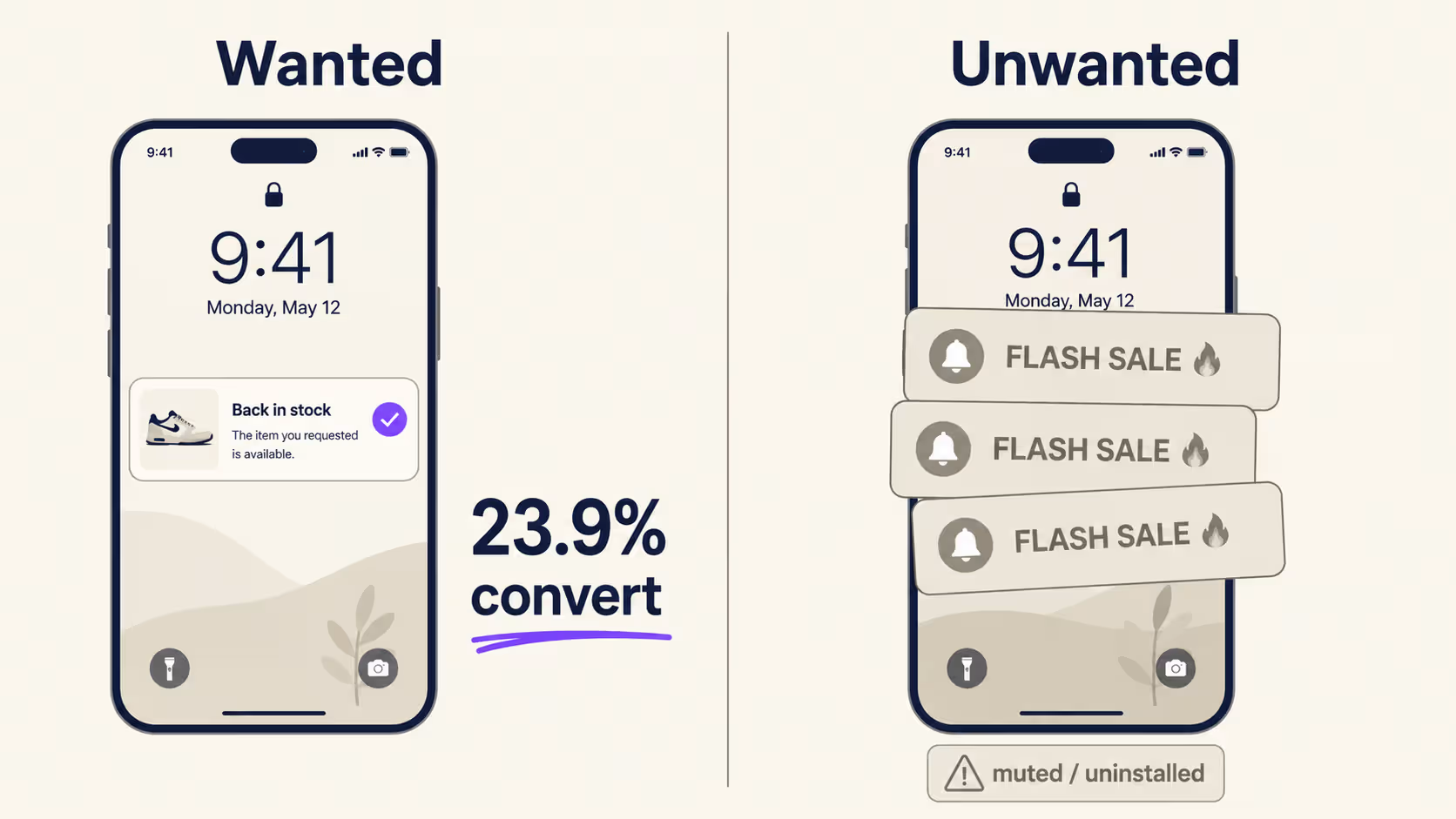
Yes, and how you handle that decides whether either channel survives. The conversion rates above assume customers keep receiving your messages. Push too hard and they don't. They mute notifications, unsubscribe from texts, or delete the app outright. The channel doesn't get weaker. It vanishes.
In a widely upvoted r/apple thread on forced marketing notifications, the dominant sentiment is zero tolerance: one unwanted promo and people turn notifications off for good, often uninstalling the app on the spot.
The line that separates brands keeping their opt-ins from the ones burning them is simple: wanted versus unwanted.
A back-in-stock alert someone requested converts at 23.9%. A third "FLASH SALE 🔥" in one week trains your best customers to mute you. Same channel, opposite outcome, and the only variable is whether the customer asked for the message.
Merchants who've run these channels for years reach the same conclusion. In a long r/shopify thread on whether SMS is worth it, the working consensus is to keep transactional and promotional messages on separate channels, and the enthusiasm is real: some sellers report five figures a year from SMS alone.
But nearly every success story carries the same warning underneath it, that marketing texts fall under TCPA consent rules push and in app messaging doesn't have.
So treat both channels as borrowed attention. Three habits protect them:
- Separate transactional from marketing. Order and shipping updates earn near-unlimited goodwill. Promos spend it. Don't let a promo ride in on a channel the customer keeps open for tracking.
- Respect the ceiling. Push tempts overuse because it costs nothing to send. Free to send is not free of consequence. Every extra promo raises the odds of an opt-out you can't win back.
- Trigger on intent, not on the calendar. The highest-converting messages in this post (cart, restock, tracking) fire because the customer did something. Segment-and-trigger beats blast-and-hope.
This is where Appbrew's AI growth agent, Milo, does the heavy lifting: you describe the audience in plain language, and Milo finds the right segment from behavior and purchase history, drafts the notification, and schedules it for peak engagement. Personalized, behavior-triggered sends are exactly what keeps notifications in the "wanted" column, and they're what turns a channel customers tolerate into one they act on.
How each notification type maps to the customer journey
The cleanest way to stay on the wanted side of that line is to match each message to where the customer actually is:
Final Thoughts
SMS and push aren't rivals fighting for the same budget line. SMS is your reach and acquisition-adjacent channel: universal, immediate, regulated, and metered. Push is your retention and lifetime-value engine: smaller audience, zero marginal cost, and unmatched conversion when the message is one the customer actually wanted.
The brands pulling ahead in 2026 stopped asking which channel to pick. They matched the channel to the moment, kept their frequency honest, and let each one do the job it's actually good at.
Ready to see what a branded mobile app and a zero-cost push channel could do for your store's retention? Book a demo with Appbrew.
{{cta2}}
FAQs
Is push notification better than SMS for ecommerce?
Push has zero cost per message and higher post-click conversion inside an app, while SMS has near-universal read rates and reaches customers without an app. For repeat buyers with your app installed, push usually wins on economics. For broad reach to anonymous shoppers, SMS wins.
Do push notifications cost money to send?
Native app push notifications have no per-message cost. They're delivered free through Apple's APNs and Google's FCM. Your only cost is building and maintaining the app. SMS, by contrast, charges per message, typically $150–$450 per 10,000 sends once carrier and 10DLC fees are included.
What's a good opt-in rate for push vs SMS?
Native app push opt-in typically runs 65–75% because installing the app already signals intent. SMS opt-in is far lower, usually 2–5% of web visitors, because it requires explicit consent capture under the TCPA.
Can I use SMS and push notifications together?
Yes, and most brands past $1M in revenue should. Use SMS to reach mobile-web and non-app customers, and push to re-engage app users at zero marginal cost. They cover different segments of the same customer base rather than competing.
What's the difference between SMS and in-app messaging?
SMS reaches customers on their phone whether or not your app is open, and requires opt-in consent. In-app messaging only appears while a customer is actively using your app, needs no opt-in, and costs nothing. SMS pulls people back; in-app converts people already there.
Why do my push notifications get low open rates on promotions?
Promotional broadcasts naturally see lower engagement (around 0.45% direct CTR) than triggered flows like back-in-stock (23.9% conversion) because they're untargeted. The fix is segmentation and restraint. Over-sending marketing pushes is the fastest way to get customers to disable notifications or uninstall entirely.