

.webp)
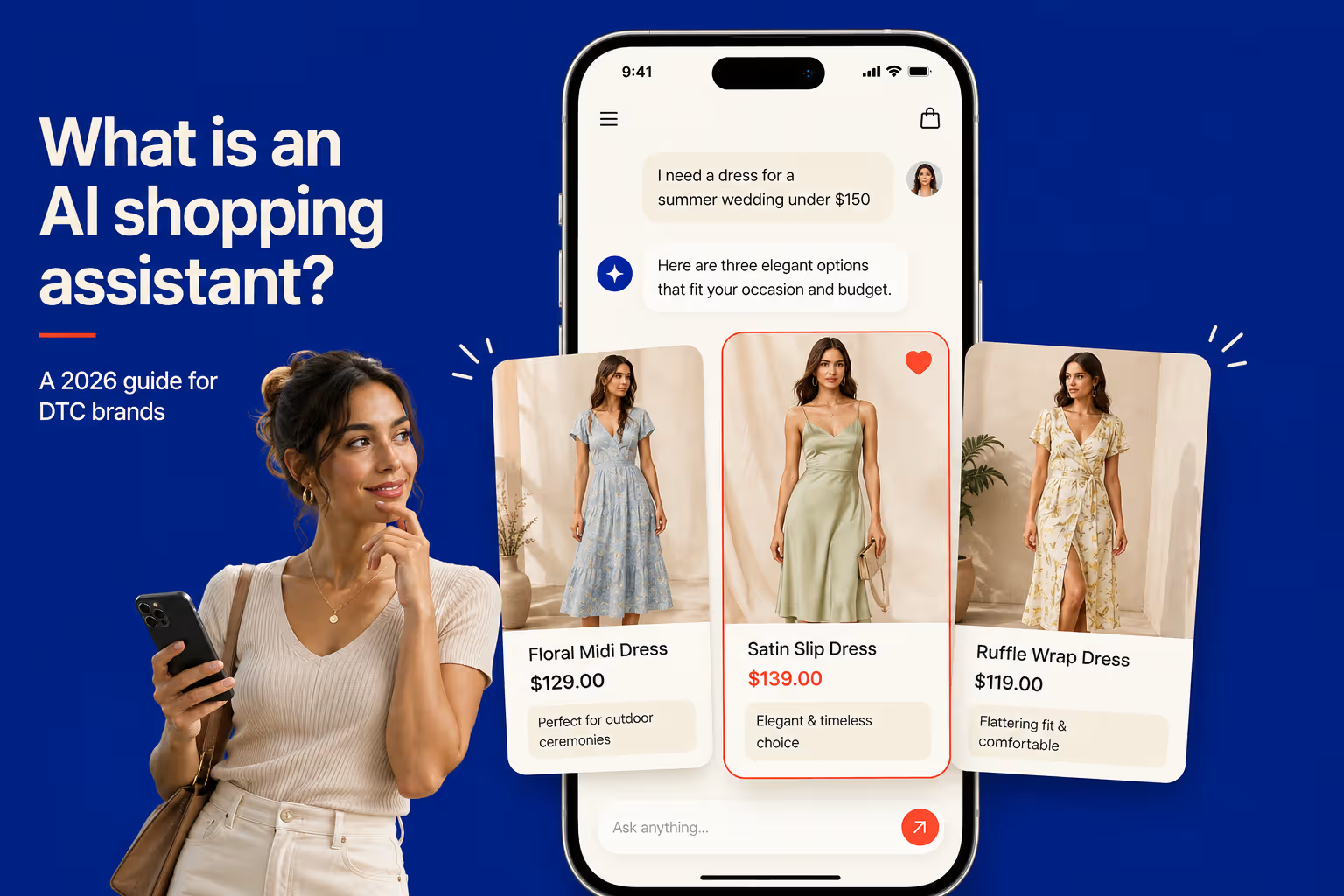
AI shopping assistants understand shopper intent, recommend products, answer questions, and guide checkout. Learn how they work and what they mean for DTC brands.
Your customer just asked ChatGPT for "the best running shoes under $100," picked one from three options it handed back, and bought it. Your store was never part of that decision.
That is happening millions of times a day now. In Adobe's 2025 survey of 5,000 U.S. shoppers, more than half said they now use AI tools like ChatGPT to shop.
And the assistants are getting good at closing. In 2025, Amazon's Rufus ai, was used by more than 300 million people and drove close to $12 billion in sales that Amazon says it would not have made otherwise. Shoppers who used it were 60% more likely to buy.
So the question you need to answer is not whether AI shopping assistants matter. It is who owns your customer when the AI does the shopping.
TL;DR
- An AI shopping assistant reads what a shopper wants in plain language, works out the intent, and points them to the right product. It reasons over your catalog instead of matching keywords like old site search.
- Whether it works comes down to your product data. Feed it stale inventory or thin descriptions and it will recommend something that is out of stock, and you lose the sale.
- What changed in 2026 is where these assistants live. Amazon's Rufus, Walmart's Sparky, Google's AI Mode, and Perplexity all run on their own surface, so the shopper and the data stay with them. This shift has a name, agentic commerce, and it is moving fast.
- Your own app is the one place you keep both the sale and the customer. That is the whole reason to run your own in-app assistant.
What is an AI shopping assistant?
An AI shopping assistant holds a real conversation with your shopper about what to buy. Someone types "white sneakers under $50 for a streetwear look," and instead of a filter menu, they get a short, ranked set of options that actually fit the request.
You have seen tools that claimed to do this before. Most did not. Here is the honest difference:
This got practical around 2024 and 2025, when large language models made intent understanding cheap enough to run inside a live store.
You will see the term written a few ways, conversational commerce tool, shopping AI assistant, AI-powered shopping assistant, but they all point at the same thing: software that understands what a shopper means and helps them buy.
How AI shopping assistants work
You can break almost any assistant down into four steps.
1. It reads intent.
"White sneakers under $50 for streetwear" becomes a price cap, a category, a color, and a style signal. It turns a sentence into something your catalog can be searched against.
2. It reasons over your catalog.
It matches that intent to your product data, attributes, reviews, and live inventory, then ranks what fits.
3. It answers and guides.
It handles the questions that usually stall a purchase, sizing, ingredients, "will this work for me," pulling answers straight from your product content.
4. It closes.
The strongest assistants build the cart, walk the shopper to checkout, and handle order tracking, returns, and reorders, the kind of post-purchase experience that brings the second order.
Step two is where most brands quietly lose. Your assistant is only as smart as the product data it reads. If your feed shows stock you do not have, the assistant will confidently recommend a sold-out product, and your shopper walks.
When a person hits a "sold out" banner they shrug and keep browsing. When an assistant hits bad data, it hands your shopper a dead end.
That makes clean, well-attributed product content the input that decides everything downstream. If you want to fix that part first, start with how to write product descriptions for AI shopping assistants.
What can an AI shopping assistant do? Key capabilities
The useful ones cluster into six jobs. Some assistants nail two or three. Very few do all six well, so this doubles as your checklist when you evaluate one.
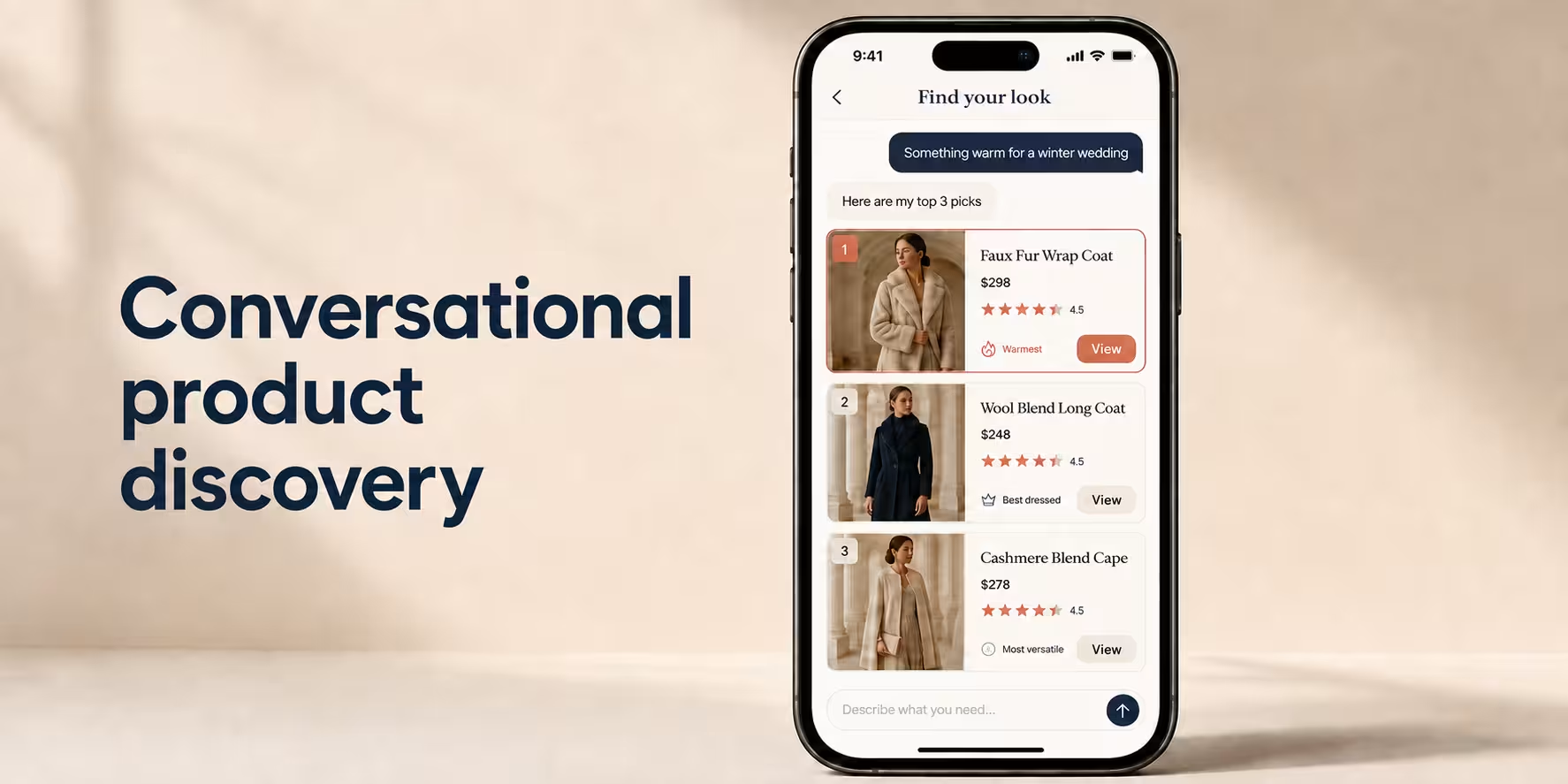
1. Conversational product discovery
It turns a plain-language goal into a shortlist, no filters required. A shopper types "something warm for a winter wedding" and gets three ranked options instead of a category page with 200 coats.
Moves: conversion rate. Shoppers who find the right thing fast buy more often.
2. Product Q&A
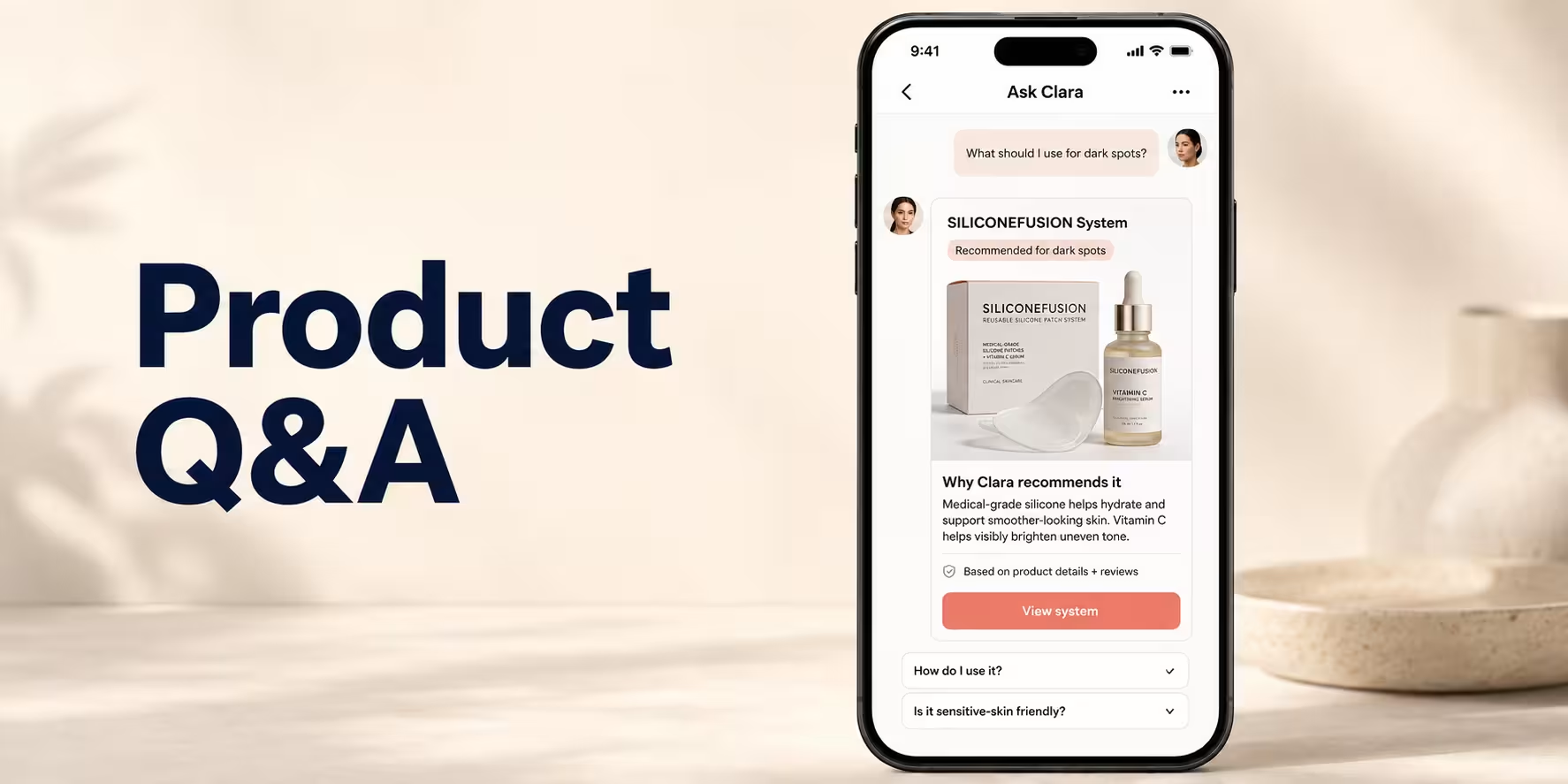
It answers fit, materials, ingredient, and compatibility questions straight from your catalog and reviews, so the shopper never leaves to go read a spec sheet. On Dermaclara's app, a shopper asked what to use for dark spots and Clara recommended the SILICONEFUSION system with the clinical reasoning behind it.
Moves: support ticket volume. Routine questions get answered before they become emails.
3. Recommendations and bundles
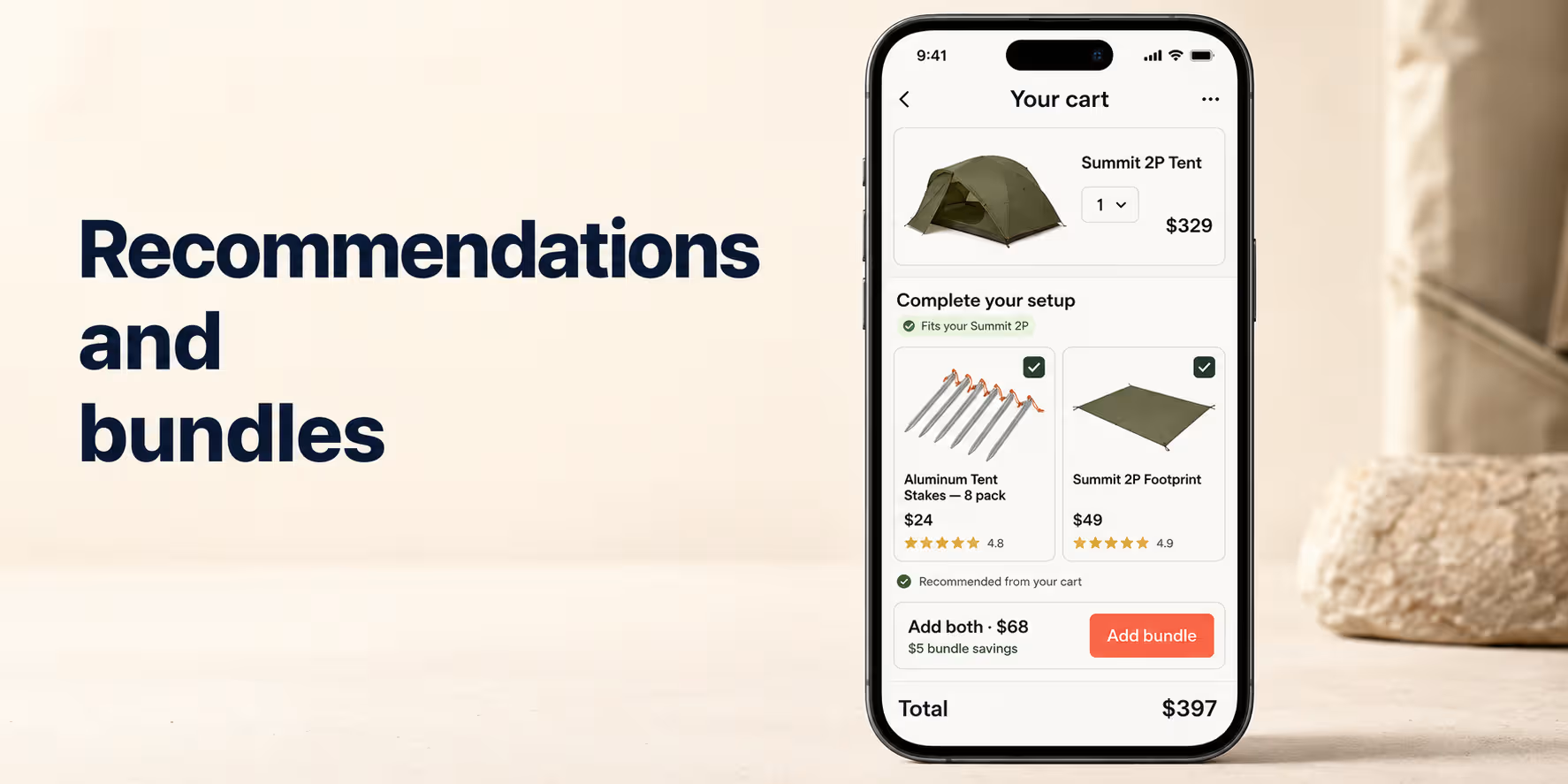
It reads behavior and cart contents to suggest the next item or complete the look, the digital version of "that jacket goes with these." A shopper adding a tent gets nudged toward the stakes and the footprint that fits it.
Moves: average order value. Relevant add-ons lift basket size without a discount, the payoff of good personalized product recommendations.
4. Cart building and in-chat checkout
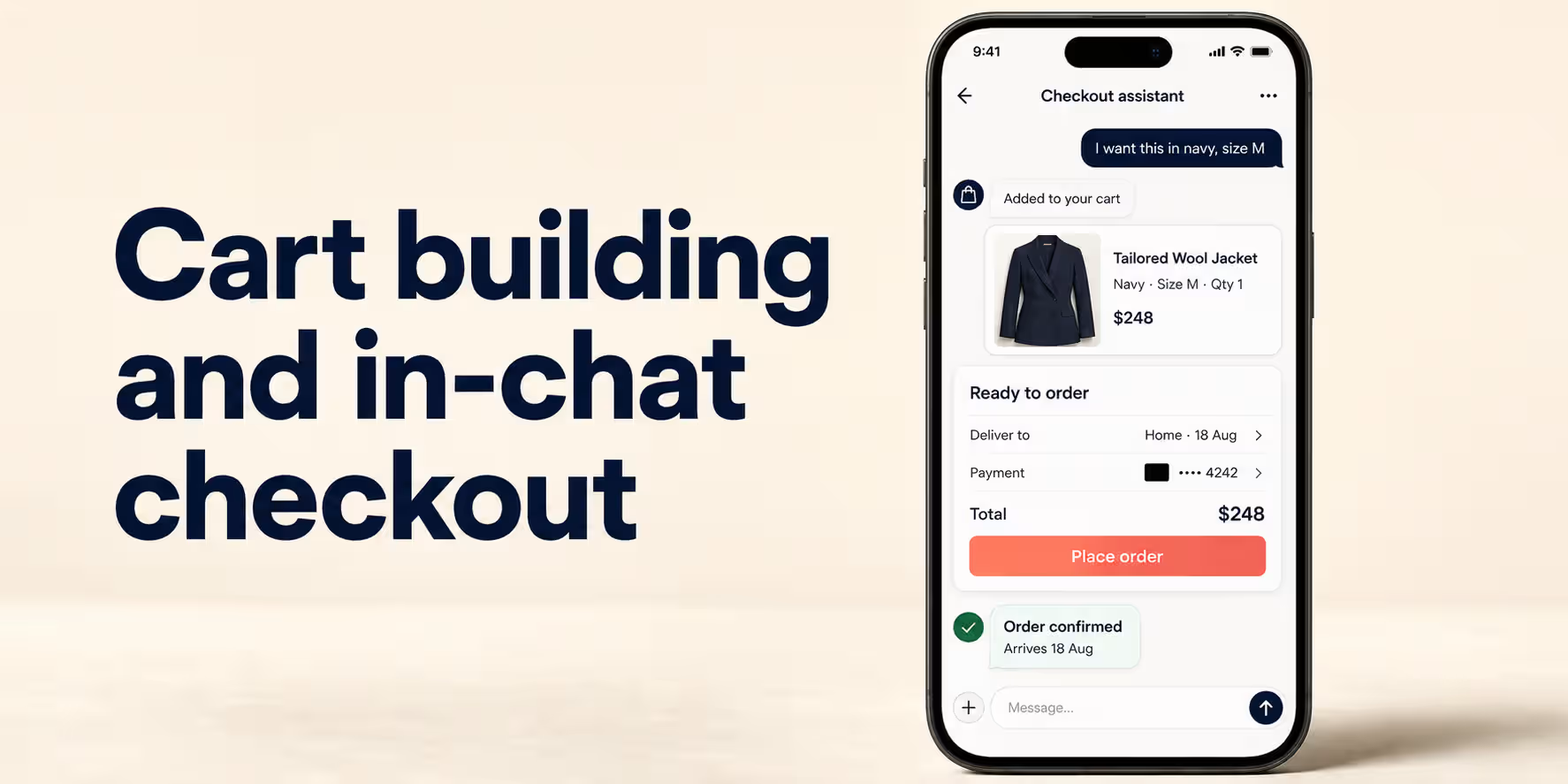
It adds items and moves the shopper toward purchase inside the conversation, so intent does not leak out during a five-tab checkout. Fewer steps between "I want this" and "it's ordered."
Moves: checkout completion rate. Every removed step is a saved sale.
5. Post-purchase support
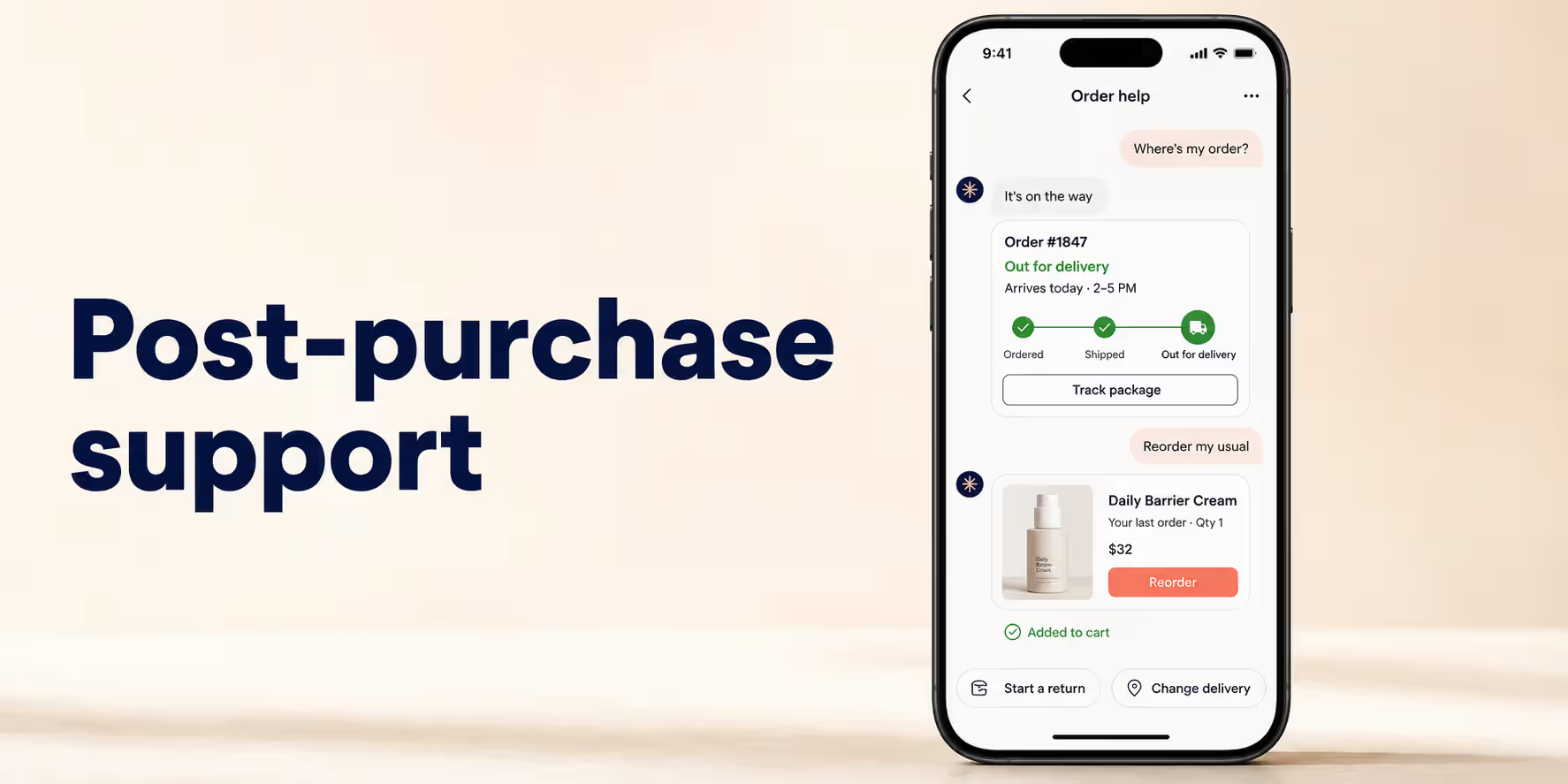
It handles order tracking, returns, and reorders on its own, so the questions that flood your inbox after a sale never become tickets. "Where's my order" and "reorder my usual" get resolved in the chat.
Moves: retention and LTV, the retention lever most brands underuse. A smooth after-sale is what brings the second order.
6. Merchant-side actions
A newer job: assistants that help you run the store rather than help a shopper buy. Drafting campaigns, personalizing the app, flagging where the funnel leaks. Appbrew's Milo is this kind, a growth assistant a marketer runs with plain-text commands.
Moves: operating speed. One marketer does what used to need a dev ticket.
Every one of those maps to a number you already watch:
If a vendor cannot tell you which of these their assistant improves, you are looking at a demo, not a purchase.
Types of AI shopping assistants in 2026
The first thing to check is who the assistant serves.
Shopper-facing vs merchant-facing AI shopping assistants
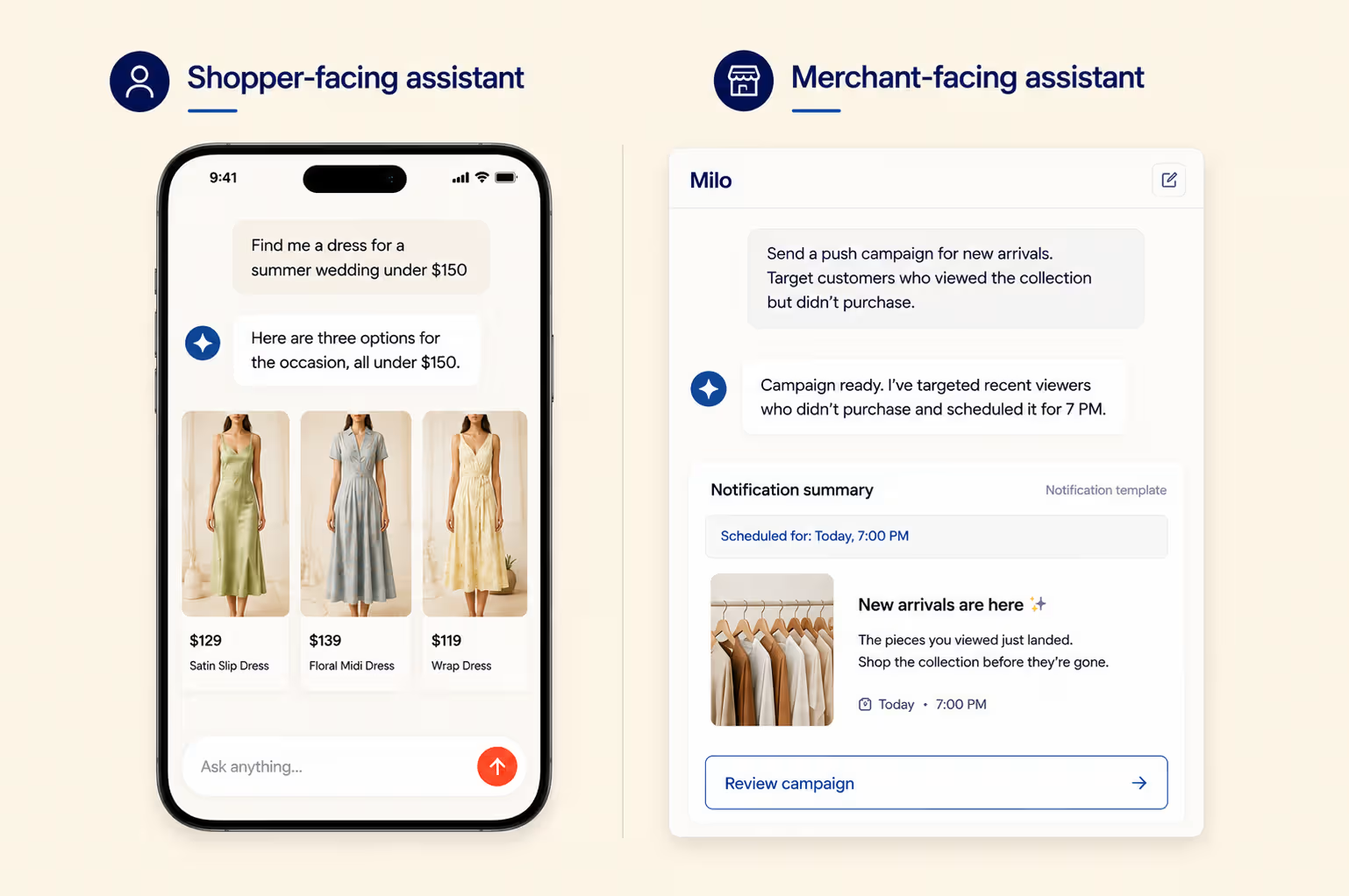
A shopper-facing assistant helps your customer buy. It is the concierge that reads intent, answers questions, and guides checkout. Appbrew's AI Concierge is this kind, sitting inside your app and talking to your customers.
A merchant-facing assistant helps you run the store. It drafts campaigns, personalizes your app, and shows you where the funnel leaks. Appbrew's Milo is this kind, built for your team rather than your shoppers.
AI shopping assistants by use case
Within the shopper-facing group, they specialize by the job the customer is trying to do:
- Personal and styling assistants read taste and occasion for the "help me put a look together" job. Fashion and beauty brands lean on these.
- Grocery assistants turn "what's for dinner this week" into a filled cart. Kroger built one on Google's Gemini, and Instacart runs Ask Instacart against the same need.
- Support-led assistants start with a service question and slide into a recommendation, which is where product Q&A and selling blur together.
- In-app, on-site, and marketplace assistants are the same idea in different homes. As the next section shows, the home matters more than any single feature.
Rufus, Sparky, and the AI shopping assistants your customers already use
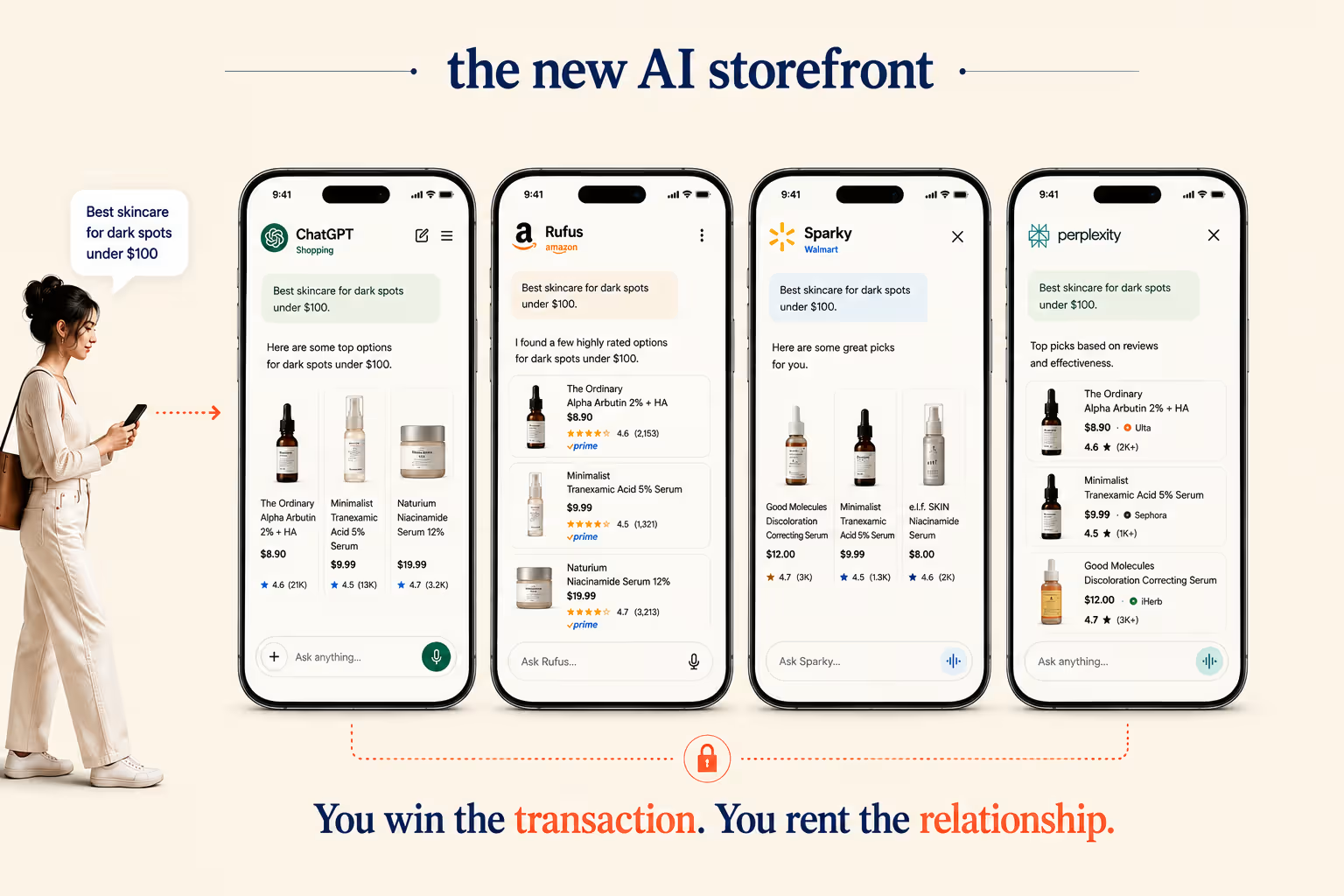
You are not competing with the idea of AI shopping. You are competing with specific assistants that already have your customer's attention. Here are the five that matter most in 2026, and what each one is built to do.
1. Amazon Rufus ai
Independent analysis of the 2025 holiday season found Rufus-assisted sessions converted at roughly 3.5 times the rate of sessions without it. Amazon also started running Sponsored Prompts inside Rufus, so the assistant is now ad space too.
2. Walmart Sparky
Launched June 2025, Sparky is built to replace keyword search with "tell me your goal and I'll handle it." Plan a cookout, get a cart.
In Walmart's own survey, 81% of shoppers said they used Sparky to check availability or review specs before buying, and Walmart credits it with lifting average order value. Walmart also wired it to OpenAI so shoppers can buy Walmart items straight inside ChatGPT.
3. Perplexity Buy with Pro
Perplexity turned its answer engine into a store. Ask a shopping question and you get product cards with pricing and reviews, plus one-click checkout through its PayPal partnership. It went free for U.S. users ahead of the 2025 holidays, and it pulls live product data from Shopify.
4. Google AI Mode
Google pushes discovery and checkout into the search surface itself, with agentic checkout routing the transaction through the protocol it built with Shopify. This is the assistant sitting where most of your shoppers already start.
5. ChatGPT Shopping
With Instant Checkout, a shopper can research and buy inside ChatGPT without ever visiting your site. OpenAI charges you a fee on completed orders on top of standard payment processing.
Every one of these keeps the shopper, and the data the shopper creates, on its own surface. When your customer finds and buys your product through Rufus or Perplexity, you might still get the sale, but you lose the discovery moment, the behavioral data, and sometimes a cut of the margin. You win the transaction and rent the relationship.
So which one should you actually use? That depends on what you are trying to protect.
What AI shopping assistants mean for your store
You are not going to out-build Amazon, so do not try. What you can do is make your own surface the best place to buy from you, and put your assistant there.
An app is the strongest version of that surface, for a simple reason. It is the one channel where you keep both the sale and the customer data, and where your assistant runs on your terms instead of a marketplace's.
Across 250+ Shopify brands on Appbrew, apps convert at roughly 3x mobile web, with average order value up about 1.3x and lifetime value up 6x.
The features that make an app pull its weight as a selling surface are the ones to look for:
- AI Concierge. The in-app assistant that reads intent, recommends by budget and taste, answers product questions, and checks out. This is your best in-store rep, in every customer's pocket.
- Milo, the growth assistant. Lets a marketer change the app or draft and schedule push campaigns with plain-text commands, and suggests send times from shopper behavior.
- Hyper-personal discovery. Every interaction sharpens the next recommendation, so the app learns what a customer wants before they type it.
- Native subscriptions, loyalty, and reviews. Reorders, points, and reviews live inside the app, which is what turns a one-time buyer into a repeat one.
- Sub-second, React Native performance. Speed is not a vanity metric here. A concierge that answers instantly on an app that loads instantly is the difference between a guided sale and an abandoned one.
Brands already selling with an in-app AI shopping assistant
- Dermaclara (skincare, built on Appbrew)
Dermaclara was the first brand to launch Appbrew's AI Concierge, named Clara, inside its app.
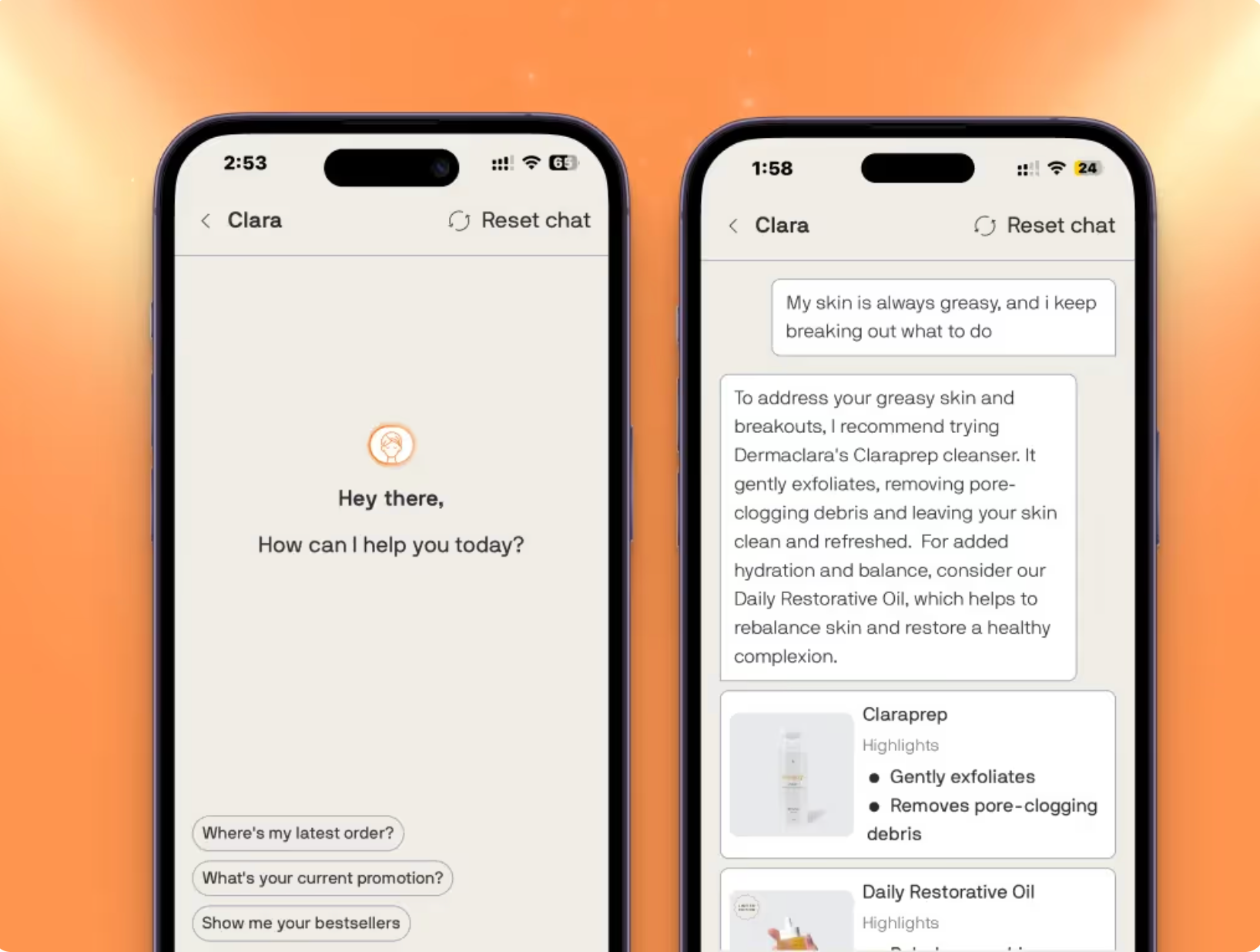
- How they use it: Clara reads each shopper's skin goals, recommends products, routines, and bundles, and answers usage questions in real time. A shopper asks what to use for dark spots that will not fade, and Clara recommends the right system with the clinical reasoning behind it, then handles reorders and support without a ticket.
- What it did for them:
- In their words: their CMO called the results strong across "customer experience, revenue, and retention," and rated the platform a 10 out of 10.
Similarly, Karma and Luck saw a 50% lift in conversion rate after moving mobile onto a dedicated app, and FREAKINS reported over 3x conversions after launch.
{{cta}}
Best AI shopping assistants in 2026 compared
The best AI shopping assistant for you depends on one thing: where you want it to run. Inside a marketplace you do not control, on your website, or in an app you own.
A word on "free." ChatGPT and Perplexity really are free for shoppers, and Rufus costs nothing inside Amazon. But free to the shopper is not free to you. A marketplace assistant that costs you no money still costs you the customer data and often the margin, which is a bill that shows up later. The assistants you pay for are usually the ones that keep the customer on your side of the fence.
If what you want is an assistant that keeps the shopper, the data, and the relationship on ground you own, you want an in-app concierge, not a marketplace one. That is what the AI Concierge does.
For the wider toolset beyond assistants, see our roundup of the 30+ best AI tools for ecommerce.
How to add an AI shopping assistant to your Shopify store
If you are on Shopify, you have three ways to add an AI shopping assistant, and they are not equal. Pick based on where you want the assistant to live and how much of the customer relationship you want to keep.
Option 1: A storefront chat widget (fastest, shallowest).
Install an assistant app from the Shopify App Store, connect it to your catalog, and it drops a chat widget onto your website. Most go live in a few minutes and need no code. The four steps are the same across nearly every tool:
- Install from the Shopify App Store. Pick a tool, install it, and approve the connection to your store.
- Connect your content. The assistant syncs your product catalog and pulls from your FAQs, shipping policies, and size guides. The more it can read, the more accurately it answers.
- Match it to your brand. Set the widget's look, tone of voice, and which questions get escalated to a human.
- Go live and read the question log. Once it is published, the most useful thing to watch is what shoppers actually ask, because that tells you where your product pages are failing.
This works, but it sits on your website, and it does nothing for the mobile app channel where your best customers convert 3x higher.
Option 2: Sync your catalog to the AI channels (do this regardless).
Through Shopify's Agentic Storefronts, you can connect your products to ChatGPT, Google AI Mode, Gemini, and Copilot from your Shopify admin, so your products show up when shoppers ask those assistants for recommendations. This is not optional hygiene anymore. Three things make or break whether those assistants surface you:
- Schema markup, so an assistant knows exactly where to find each product's price, color, and availability.
- A single source of truth for product materials, care, and shipping, so answers stay accurate and consistent.
- Clean, complete product data, which is the input every agentic surface reads.
For detailed guidance read: how to write product descriptions for AI shopping assistants.
The catch: this makes you findable inside someone else's assistant. You still do not own the shopper or the data.
Option 3: Put the assistant inside your own app (keeps the customer).
The other two options make you findable inside someone else's assistant. This one makes the assistant yours. With Appbrew, you turn your Shopify store into a native app and the AI Concierge ships inside it, already wired to your catalog, so there is no separate integration to maintain.
Dermaclara ran this play and lifted app conversion 32%. New to the app route? Turning your Shopify store into a mobile app covers the setup.
Here is the honest way to choose:
The bottom line
The assistants are not slowing down. Rufus, Sparky, and the rest will keep getting better at turning a question into a sale, and more of your customers will start there. The brands that come out ahead are the ones treating their own app as the place that conversation happens, with an assistant that works for them instead of a marketplace. See what an in-app AI Concierge does for your store.
{{cta2}}
FAQs
What is an AI shopping assistant?
It is a conversational tool that reads a shopper's plain-language request, recommends products by reasoning over your catalog, and can take them through to checkout. Unlike site search or a scripted chatbot, it understands intent and handles follow-up questions.
What is a good name for an AI shopping assistant?
The ones in the market keep it short and personable: Amazon's Rufus, Walmart's Sparky, Shopify's Sidekick, Appbrew's Milo. A name that is easy to say and hints at "helpful companion" tends to land better than a literal "shopping bot."
Are AI shopping assistants free?
Some are. ChatGPT and Perplexity have free shopper tiers, and Rufus is free inside Amazon. Assistants that run on your own site or app are usually paid, because they keep the customer and the data with you instead of the platform.
What is the difference between an AI shopping assistant and a chatbot?
A chatbot follows a script and breaks on anything it was not written for. An AI shopping assistant reasons over your catalog and reviews, adapts to questions nobody anticipated, and can carry a shopper from intent to checkout.