

.webp)
Learn how to optimize product descriptions, with before-and-after rewrites and category templates, so ChatGPT, Rufus, and Perplexity pick your products.
A shopper opens ChatGPT and types "a fragrance-free moisturizer for sensitive, acne-prone skin under $30." The assistant returns three products and a reason for each. Your product is not one of them.
Not because it is wrong for her. Because your description never gave the assistant the facts it needed to know it was right.
This is the new front door to your catalog. When a shopper asks an AI shopping assistant for a recommendation, it reads your product page the way a careful human would, looking for concrete facts it can trust and repeat. Thin, vague, or adjective-heavy copy gets skipped.
This guide covers how these assistants actually read a page, the best practices that get you recommended, before-and-after rewrites, and copy-paste templates for the main DTC categories.
TL;DR
- AI shopping assistants do not keyword-match. They convert a shopper's question into meaning, retrieve the products whose descriptions are the closest match, and answer using only what they retrieved.
- A missing fact is not guessed. If your description does not state the skin type, the fit, or the dosage, the assistant cannot recommend you for it, and often says "check the product page" instead.
- The fixes that matter most: lead with concrete specs, add explicit "Best for" and "Not ideal for" lines, answer the real questions from your reviews and support tickets, and keep the feed current.
- The same clean product data that gets you recommended by ChatGPT and Perplexity also powers your own in-app assistant, so the work pays off on every AI surface at once.
How AI shopping assistants actually read a product page
You cannot optimize for a system you do not understand, so start here. It takes two minutes and explains every tactic below.
When a shopper asks a question, the assistant does not scan for keywords. It runs a process called retrieval-augmented generation, or RAG, which is the dominant production pattern behind ChatGPT Shopping, Perplexity, Rufus, and in-app assistants alike.
It works in three steps:
1. It converts the question into meaning.
The query becomes a vector, a mathematical representation of intent. "Lightweight running shoes" and "breathable trail runners" land close together even though they share no words.
2. It retrieves the closest products.
The system searches your catalog for the descriptions whose meaning sits nearest the query, and pulls the top matches as candidates.
3. It answers from only what it retrieved.
The model generates a recommendation using the facts in those descriptions, and nothing else. Guardrails tell it to fall back or stay silent when the evidence is missing, never to guess a price or invent a spec.
In practice that looks like this: a shopper asks "is this jacket waterproof," and if your description only says "great for rainy days," the assistant will not upgrade that to "yes, waterproof." It hedges, "the description mentions it is suited for rain, but does not confirm a waterproof rating", or it moves on to a competitor whose page says "10,000mm waterproof rating." The vague phrase cost you the sale.
Two rules fall out of this, and every best practice below comes from them:
- The assistant can only recommend what it can retrieve, and it retrieves on meaning. So your description has to state the meaning plainly.
- The assistant answers only from what it pulled. A missing fact is not guessed. It becomes "please check the product page or contact support," and you lose the sale.
If you want the wider picture first, how these assistants work, the capabilities they have, and what Rufus, Sparky, and Perplexity mean for your store, start with our full guide to what an AI shopping assistant is and how it works.
8 best practices for optimizing product descriptions for AI shopping assistants in 2026
AI assistants are far more selective than a page of search results. SOCi's 2026 Local Visibility Index, built on 350,000+ locations, put it bluntly: as AI-powered assistants replace traditional search results with a single recommended answer, visibility is no longer about ranking, but about being chosen, and the cost of invisibility has never been higher.
A search page shows ten links. An assistant names three products. Being one of those three is the new page one, and the thing that decides it is not your ad budget, it is whether your product data is legible to a machine.
In 2026, data quality now matters more than traditional marketing, because agents select products using structured product data, not brand awareness.
Eight changes get you into that shortlist. Each is tied to how retrieval actually works.
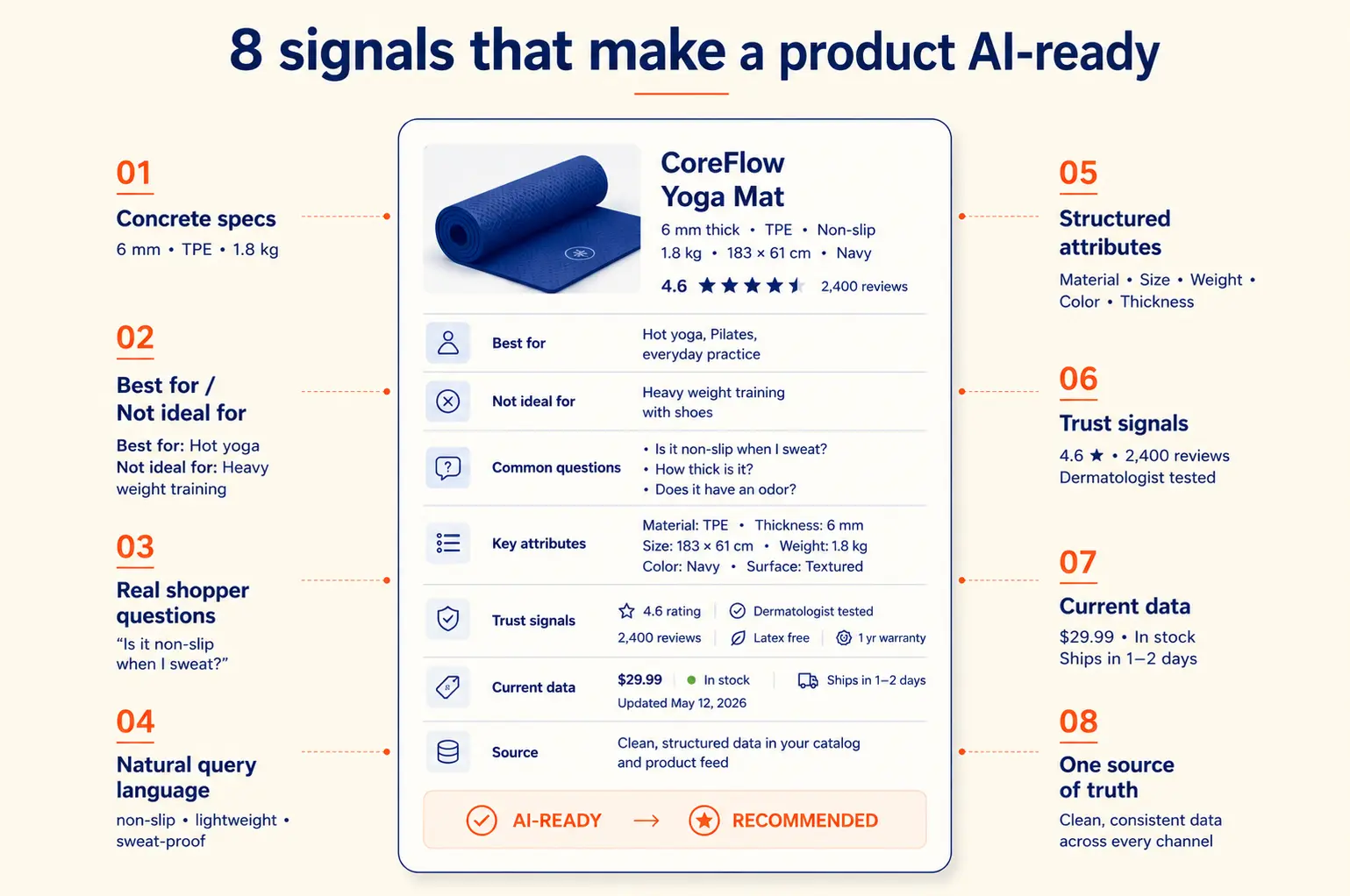
1. Lead with concrete specifications, not adjectives
"Premium quality yoga mat" gives the retrieval layer almost nothing to match against, because no shopper asks for "premium." They ask for "a thick mat that won't slip when I sweat."
Rewrite it as "6mm thick, cushioned TPE, textured non-slip surface, 1.8kg" and you have handed the system four attributes it can match to real queries and quote back with confidence. Specificity here is not a style preference.
The model is constrained to the retrieved text, so if a fact is not in the description, it does not exist as far as the assistant is concerned.
2. Add explicit "Best for" and "Not ideal for" lines
This is the highest-leverage change most catalogs can make. Explicit use-case lines raise the semantic match score when a shopper asks an intent-driven question, because the description now carries the persona and the problem, not just the product.
- Best for: oily skin, humid weather, daytime use under makeup
- Not ideal for: dry or sensitive skin
Real example: On the Dermaclara app, this is exactly the pattern that lets its concierge, Clara, answer "what should I use for dark spots that won't fade" with a specific product and the reasoning behind it, instead of a dead end. You can see the full Dermaclara story here. The "not ideal for" line does quiet work too: it filters out the wrong buyer before checkout, which cuts returns.
3. Answer the real questions shoppers actually ask
Shoppers give assistants long, constrained questions, "a bag that fits under a plane seat, handles rain, and looks professional", not "black bag." Your copy should answer those questions in the shopper's own words.
The best source for that phrasing is already in your business:
- Reviews: the exact language customers use to describe fit, feel, and use.
- Support tickets: the questions that come up before purchase, again and again.
- On-site FAQ and chat logs: the objections that stall a sale.
If your support inbox answers the same sizing question fifty times a week, that question belongs in the product description, because it is the exact query a shopper will type into an assistant.
4. Write for the question, not the keyword
Old SEO copy stuffed "buy cheap moisturizer online." That phrasing is invisible to an assistant, because nobody asks a concierge to "buy cheap moisturizer online." They ask for "a fragrance-free moisturizer for sensitive, acne-prone skin."
Name the skin type, the concern, and the use case in natural sentences. You are no longer writing for a crawler counting keyword density. You are writing for a system that reads for meaning and rewards clarity over repetition.
Real example: CeraVe's product pages name the skin type and the actives directly, "developed for dry skin, with three essential ceramides and hyaluronic acid." That is why assistants reliably surface it for symptom-based queries like "moisturizer for a damaged skin barrier."
Done right, the same copy reads better for the human too, which is the payoff behind good personalized product recommendations.
5. Structure the facts so a machine can extract them cleanly
Grounded answers depend on the assistant pulling precise facts into its context window without ambiguity. When attributes sit in clear key-value pairs or a bulleted spec block, the system injects exact facts and answers confidently. When the same information is buried in a paragraph, it produces hedged, generic replies or dead ends.
A quick comparison:
The right column answers a shopper's fit, fabric, and care questions in one pass. The left column answers none of them.
6. Add trust signals the model can cite
Assistants weigh products that carry verifiable evidence, and the structured commerce protocols make this explicit. Google's Universal Commerce Protocol emphasizes rich structured product signals, with schema markup including Product, Offer, and AggregateRating.
In plain terms, give the model quotable proof:
- Review count and average rating ("2,400+ reviews at 4.6 stars")
- Certifications and testing ("dermatologist-tested," "third-party lab verified")
- Ingredient or material sourcing
- Expert or clinical mentions
"Best-in-class" and "high quality" give the assistant nothing to verify, so it stays silent about you. Concrete proof gives it something to repeat.
7. Keep the description and the feed current
Assistants prioritize recently updated content, and staleness is a specific, documented failure mode. When a product is discontinued or repriced but the index refreshes on a slow batch schedule, the assistant quotes the old price because the stale data still surfaces as the top match. That is a broken experience at the point of purchase.
Accurate, live descriptions are not a one-time task. They are the ongoing input that keeps you recommendable, which is also why a maintained feed on a surface you own beats a set-and-forget catalog. The agentic commerce guide develops that point in full.
8. Write the same facts for every AI surface, once
The work you do here is not for one assistant. External crawlers like GPTBot and PerplexityBot and your own in-app assistant read the same underlying data: structured schema, explicit attribute tables, and clear problem-solution framing.
That means a brand with rich Shopify metafields and clean product schema feeds every channel at once, no duplicate effort. Optimize the description properly and you show up in ChatGPT, in Google's AI Mode, and inside your own app from a single source of truth. Skip it, and you are invisible in all of them together.
{{cta}}
Before and after: product descriptions rewritten for AI
Principles are easier to apply when you see them. Here are three rewrites across common DTC categories.
Skincare
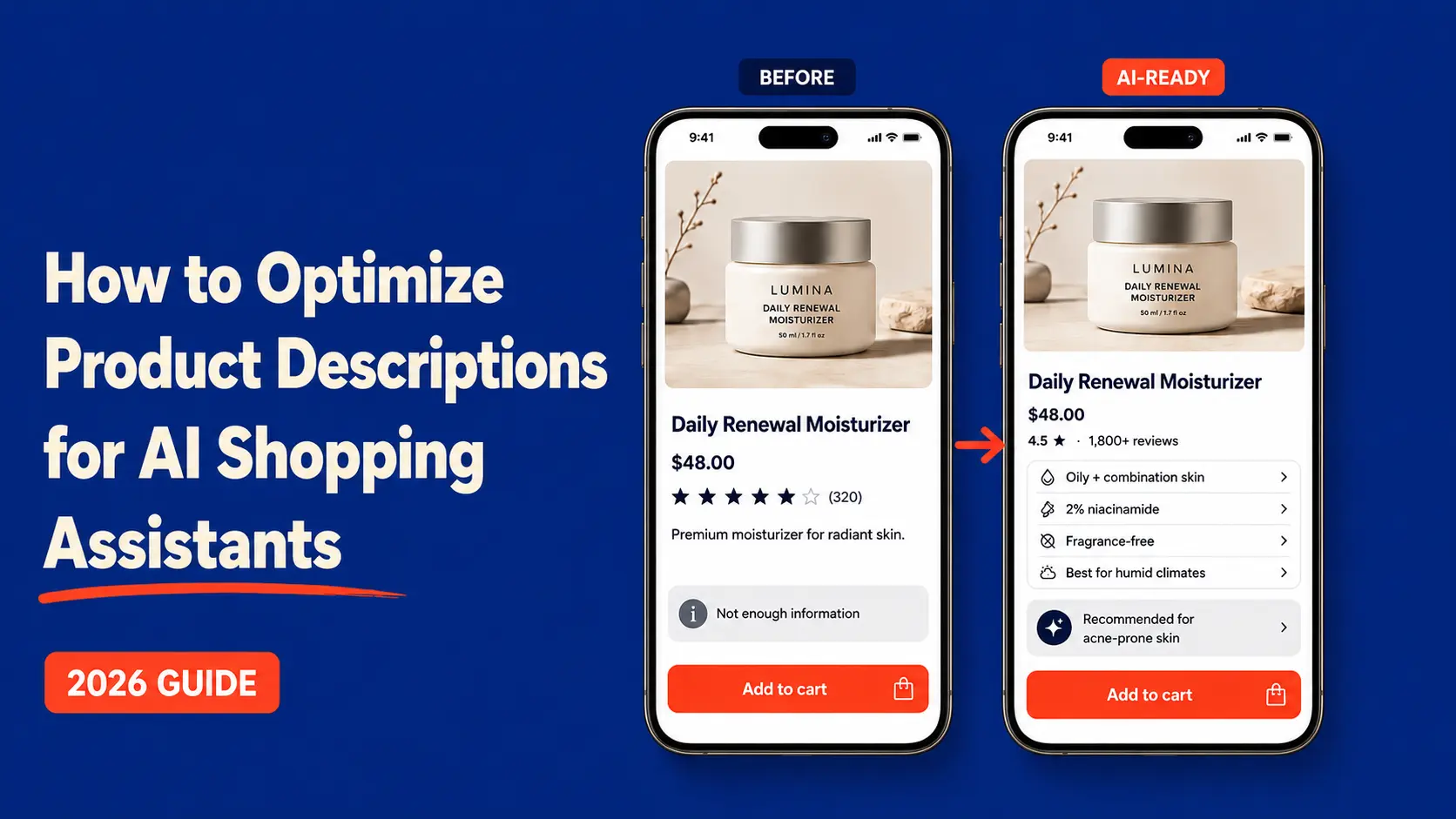
- Before: "Our luxurious, best-in-class moisturizer leaves your skin feeling amazing. Premium ingredients for a radiant glow."
- After: "Lightweight gel moisturizer for oily and combination skin. Fragrance-free, non-comedogenic, with 2% niacinamide and hyaluronic acid. Best for: daytime use under makeup, humid climates. Not ideal for: very dry skin. Step 3 of 4 in a morning routine. 1,800+ reviews, 4.5 stars."
- What changed: skin type, actives, use case, routine placement, and trust signals, every one a fact an assistant can match and quote.
Apparel
- Before: "A versatile, high-quality jacket that's perfect for any occasion. You'll love the premium feel."
- After: "Water-resistant shell jacket. Fit: true to size, relaxed through the shoulders. The model is 6 '1 " wearing medium. Shell: 100% recycled nylon, taped seams. Best for: light rain, commuting, layering over a hoodie. Machine washable."
- What changed: fit profile, model reference, fabric, weather use case, and care, the exact things a shopper asks about before buying.
Supplements
- Before: "Boost your health with our powerful, effective daily supplement made from the finest ingredients."
- After: "Daily magnesium glycinate, 400mg per serving, for sleep and muscle recovery. Take one capsule 30 minutes before bed. Vegan, non-GMO, third-party tested for purity. Best for: people with trouble falling asleep. Not intended for pregnant or nursing users, consult a doctor."
- What changed: dosage, timing, certifications, use case, and a safety boundary, concrete, quotable, and honest.
Product description templates for AI shopping assistants, by category
Use these attribute orders as a skeleton. Each is built around the questions assistants get most in that category, so filling them in makes your products retrievable by design.
Beauty and skincare
- Target skin type or concern
- Key active ingredients and percentages
- Texture and finish
- Routine order (for example, step 2 of 4)
- Fragrance-free, cruelty-free, or other badges
- Best for / Not ideal for
Example: "Gel-cream moisturizer for oily and combination skin. 2% niacinamide, hyaluronic acid. Lightweight, matte finish. Step 3 of 4 in a morning routine. Fragrance-free, cruelty-free. Best for: humid climates, use under makeup. Not ideal for: very dry skin."
Apparel and footwear
- Fit guide (true to size, oversized, size up)
- Model stats (height, size worn)
- Fabric blend and stretch
- Care instructions
- Best for (travel, layering, occasion)
Example: "Relaxed-fit shell jacket, true to size. Model is 6'1" wearing medium. 100% recycled nylon, taped seams, no stretch. Machine washable. Best for: light rain, commuting, layering over a hoodie."
Supplements and health
- Key benefit and timeline
- Active ingredients per serving
- Suggested intake and timing
- Dietary certifications (vegan, non-GMO, third-party tested)
- Safety boundary or "not intended for"
Example: "Magnesium glycinate for sleep and muscle recovery. 400mg per serving. Take one capsule 30 minutes before bed. Vegan, non-GMO, third-party tested. Best for: trouble falling asleep. Not intended for pregnant or nursing users, consult a doctor."
Home and lifestyle
- Dimensions and weight
- Material, source, and durability
- Care and cleaning
- Compatibility or assembly requirements
- Best for (space, use case)
Example: "Solid oak side table, 45cm wide, 8kg. FSC-certified wood, water-resistant finish. Wipe clean. Tool-free assembly, fits standard sofa height. Best for: small living rooms, as a nightstand."
Across the DTC categories, the questions that most often stump an assistant when the data is missing are sizing and fit in apparel, ingredient and skin-type compatibility in beauty, and dosage and allergen details in supplements. If you fix nothing else, fix those.
Beyond the description: structured data and your feed
The description is half the job. The feed the assistant reads is the other half, and both external assistants and your own in-app one draw from the same source.
- Add schema markup. Product, Offer, and AggregateRating tell an assistant exactly where to find price, availability, and rating. This is what the UCP and ACP protocols read.
- Keep one source of truth. Product facts, materials, care, and shipping should live in one place, so answers stay consistent across every surface.
- Sync it live. A stale feed produces wrong answers at checkout. Keep the index current.
The upside of getting this right is that the work pays off twice. The same structured metafields and clean schema that let external assistants like ChatGPT and Perplexity recommend you also feed your own in-app AI Concierge, no duplicate effort.
Clean product data is the input layer for every AI surface you touch, owned or not. If your next step is bringing that assistant onto a surface you control, turning your Shopify store into a mobile app covers the move.
The bottom line
Assistants are reading every product page whether you write for them or not. The brands they recommend are the ones that state their facts plainly, answer the real questions, and keep the data current.
Start with your worst-performing category, rewrite ten descriptions using the template above, and watch how much more often the assistant has something concrete to say about you.
{{cta2}}
FAQs
What makes a product description "AI-friendly"?
Concrete facts an assistant can retrieve and quote: specific attributes, explicit use cases ("best for"), structured specs, and trust signals like reviews and certifications. Vague adjectives ("premium," "high quality") are not retrievable, so they get skipped.
Do AI shopping assistants use schema markup?
Yes. Structured data like Product, Offer, and AggregateRating tells assistants where to find price, availability, and ratings, and the agentic commerce protocols (UCP, ACP) read it directly. It is one of the clearest ways to make a product understandable to an AI.
How long should an AI-optimized product description be?
Long enough to answer the real questions a shopper asks, no longer. A tight, structured description with the right attributes beats a long, flowery one. Prioritize completeness of facts over word count.
Will writing for AI hurt readability for human shoppers?
No. Done right it helps both. Clear specs, honest "best for" lines, and scannable structure are exactly what a human shopper skimming on a phone wants too. You are writing for a careful reader, and the assistant reads the same way.
Which product categories are most affected by weak descriptions?
Beauty (ingredients, skin-type fit), apparel (sizing and fabric), and supplements (dosage, allergens) suffer most when data is missing, because shoppers ask detailed, constrained questions in those categories that an assistant cannot answer from a thin copy.