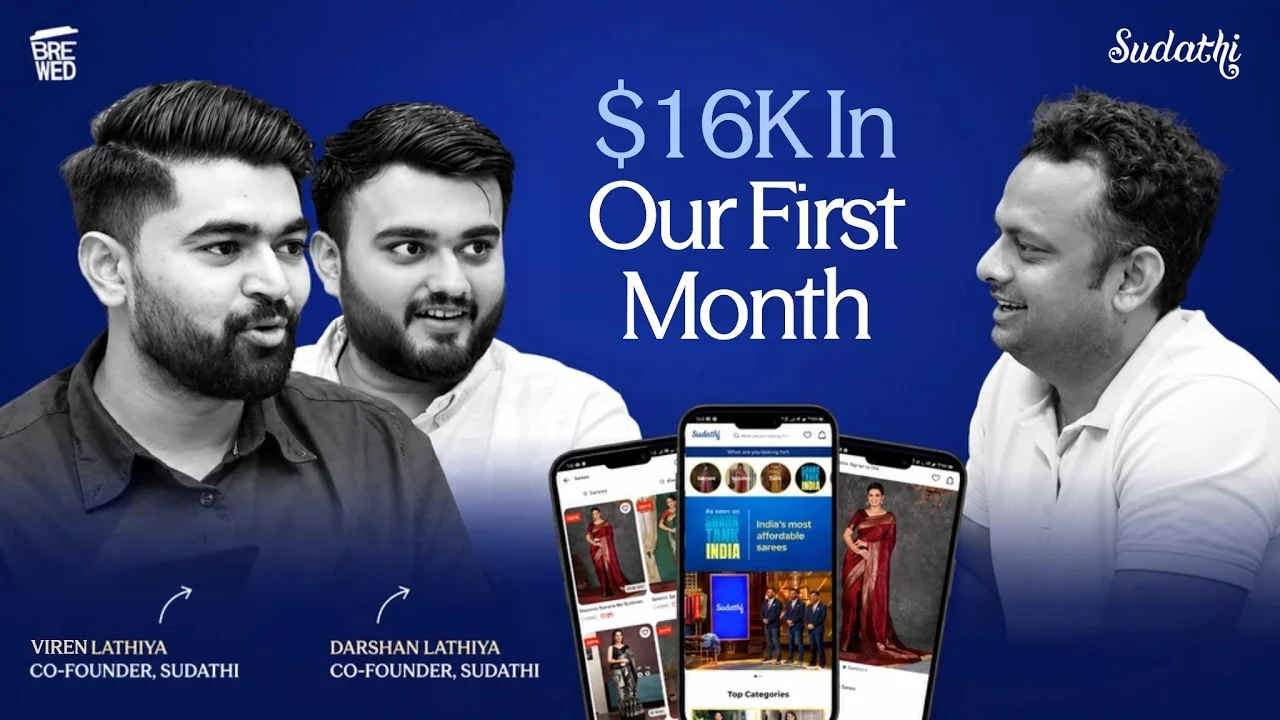
How Sudathi Made $16K in Month One Selling Sarees: Viren & Darshan Lathiya on Building a GenZ Brand


Viren and Darshan Lathiya didn't set out to sell the cheapest saree in India. They set out to sell one customers would trust, from a city that makes 90% of the country's polyester sarees but had never built a brand.
About this episode
Ninety percent of India's polyester sarees are made in Surat. Viren and Darshan Lathiya grew up in a family that has been in textiles for generations, and they kept coming back to one question: if the sarees are made here, why has no brand from Surat ever sold them directly to customers across India? So they built one. Darshan put up a website in a week, Viren started marketing it on Instagram from day one, and a third co-founder with 10 years in supply chain handled the product. Sudathi did ₹15 lakh in sales in its first month, with no plan at all.
In this episode of Brewed, Viren and Darshan break down why a ₹599 saree sold better than a ₹499 one, what it was like to watch 5,000 people land on the website at once while their Shark Tank episode aired, why customers asked a three-month-old brand for an app, and how Saree Saturday, 100+ new sarees every week behind an in-app countdown, keeps shoppers coming back.
This conversation is for DTC founders building in India, operators selling to tier 2 and tier 3 cities, and anyone who has been told that customers only care about the lowest price.
What you'll learn
- The Sudathi story: a gap in Surat and a website built in a week
- ₹499 vs ₹599: why price is a trust signal
- Selling a saree nobody can touch: PDPs, regional taste, and two-day delivery
- Shark Tank and the shift from instinct to data
- Customers asked for an app at month three, and expected Myntra on day one
- If they started again: no Meta ads on day one
- "Why will a customer keep my app?": loyalty, screen time, and mind share
- Saree Saturday and becoming the Zudio of sarees
- Winning Gen Z: ready-to-wear sarees and the pocket reel
- The broader lesson: whatever you say, deliver it
The complete breakdown
1. The Sudathi story: a gap in Surat and a website built in a week
Within a 4 to 5 kilometer radius in Surat, there are more than 50,000 saree traders. There are retailers, wholesalers, and many, many middlemen. Until Sudathi, none of them were selling directly to customers across India.
"Surat is the main hub for man-made sarees. 90% of polyester sarees are created in Surat, but we hadn't seen a single brand coming out of Surat and delivering pan India. That was the gap we found."
The reason, as Viren saw it, was that everyone around them preferred marketplaces. Upload the catalog, make quick money, skip the effort of building a brand, and never deal with customers directly. Nobody wanted the back and forth of reading reviews and updating the product.
The Lathiyas came at it differently. Textiles run through generations of their family, and about three years ago the DTC space in India was growing fast, with "made in India" sentiment at a high. Darshan came from tech, Viren from marketing, and a third co-founder had spent 10 years in the supply chain for the product. That was enough of a base to start.
"Within one week, Darshan came up with the website and I started marketing it from day one on Instagram. In the first month, we did ₹15 lakh in sales, and that was without any idea or plan. We just had a simple website, a marketing skill, and a supply chain."
The return on ad spend in that first month was above 10x, and they still didn't know whether the price was right or how the logistics would work out. That result gave them the motivation to stop experimenting and start re-engineering everything around a proper brand.
2. ₹499 vs ₹599: why price is a trust signal
When Abhijeet showed the Sudathi app to his mother and the women around him, the reaction wasn't about the designs. Everyone liked the designs. The reaction was disbelief. Will I even get the order? Should I prepay, or is cash on delivery safer?
Sudathi had already lived that reaction in its data. The brand first launched with ₹499 products, and the gap it found was counterintuitive: customers were willing to pay a little more.
"Customers expected that ₹499 would be very cheap and that they wouldn't get good enough quality for ₹499. So ₹599 was the sweet spot. We found it by launching multiple price points, and within a short period of time we got a good response from that price."
The marketplace research explained why. There were sarees priced below and above that point, but the gap between what customers paid and what they received was huge. Thousands of negative reviews said the same things: it's cheap, so it won't be good. I don't trust this brand. The same image is being used for multiple products.
Sudathi's answer was a simple rule. At ₹599, traction picked up, reviews turned positive, and customers started reordering, but only because the product matched the price.
"Since day one, the goal was clear. Whatever price we charge for the product has to justify that price. Not too low, not too high, but it should meet the expectation."
3. Selling a saree nobody can touch: PDPs, regional taste, and two-day delivery
In a store, a shopper feels the fabric and drapes it to see how it looks on her. Online, she can't do either, so she researches instead. Sudathi's view is that the product page has to do the job of the shop. Marketplace listings usually had four or five images, a close-up and a wide shot. Sudathi raised that to 8 or 9 images per product, with fabric close-ups, the name of the fabric, the design type, and the pattern.
"Online, customers will research more about the product. So the more information we show, the more trust they will have in the product. If every question a customer has can be answered through the PDP, then you're winning that customer."
The first purchase, as the founders describe it, is always impulse and a little shock: will I actually get this? The second purchase came from a different kind of shock. Sudathi was shipping by air and delivering within two days of the order, and reviews started saying exactly that: it arrives fast, and the quality is good.
On top of trust, there's geography. Western wear looks broadly the same across India. Sarees don't. In the south, Kanjivaram and woven sarees are preferred. In the north, shoppers lean toward lightweight sarees in brighter shades. Colors, fabrics, and patterns all change from region to region.
"Saree is more of a regionally specific product. Every Indian city has a different taste in sarees. With western wear, you can differentiate with styles, but with a saree you need many more factors to make the product convert."
That leaves Sudathi solving three hard problems at once: building trust through the catalog, running performance marketing for very different regional audiences, and fulfilling it all fast enough to keep the promise.
4. Shark Tank and the shift from instinct to data
The episode was airing, and the founders were watching the website. 5,000 new users landed at the same time, all of them there to check whether what Sudathi said on screen was true. By the end of that day, orders were close to 3x.
Shark Tank didn't just bring traffic. It changed what customers expected. Before the show, a new customer had no expectations. After it, millions of people had seen the brand, and they would show up expecting more.
"If we reached customers normally, they would be under-expecting. After Shark Tank, they would be over-expecting. So we had to set our benchmark higher, to match their expectations and beat them. And we did that. Since then, we've been consistently growing."
Internally, that meant every decision got stricter. Before launching a campaign or making a product live, it now passes through multiple levels of checks, and quality control became tighter so the quality they claim is the quality that ships.
The bigger shift was moving from instinct to data. Because saree preferences change by region, Sudathi built in-house tech on top of Shopify analytics to see which customers in which region buy which type of saree, so they can upsell and cross-sell the right products, and which regions send traffic that converts, so performance marketing goes to the audiences most likely to buy. Instinct didn't disappear entirely, though.
"Not every marketing campaign can be calculated. The data is saying one thing, but sometimes I think I should go with my gut. You have to carry both of them, data plus gut, and then make the decision. A lot of times, that's the right way to look at a campaign."
5. Customers asked for an app at month three, and expected Myntra on day one
The requests showed up in the comments under Sudathi's own performance ads. Good product, but I think you should make an app. It's great, an app would make it more fun.
For a three-month-old brand, that seemed strange. But when the team went into the data and called its early customers, the pattern was clear. They kept an Excel sheet of the feedback, and it kept saying the same thing: if you had an app, I would have bought more, or scrolled more.
Sudathi's price range attracts customers mostly from tier 2 cities onward, and those shoppers have a habit of scrolling and shopping fashion on Meesho, Myntra, and Flipkart. Sudathi was asking them to go to Google, search for the brand, open the website, and then browse.
"In the app, you click, you scroll, you like it, you order. The process is fast. It's convenience."
Darshan's idea was to build the app on Shopify and find someone who could build it with them. That's how Sudathi found Appbrew. The flip side arrived quickly. Customers who live on marketplace apps compare every app to them, and those apps have years of updates and very large teams behind them.
"Customers expected from us on day one that we would bring the same features. This page isn't working. You don't have a review system. This button isn't working. The ease and convenience the marketplace apps were giving, they expected the same from us."
6. If they started again: no Meta ads on day one
Asked what he would change about the first 90 days, Viren doesn't hesitate. He wouldn't start Meta ads straight away. When Sudathi launched, the plan was what everyone follows: run Meta from the first or second week and orders will come. What the team didn't anticipate was how fast that works, and how fast everything falls when you stop. Worse, it skipped the process of getting orders organically, collecting feedback, and fixing the product and pricing.
"We did it way too early. The website was being built, there were four posts on social, and we were running Meta ads saying buy my product, without a brand language, without cracking the product pricing, anything."
Looking back, he would spend at least the first two or three months building a solid product, landing the right pricing, and finding the brand language. Let customers discover the brand organically, build a community that buys again within three months, and only then switch on performance marketing based on what organic reach taught you.
"A lot of founders ask me today, and I tell them: don't do performance on day one. Get the feedback from customers. Your performance will be better, for sure, and that's guaranteed."
Darshan's answer is about focus. Early on, Sudathi sold everything: kurta sets, dupattas, shapewear, jewelry, and sarees. Realizing they were overdoing a lot of things and under-delivering, they cut every category except sarees and built that into the hero category. His second lesson was shipping. The early assumption was that tier 2 and tier 3 customers buying affordable products wouldn't mind waiting, so Sudathi used surface shipping. Four or five months in, the data said otherwise: switching to express improved delivery performance, orders, conversion, and word of mouth, and reduced RTO.
"You're giving me a ₹600 saree, but I want it tomorrow morning at my house, and I'll accept it happily. If it's delayed, I don't want the saree anymore. I've forgotten that I even ordered it."
7. "Why will a customer keep my app?": loyalty, screen time, and mind share
Abhijeet hears two objections from founders. The app looks expensive. And: I'm not Myntra, not Flipkart, not Amazon, so why would a customer keep my app? Darshan's answer to the first starts with what Sudathi is for. The core of the business is building and selling product, not building technology. Working with a partner instead of hiring a tech team meant moving at double the speed and at a much lower cost.
The answer to the second is in the numbers. Sudathi tracks app revenue share, app users, and sessions. From launch, downloads were strong, and the average screen time on the app was over 10 minutes.
"That's too high for a brand. People are installing the app, scrolling for 10 minutes, and converting at a better rate than our web. That means this has the potential to grow even more."
Since then, the app has consistently driven 40 to 50% of Sudathi's overall conversions. And because it's a platform the brand owns, the data and the audience stay with Sudathi.
For Viren, it comes down to loyalty. Sudathi's business is driven by festivals and occasions. When there's a function at home, the customer opens the app, orders, and forgets about it until the next one. Without an app, the same customer is searching Google for saree brands or scrolling through thousands of options on a marketplace.
"Why would I install your brand's app among all the other brands? That means you have my trust. And whenever I think about buying a saree, your app will be on my phone and I will convert. It's mind share, and we keep it with push notifications."
8. Saree Saturday and becoming the Zudio of sarees
Abhijeet pushes further. Most fashion customers buy two or three times a year. The rest of the time, notifications go unread and the app goes stale. What keeps it alive? Sudathi's answer is a weekly ritual. Every Saturday, the brand launches 100+ new sarees: Bandhani, Paithani, Banarasi, and every other kind. The team even coined a name for it.
"It's called Saree Saturday. Every Saturday we launch 100+ new sarees, so it becomes a routine for customers. I will keep visiting the app every Saturday because there will be new designs for me."
The app has a custom-built section with a countdown running to every Saturday, and the moment it hits 12:00, the 100 new sarees go live. It works because, as the founders put it, women are always exploring fashion and rarely repeat a look, especially once a saree has been posted on Instagram.
On notifications, the founders point to Zomato and Swiggy as the brands that cracked it in India: keep them cool and engaging, and don't try to sell every time. Sudathi sends messages like "It's 2 AM, I think it's time to sleep," built for brand recall rather than a sale. The three app metrics they check daily are notification conversion, app downloads, and active sessions.
The ambition behind all this is to become the Zudio of sarees. Zudio went from a brand nobody knew to one every person in India knows in three years, and it did that by being affordable, holding quality at its price point, and refreshing its styles constantly. The difference is the channel: Zudio isn't online and is scaling only offline, while Sudathi plans to be omnichannel, with its own website, quick commerce, and its own offline stores.
"Whenever anyone thinks about sarees, or ethnic fashion in general, Sudathi should be at the top of their mind. Zudio is affordable and Sudathi is affordable. Every time you go into Zudio there are new designs, and every Saturday you come to us, you will find new sarees."
9. Winning Gen Z: ready-to-wear sarees and the pocket reel
There's a feeling in fashion that the saree's moment is over and everything is westernizing. Sudathi's 10-year vision is to bring the saree culture back, and to reach ₹3,000 to 4,000 crore in revenue doing it.
The obstacle isn't desire. It's draping. Wearing a saree is a difficult task for most people in India, and a younger generation won't give it 10 minutes.
"If we want the younger generation to adopt the saree, or anything new, we have to mold it according to them. We cannot ask them to spend 10 minutes putting on a saree. It has to come with clips and hooks, so you can quickly drape it and go."
The ready-to-wear saree came directly from customers. Loyal buyers started saying they'd seen one-minute sarees elsewhere and asked why Sudathi didn't have one. The first version was a belt you hook on. Customers said the belt felt slightly uncomfortable and wanted one more step of security, so Sudathi added a knot. Then the length didn't suit every height, so it became more elastic and adjustable. Then the pallu was too short or too long, and that got adjusted too.
Then customers asked for a pocket. Sudathi shot a video at a random public spot, asking women whether they had ever seen a saree with a pocket. Nobody had. Then came the product demo, with a woman wearing the saree and using the pocket.
"They were like, no, where does a pocket come from in a saree? And then the demo happens, where she's wearing the saree. That video went to 10 million views."
10. The broader lesson: whatever you say, deliver it
Asked which DTC fashion founders they admire, the brothers pick two brands that look nothing alike but share the same trait.
Viren picks Snitch. In a category still changing quickly, Snitch has stayed strictly DTC instead of going to marketplaces, opened stores early using proper data and insights, and stuck to the quality it promised, while growing year on year. Opening 100+ stores as a DTC-first brand is something only legacy brands with deep budgets used to do in India.
"Three years ago, if someone had said they would open 100 stores, no one would have believed it. And they've done it."
Darshan picks Shein, for its data-driven operations at a scale nobody had imagined: shipping to the whole world, launching new designs constantly, following trends quickly, and avoiding dead stock.
Both answers lead back to the rule Sudathi set on day one. A ₹599 saree only sells if it feels like it's worth ₹599. A two-day delivery only matters if it actually arrives in two days. Saree Saturday only works if there really are 100 new sarees when the countdown ends. Every part of the business is built on making a claim and then keeping it.
"Whatever we say, we deliver. We don't under-deliver. A lot of times we over-deliver, but under-delivering is not an option."
The complete episode transcript
Abhijeet: Welcome, Darshan and Viren, to the Appbrew office. We've spoken with nine brands on Brewed so far, you're the tenth, and I'm glad this one is happening in person. Let's start with the question everyone has: people think affordable means the customer has to compromise on quality. How did you crack the ₹599 saree market while building trust with the customer?
Viren: Since day one, the goal was clear: whatever price we charge for the product has to justify that price. While keeping the price at ₹599, we made sure the quality the customer gets matches that price. Not too low, not too high, but it should meet that expectation. When we first launched at this price, the results were far better. We had done research on marketplaces. There were products below this price and more expensive than this, but the gap between what customers paid and what they received was very high. There were thousands of negative reviews saying it's cheap, so it won't be good, I don't trust this brand, the same image is being used for multiple products. Once we figured all that out, we decided on a price and made sure that whatever we say, we deliver. We don't under-deliver. A lot of times we over-deliver, but under-delivering is not an option. That's how we justify the price. Then word of mouth keeps rolling, people start trusting you more, they buy more, and they tell others, look at what they're giving at this price, you should order too. In the first month, whatever numbers we did were purely on the basis of price and the quality we delivered.
Abhijeet: A lot of founders have an idea and a product, do their primary research, and look at keywords. You could have chosen any price. On marketplaces it could be ₹700, ₹800, ₹999. Why ₹599? And how do you communicate trust to a first-time user? To be honest, when I showed the Sudathi app to my mother and the women around me, their reaction was, how is this possible? Will I even get the order? Should I prepay or choose cash on delivery? I'd rather do cash on delivery, because I don't know if I'll get it. Everybody liked the designs, but they couldn't believe it.
Darshan: Before ₹599, we launched with ₹499 products. The gap we found was that customers were willing to pay a little higher. They expected that ₹499 would be very cheap and that they wouldn't get good enough quality at ₹499. So ₹599 was the sweet spot. We found it by launching multiple price points, and within a short period of time we got a good response at that price. After that A/B testing, we figured out that this was the price where, having improved the product quality and justified the price, we were getting traction, the reviews were positive, and customers were reordering. It's also a better position for us, because we can give the best quality at that price point, better than the market.
Abhijeet: How do you define quality? Users like our mothers, our wives, our friends all have their own understanding of quality in a saree. Imagine you're explaining this to someone who is new to sarees. How would you communicate it?
Viren: Build a strong PDP that shows exactly how the saree looks. Every product on our website has close to 8 or 9 images. It has the fabric, multiple images, close-up shots, the name of the fabric used, the design type, and the pattern. Looking at that information, customers can decide. The first decision is always impulse and a shock factor: will I even get this? What will it be like? The more information you give them, the better their decision-making when they want to buy. Usually on marketplaces there were four or five images, a close-up and a wide shot. In the initial days, we increased the number of images and showed more close-ups, so they could see this is the fabric. That started working. Once it was delivered, the second order came again because of shock value, because they realized it actually gets delivered. And you won't believe it, but we were delivering by air within two days of ordering. So the shock doubled: the order arrives quickly, and it's this good. Reviews said they deliver so fast and give good quality, and that kept building.
Abhijeet: That's a really good insight. Whatever product we sell, we need a detailed story of every factor that contributes to the customer experience before purchase and at purchase.
Viren: Currently, customers want to know everything about the product. If they go to a shop, they feel how the product is in their hand and try it on to see how it looks on them. Online, they research more about the product. So the more information we show, the more trust they will have in the product. That's exactly what they need, and we're replicating the offline shopping experience online, where there's no interaction. If every question a customer has can be answered through the PDP, then you're winning that customer.
Abhijeet: That's counterintuitive. Half an hour ago we were saying fashion is all about discovery, but when you double-click on it, it starts to look like personal care, where people want to know how it will act on their skin. It's very information heavy. To break into a category, you have to do your homework to gain trust, and the only way is to answer customer queries visually.
Darshan: Additionally, the saree is a more regionally specific product. Every Indian city has a different taste in sarees. If you go from north to south, it changes completely. In the north, the colors are different, the fabrics people choose are different, the style patterns are different. In the south it's totally different again. Kanjivaram and woven sarees are preferred in the south, while lightweight sarees in brighter shades are preferred in the north. With western wear, you can differentiate with styles, but with a saree, you need many more factors to make the product convert regionally.
Abhijeet: There's a saying that the water and the language change every few miles, and the saree is a true representation of India's cultural diversity. That makes performance marketing harder.
Darshan: Western wear is derived from the West and has the same presence across India. It doesn't change by state. Here, every type of fabric has every type of design, and the customer has their own choice. People in the south prefer Kanjivaram, but they won't prefer it in the north.
Abhijeet: So I see multiple levels of complexity. One is building trust, so your PDP shots and catalog need to be very region-specific, with a story for each product. The second is performance marketing. The third is supply chain and fulfillment. You're marrying multiple complexities together, while attacking one of the biggest categories.
Darshan: We also need to take care of every audience, because everyone's requirements are very different. We make sure we give everyone what they need, showcasing every type of saree and every type of collection.
Abhijeet: What's the one thing you saw in the Surat textile market that made you say, I'll test sarees? It's one of the largest categories in Indian fashion. What was the internal motivation?
Darshan: Surat is basically the main hub for man-made sarees. 90% of polyester sarees are created in Surat, but we hadn't seen a single brand coming out of Surat and delivering pan India. That was the gap we found. Within a radius of 4 to 5 kilometers, there are more than 50,000 traders, but none of them are delivering pan India directly to customers. There's a set of retailers, wholesalers, and many, many middlemen, but no one is delivering directly to customers.
Abhijeet: I want to know about the spark. That one moment when Darshan told Viren, this looks right, should we do something with it?
Viren: We both come from different backgrounds, tech and marketing. When we were discussing it, the DTC space in general was growing very fast. Indian-born brands, made in India, all of that sentiment was very high three years ago. And the category we were born into, textiles, has been in our family for generations. But how many brands have we seen from Surat going pan India, when Surat is one of the largest exporters selling to everyone? Why is that? What is the one thing that isn't clicking for everyone that stops them from building? Everyone was more inclined toward marketplaces, where you just upload and make quick money. There's no brand-building effort, and you don't have to face customers directly, get their reviews, and update the product. Nobody wanted that back and forth. So the idea was simple. We had to build a website, which Darshan was proficient at, and market it from day one, which I could do. And there was a third co-founder who had known the supply chain for this product for 10 years. So we had a tangible base to start an idea. Within one week, Darshan came up with the website and I started marketing it from day one on Instagram, just the basics. In the first month, we did ₹15 lakh in sales, and that was without any idea or plan. We just had a simple website, a marketing skill, and a supply chain.
Abhijeet: What was the ROAS in that first month?
Viren: In the first month it was above 10x, and we were operating with zero effort. We didn't even know if the product we were selling was worth the price, or how we would figure out the logistics. That gave us the motivation to build a proper brand, and we started re-engineering a lot of things around it.
Abhijeet: You started working on this about two and a half years ago, and when you started, Shark Tank wasn't in the picture. A lot changed after Shark Tank. From a founder's lens, what has changed internally for you, in the way you operate, that you'd like to share with other fashion founders?
Viren: First, you're running at a fairly steady kind of growth, and then something comes and hits you and tests your capacity at every level. You're visible to a pan-India audience. They want to try the brand, see what you're doing, check whether it's worth it, whether your claims are good or bad. In that phase, as founders, we got to test our operational efficiency and our marketing claims. We didn't expect some of what happened. For example, we were sitting on the website while the episode was airing, and there were 5,000 new users on the website at once, just checking whether what we were saying was true. And on the same day, we did close to 3x orders.
Abhijeet: So getting on Shark Tank opened you up to very large audiences, and with more views, the brand got built.
Viren: It came with a lot of responsibility. Millions of people had seen us there, and they would be expecting something from us. If we reached them normally, they would be under-expecting. After Shark Tank, they would be over-expecting. So we had to set our benchmark higher, to match their expectations and beat them. We did that, and since then we've been growing consistently.
Abhijeet: The zero-to-one journey is different. The most fun part was probably that ₹15 lakh month, no stress. But at every scale, you feel pressure as a founder, and you have to evolve. You lead marketing, and Darshan leads product and tech. What has evolved in your operating style, and what should fashion founders who are about to reach a larger stage learn from you? You used to have a philosophy of under-promise and over-deliver.
Viren: I think we're now more particular about every detail we put out. Earlier there was no pressure of performing at scale. Now every decision, before launching a campaign, before making a product live, before doing QC, passes through multiple levels. QC has become stricter, so we make sure the quality we're claiming is the quality we deliver. At that level, the team in general, and we as founders, have become more serious about things, because everyone now has a base level of expectation after Shark Tank. Beyond that, whenever we run a campaign, a lot of people in fashion are looking up to us: they've been on Shark Tank, they've done this, so this is the bare minimum we should do. It sets a benchmark in the industry when someone from your industry has been on Shark Tank. That's what we hear when we talk to founders too.
Darshan: Additionally, Shark Tank brought us a huge change: after it, we moved to data. Our results are data-driven and our decisions are data-driven. Before that, we were going with instinct, intuition, everything. After Shark Tank, data became much more important to us, because we got so much trust and such a huge audience, and saree culture is different for each region. We wouldn't be able to identify what type of sarees or products to deliver to customers otherwise. So everything changed to data. A lot of in-house tech has been built on top of Shopify analytics, where we can see which customer in which region is buying which type of saree, so we can upsell and cross-sell those sarees to them. Plus, which region sends what type of traffic, whether it's high converting or low converting, and then running performance marketing for the audiences most likely to convert. We started looking at all of this in much more detail and depth, so our decisions are more relevant for the customers browsing our website and seeing our stores. That change is happening, it's good, and it's driving results for us.
Abhijeet: So you're much more data-driven now. Do you miss your instinct? Do you miss the privilege of being creative?
Viren: From a marketing point of view, I think it's good and bad, because not every marketing campaign can be calculated, and it shouldn't have to be one perfect method. So it's a mix of data plus instinct: will this decision work on this type of audience or not? The data is saying this, but I think I should go with my gut. You have to carry both of them, data plus gut, and then make the decision. A lot of times, that's the right way to look at a campaign.
Abhijeet: Earlier you had a free hand. Now there's a lot of responsibility, and you have to grow month on month. This question is for both of you: one customer story that made you feel wow about what you're doing.
Viren: There are a lot of positive stories, but the story I have is that the decision to build an app is also a very good story. When Darshan came to you for an app, there was a particular reason we decided at three months. When we launched the product and I was doing the marketing, we were getting reviews and feedback from customers saying you should build your app. We were like, why would a three-month-old brand build an app? Why is this happening? But when we went deep into the insights and data and discussed internally why these reviews were coming, we saw that the price range and the customers we target are mostly from tier 2 onward, and there they have a habit of shopping from Meesho, Myntra, and Flipkart. They have a habit of scrolling an app and shopping fashion, and we were selling to them from a website. So we said we should make an app, and we need to find the right partner who will build it with us. Darshan came up with the idea: let's build our app on Shopify and find someone who can build it. That's how we found Appbrew.
Abhijeet: So this came from the customers' side.
Viren: Yes, from customers. I remember the comments under our early performance ads: good product, but I think you should make an app. It's great, an app would make it more fun. It was in our social media posts too. People would ask in the comments for an app. We also used to call the customers who placed the initial orders and ask how they liked it, and we have an Excel sheet of that feedback where people said it would be nice to have an app. That was data-driven too. People said if you had an app, I would have bought, or scrolled more, and I would have liked it, because their habit is to scroll on Meesho and Myntra. We were making them put in extra effort: go to Google, search for Sudathi, open our website, and then scroll the products. In the app, you click, you scroll, you like it, you order. The process is fast. It's convenience. So that's the customer insight story of how we found Appbrew.
Abhijeet: Wow, thank you. And one tragedy?
Darshan: The tragedy was the same customer behavior. They shopped mostly through apps, but apps like Myntra, Meesho, and Flipkart have been around for years, with constant updates and very big teams. Customers expected from us on day one that we would bring the same features. This page isn't working. You don't have a review system. This button isn't working. The ease and convenience the marketplace apps were giving, they expected the same from us. So just as our journey was starting, their requirements were being compared with the marketplaces. We were trying to build it slowly, and it felt like, these are the initial days, give us a little support and we'll do everything. That was a time when their demands were very high.
Abhijeet: So your customers were coming from tier 2 and tier 3 cities, they really liked your product, but they wanted a digital experience that matched the marketplaces, and with limited resources you couldn't offer that in the initial part of the journey. Then you needed a partner to take care of it. Let me go back to the first 90 days. If you could redo them, what would you do differently?
Viren: If I could go back, I probably wouldn't start Meta ads straight away. When we launched the brand, we thought that if we started running Meta from the first or second week, orders would come, and that's the strategy everyone follows, so we followed it. The problem was that we didn't expect how quickly it would turn around, and once you stop, everything falls down. And then you never learn the process of getting orders organically, getting the feedback, and then updating the product, the pricing, and everything else. If I could go back, I would wait at least two or three months until I could build a solid product, conclude the right pricing, and find the brand and the language of Sudathi. I would have chosen the other way around: get feedback first, ask customers how the product is, let them discover it organically, build a community of customers who buy from you again and repeat within three months, and then, based on that feedback, launch your brand and do performance marketing. We did it way too early. The website was being built, there were four posts on social, and we were running Meta ads saying buy my product, without a brand language, without cracking the product pricing, anything. So I would not have started Meta ads as soon as possible.
Abhijeet: So you'd have taken a community-first approach. Sudathi has one of the largest app user bases in fashion, and a very vibrant community you curate on Instagram, called Sudathi Stars. Going back, you'd lead with community rather than banking on paid marketing.
Viren: This is one learning any fashion founder should take: exploit reels, Instagram, every organic platform, every way you can reach customers. Do that first, analyze it, and then do paid marketing based on the insights you get from those organic platforms. Whatever is available in marketing, shoot videos, create content, take feedback from the customers you're delivering to, all of this process, and then do paid marketing.
Darshan: I think he could have gotten 20x ROAS if he had done it better.
Viren: A lot of founders ask me today, and I tell them: don't do performance on day one. Get the feedback from customers. Your performance will be better, for sure, and that's guaranteed.
Abhijeet: He's given the marketing insight. Darshan, what about you?
Darshan: In the first 90 days, we tried a lot of things in between. We tried categories and verticals. I wouldn't do all that, and would focus more on sarees. Initially we thought that when we're starting, we should sell a lot of things. Why sell just one thing? We were selling kurta sets, dupattas, shapewear, sarees, and jewelry. It was an e-commerce platform where we sold everything. But early on we decided we were overdoing a lot of things and under-delivering. So we removed all the categories and stuck only to sarees. We sell only sarees, take feedback on them, and strengthen this one vertical. Better vertical expansion than horizontal. Make this the hero product, the hero category, and then slowly launch other categories. Additionally, in the initial days we were aiming to build an affordable brand catering to tier 2 and tier 3 cities. Our intuition back then was that the cheaper we could make it for customers in tier 2 and tier 3 cities, the more okay they'd be with getting the product late. So we tried surface deliveries, not express. Then we derived a data set, and after four or five months we started sending express. Delivery performance got better, orders got better, conversion got better, and word of mouth got better. If we had known earlier, we wouldn't have had that intuition from day one. You'd see that whatever arrives faster gets accepted faster, RTO goes down, and conversion comes in. So ship by air from day one. There's a mindset, a presumption, that if it's affordable, customers don't need it quickly and they'll wait 10 days to get an order. But we saw that the later it arrived, the fewer deliveries went through and the more returns came back. The customer's attitude is: you're giving me a ₹600 saree, but I want it tomorrow morning at my house, and I'll accept it happily. If it's delayed, I don't want the saree anymore. I've forgotten that I ordered it. I saw a Meta ad somewhere, ordered it, and now I don't want it.
Abhijeet: When brand founders come to us, they throw two things at me. One, the app looks unaffordable, even on base prices, and people say the price is too high. Two, who will keep my app? I'm not Myntra, I'm not Flipkart, I'm not Amazon. Why would a customer keep my app? If I put that question to you, and you were in my shoes, what would your answer be? You've seen it firsthand.
Darshan: On the price point, it was clear from day one that our core is to build product and sell product, not to have a tech team. Why invest more in tech and think about tech? With a partner enabling us, we move faster, the speed is double, and it's much more cost-effective than thinking about spending more on our own.
Abhijeet: Brands spend a lot on Meta marketing, probably 20x what they'd pay a month for an app platform. How do you see the ROI on an app? What's your framework for analyzing it?
Darshan: Our ROI metrics are app share, how much revenue we're getting from the app, and how many users. The customers' sessions are long, they're scrolling a lot, and if they're scrolling more, they'll convert more someday. When we launched our app, we got a lot of insight into why people were downloading it, because the download ratio has been very high since we launched, and we knew this was a substantial platform where we should invest more. We saw that the average screen time on our app was over 10 minutes, and that's too high for a brand. People are installing the app, scrolling for 10 minutes, and converting at a better rate than our web. That means this has the potential to grow even more. Since then, the app has consistently been 40 to 50% of our overall conversions. It's always better to have a platform where you hold your data and your audience yourself.
Abhijeet: So it's direct with the customer, more engagement time, and that converts into business and a better customer experience. Tell me more: how is an app a better customer experience than mobile web?
Darshan: On mobile web, they need to figure out what the site was, how to open the page, and everything else. The Indian market is app heavy. Most purchases happen on marketplaces, so everybody is habituated to apps. With our app, it's better for them to get all the information in one place.
Viren: Personally, I feel it's more about loyalty. Why would I install your brand's app among all the other brands? That means you have my trust. And whenever I think about buying a saree, your app will be on my phone and I will convert. That's the simple loyalty framework an app gives us: if there's an app, I'll just order from here, and I'll keep repeating whenever I have an occasion. For our business, it's mostly about festivals and occasions. Whenever there's a function at home, I open the app, order, and forget about it. The next function comes, I open the app, order, and go. Without an app, I'm adding extra steps: searching Google for saree brands, ordering from whoever comes up, or scrolling through thousands of options on a marketplace. It's mind share, and we keep that mind share with push notifications.
Abhijeet: Here's the other side. A fashion app user buys twice or thrice a year, twice for most brands. The rest of the time, they see a push notification and the app goes stale, you can't sell anything, and Apple and others are restricting things too. That will happen at your base as well. People ask me, they buy once or twice a year, so why would they keep the app? How do you think about this from a marketing perspective?
Viren: One thing is simple. Our brand is built on launching new designs every week. Customers have always been curious about the 100 sarees we launch every Saturday. This is the first time in India, no one has done it. So I'll want to keep this app and check every Saturday what they've launched and how many designs there are. It keeps them hooked on the app every Saturday. We custom-built a section in the app where there's a countdown running to every Saturday, and as soon as it hits 12:00, there are 100 new sarees. The next Saturday, they come back and see another 100 sarees released. As for notifications, that's been cracked in India by Zomato and Swiggy: keep it cool and keep it engaging. You don't have to sell something in every notification, this is launched, buy this, buy that. You can be more creative with notifications. If there's a trend running, just mention it. We send things like, it's 2 AM, I think it's time to sleep. Send notifications that increase brand recall. You don't want to sell every single time you send a notification.
Abhijeet: So you're building a Sudathi ritual. You're inculcating a brand behavior in your customer through the app, a kind of bell ringing on the weekend: today is a new lot.
Viren: We've named it and coined the term specifically for this. It's called Saree Saturday. Every Saturday we launch 100+ new sarees, so it becomes a routine for customers: I'll keep visiting the app every Saturday because there will be new designs for me. It's a mix of everything: Bandhani, Paithani, Banarasi, all sorts of designs. One benefit for us is that this is women's fashion, and women are always exploring fashion. They don't repeat. Today is the time of influencers and Instagram. Once they've posted wearing a saree, they won't post it again or wear it again, and they'll need a new one. So it's perfect: she wants to keep coming back, because she knows she's not seeing the same SKUs every time she opens the app. Every time, there are 100 new ones and it keeps changing. And because she wants new fashion again and again, it being affordable and the best quality is what makes the proposition work.
Abhijeet: Rapid fire, last question on the app: three metrics you check on a daily basis.
Darshan: Three things: notification conversion, number of app downloads, and active sessions on the app.
Abhijeet: Same question to both of you. Sudathi wants to be the Zudio of sarees. What does that actually look like in 3 years and in 10 years?
Viren: The Zudio of sarees is an instinct, because we've seen in India that a brand nobody knew became known to every single person in India in three years. Everyone knows what Zudio is and how they've scaled. It's a reflection of the growth we're projecting for ourselves: we'll build the Zudio of sarees. Whenever anyone thinks about sarees, or ethnic fashion in general, Sudathi should be at the top of their mind, so they think, I'll just buy from there. Both are affordable. Zudio is affordable and Sudathi is affordable. Both claim that the quality at their price point holds up, and we deliver the quality we talk about. And there's the scale at which we launch new styles: every Saturday you come, you'll find new sarees, which is what Zudio does. Every time you go into Zudio, there are different types of clothes and different designs. So the similarities are there. When you think of fashion right now, Zudio comes to mind for affordability and for new design launches, and you can see how Zudio went from zero to 100+ stores in no time. We're doing that digitally, and hopefully we're also going omnichannel, where we'll launch our own stores and you can experience it everywhere. Right now, Zudio isn't online. They're only scaling offline. Sudathi will be on quick commerce, on our own website, and offline. It will be a complete omnichannel experience, so when you think of women's fashion, this is the first thing that comes to your mind.
Abhijeet: Three years is clear to me. How would it look in 10 years?
Darshan: There's a sense in fashion that the saree trend is over and that everything is westernizing. But we'll bring that back. We'll bring back the saree culture. In 10 years, Sudathi would be at ₹3,000 to 4,000 crore in revenue, and we'll be reinterpreting fashion with sarees. It will be at a whole other scale.
Abhijeet: For example, my wife bought a ready-made, ready-to-wear saree, and she still curses me because I lost it. The order arrived, the guard downstairs had kept it, I picked up the packages on my way from home to the office, put them on top of the car, got distracted, and it was gone. Whenever sarees come up, she says, you lost my saree. What's the logic behind ready-to-wear?
Viren: It's simple. If we want the younger generation to adopt the saree, or anything new, we have to mold it according to them. We cannot ask them to spend 10 minutes putting on a saree. This is how we're bringing back our old culture. First of all, wearing a saree in India is a difficult task. If you ask anyone, it's difficult. So to get Gen Z to wear one, you have to mold it so that it comes with clips and hooks, and you can quickly drape it and go. In the future, when we want Gen Z to come to us, they'll choose this over draping a saree, which is a long process.
Darshan: And when we're selling sarees, the feedback comes from customers. They say, we don't know how to wear it, I don't know how to put on this saree. When you're at scale, they start asking for things. They want you to launch the products that are trending in the market. They say people are wearing sarees in under a minute, so why aren't you making those? I'm a loyal customer of Sudathi, and I've seen one-minute sarees somewhere, so you should launch a one-minute saree too. That starts the conversation internally: we should start working on ready-to-wear sarees. Then a lot of versions came in. When ready-to-wear first launched, it was just a belt. You hook the belt and you can wear a ready-to-wear saree. Then customers said the belt was slightly uncomfortable, or that they needed one more step of security, so we added a knot. Belt it, knot it, an added security step. Then they said the length of the saree was too much for their height. So we made it more elastic and comfortable so it adjusts to height. Then they said the pallus were too short or too long, so we had to adjust all of that. There were different versions. And they also asked for a pocket.
Abhijeet: You gave it a pocket. That's the viral reel.
Darshan: We shot a video asking people whether a saree has a pocket, and they wouldn't believe it. We shot it at a random public place, asking, have you ever seen a pocket in a saree? They were like, no, where does a pocket come from in a saree? And then the product demo happens, where she's wearing the saree. That video went to 10 million views.
Abhijeet: Wow. Modern problems need modern solutions. I have 10 things to keep, so I need space in my saree. I hope you both enjoyed the discussion. Last question: one DTC fashion founder you admire and learn from. It can be anybody, India, the US, it doesn't matter.
Viren: Personally, I look up to Snitch, because of the scale they've reached in a space that is still evolving very fast. There are very few examples in DTC where a brand has scaled this much in this time. And the steps they've taken: they've remained strictly DTC rather than going to marketplaces, they started their stores very early with proper data and insights, and they stick to the quality they promise, all while growing year on year and month on month behind the scenes. I think they're an inspiration for a lot of DTC founders, not just us, because the numbers that were hard to believe and hard to achieve, they've shown are achievable.
Abhijeet: I've heard the same feedback from investors about their numbers, that the metrics are almost perfect.
Viren: For a DTC-first brand to open 100+ stores is something only legacy brands do in India, if they have deep budgets and funds. Three years ago, if someone had said they would open 100 stores, no one would have believed it. And they've done it.
Abhijeet: Darshan, yours?
Darshan: Shein. Their whole operation is data-driven. They're one of the biggest brands in the world, shipping to the whole world, and they're more fashionable. Everybody looks up to Shein for inspiration on designs and on how to operate at scale without dead stock: frequent designs, new trends, following trends. They're an industry leader, with operational efficiency at a level no one had imagined before, launching 100 styles a day and making it work operationally for the whole world. There's a lot of math and a lot of data behind it, and the entire world looks up to them for fashion. That's a fact.
Abhijeet: Thank you, Darshan and Viren, for joining us on Brewed. I know it was impromptu, but we had fun, and I hope more fashion founders learn from your experience of building a brand, growing it, and dreaming about building a multi-billion dollar brand out of Surat. You're not restricting yourselves to manufacturing. You're building narratives and stories, and capturing the maximum value out of the whole vertical value chain.
Viren: Thank you for the words, and thank you for hosting us at the office for this podcast.