

.webp)
.webp)
How to increase customer lifetime value for your Shopify store: the CLV formula, 8 proven strategies, and first-party data on the mobile-app CLV lift.
Your store can be growing and still have a customer lifetime value problem. First-order revenue is increasing. Paid acquisition continues to bring in customers. But CAC is rising faster, payback periods are getting longer, and the customers acquired three months ago are not returning often enough.
The usual response is to add more loyalty points, discounts, bundles, subscriptions, and lifecycle campaigns. That creates activity. It does not necessarily fix the underlying problem.
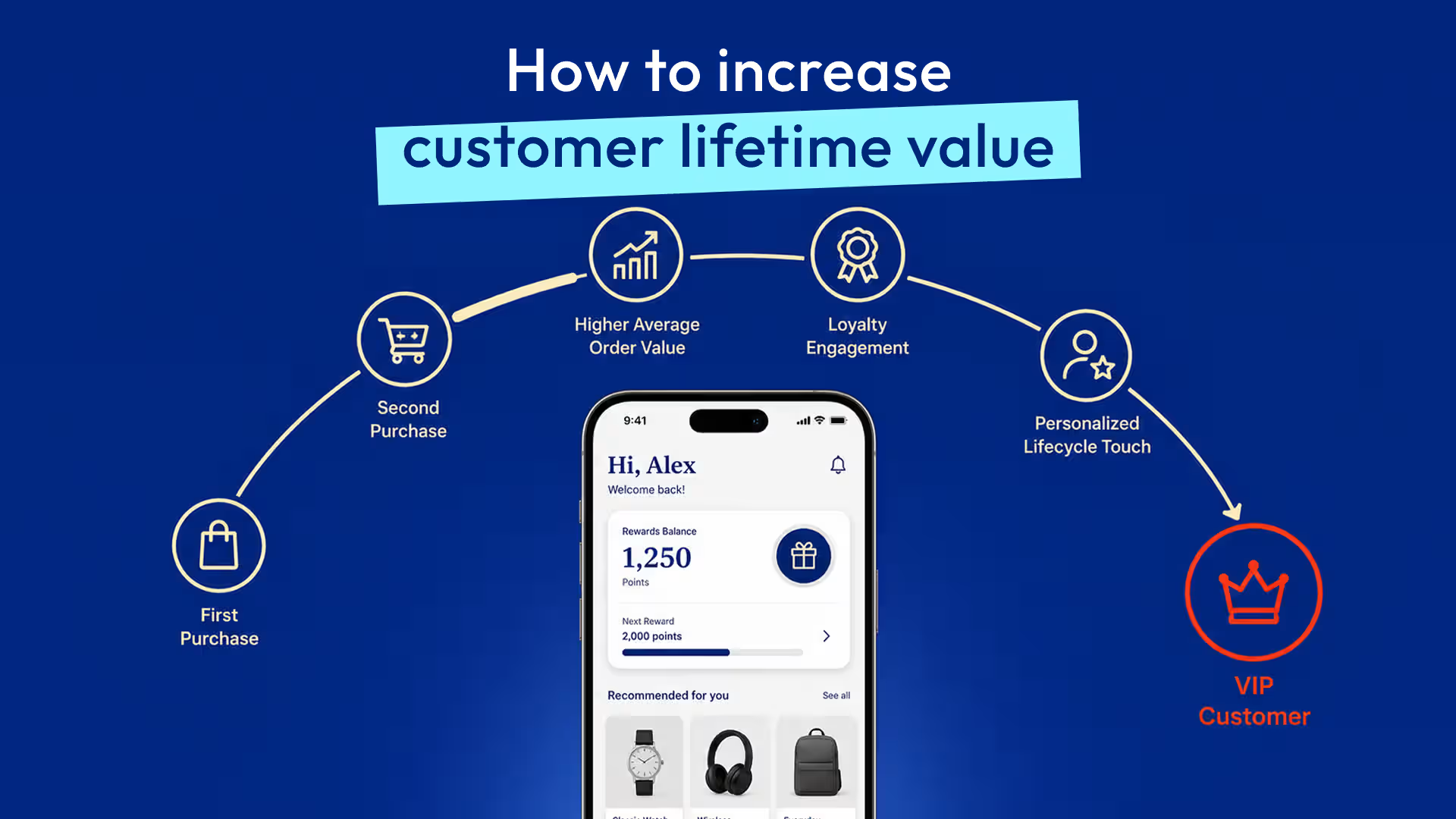
Customer lifetime value is the outcome of three different behaviours: how much customers spend, how frequently they purchase, and how long they remain active. Until you know which of these is underperforming, you are optimizing blind.
For many ecommerce brands, the first place to investigate is not the loyalty program or average order value. It is the gap between the first and second purchase. If customers never cross that gap, there is no meaningful “lifetime” to optimize.
This guide will help you identify the CLV lever holding back your store, decide what to fix first, and measure whether the change is working. We will also use Appbrew’s analysis of 30.82 million customer profiles across 250+ Shopify brands to examine how repeat-purchase and retention behaviour differs between app-installed and web-only customers.
TL;DR
- Customer lifetime value (CLV) is what a customer is worth across their entire relationship with your store: Average Order Value x Purchase Frequency x Customer Lifespan.
- Increasing customer retention by 5% raises profit by 25% to 95%.
- Most Shopify stores lose 70% to 75% of customers after the first order. Fixing that second-purchase gap is the single fastest CLV lever.
- Across 250+ Shopify brands and 30.82 million customer profiles, app-installed customers show a 32.2% higher lifetime repeat-purchase rate and a 41.4% higher 90-day retention rate than web-only customers (Appbrew, 2026).
- Loyalty and discounts mostly move AOV. An owned mobile app moves purchase frequency and customer lifespan, the levers everything else struggles to touch.
What is customer lifetime value in e-commerce?
Customer lifetime value is the total net profit a customer generates across the full length of their relationship with your brand, from first order to last. It is not a single transaction and it is not one year of spending. It is the whole relationship expressed as a number. That number is the clearest signal of business health you have. A rising CLV means customers trust you enough to come back. A flat or falling CLV means something in the experience is leaking, and no amount of top-of-funnel spend will fix it.
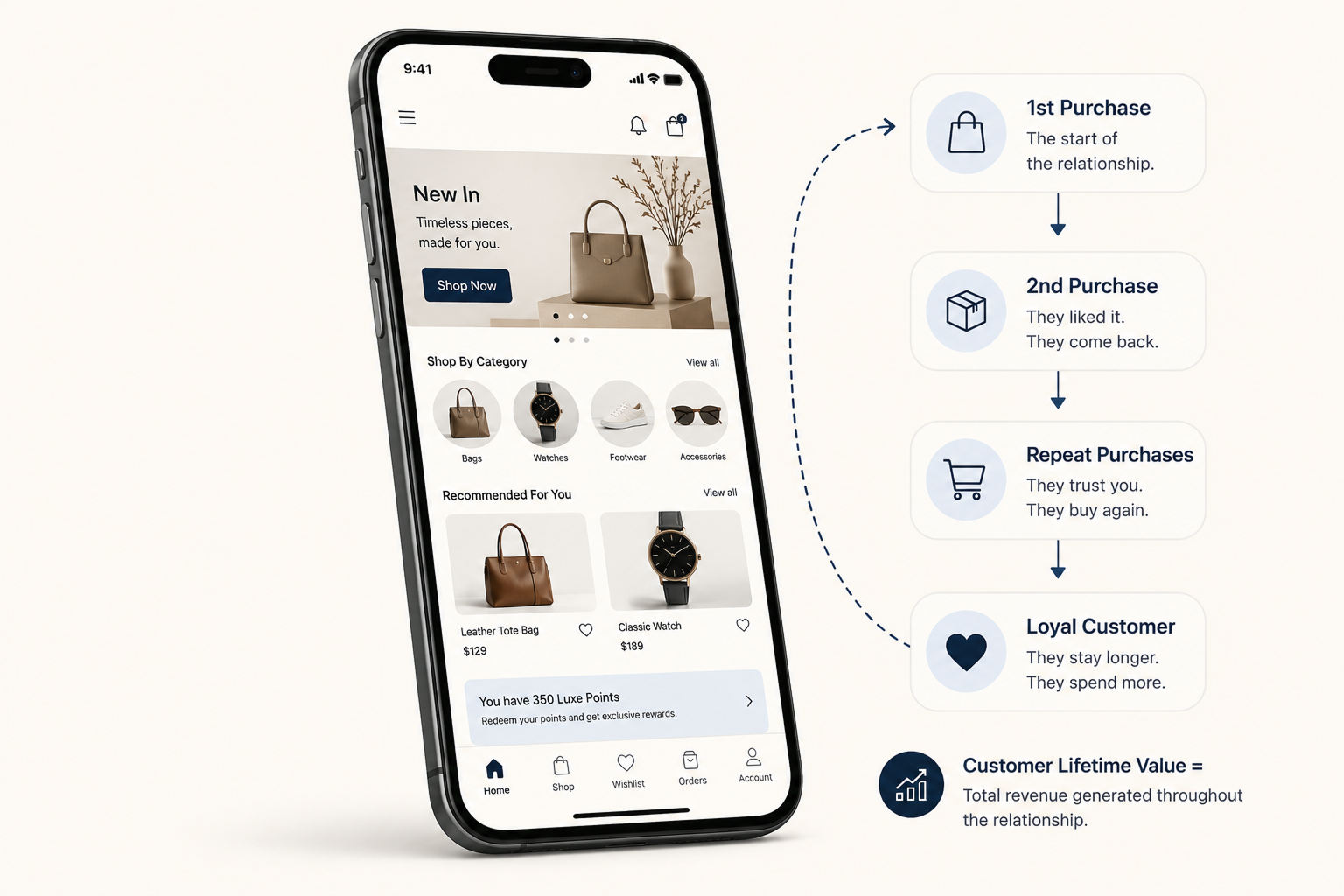
Customer lifetime value ultimately depends on retention. If you're looking for practical ways to keep customers coming back, explore these customer retention strategies.
The 3 core components of CLV
Three variables drive customer lifetime value, and every tactic in this guide moves at least one of them:
- Average Order Value (AOV): how much a customer spends per order. Raise it with bundles, upsells, and cross-sells.
- Purchase Frequency: how often they buy in a given period. Turning one order a year into two doubles that customer's annual value.
- Customer Lifespan: how long they keep buying before they churn. The longer they stay, the more orders you get from the acquisition cost you already paid.
Improve one and CLV rises. Improve all three and you have built a business that does not depend on next month's ad budget to survive.
CLV vs. LTV: are they the same?
Yes. In ecommerce, customer lifetime value (CLV) and lifetime value (LTV) refer to the same metric. Some finance teams use LTV in broader modeling and CLV specifically for customers, but the calculation is identical. Treat them as interchangeable.
How to calculate customer lifetime value
Calculating customer lifetime value ranges from a back-of-envelope estimate to a margin-adjusted forecast. Start simple, then get more precise as your data allows.

The simple CLV formula
For a quick estimate, multiply the three components:
CLV = Average Order Value x Purchase Frequency x Customer Lifespan
A customer who spends $60 per order, buys three times a year, and stays for four years is worth $720 in revenue. Run that across your customer base and you have a working baseline. It ignores margin, so treat it as revenue, not profit.
The traditional CLV formula
For a profit-accurate figure, fold in gross margin and a discount rate:
Customer Lifetime Value (CLV) = Gross Margin × (Retention Rate ÷ (1 + Discount Rate − Retention Rate))
This formula incorporates:
- Gross margin: profit remaining after the cost of goods sold.
- Retention rate: the percentage of customers who continue buying over a given period.
- Discount rate: typically around 10%, reflecting the fact that future revenue is worth less than revenue earned today.
Example
Assume:
- Gross margin = $400
- Annual retention rate = 80% (0.80)
- Discount rate = 10% (0.10)
CLV = $400 × (0.80 ÷ (1.10 − 0.80))
CLV = $400 × 2.67
CLV ≈ $1,067
Unlike the simple formula, this estimates profit-based customer lifetime value, making it more useful for financial planning and customer acquisition decisions.
Predictive CLV and the data it needs
The formulas above look backward. Predictive CLV looks forward, using machine learning to forecast what a customer will be worth based on the timing between orders, product mix, and early engagement signals. It is the version that lets you act before a customer churns instead of after.
Most stores never get here because the data sits in five disconnected tools. Appbrew's Milo AI is built to close that gap: it reads your app behavior and surfaces performance insights, growth recommendations, and the early churn signals that predictive CLV depends on. That is the difference between knowing a customer left and knowing they were about to.
Customer lifetime value vs. customer acquisition: which matters more?
Retention is the most capital-efficient growth lever you have. Increasing customer retention by just 5% lifts profit by 25% to 95% (Bain & Company), while acquiring a new customer costs 5 to 7 times more than keeping an existing one.
For example, at a $70 CAC and 50% gross margin on an $85 first order, you net $42.50 against $70 in acquisition cost. You lose $27.50 on every first-time buyer who never returns. The entire profit lives in the second order and beyond, which is exactly the part most stores neglect.
What is a good CLV:CAC ratio in 2026?
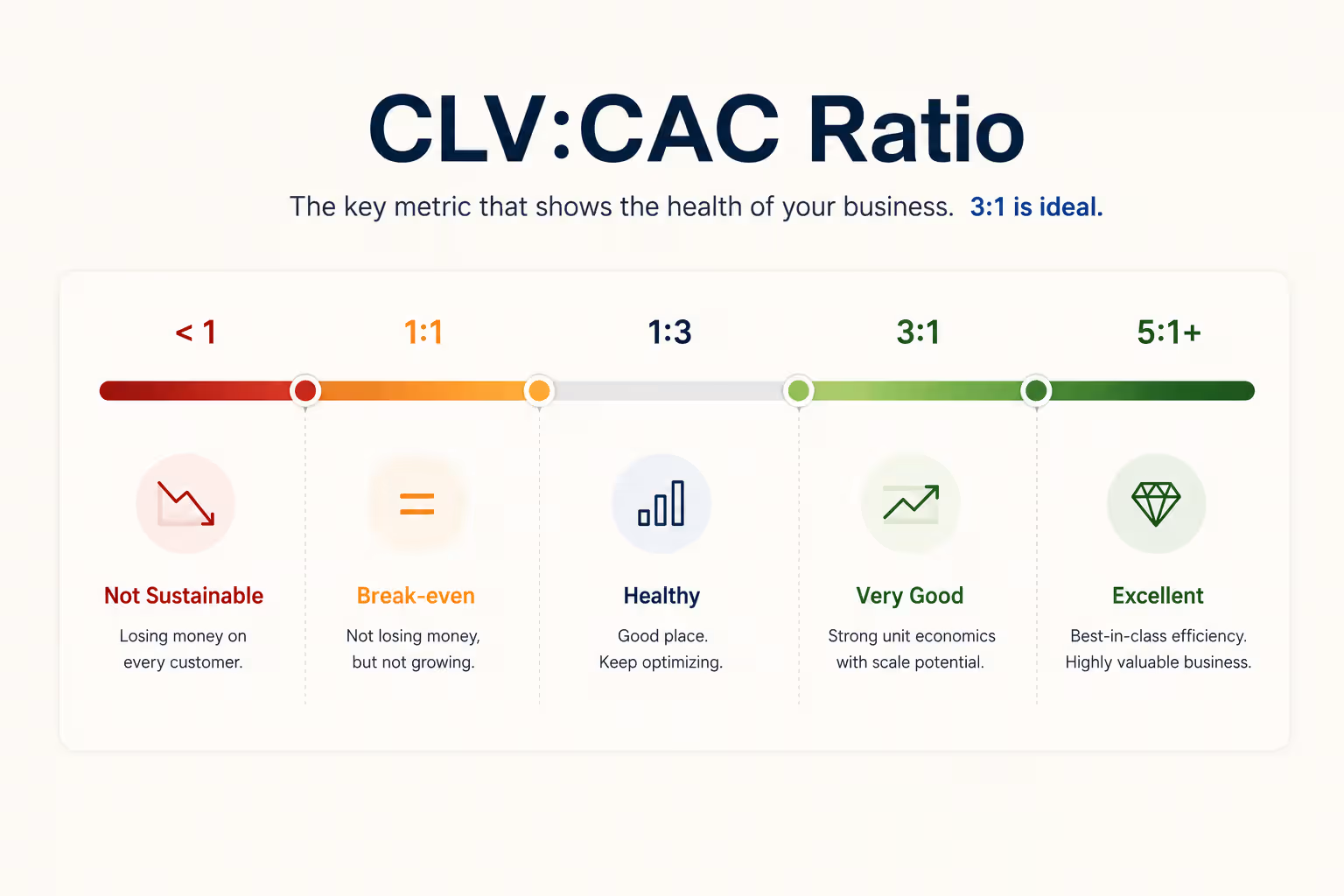
The single number that tells you whether your model is sustainable is the CLV to CAC ratio. A healthy target is 3:1 or higher, meaning each customer is worth at least three times what you paid to acquire them. Below that, you are running a leaky bucket, pouring acquisition spend into a base that empties faster than it fills. Above it, every retention gain compounds without another dollar of ad spend.
|
CLV:CAC Ratio |
What it tells you |
|
Below 1:1 |
Customers cost more to acquire than they generate in value. |
|
1:1–2:1 |
Margins are thin, leaving little room to scale profitably. |
|
Around 3:1 |
Generally considered a healthy balance between growth and efficiency. |
|
5:1 or higher |
Strong customer economics. You may have room to invest more aggressively in acquisition if demand exists. |
The ratio shouldn't be viewed in isolation. A 3:1 benchmark is a useful target, but improving the ratio by increasing customer lifetime value is usually more sustainable than improving it solely by cutting acquisition costs. Higher CLV gives you the flexibility to bid more aggressively, absorb rising CAC, and continue growing without sacrificing profitability.
How to increase customer lifetime value: 8 proven strategies
Customer lifetime value improves in stages. First, earn the second purchase. Then increase basket size. Finally, give customers more reasons to keep coming back. The eight strategies below follow that progression.
1. Fix the second-purchase problem first
Most Shopify stores lose 70% to 75% of customers after the first order, and healthy repeat rates sit between 25% and 40% depending on category (BuildGrowScale, 2026). Nothing else on this list matters as much as moving a first-time buyer to a second order.
The mechanic that works: a timed post-purchase sequence that teaches the customer how to get value from what they just bought, then reintroduces the next logical product before the initial excitement fades.
2. Raise average order value with bundles, upsells, and cross-sells
Getting each customer to spend a little more per order compounds fast across a year. Bundle complementary products at a small discount to lift perceived value. Offer a premium version at the point of decision (upsell) and a related item at checkout (cross-sell). A free-shipping threshold set just above your current AOV is one of the most reliable ways to nudge basket size up.
Read our guide on: How to increase AOV: 10 mobile app strategies for Shopify
3. Increase purchase frequency with a loyalty program
A loyalty program formalizes the reason to come back to you instead of a competitor. Reward repeat behavior, not just high one-time spend, and tie points to actions that deepen the relationship: second orders, reviews, referrals.
Tools like Yotpo Loyalty or Smile handle the mechanics. The design choice that matters is rewarding frequency, because frequency is the lever loyalty is uniquely good at moving.
4. Improve customer lifetime value with personalization
Generic blasts underperform personalized campaigns by a wide margin. Use purchase history to tailor what each customer sees: category-specific emails, product recommendations based on the last order, a re-engagement offer the moment behavior signals a customer is drifting.
Personalization is how you make a large base feel like a set of individual relationships, and it is one of the most dependable ways to improve customer lifetime value over time.
5. Build CLV-focused lifecycle flows across email, SMS, and push
Staying top of mind drives repeat purchases, but the channels are not equal. Email deliverability and open rates keep sliding, and SMS carries a cost per send that adds up fast at scale. Layer the three so each does what it is best at: email for depth, SMS for urgency, and push for free, opt-in reach that lands on the lock screen.
The brands with the strongest CLV-focused marketing strategies run all three from a single view of the customer, segmented by value rather than blasted uniformly.
6. Use subscriptions where demand is genuinely recurring
If your product gets consumed and repurchased on a predictable cadence, subscriptions convert one-time buyers into a stable, forecastable revenue base. The key is low cancellation friction and honest cadence. Force a subscription onto a product people buy once and you generate churn and chargebacks, not lifetime value.
7. Extend customer lifespan with reviews and social proof
Customers trust other customers more than they trust your ads. Reviews, ratings, and user-generated content build the confidence that keeps a relationship going past the first order.
Collect high-intent reviews with photos and video, display them where they influence the decision, and reward customers with loyalty points for submitting them so the two systems feed each other.
8. Turn customer support into a retention channel
Support is not a cost center, it is a lifespan lever. One in three consumers will leave a brand after a single bad service experience. Fast, personalized, proactive support (agents who can see order history, help that arrives before the customer has to ask) turns a potential churn moment into a reason to stay. Every interaction either extends the relationship or ends it.
How a mobile app increases customer lifetime value
Mobile app separates the brands compounding CLV from the ones stuck reacquiring the same customers. A branded mobile app is the closest thing to a fully owned channel in ecommerce, and it moves the two levers everything else struggles to touch: purchase frequency and customer lifespan. It is the one surface where a repeat customer stays a tap away, with no algorithm gating who sees you and no per-message cost to reach them.
App vs. web: the customer lifetime value gap
Appbrew ran a longitudinal study of 30.82 million customer profiles across 250+ Shopify brands using native mobile apps, over three years from June 2023 to July 2026.

The gap is large and it is consistent.
|
Metric |
Web-Only Customers |
App-Installed Customers |
Lift |
|
Lifetime repeat-purchase rate |
44.40% |
58.68% |
+32.2% |
|
90-day retention rate |
24.04% |
34.01% |
+41.4% |
Across 24.4 million web-only and 6.4 million app-installed profiles, app customers repeat and retain at materially higher rates. These are the two hardest lines in the CLV formula to move, and the app moves both.
Push notifications vs. email decay
The app moves frequency because of the channel it unlocks. Push notifications land on the lock screen, opt-in, at no cost per send, while the alternatives keep getting more expensive or less reliable:
- Email: open rates keep eroding, and deliverability sits at the mercy of inbox providers
- SMS: it still works, but you pay per message and the cost scales with your list
- Push: free per send, opt-in, and it reaches an installed customer directly on their lock screen
With 66% of Shopify orders already placed on mobile, the app is where your highest-intent customers already are. Push is the only free, owned way to reach them there.
App-only loyalty and faster repeat purchases
An app compresses the path to the next order. Saved payment, one-tap reorder, app-only rewards, and a home screen icon that acts as permanent shelf space all cut the friction that kills repeat purchases on mobile web. The result is the retention curve in the table above: customers who install simply come back more.
Case study: what the app did for real D2C/e-commerce brands
The aggregate lift shows up as revenue at the brand level.
Bacca Bucci, an athleisure and footwear brand that has shipped more than 5 million pairs, had a familiar problem. 85% of its traffic was mobile, but the mobile website converted poorly, retargeting struggled to bring shoppers back, and post-purchase communication did little to build loyalty.
They launched a native app with Appbrew built around interactive shoppable video, real-time order tracking, push notifications, and personalized campaigns. The results at the brand level:
- 4x higher Day-30 retention on the app compared to the website
- 3.5x higher conversion rate than the mobile site
- 15% higher average order value
- 25% of DTC revenue now coming through the app
- 9x more time spent in the app than on the web
You do not need a six-month build or a custom engineering team to get here. Appbrew turns a Shopify store into a native app in a few days, with the push, loyalty, and personalization built in.
{{cta}}
3 advanced CLV strategies: segmentation, RFM, and CLV tiers

Once the fundamentals are running, customer lifetime value becomes a targeting tool, not just a metric you report. The 80/20 rule holds in most stores: roughly 80% of revenue comes from 20% of customers. Find that 20% and you know where to spend your retention effort.
1. Find your most valuable customers
Rank customers by CLV and the top decile usually reveals a clear profile: a first product, an acquisition channel, a category. Feed that profile back into acquisition so you attract more of the customers who actually stay, not the discount-seekers who buy once and vanish.
2. RFM analysis for CLV segmentation
RFM scores customers on three axes:
- Recency (how recently they bought)
- Frequency (how often)
- Monetary value (how much)
Scoring across these three sorts your base into actionable groups like Champions, Loyal, and At-Risk, so you stop sending the same message to a first-time buyer and a VIP.
3. Tailor marketing to high, mid, and at-risk CLV tiers
Segmentation only pays off when the message changes with the tier:
- High-CLV: treat them as VIPs with early access, exclusive drops, and personal outreach.
- Mid-CLV: nurture toward the top tier with targeted cross-sells and a reason to join loyalty.
- At-risk: win them back with a re-engagement offer or a survey before they churn for good.
How to measure and track customer lifetime value
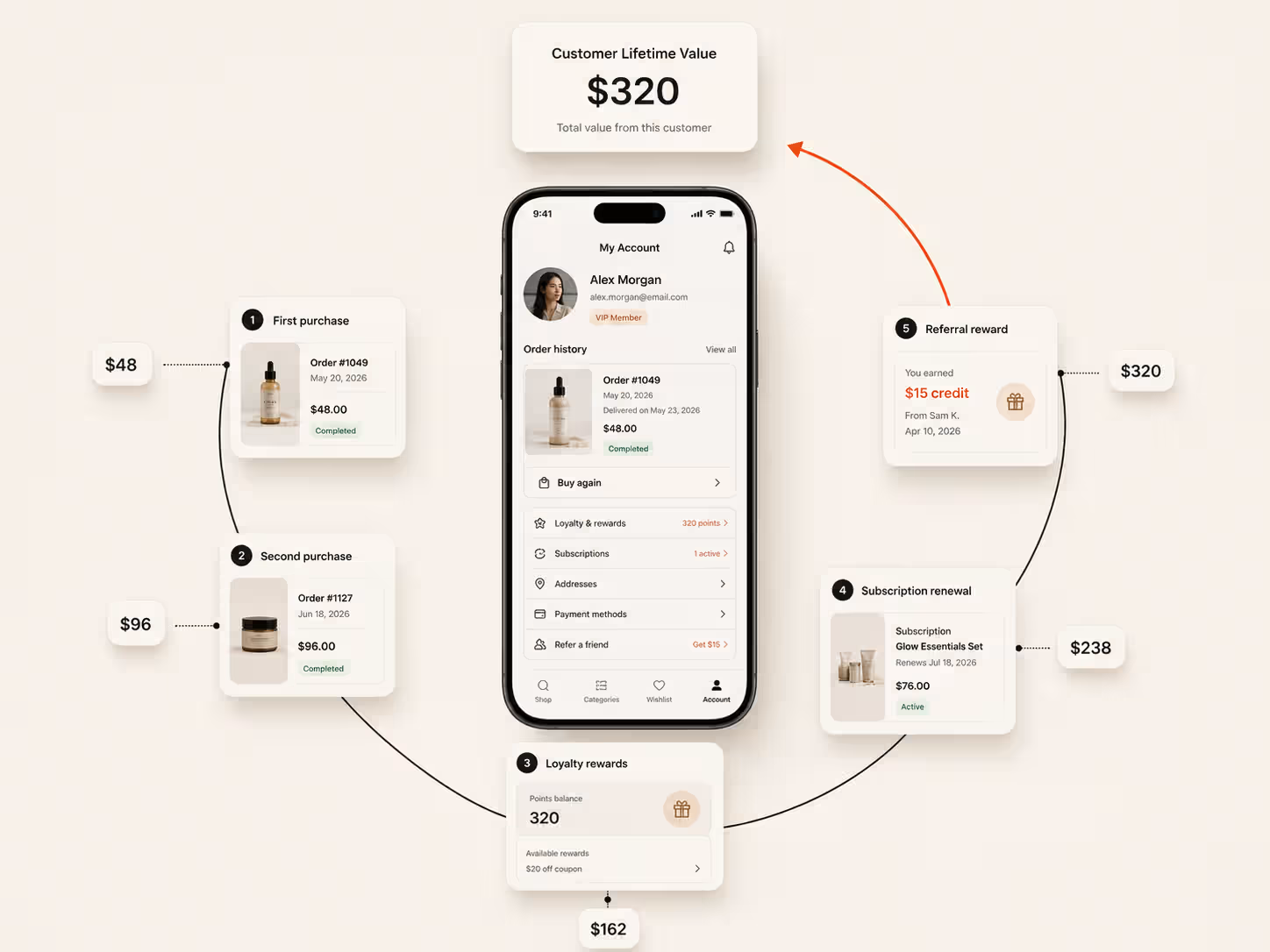
You cannot improve what you do not measure, and customer lifetime value in ecommerce is a trend, not a snapshot. Track it quarterly by cohort so you can see whether the customers you acquired this quarter are worth more over time than last quarter's.
Step 1: Decide which CLV you're measuring
Settle these before pulling any numbers, teams that skip this compare figures that were never the same metric.
| Question | Options | Use this one |
|---|---|---|
| Revenue or profit? | Revenue-based / Profit-based | Profit-based for all budget decisions. Revenue-only overstates value and inflates CAC targets. |
| Backward or forward? | Historical / Predictive | Both, historical to report, predictive to act early. |
| Gross or net? | Before or after returns & discounts | Net, so promos and returns don't flatter the number. |
Without team alignment on these, your LTV insights won't drive action. One label warning: Klaviyo's "Predicted CLV" is forward-looking, while some tools use "LTV" to mean historical revenue to date. Pick one definition and use it everywhere.
Step 2: Track by cohort, never as a blended average
The most common mistake is reporting a single blended CLV. A handful of high-spending "whales" distort it badly.
Instead:
- Group customers by acquisition month or quarter.
- Watch each cohort's value grow over time.
- Compare cohorts: are the customers you're acquiring now worth more than last quarter's?
Rising cohort value quarter over quarter is the clearest sign your retention work is compounding.
The fastest leading indicator is the second-purchase rate. Pull customers acquired ~90 days ago and check what share placed a second order. If it is below 30%, fix your post-purchase flow before anything else.
Step 3: Know what Shopify gives you (and what it doesn't)
Shopify covers the raw inputs and some segmentation, but stops short of true CLV.
What's native:
- AOV and repeat-customer rate, straight from the reports.
- Purchase frequency , total orders ÷ unique customers on a 12-month rolling window, not a snapshot a sale can skew.
- RFM analysis, built-in segmentation by recency, frequency, and monetary value.
- Predicted spend tier, buckets customers High / Medium / Low.
Where it stops: Shopify doesn't produce full cohort-based, dollar-value CLV out of the box. For that you'll add an analytics layer or build it from the cohort reports by hand.
Step 4: Add GA4 for channel and predictive signals
Connect GA4 with ecommerce tracking for two things Shopify won't give you: which acquisition sources deliver your best customers, and a forward-looking view.
Build it as an Exploration using the User Lifetime technique. Unlike the old Universal Analytics report, GA4's version uses machine learning to predict future purchases, activity, and revenue.
The three predictive metrics:
| Metric | What it predicts |
|---|---|
| Purchase probability | Likelihood a user buys in the next 7 days |
| Churn probability | Likelihood an active user won't return |
| Predicted revenue | Expected future revenue per user |
They're powerful but conditional:
- Needs 1,000 returning and 1,000 non-returning users in a 7- or 28-day window before models kick in.
- Per-user predictions take 90+ days of history to stabilize.
- Export predictive audiences (e.g. High-Value Purchasers) to Google Ads , property must be linked, and lists generally need ~1,000 users to target effectively.
Step 5: Set a review cadence
Put a short set of numbers on a dashboard and review on a fixed rhythm instead of chasing one headline figure.
| Cadence | Watch |
|---|---|
| Weekly | Second-purchase rate for the newest cohort |
| Monthly | AOV, purchase frequency, repeat rate: split by channel and first product |
| Quarterly | Profit-based CLV by cohort (as a curve) + CLV:CAC ratio |
What is a good customer lifetime value?
There is no universal target, because a furniture brand and a phone-case brand live on different planets. Most stores land between $100 and $300 in average CLV. The more useful benchmark is the CLV:CAC ratio at 3:1 or higher, and the direction of travel. Rising cohort value quarter over quarter is the signal that your retention work is compounding.
Conclusion
Customer lifetime value doesn't improve because you optimize a single campaign. It grows when you consistently increase purchase frequency, average order value, and customer lifespan across the entire customer journey. That's how brands build sustainable, profitable growth instead of relying on rising acquisition spend.
The brands that keep growing despite rising acquisition costs aren't necessarily acquiring more customers. They're extracting more value from the customers they already have by making repeat purchases easier, more frequent, and more rewarding. That's the playbook you'll find behind many of the highest-performing Shopify brands.
{{cta2}}
Frequently Asked Questions
How do you calculate customer lifetime value?
Multiply average order value by purchase frequency by customer lifespan for a revenue estimate. For a profit figure, use the margin-adjusted formula that factors in gross margin, retention rate, and a discount rate. Shopify gives you AOV directly, and GA4 with ecommerce tracking fills in frequency and lifespan by cohort.
What is a good customer lifetime value for an ecommerce store?
It varies by category, but many stores average between $100 and $300. The better benchmark is your CLV:CAC ratio, where 3:1 or higher signals a sustainable model. Watch the trend across cohorts rather than fixating on a single number.
How can I increase CLV without spending more on ads?
Focus on customers you have already paid to acquire. Drive the second purchase with post-purchase flows, raise AOV with bundles, and re-engage through owned channels like email, SMS, and app push. These gains compound without adding acquisition cost.
Does a mobile app actually improve customer lifetime value?
Yes, for repeat-purchase brands. Across 250+ Shopify brands, app-installed customers show a 32.2% higher repeat-purchase rate and a 41.4% higher 90-day retention rate than web-only customers (Appbrew, 2026). The app lifts purchase frequency and customer lifespan, the two hardest levers to move.
What is the difference between CLV and LTV?
They are the same metric in ecommerce. Some finance teams use LTV more broadly and CLV specifically for customers, but the calculation is identical.
Which component of CLV should I focus on first?
For a newer store, prioritize purchase frequency by converting first-time buyers into repeat customers. For an established store with a loyal base, optimizing AOV through bundling and upsells often delivers faster returns.
Can customer lifetime value be negative?
Yes. If the cost to acquire and serve a customer exceeds the revenue they generate, their CLV is negative. That usually points to a problem with acquisition targeting, pricing, or product-market fit.
What are common mistakes when managing CLV?
The biggest is reporting only the blended average, which a handful of whales can distort. Segment by acquisition channel, first product, and cohort instead. The second mistake is treating CLV as a metric to report rather than a lever to act on.
How long does it take to see an increase in CLV?
AOV changes from bundling can show up within weeks. Meaningful gains in retention and customer lifespan take several months to a year to appear in the data, because lifespan is measured over time by definition.
How does customer service impact CLV?
Directly. One in three consumers will leave after a single poor service experience, while proactive support builds the trust that extends customer lifespan. Every support interaction either lengthens or ends the relationship.