

.webp)
.webp)

Use these 11 ecommerce customer retention strategies with real examples and first-party benchmarks from 250+ brands to help increase repeat purchases.
The cheapest customer you'll ever get is the one you already have. You know this. The hard part is the how: which strategies actually earn the next order, and what the brands winning at retention do differently.
Nike built a membership program with more than 150 million members, who spend roughly three times as much as non-members. But retention is not reserved for brands with Nike-sized budgets.
In 2026, ecommerce customer retention is one of the strongest competitive advantages a brand can build. Products can be copied and ad costs can rise, but a customer base that keeps coming back is much harder to replicate.
Yet the average ecommerce store retains only about 30% of its customers. The other seven in ten buy once and disappear, often unnoticed because new orders keep covering the loss.
This guide explains what a healthy ecommerce returning customer rate looks like for your category, how to calculate yours, and which retention strategies actually bring customers back.
|
What is ecommerce customer retention? Ecommerce customer retention is a store's ability to turn one-time buyers into repeat customers over a given period. It is measured by the customer retention rate, or the percentage of existing customers who buy again. The average ecommerce retention rate is about 30%. A healthy rate is 30 to 40%, and the best stores reach 40 to 60%. |
Quick Insights
- Category changes everything: Median repeat rates range from 40.5% in pet care to 4.9% for mattresses.
- More messages are not the answer: The strongest retention strategies make the next purchase easier, better timed, or more valuable.
How to Gauge Your Brand's Health
- Below 20%: Retention engine needs attention (evaluate post-purchase experience, email/SMS/push cadence, product quality, or onboarding).
- 25% – 35%: Healthy baseline for standard DTC fashion, lifestyle, and multi-category retail.
- Above 40%: Best-in-class performance (common for brands with strong community, loyalty programs, or subscription/replenishment mechanics).
Why customer retention matters in ecommerce
The first order barely covers advertising, discounts, fulfillment and returns. Profit often comes from the purchases that follow. Returning customers also make revenue more predictable and reduce how heavily growth depends on paid media.
You will often hear that retaining a customer costs five to 25 times less than acquiring one. Treat that as a general rule, not a universal benchmark. The exact difference depends on your margins, category, and purchase frequency.
What matters is the principle: the more customers return, the stronger the economics of your store become. Across Appbrew’s network of 250+ Shopify brands, repeat purchases account for 32% of app buyers.
What is a good ecommerce returning customer rate in 2026?
A good ecommerce returning customer rate is generally 20% to 40% over 12 months. But the right benchmark depends on what you sell, how often customers need it, and whether purchases are transactional or subscription-based.
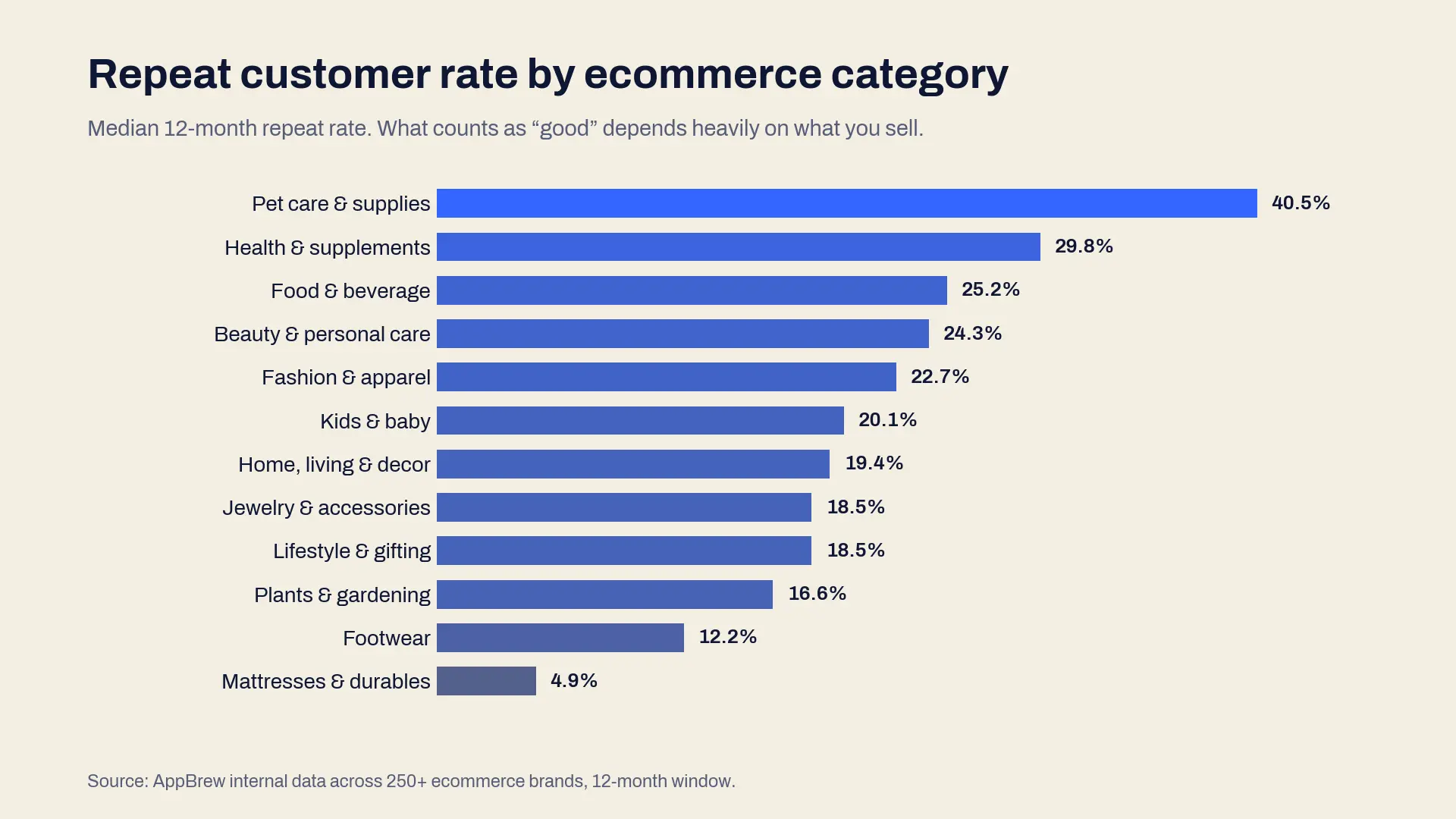
Appbrew’s internal data shows how widely repeat rates vary across ecommerce categories.
Ecommerce returning customer rate benchmarks by industry (2026)
|
Industry vertical |
Median overall repeat customer rate |
Brand spread |
Median mobile-app repeat customer rate |
|
Pet care and supplies |
40.5% |
38% to 58% |
42.1% |
|
Health, wellness and supplements |
29.8% |
15% to 43% |
33.4% |
|
Food and beverage |
25.2% |
11% to 32% |
33.1% |
|
Beauty and personal care |
24.3% |
10% to 51% |
28.5% |
|
Fashion and apparel |
22.7% |
7% to 42% |
20.8% |
|
Kids and baby |
20.1% |
15% to 24% |
27.7% |
|
Home, living and decor |
19.4% |
8% to 26% |
23.9% |
|
Jewelry and accessories |
18.5% |
7% to 43% |
15.5% |
|
Lifestyle and gifting |
18.5% |
2% to 22% |
20.2% |
|
Plants and gardening |
16.6% |
11% to 21% |
23.0% |
|
Footwear |
12.2% |
2% to 22% |
25.0% |
|
Mattresses and large durables |
4.9% |
5% |
N/A |
Source: Appbrew internal data across 250+ ecommerce brands, measured over a 12-month window.
Three patterns stand out:
1. Consumable products bring customers back more often
Pet care had the highest median repeat rate at 40.5%, followed by health and supplements at 29.8% and food and beverage at 25.2%.
2. Brands in the same category can perform very differently
Beauty brands ranged from 10% to 51%, even though the category median was 24.3%. Fashion showed a similarly wide spread, from 7% to 42%.
In beauty, brands that build complete routines and use replenishment reminders have more opportunities to earn the next order. In fashion, frequent drops can bring customers back more often than occasion wear or seasonal collections.
3. Mobile-app customers often have higher repeat rates
App customers repeated more frequently in several categories. The clearest differences included food and beverage: 33% in the app vs 25% overall, beauty and personal care: 28.5% vs 24.3% and more.
Retention also varies by business model
|
Business model |
Typical annual retention |
|
Subscription ecommerce |
70–80% |
|
Traditional retail |
~63% |
|
Transactional ecommerce |
~30% |
|
Email-mature stores |
40–52% |
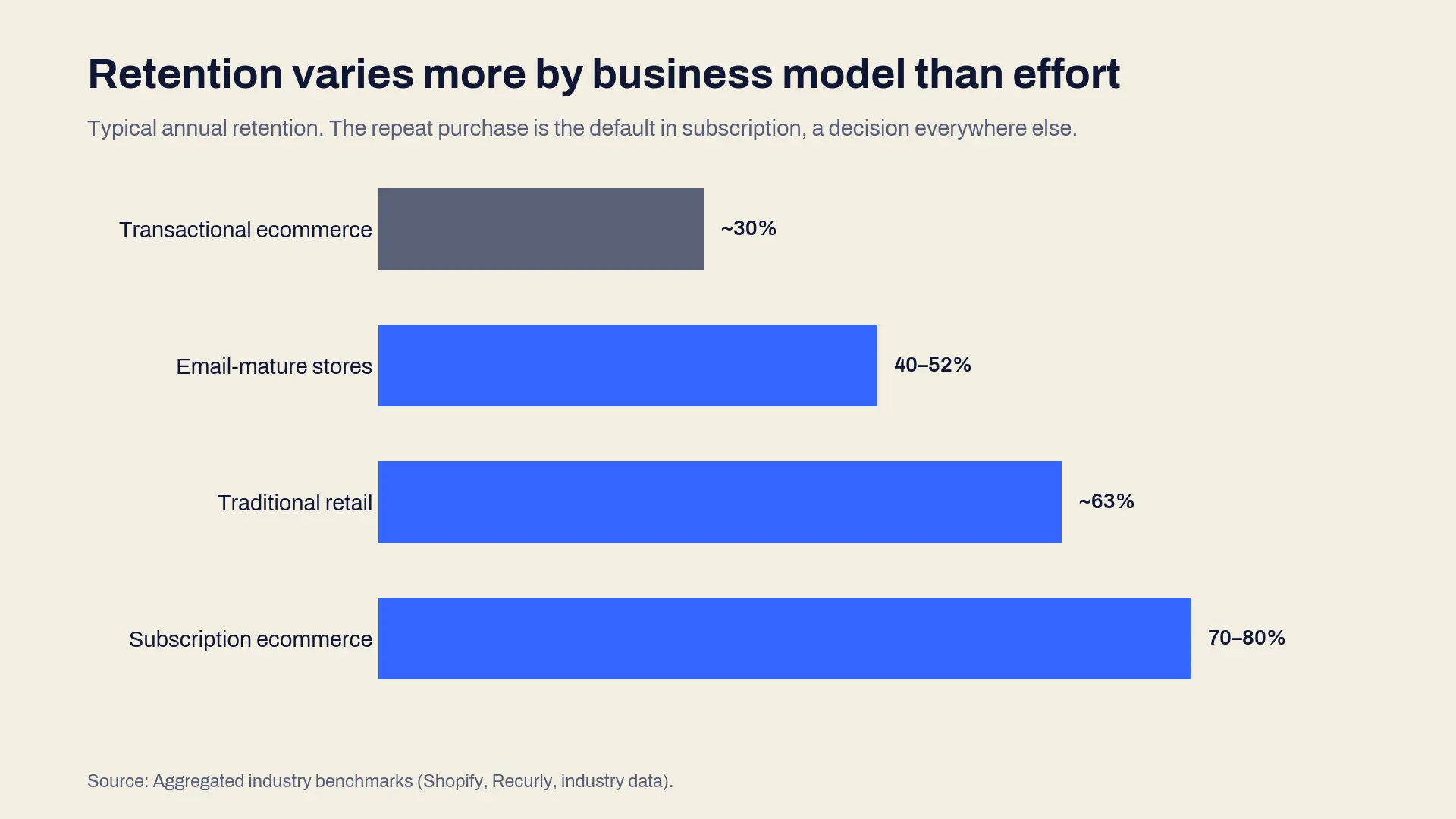
Subscription brands usually report higher retention because customers remain active until they cancel. For a transactional store, retention must be defined using a repeat-purchase window, such as 90, 180, or 365 days.
11 ecommerce customer retention strategies that work in 2026
The best ecommerce customer retention strategies make the next purchase easier, better timed, or more valuable. Start with the points where customers already show intent rather than sending more generic promotions.
1. Personalize the experience with first-party data
Use browsing history, previous orders, size, location, and product preferences to improve what customers see. A returning skincare customer should not receive the same recommendations as a first-time visitor.
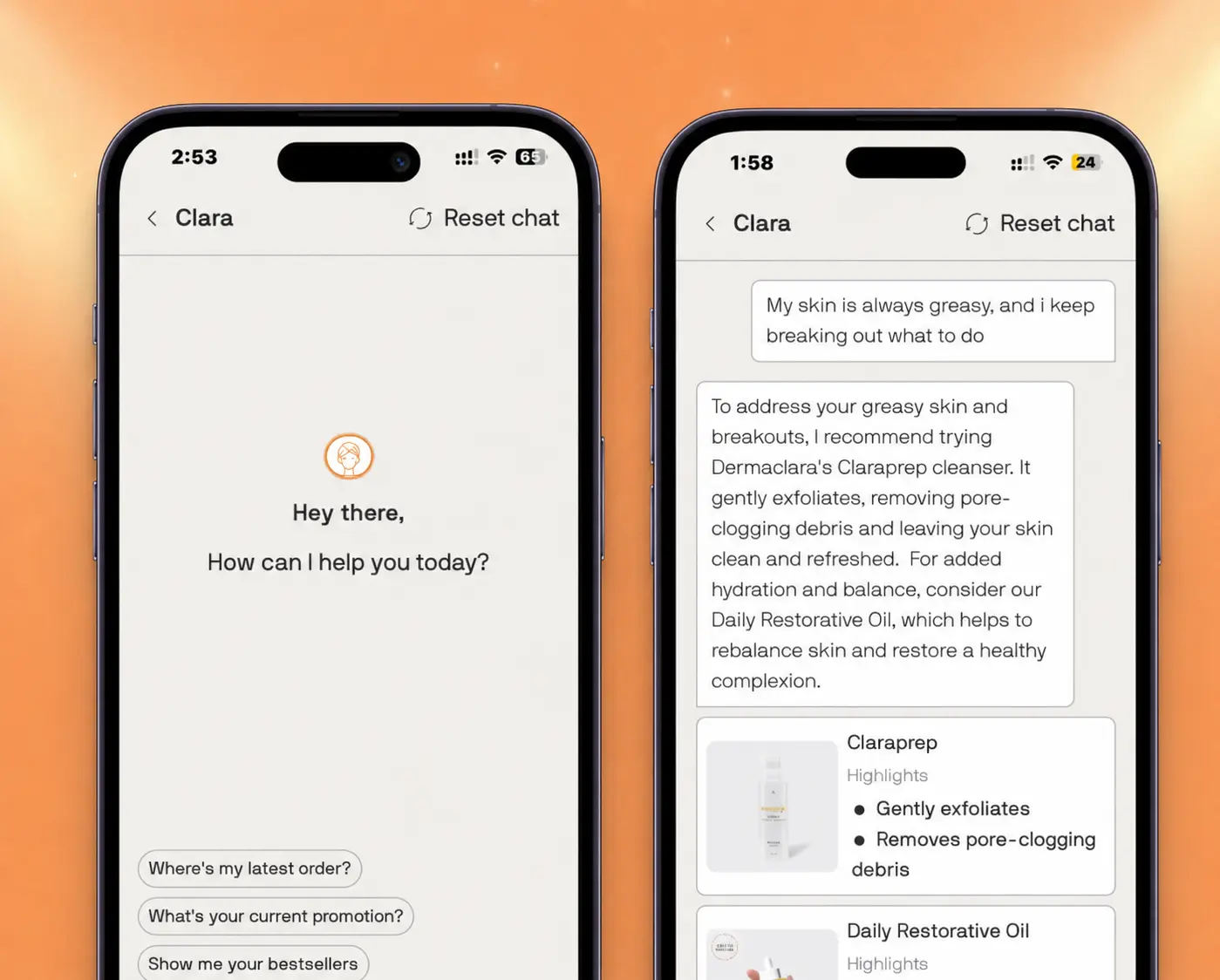
Dermaclara, a US skincare brand, built an in-app AI concierge called Clara that recommends products and routines based on each customer's skin goals and answers questions in real time. Turning a static storefront into a guided experience lifted conversion 32% and grew engagement 5.5x.
One caution worth taking seriously: more personalization isn't always better. Gartner found that over 53% of customers reacted negatively to personalization that felt invasive, and those customers went on to buy less.
2. Give customers a reason to join your loyalty program
Shoppers join eight loyalty programs on average but actively use only five, and 40% sometimes forget to redeem what they've earned.
So the highest-leverage work isn't adding more points. It's putting earned rewards in front of people at the moment they'd act:
- Show point balances and expiring rewards at checkout
- Remind lapsed customers what they're leaving on the table
- Make redemption one tap
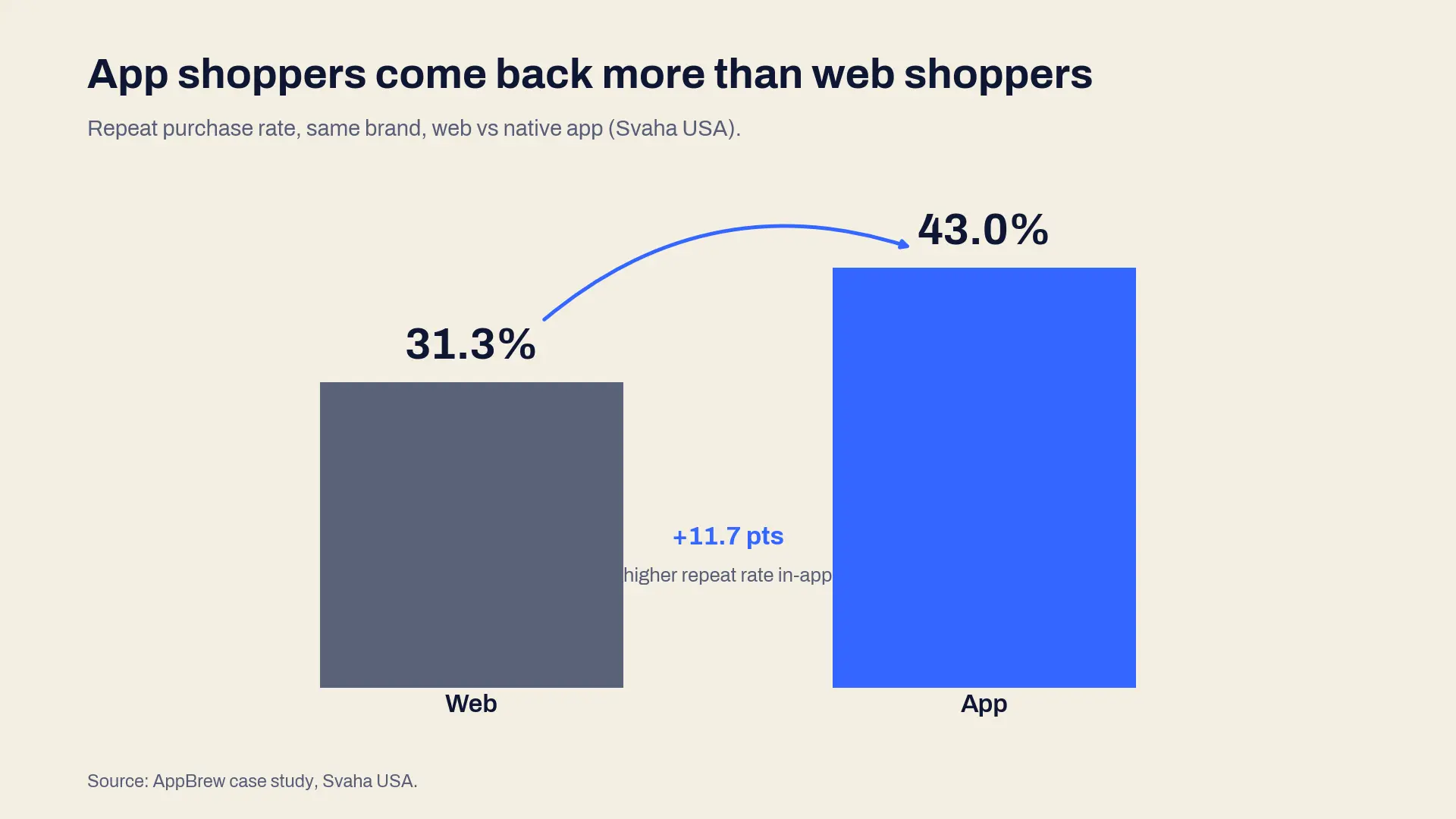
When Svaha USA, a US apparel brand, surfaced its rewards and referral links clearly inside its app instead of hiding them, participation climbed and repeat purchase rate went from 31.3% on web to 43% in the app. Same program, made visible.
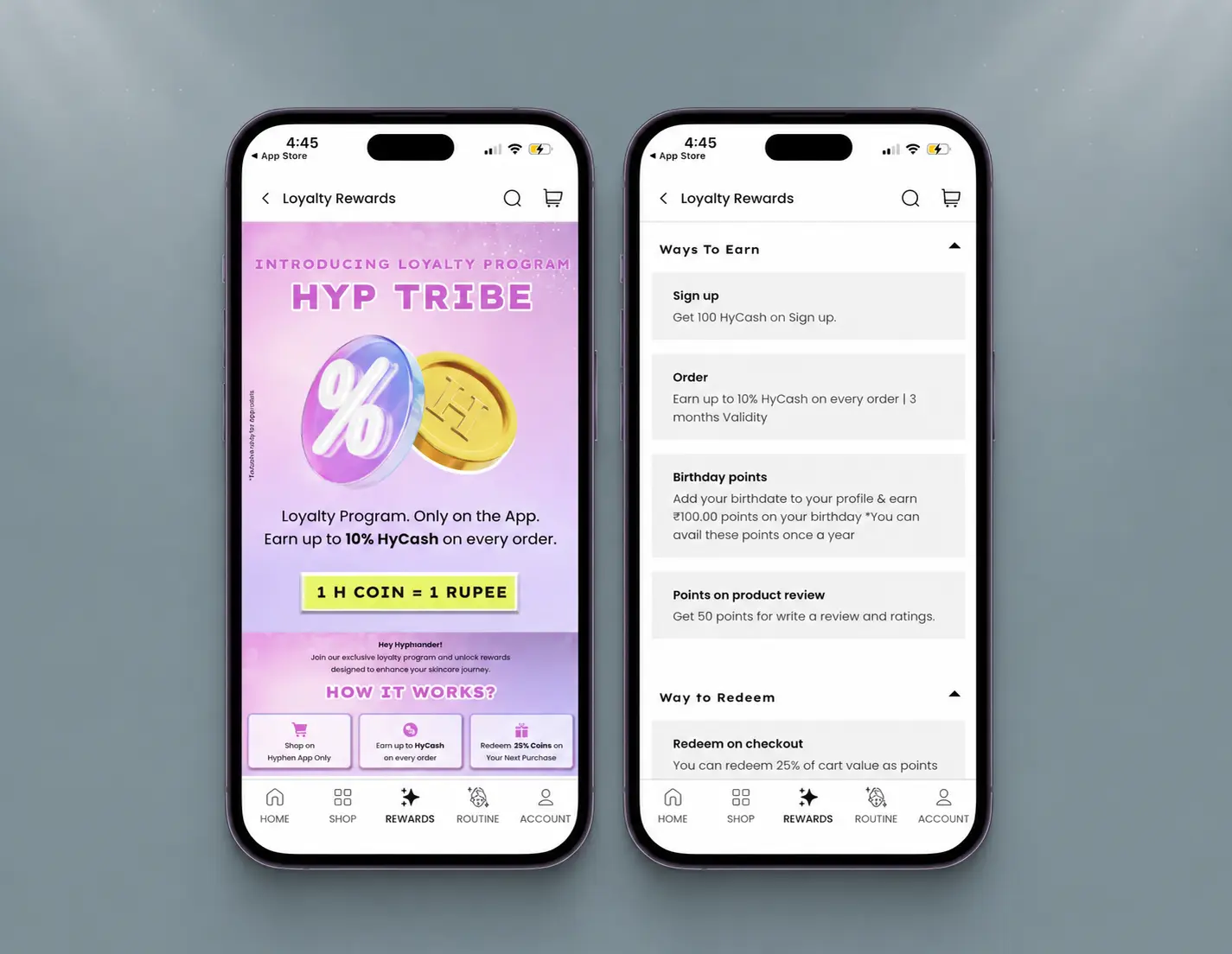
Hyphen surfaces HyCash within its app experience rather than treating loyalty as a separate page customers must remember to visit. This helped make rewards part of product discovery and checkout.
3. Build email and SMS around the customer lifecycle
Separate lifecycle messages from promotional broadcasts. Useful retention flows include post-purchase education, replenishment reminders, back-in-stock alerts, loyalty updates, and win-back campaigns.
Email carries detail and does the lifecycle heavy lifting. SMS is for the time-sensitive stuff, a flash sale or a back-in-stock alert, because it gets read within minutes.
4. Use retargeting to recover, not just acquire
Retargeting gets filed under acquisition, but its sharpest use is retention: reaching people who already bought or already showed intent, instead of paying to introduce yourself to strangers.
The practical rule is to match the message to the behavior:
|
Who they are |
What to show them |
|
Abandoned a cart |
The exact items, with a nudge (not always a discount) |
|
Bought once, went quiet |
A complementary product or a reorder reminder |
|
Repeat customer |
Early access or new arrivals, never a first-timer coupon |
5. Make reordering automatic with subscriptions
Subscriptions work best for products customers already need regularly, including food, supplements, skincare, and pet supplies. Let customers pause, skip, swap, or change delivery dates without contacting support. Also use payment reminders and failed-payment recovery to prevent involuntary churn.
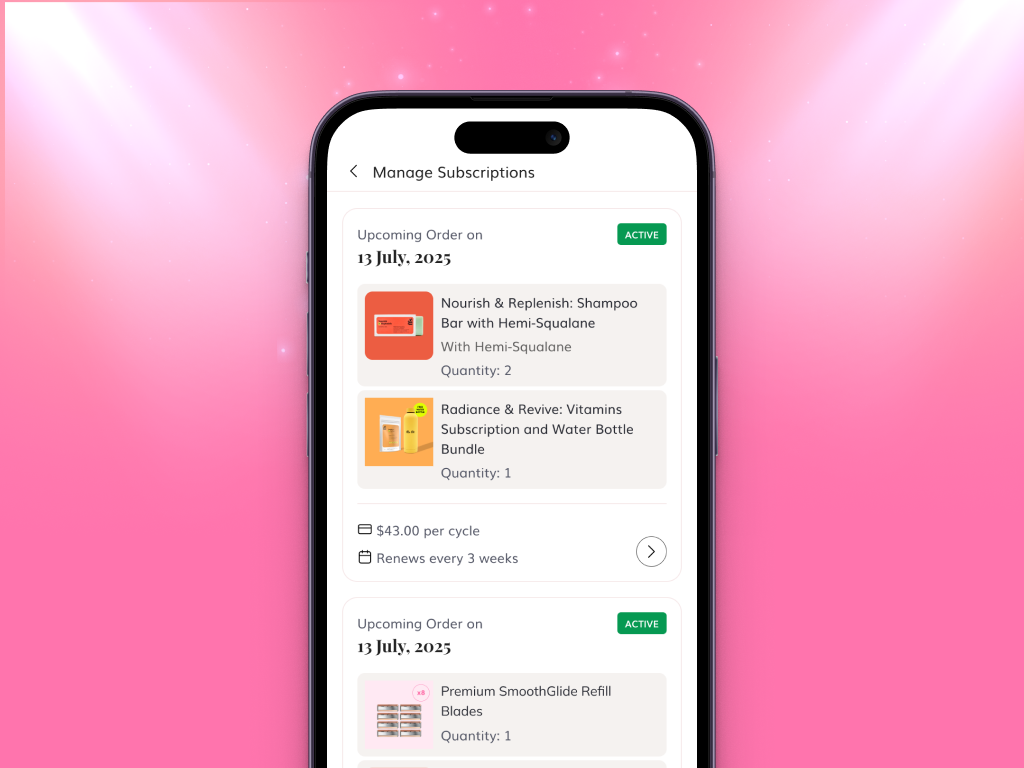
FFS Beauty, a razor subscription brand, is a clean example: on its old setup, subscribers had to log in twice just to manage a plan. After moving subscription controls (skip, pause, modify) into a single native flow, 30-day retention went from 0.1% to 2.7%, a 27x jump in stickiness.
The new experience produced 2 times higher conversion than its previous mobile experience.
Practical guidance if you sell anything consumable:
- Offer subscribe-and-save on products people reorder on a predictable cycle.
- Make skip and pause as easy as cancel, so a busy month doesn't become a lost customer.
- Let customers change quantity and timing themselves.
6. Use a branded mobile app as a retention channel
A customer retention app keeps customers logged in, preserves their preferences, and gives the brand a direct channel through push notifications.
App shoppers consistently convert higher, engage longer, and come back more than the same brand's web shoppers:
|
Brand |
App vs web |
|
Kut from the Kloth (US denim) |
5.4% app conversion vs 2.3% web 19x longer engagement |
|
Svaha USA (US apparel) |
Repeat rate 43% in app vs 31.3% web |
|
Anatomie (US travel wear) |
5x higher lifetime value |
The logic is simple: someone who just bought is the likeliest person to buy again, so that's the moment to move them onto the channel where coming back is easiest.
A branded app gets customers back in the door but keeping them active is its own discipline. Onboarding, push timing, winning back the ones who go quiet: our guide to mobile app retention strategies covers what actually works.
{{cta}}
7. Continue the experience after delivery
The customer journey should not end with a shipping confirmation and review request. Use the post-purchase period to help customers get more value from what they bought. These post-purchase experience strategies can help you turn the period after delivery into a structured retention journey rather than a sequence of transactional updates.
Send setup guidance, usage tips, care instructions, replenishment timing, and support information. Then recommend the next product only when it fits naturally with the original purchase.
For example, BeastLife supports supplement shoppers with usage information, lab reports, certifications, bundles, and product education. Its app recorded more than eight times stronger Day-30 retention than web users.
8. Remove friction from returns and exchanges
A difficult return may protect one transaction while losing every future one. NRF's 2025 report found that about 71% of shoppers are less likely to buy from a retailer again after a poor returns experience.
- Keep the policy clear, show the return status, and make exchanges easy when another size, color, or product could solve the problem.
Track return reasons by product. Returns also provide useful retention data.
If customers repeatedly return an item because it runs small, improve the size guidance before offering another discount.
This is especially important in fashion. Better fit information can prevent both returns and churn. Anatomie introduced an AI size guide alongside personalized recommendations, contributing to three times higher app conversion and significant lower returns.
9. Connect the customer experience across channels
Customers may discover a product on social media, browse on mobile web, purchase in an app, and collect or return it in a store. Their account, rewards, preferences, and order history should follow them.
Omnichannel retention is less about appearing everywhere and more about making every channel feel like part of the same relationship.
That consistency now matters for AI search too. OpenAI recommends regularly updated product feeds so its shopping results can represent products accurately. This means conflicting information across your storefront, feed, app, and other sales channels can weaken both customer trust and AI product discovery.
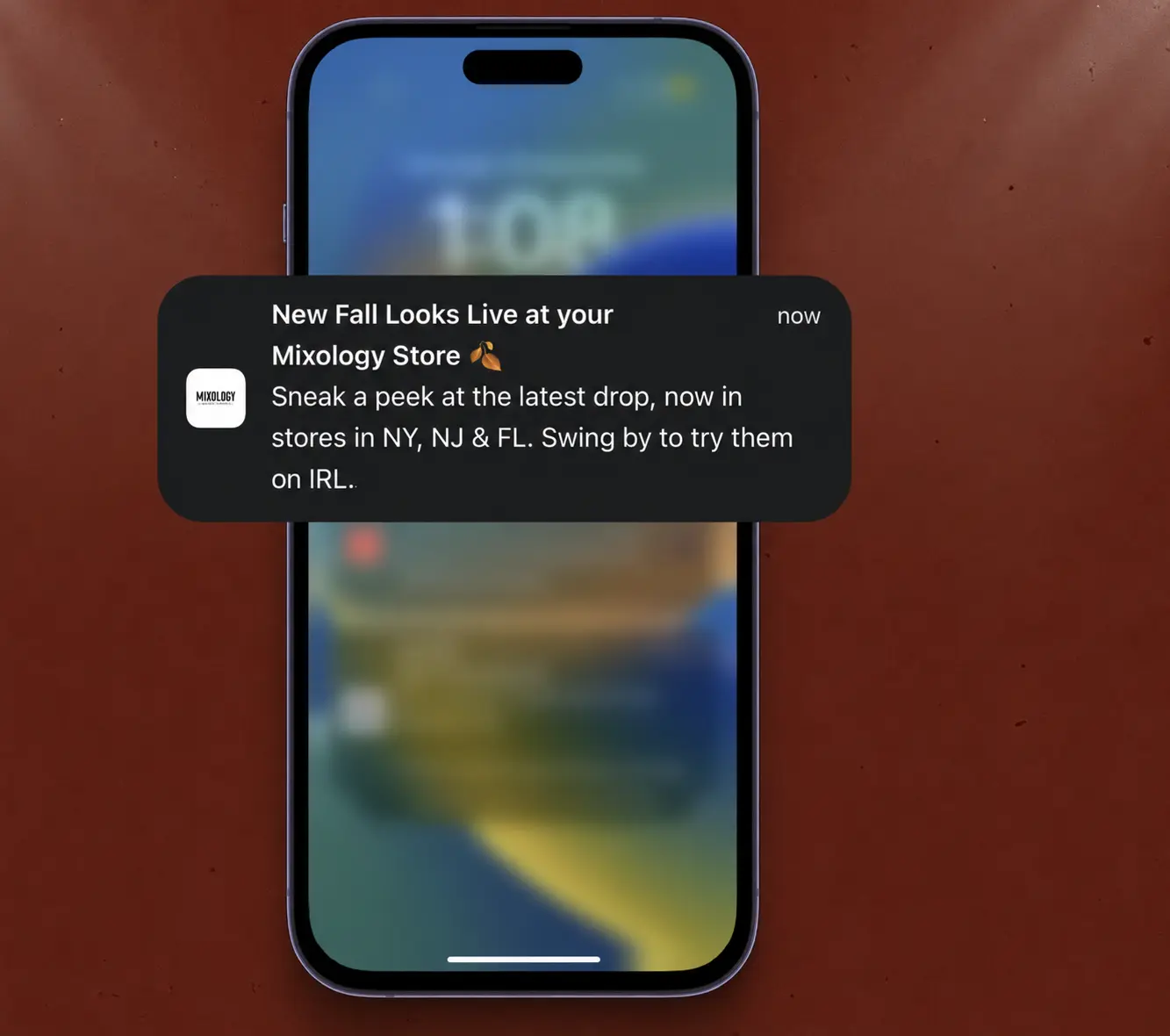
Mixology connected its physical boutiques with unified loyalty, shoppable content, and city-based push campaigns. Its app users generated twice the conversion rate, 50% higher AOV, and three times deeper engagement.
Our guide to optimizing product descriptions for AI shopping assistants explains how to structure these details so platforms such as ChatGPT, Rufus, and Perplexity can understand and recommend your products.
10. Build referrals and community into retention
Offer rewards that suit the brand, such as store credit, cash, exclusive access, or benefits for both people.
Svaha USA incorporated referrals alongside loyalty, wishlists, promotion improvements, and deeper app links. Its repeat-purchase rate reached 43% in the app, compared with 31.3% on the web.
Referral rate can also act as a quality signal. Customers who purchase repeatedly but never recommend the brand may be returning for convenience or price rather than genuine loyalty.
Community goes a step further than referrals. When customers feel part of something (a brand's values, an identity, a shared interest) they stick around for reasons that have nothing to do with discounts.
Build spaces for customers to engage, whether that's user content, a cause, or a shared interest your brand represents.
11. Predict churn before the customer disappears
Do not wait for a customer to become inactive before starting a win-back campaign. Watch for earlier signals, such as declining session frequency, missed replenishment windows, unused rewards, subscription skips, or lower email engagement.
How to measure ecommerce customer retention: 6 key metrics
No single metric tells the whole retention story. Together, these six show how many customers return, how often they buy, and how valuable they become over time.
1. Customer retention rate
Customer retention rate measures the percentage of existing customers who remain active during a set period.
Customer retention rate = (Customers at the end − New customers acquired) ÷ Customers at the start × 100
If you start the year with 500 customers and end with 480, including 100 new customers:
(480 − 100) ÷ 500 × 100 = 76%
Your annual customer retention rate is 76%.
2. Repeat purchase rate
Repeat purchase rate shows how many customers placed more than one order during the period.
Repeat purchase rate = Returning customers ÷ Total customers × 100
3. Customer lifetime value
Customer lifetime value, or CLV, estimates how much revenue or profit a customer generates throughout their relationship with your brand.
A simple version is:
CLV = Average order value × Purchase frequency × Customer lifespan
CLV helps determine how much you can afford to spend on acquisition while remaining profitable.
4. Churn rate
Churn rate measures how many customers become inactive during a given period.
Unlike subscription businesses, ecommerce customers do not formally cancel. You need to define churn based on your normal buying cycle. A coffee customer might be considered inactive after 60 days, while a furniture customer may not buy again for years.
5. Cohort retention
Cohort analysis groups customers by when they first purchased and tracks how many return after 30, 60, 90, or more days.
This gives you a clearer view than a store-wide average. For example, you can see whether customers acquired during a holiday sale return less often than those acquired through organic search.
6. Net Promoter Score
Net Promoter Score, or NPS, measures how likely customers are to recommend your brand.
It can help identify satisfaction and loyalty, but it should not be used alone. A customer saying they would buy again is not the same as placing another order. Compare NPS with repeat purchase rate and cohort retention to see whether positive sentiment leads to actual behavior.
Ecommerce customer retention by channel: web vs email, SMS and mobile apps
No single channel is best for every retention campaign.
|
Channel |
Best retention use |
Industry benchmark |
What it measures |
|
Mobile web |
Broad product discovery and convenient repeat checkout |
18.8% to 30% |
Ecommerce customers who place another order within roughly 12 months |
|
Email campaigns |
Product education, announcements and longer-form offers |
0.16% placed-order rate |
Orders attributed to each campaign recipient |
|
Automated email flows |
Post-purchase education, replenishment and win-back |
2.11% placed-order rate |
Orders attributed to each automated-flow recipient |
|
SMS |
Urgent alerts, expiring offers and requested restock messages |
95.79% subscriber retention |
Subscribers who remain opted in after 30 days, not customers who repurchase |
|
Mobile app and push |
Loyalty, personalized re-engagement, replenishment and product drops |
32% repeat-order share |
Share of app orders placed by returning customers across Appbrew brands |
Sources: BS&Co Ecommerce Repeat Purchase Benchmark (2026); Klaviyo Email Marketing Benchmarks (2026); Postscript SMS Benchmarks (2026); Appbrew first-party ecommerce app data.
5 common ecommerce customer retention challenges and how to fix them
Low retention is not always a marketing problem. It can come from the product, customer acquisition strategy, or buying cycle. The first step is identifying where customers stop returning.
1. Customers bought only for the discount
A large first-order discount can attract deal hunters who have little reason to pay full price later.
Fix: Compare retention for discounted and full-price cohorts. If discounted customers repeat less often, replace deeper discounts with bundles, gifts, loyalty credit, or benefits that become more valuable after the first purchase.
2. The product has a long buying cycle
Furniture, electronics, and luxury goods naturally produce fewer repeat orders than food or skincare.
Fix: Expand retention beyond replenishment. Recommend accessories, complementary products, maintenance services, gifting options, or new categories that fit the original purchase.
3. Customers do not know what to buy next
A shopper may like the first product but still leave because the next choice is unclear.
Fix: Use the first purchase to guide the second. A skincare brand can recommend the next step in a routine, while a fashion brand can show products that complete the look.
Anatomie uses “Style It With” recommendations alongside personalized discovery.’
4. Returns or support problems are treated as isolated cases
Repeated complaints about sizing, quality, delivery, or product expectations often signal a larger retention problem.
Fix: Connect return reasons and support tickets with repeat-purchase data. If customers returning a particular SKU rarely buy again, correct the PDP, product, packaging, or fulfillment issue before investing in another win-back campaign.
5. Store-wide averages hide the real problem
Overall retention may look stable even when a valuable customer segment is declining.
Fix: Review retention by first product, acquisition source, discount status, category, geography, and customer cohort. Look for where the second-purchase rate drops, then fix that specific journey.
Retention technology is becoming more predictive, while AI shopping agents are changing how customers discover and repurchase products. We cover those developments separately in our guides to agentic commerce and ecommerce personalization trends.
Build retention before acquisition gets more expensive
Customer retention does not improve because a brand launches another loyalty program or sends more reminders. It improves when the product delivers on its promise and the path to the next purchase feels obvious, timely, and worthwhile.
Start with your returning customer rate, identify where the second purchase breaks down, and fix that part of the journey first. For some brands, the answer will be better post-purchase education. For others, it may be replenishment, subscriptions, loyalty visibility, or fewer but more relevant messages.
If repeat customers already drive a meaningful share of your revenue, a branded mobile app can give them a faster, more personalized place to return. Appbrew helps Shopify brands build that owned retention channel around persistent login, loyalty, subscriptions, personalized discovery, and push notifications. See how Appbrew works.
{{cta2}}
Ecommerce customer retention FAQs
What is a good ecommerce customer retention rate?
A good ecommerce customer retention rate is usually between 20% and 40%, depending on the category and measurement period. Consumables generally retain more customers than luxury goods, electronics, or furniture because they have shorter repurchase cycles.
What are the three R’s of customer retention?
The three R’s are recruit, retain, and recover:
- Recruit customers who are likely to receive lasting value from the product.
- Retain them through a strong product and customer experience.
- Recover customers who become inactive or have a poor experience.
How do you calculate ecommerce customer retention rate?
Use this formula:
Customer retention rate = (Customers at the end − New customers acquired) ÷ Customers at the start × 100
What does an 80% customer retention rate mean?
An 80% retention rate means the business retained eight out of every ten existing customers during the measured period.
That would be unusually high for transactional ecommerce but more realistic for a subscription business. Always check the period, customer definition, and business model before comparing rates.
What are the best ecommerce customer retention strategies?
The most effective strategies include personalization, loyalty benefits, post-purchase education, replenishment reminders, subscriptions, frictionless returns, and relevant email, SMS, or push campaigns.
The right strategy depends on why customers are not returning. Diagnose the drop-off before choosing the channel or incentive.
How much does customer retention cost compared with acquisition?
The frequently quoted claim is that acquiring a new customer costs five to 25 times more than retaining one. Treat this as a broad business heuristic rather than a universal ecommerce benchmark.
Your actual difference depends on acquisition costs, margins, purchase frequency, discounts, and the cost of your retention channels.
Why is customer retention important in ecommerce?
Customer retention gives acquisition spending more time to pay back. Returning customers can increase purchase frequency and customer lifetime value while making revenue less dependent on continually acquiring new buyers.