


.webp)
Learn the highest-ROI Shopify CRO strategies for 2026, from Shop Pay and mobile UX fixes to apps, retention, and conversion growth.
Your traffic is fine. Your conversion rate is the problem, and you already know it. Every time the deck gets opened in a Monday meeting, the same line gets repeated: traffic is up, CVR is flat, mobile is the worst of it. The spreadsheet doesn't change.
That stalemate is the real Shopify CRO problem. Not a lack of tactics, but a lack of clarity on which tactics actually move the number for stores at your stage and which ones look productive but barely register at the till. To pin it down, we audited five Indian D2C Shopify brands across categories: Libas (apparel), Knya (medical apparel), ThriveCo (haircare), Miraggio (handbags), and EDT (electronics). The patterns that came out of those audits map almost exactly to the friction points that the platform-wide data flags.
This piece is the operator's read on what those patterns reveal, what to fix first, when to hire help, and where mobile web hits a ceiling no amount of optimisation will break.
TL;DR
- Shopify CRO in 2026 is no longer optional; rising CAC and lower ROAS mean conversion rate optimization is now one of the biggest profitability levers for ecommerce brands.
- Audits across major Indian Shopify brands revealed recurring mobile conversion issues including checkout friction, slow page speed, weak mobile CTAs, and poor re-engagement systems.
- The highest-ROI Shopify CRO improvements are Shop Pay activation, Core Web Vitals optimization, sticky add-to-cart CTAs, and multi-channel retention flows.
- Mobile web optimization has structural limits, especially around push notifications, checkout friction, and retention loops, which native apps solve more effectively.
- Shopify brands with high mobile traffic and repeat purchase behavior increasingly rely on mobile apps to improve conversion rates, AOV, and customer retention.
- Most brands under ₹4 crore revenue should focus on mobile web optimization first, while larger repeat-purchase brands benefit significantly from investing in native mobile apps.
- Appbrew portfolio brands consistently show 3–5x higher app conversion rates compared to mobile web, driven by faster checkout and push-driven retention.
- The most effective Shopify CRO strategies combine speed, checkout optimization, mobile UX, and owned-channel retention infrastructure.
What is Shopify CRO actually solving for in 2026?
Shopify CRO is the practice of removing friction from the visitor-to-buyer path so a higher percentage of your existing traffic converts, without spending more on acquisition. The mechanics haven't changed. The economics have.
Three years ago, Shopify CRO was a "nice to have" for stores hitting their growth targets through paid acquisition. In 2026, with median ROAS sitting at 2.04 across ecommerce and CAC up roughly 60% on Meta since 2021, conversion rate optimization is the channel doing the heaviest lifting on profitability. A 0.5 percentage point lift on a 1.5% baseline isn't a marginal gain. It's a 33% increase in revenue from the same traffic.
The problem is that "Shopify conversion rate optimization" is an overloaded term. It covers everything from a one-line theme tweak to a six-month enterprise CRO program. The five-brand audit data is useful because it shows which fixes recur, regardless of category, revenue stage, or brand maturity.
{{cta}}
What patterns showed up across all five brand audits?
The same five issues appeared in nearly every audit. These are the places to look first in your own store, because if five different brands across five different categories all have them, your store probably does too.
|
Pattern |
Why it matters |
|
No sticky add-to-cart on PDP |
On long mobile PDPs, the CTA scrolls off-screen for 80% of the session |
|
Trust signals buried below the fold |
Mobile users don't scroll for reassurance, they bounce |
|
Return policy hidden at decision point |
Hidden policies are a top driver of cart abandonment after surprise costs (Baymard, 2026) |
|
Personalisation in app, missing from web |
Web visitors get a strictly worse experience than app users |
|
Page weight from carousels, scripts, unoptimised images |
Sub-3-second load is the bar; most stores miss it on mobile |
This is the structural lesson the audits keep returning. Mobile web optimization has real ceilings. The brands serious about mobile revenue are running a parallel app channel that doesn't carry the same constraints.

Which Shopify CRO fixes have the highest ROI?
Four levers do most of the work. Everything else is rounding.
1. One-tap checkout (Shop Pay, Apple Pay, Google Pay)
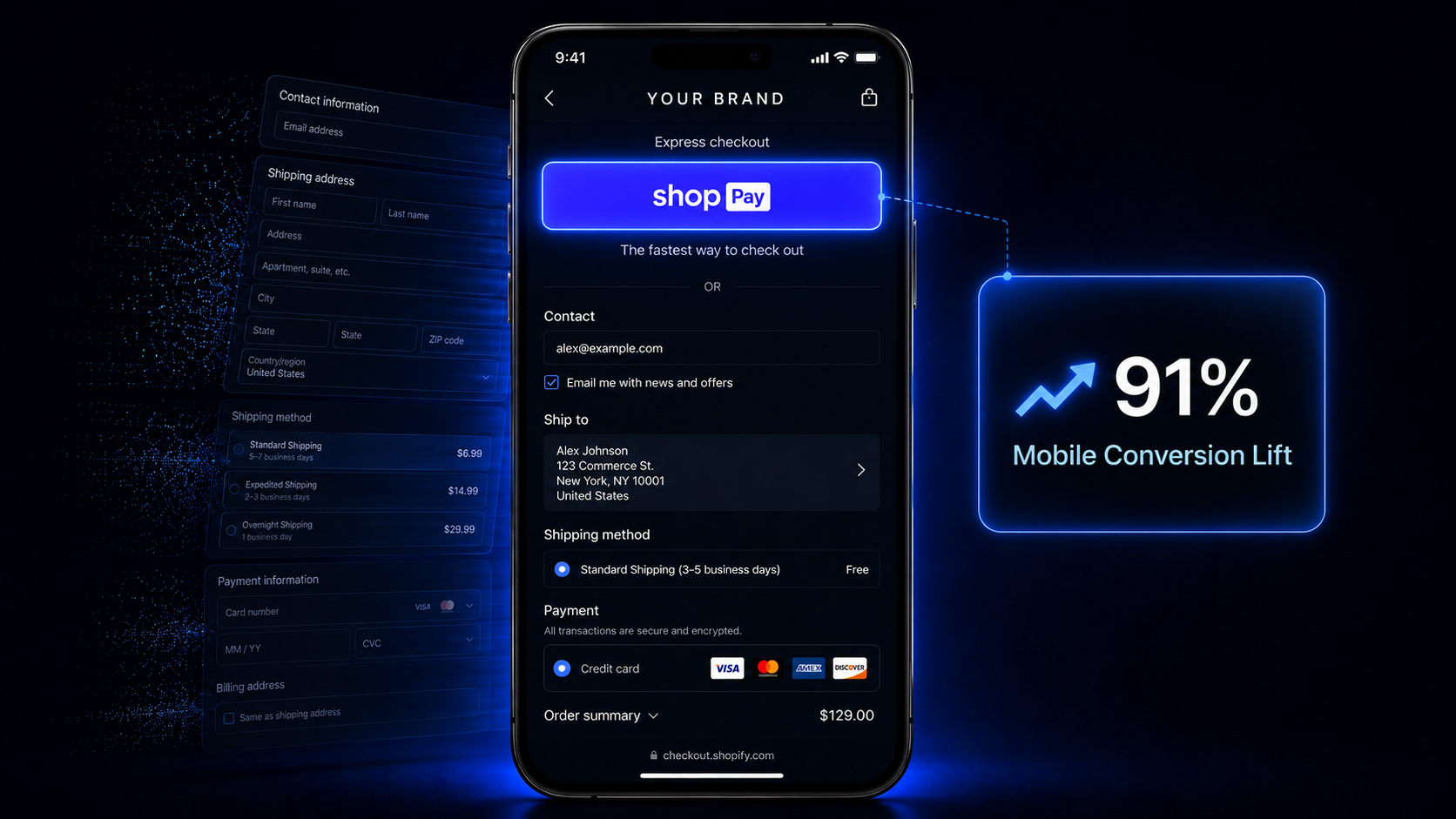
This is the single biggest Shopify CRO move on mobile, full stop. Shop Pay delivers a 91% conversion lift on mobile specifically and a 50% lift overall versus standard guest checkout (Shopify, 2026). 75% of Shop Pay users complete purchase in a single tap, and their carts move through 4x faster than standard checkout. None of the five brands audited had clear evidence of express checkout being surfaced prominently on mobile PDPs. That's the first place to look in your own store.
If you're under ₹4 crore in revenue and haven't enabled Shop Pay yet, do that before anything else in this list. The math on every other fix is downstream of this one.
2. Page speed and Core Web Vitals
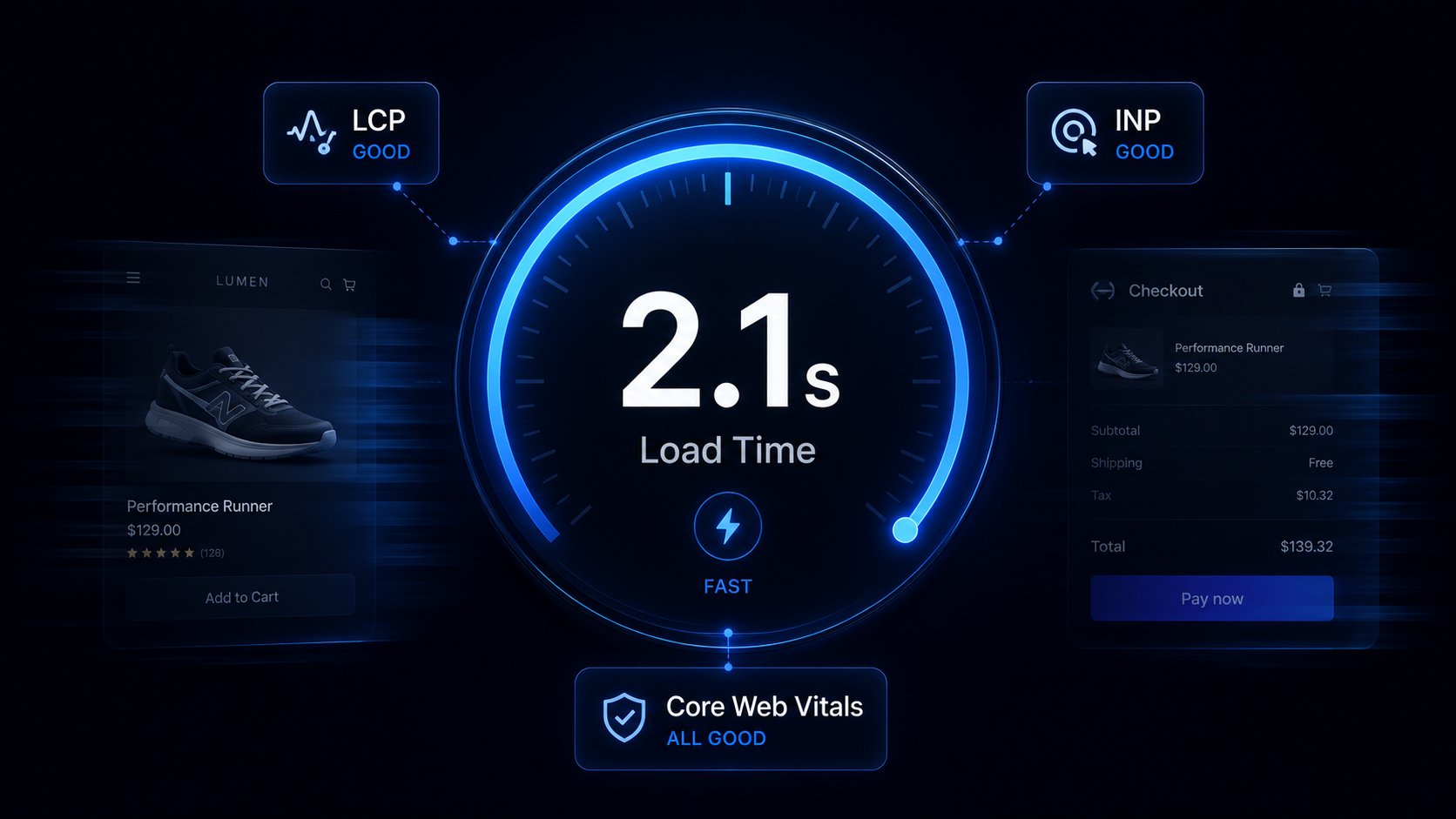
Google now classifies "good" responsiveness as INP under 200 milliseconds (Google, 2026). LCP target is under 2.5 seconds. Most Shopify stores miss both on mobile. The audit pattern was consistent: heavy hero sections, autoplaying carousels with 12+ slides (EDT), scrolling blog tickers (ThriveCo), and third-party scripts loading on every page (Miraggio's Cloudflare Rocket Loader plus Facebook Pixel plus Swym).
The diagnostic stack: PageSpeed Insights for the LCP and INP read, Shopify's Web Performance dashboard for theme-level signals, and a manual audit of installed apps. Every Shopify app you install adds JavaScript. Most stores have 15-25 active apps. That's where the weight lives.
3. Thumb-zone UX and sticky CTAs
A sticky add-to-cart bar on mobile lifts conversion by 10-15% on average (Easy Apps, 2026). Three of the five audited brands had no sticky CTA at all. The pattern was long, content-rich PDP with reviews, ingredient breakdowns, FAQ accordions, and clinical claims, but the actual purchase button buried at the top of the page.
Mobile users don't scroll back up to find the CTA. Instead they just leave. The fix is mechanical: add a sticky bottom bar with the variant selector, price, and a primary CTA. Keep tap targets at 48x48px minimum. Place primary actions in the bottom third of the screen where the thumb naturally rests.

4. Re-engagement (push, SMS, email sequencing)
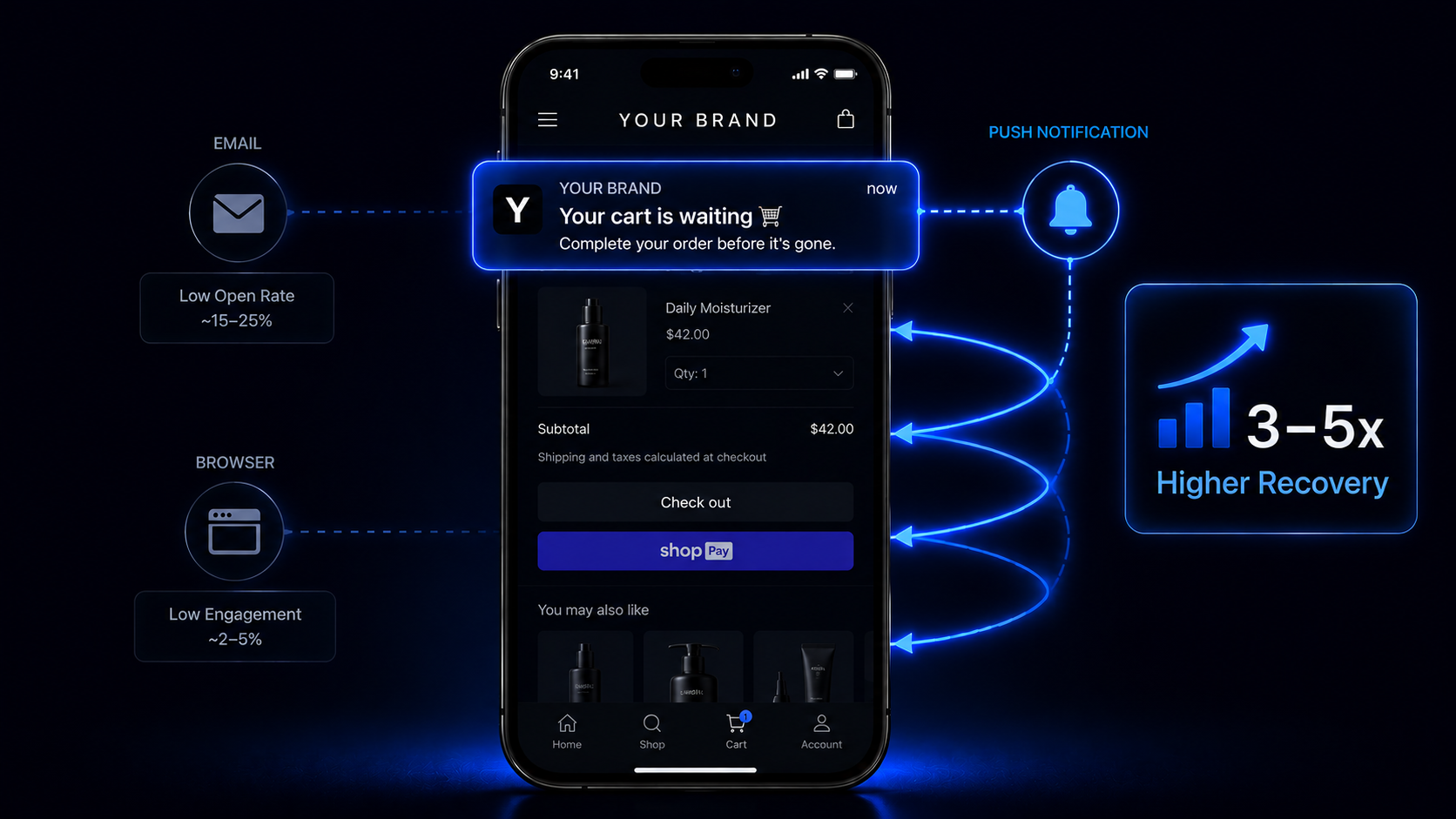
The 80%+ of mobile shoppers who abandon aren't lost if you can pull them back. This is where the toolset gets interesting, because mobile web fundamentally cannot deliver push notifications. Browser push on mobile has 7-12% opt-in rates and degrades fast.
App push notifications, by contrast, deliver 40-60% open rates on Shopify brands using Appbrew's push notification infrastructure, with cart recovery rates 3-5x higher than email alone. This is the gap that justifies the app investment for repeat-purchase brands. You can't recover an abandoned mobile web cart with push because mobile web can't send push.
When should you hire a Shopify CRO agency vs run optimization in-house?
The hire-vs-DIY decision comes down to traffic volume, revenue, and whether you have someone in-house who can read funnel data without flinching.
The threshold rule most operators land on after a few cycles: hire a Shopify CRO agency or a dedicated Shopify CRO expert when you have at least 100,000 monthly sessions and ₹4 crore in annual revenue. Below that, you don't have enough traffic to run statistically meaningful tests, and the cost of an agency retainer (typically ₹4-12 lakh per month for serious work) outweighs the incremental lift you can prove.
What in-house CRO looks like at the under-₹4 crore stage:
- Shop Pay enabled and surfaced on PDP
- Mobile sticky CTA implemented
- Return policy and trust badges placed above the fold on PDP
- PageSpeed Insights audit run quarterly, with theme cleanup
- One basic A/B test running at any time (CTA copy, hero image, pricing display)
That's it. Five things, owned by whoever runs the storefront, no agency required.
What changes above ₹4 crore is volume. You can run two or three concurrent tests with statistical validity. You can afford qualitative research (heatmaps, session recordings, user interviews). You start to see returns on the kind of structural work agencies do well: full PDP rebuilds, custom checkout extensions, advanced segmentation. At this stage, the right Shopify CRO agency can deliver 15-30% conversion rate lift over 6-9 months, which on a ₹50 crore business is ₹7.5-15 crore in incremental revenue against an agency cost of ₹50 lakh-1.5 crore. The math works.
What to look for in a Shopify CRO expert or agency:
- Case studies with named brands and verifiable metrics, not "Brand X saw a 40% lift"
- A research-first methodology. If their first deliverable is a redesign, walk away
- Clear separation between testing and implementation. You want a team that proves the lift before they ship
- Shopify-native experience specifically. CRO patterns that work on WooCommerce or Magento don't always translate
The audit work the five brands in this piece could benefit from is mostly in-house territory. Sticky CTAs, trust signal placement, page speed cleanup, Shop Pay activation. None of that needs an agency. The work that does need outside help, like the mobile-app-vs-web architectural call Libas is already making, sits at a different stage.
When does a Shopify store need a dedicated mobile app vs more web optimisation?
Most stores hit a conversion wall around 2-3% on mobile web no matter how much they optimize. Apps clear that wall because of three structural advantages: push notifications, sub-second load times, and one-tap retention loops that don't exist in the browser.
The decision frame is straightforward:
- Mobile traffic is over 60% of total sessions: the app math starts to make sense
- Returning customer rate is over 30%: the retention loops compound
- Repeat purchase frequency under 90 days: push notifications have a job to do
- Revenue above ₹8 crore: the cost of a branded app is no longer the bottleneck
If three of those four are true, an app is almost certainly underwriting itself within six months. If you're under ₹4 crore in revenue with a low repeat rate, fix mobile web first. Shop Pay, sticky CTAs, page speed, trust signals. Most of the gap closes there.
For the brands that have crossed the threshold, the lift is well-documented. Snitch hit 2.5x conversion rate and 60% mobile revenue growth post-app launch. Karma and Luck saw a 50% increase in CVR and 25% AOV growth. Freakins hit 3.2x conversion rate and 15% higher AOV. The pattern across Appbrew's Shopify mobile app builds is consistent: app users convert 3-5x mobile web users from the same brand.
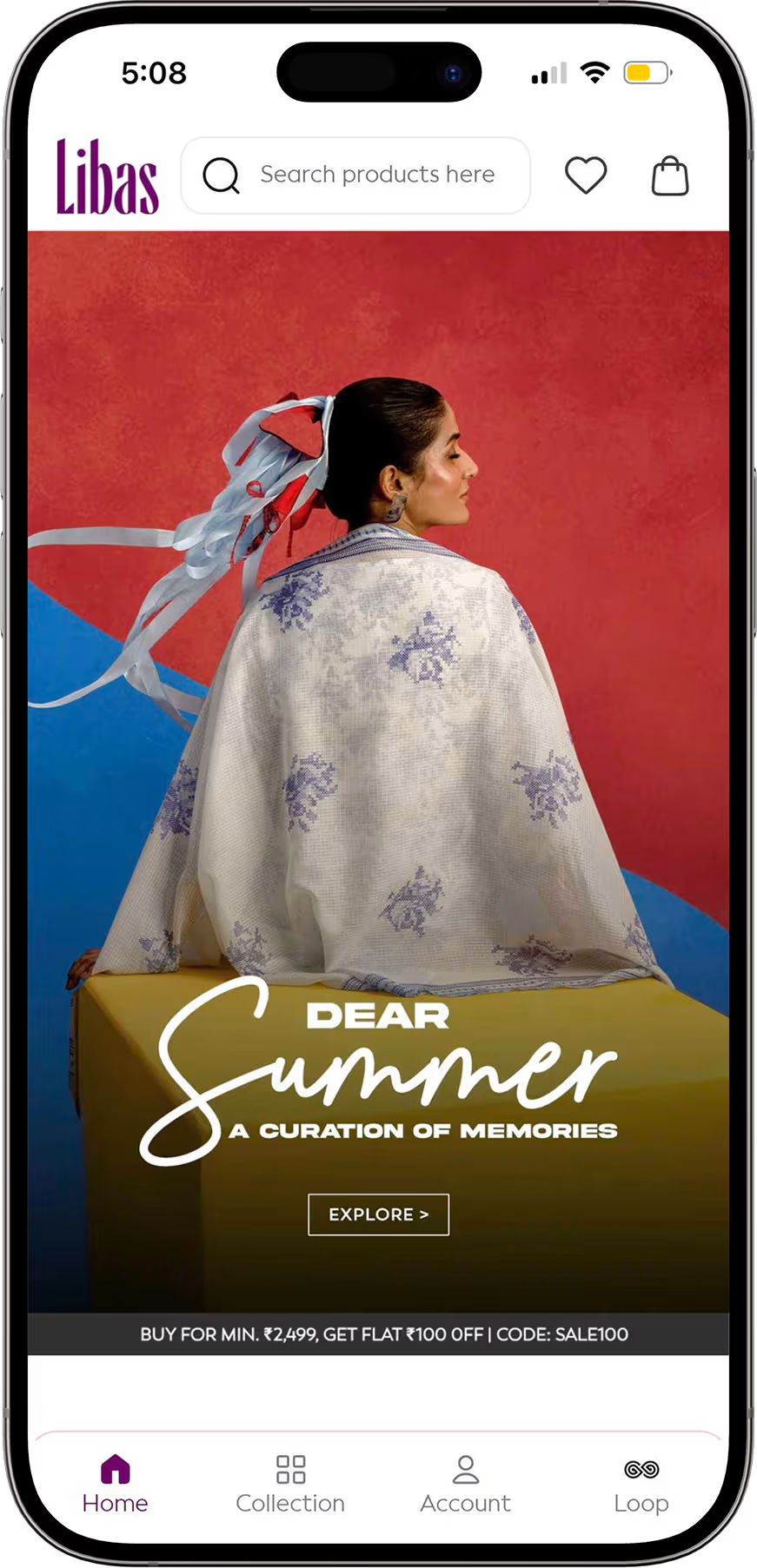
Libas is in this bracket already. The audit flagged that mobile web personalisation is missing precisely because the brand is investing where the math points: the app channel, where Smart Search, push, and tier-based loyalty actually function. The mobile web isn't being neglected by accident. It's being deprioritised because the ceiling is low.

{{cta2}}
Which Shopify CRO tools should you actually use?
Tool choice depends on revenue stage, traffic mix, and whether the priority is acquisition or retention. The categories worth knowing:
|
Category |
Best for |
Tools |
When to pick |
|
Native Shopify checkout |
Speed, simplicity, lowest config |
Shop Pay, Shopify Checkout Extensibility |
Under ₹4 crore GMV, low test volume |
|
Page speed optimisation |
Theme and asset bloat |
Hyperspeed, Shopify Web Performance |
Slow LCP, heavy theme, 15+ apps |
|
Mobile CRO testing on Shopify |
Conversion testing on traffic |
Intelligems, Visually |
₹8 crore+ GMV, dedicated CRO owner |
|
Re-engagement |
Cart recovery, retention |
Klaviyo (email/SMS), Appbrew (push) |
High abandonment, repeat-purchase model |
|
Branded mobile app |
Push, loyalty, AOV lift, retention |
Appbrew, Tapcart, Vajro |
₹8 crore+ GMV, 60%+ mobile traffic |
Read the table by stage. Under ₹4 crore, Shop Pay plus a fast theme plus Klaviyo is enough. Above ₹8 crore with a repeat-purchase model, the app channel becomes the highest-leverage move and the comparison narrows to Appbrew, Tapcart, and Shopney. The differentiation between those three is mostly architectural. Appbrew is built on React Native (the same stack as H&M and Zara), supports deeper Shopify integration, and is the only one with native Lightning Fast Checkout deployed for brands like Libas. Tapcart's strength is speed of launch. Vajro is the budget option.
On mobile CRO testing specifically, Intelligems and Visually are the two serious options for Shopify in 2026. Intelligems is stronger on price and offer testing. Visually is stronger on visual element testing (hero images, PDP layouts, button colours). Both require traffic volume to deliver clean results, which is why they sit on the higher end of the table.
The fastest mobile revenue gain for almost every Shopify store is the same: turn on Shop Pay, fix the sticky CTA, surface the return policy. Most stores recoup 15-25% of their mobile abandonment in those three changes alone. The agency conversation comes when you have the traffic to test seriously, and the app conversation comes when mobile web has hit its ceiling and the retention math demands push and loyalty loops the browser can't deliver.
Ready to see what a branded mobile app could do for your store's Shopify CRO performance? Book a demo with Appbrew →
Frequently Asked Questions
What is a good conversion rate for a Shopify store in 2026?
The Shopify platform average sits at 1.4-1.8%, with top-quartile stores at 3.2% and the top decile at 4.7%+ (Brenton Way, 2026). The relevant benchmark is your category, not the platform-wide number. Beauty and food and beverage convert above 4%. Luxury and high-AOV apparel run under 1.5%. Mobile and desktop should be benchmarked separately, with mobile typically 35-50% lower than desktop on the same store.
Does Shop Pay actually improve conversion, and by how much?
Yes, more than any other single change. Shopify's 2026 data shows Shop Pay delivering a 91% conversion lift on mobile specifically and a 50% lift overall versus standard guest checkout. Everlane saw checkout conversion rates of up to 70% post Shop Pay integration, with 15% of their audience adopting Shop Pay within the first 30 days.
When should I hire a Shopify CRO agency?
Hire when you have at least 100,000 monthly sessions and ₹4 crore in annual revenue. Below those thresholds, you don't have enough traffic for statistical validity in tests, and the agency cost outweighs provable lift. Above ₹4 crore, a strong Shopify CRO expert or agency typically delivers 15-30% conversion rate lift over 6-9 months, which is where the math starts working in your favour.
Is a mobile app worth it for a Shopify store under ₹4 crore in revenue?
Usually no. Below ₹4 crore, the highest-ROI moves are Shop Pay, page speed, and trust signal placement on mobile web. App economics start working when mobile traffic exceeds 60% of total sessions, returning customer rate is above 30%, and revenue is at or above ₹8 crore. Below those thresholds, the mobile web fixes deliver more incremental revenue per rupee spent.
How long does it take to see results from Shopify CRO changes?
Shop Pay activation shows up in checkout completion data within 7-14 days. Page speed and sticky CTA changes need 30 days of traffic to read cleanly. App-driven retention metrics (push open rates, repeat purchase rate) take 60-90 days because the loop has to compound through a full purchase cycle. Don't make decisions on a 7-day window for anything except checkout.
What's the difference between Appbrew, Tapcart, and a custom mobile build?
Appbrew and Tapcart are no-code app builders for Shopify, both purpose-built for D2C brands. Appbrew uses React Native and is deeper on Shopify integration, personalisation, and checkout (Lightning Fast Checkout deploys sub-1-second load). Tapcart is faster to launch but lighter on customisation. A custom build runs ₹40 lakh-80 lakh upfront plus ongoing engineering, justifiable only for ₹50 crore+ brands with very specific requirements no platform supports.