


.webp)
.webp)

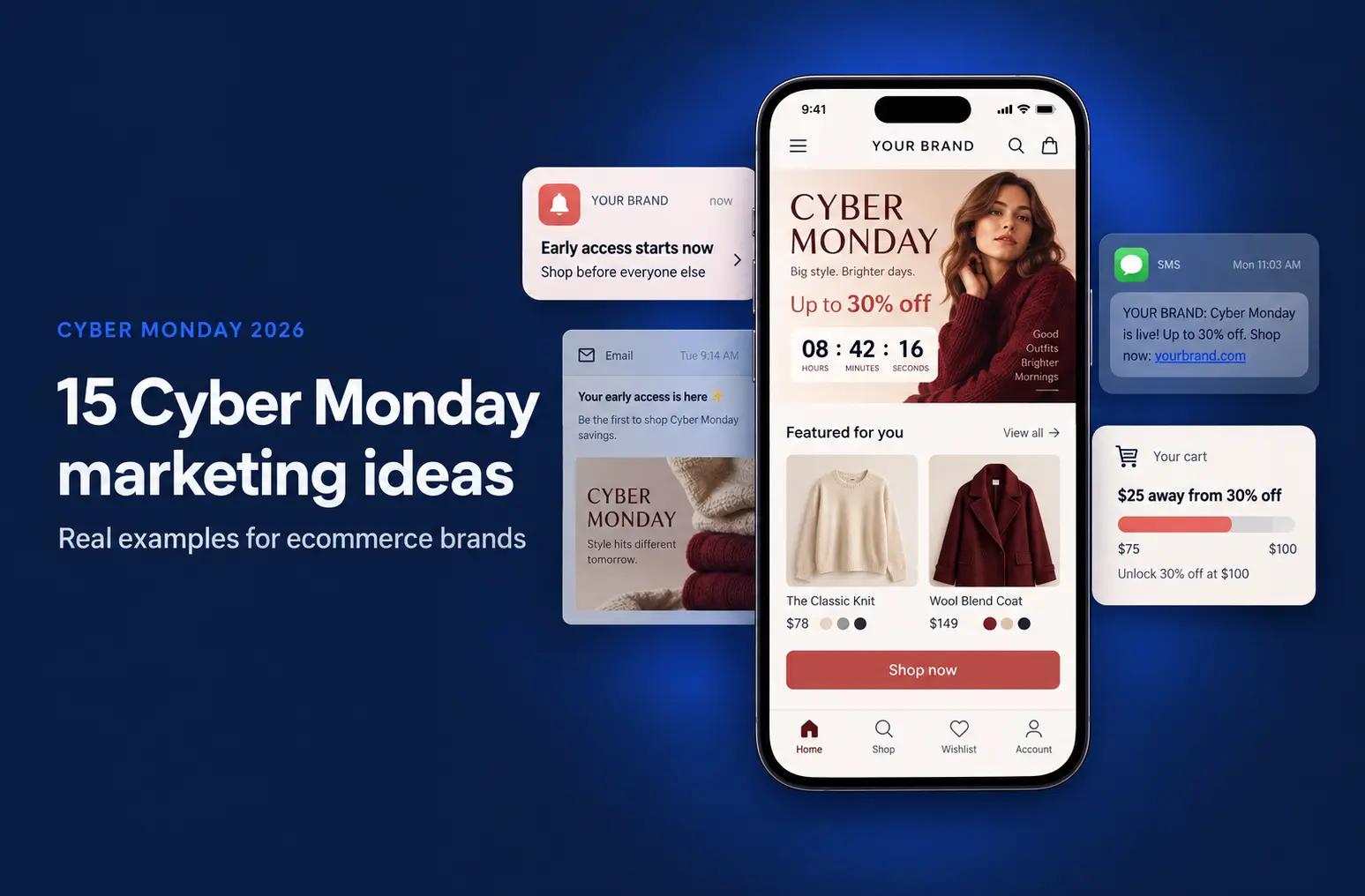
Explore 15 Cyber Monday marketing ideas for 2026, with real Shopify examples, offer strategies, and data to increase conversions, AOV, and repeat sales.
Cyber Monday marketing is how ecommerce brands attract, convert, and retain high-intent shoppers on the Monday after Thanksgiving. In 2026, Cyber Monday falls on November 30.
U.S. shoppers spent $14.25 billion online on Cyber Monday 2025, up 7.1% year over year. Adobe recorded peak spending of $16 million per minute between 8 and 10 p.m. For ecommerce brands, that makes Cyber Monday one of the most concentrated online sales periods of the year.
But most brands walk into it treating it as a second Black Friday and that's exactly why they underperform. The shopper is different, the psychology is different, and the channel economics shifts enough that tactics built for Black Friday actively misfire on Monday.
This guide gives you 15 Cyber Monday marketing ideas for 2026 and the strategy to sequence them, each backed by real BFCM data and what Appbrew observed across 250+ Shopify brands during Cyber Monday 2025.
TL;DR
- Cyber Monday 2026 falls on November 30, three days after Black Friday.
- Use weekend behavior to target product viewers, cart abandoners and subscribers who have not purchased.
- Flash offers, tiered discounts and honest final-day messaging give shoppers a reason to act.
- Push, segmented email and SMS reduce the need to compete for every visit through paid ads.
- Show BNPL before checkout and make mobile payment as short as possible.
- Judge the campaign on contribution margin and repeat purchases, not day-one revenue alone.
- Creator-led and social commerce are rising fast. TikTok Shop and micro-influencer activations are now core revenue channels, not experiments.
Cyber Monday 2026: date and how it differs from Black Friday
In 2026, Cyber Monday falls on Monday, November 30, three days after Black Friday (November 27) and the close of the Cyber Five weekend that starts on Thanksgiving, one of the biggest stretches on the US ecommerce holiday calendar. If you need the full picture of how the weekend fits together, here's what BFCM means.
The practical difference is the data available to you. Black Friday starts with forecasts. By Cyber Monday, you know which products sold, which carts were abandoned and which subscribers engaged without buying. Your Monday campaign should use that information rather than repeat the same promotion to everyone.
|
Aspect |
Black Friday |
Cyber Monday |
|
Shopper mindset |
Browsing, comparing, still deciding |
Decided, buying before the deal ends |
|
What converts |
Headline discounts, scroll-stopping creative |
Urgency: flash drops, countdowns, last-chance framing |
|
Best channels |
Discovery: email, paid social, search |
Cut-through: push, SMS, retargeting |
|
Email performance |
Fresh, high open rates |
Fatigued after a weekend of sends |
|
Your data advantage |
Limited, the season just started |
4 days of purchase data to target with |
|
Peak traffic |
Mid-morning |
Evening, ~8–10 PM EST, a major 2025 spending window |
Those differences are the reason a Cyber Monday campaign needs its own playbook. Here are 15 ideas to build one, ordered roughly the way you'd sequence them, from offer design through post-sale retention.
If your Black Friday groundwork isn't set yet, read our guide on Black Friday marketing strategy.
15 Cyber Monday marketing ideas for 2026
You do not need all 15 ideas below. Choose the ones that fit your margins, inventory and customer behavior.
1. Run short flash offers with a real deadline
An all-day discount gives shoppers little reason to purchase now. A flash offer gives them a clear decision window.
Run one or two short offers on products you can support with enough inventory and margin. Show the exact closing time on the product page and cart. If the offer ends at 3 p.m., it should end at 3 p.m.
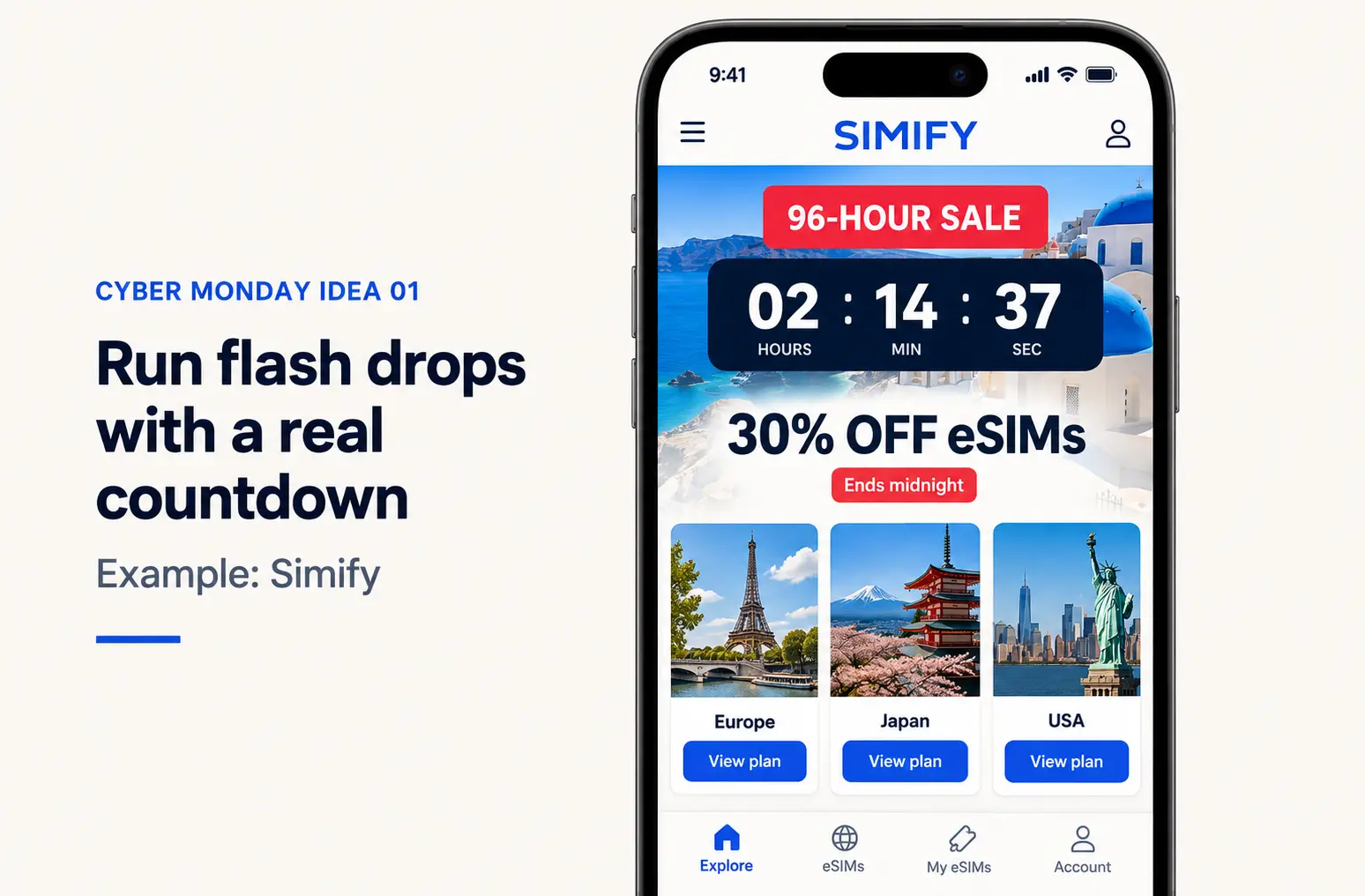
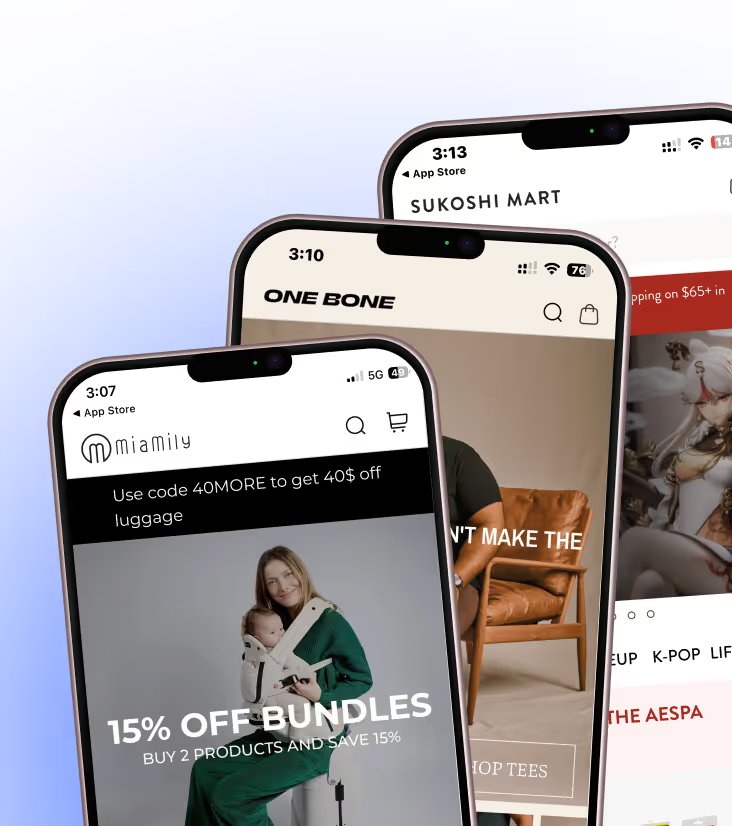
Example: On Cyber Monday 2025, eSIM brand Simify ran a "96-Hour Sale" with a high-contrast countdown timer pinned to the top of its app home screen, ticking down to the midnight cutoff. Cyber Monday became its single best day of the whole weekend, with 773 app orders and $35,589 in GMV at a $46.04 average order value, a 43% jump over its Black Friday orders. (Appbrew network data, Cyber Monday 2025)
Send shoppers directly to the qualifying product or collection. Do not make them search from the homepage.
2. Use tiered discounts to increase order value
A flat discount reduces margin at every basket size. A tiered offer gives shoppers a reason to spend more for the higher saving.
For example, offer 15% off above $75 and 25% off above $150. Set the thresholds above your normal AOV, but close enough that adding one product reaches the next tier.
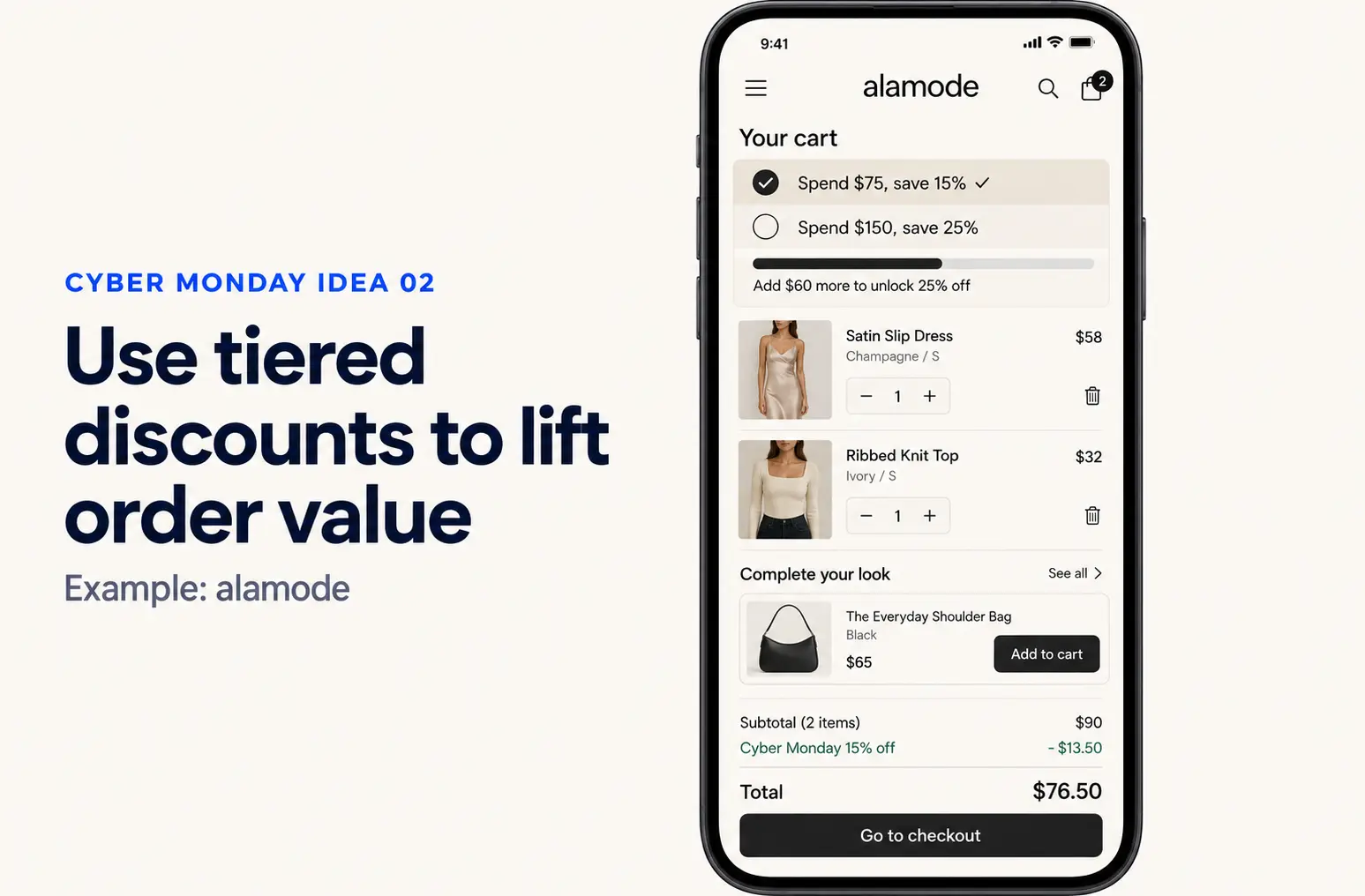
Example: Alamode recorded 950 app orders on Cyber Monday 2025. Its app AOV was $47.43, 10.6% above its $42.87 web AOV during the same period. Bundles and spending thresholds were core part of its offer strategy. (Appbrew network data, Cyber Monday 2025).
Put the tiers where people decide: the product page, the cart, and your early-access push.
3. Use push for the moments that matter
Push notifications reach opted-in customers without a media charge for every send. That makes them useful when paid media is expensive and email volume is high.
Across Appbrew’s network on Cyber Monday 2025, brands sent 9.02 million push notifications, up 177% year over year. Appbrew attributed 453,000 product views and 3,221 purchases to those sends.
Use push for a sale launch, a relevant product drop, a restock or the final hours. Each notification should open the exact product or offer it mentions.
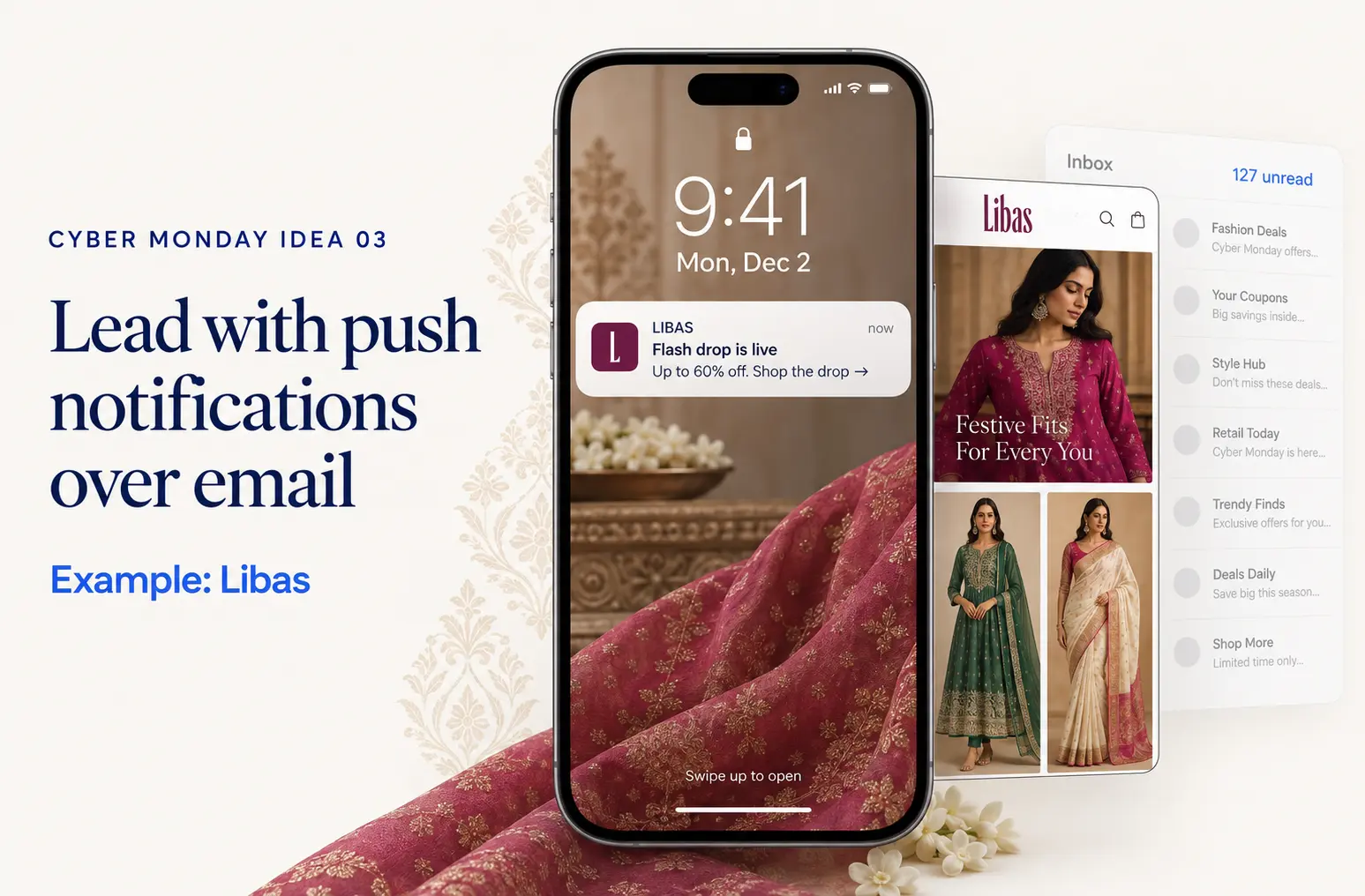
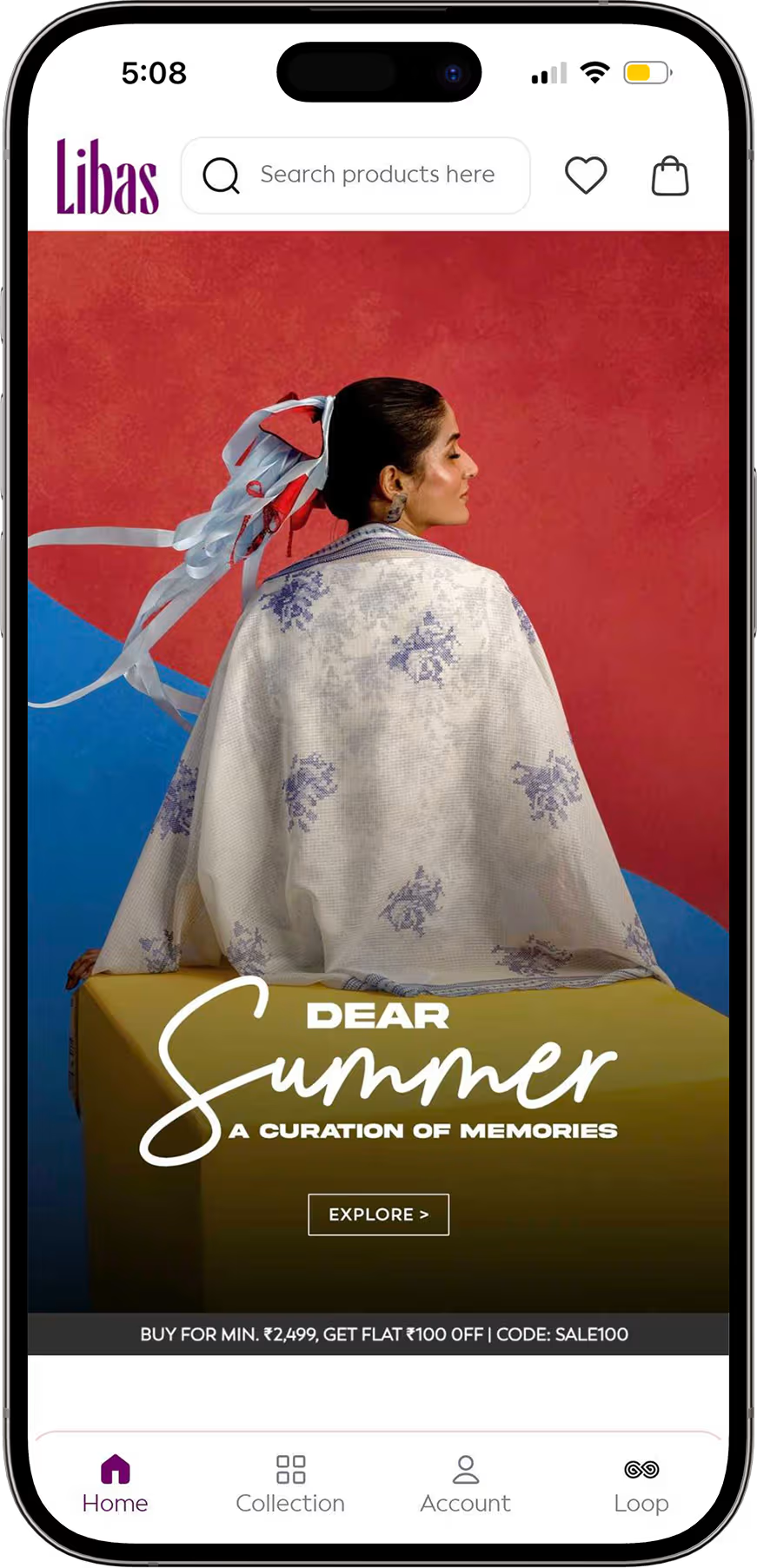
Example: On Cyber Monday 2025, ethnic wear brand Libas took 2,533 orders through its app during the sale, with push notifications the main channel it used to open flash drops and early access rather than paid ads (Appbrew network data, Cyber Monday 2025).
4. Show BNPL before checkout
Buy Now Pay Later spending reached $1.03 billion on Cyber Monday 2025, equal to about 7.2% of online sales reported by Adobe. But shoppers cannot consider an installment option they only discover at the final payment step.
Show the installment amount ("4 payments of $24.75") on the product page for higher-priced SKUs, and repeat it in your push and email creative.
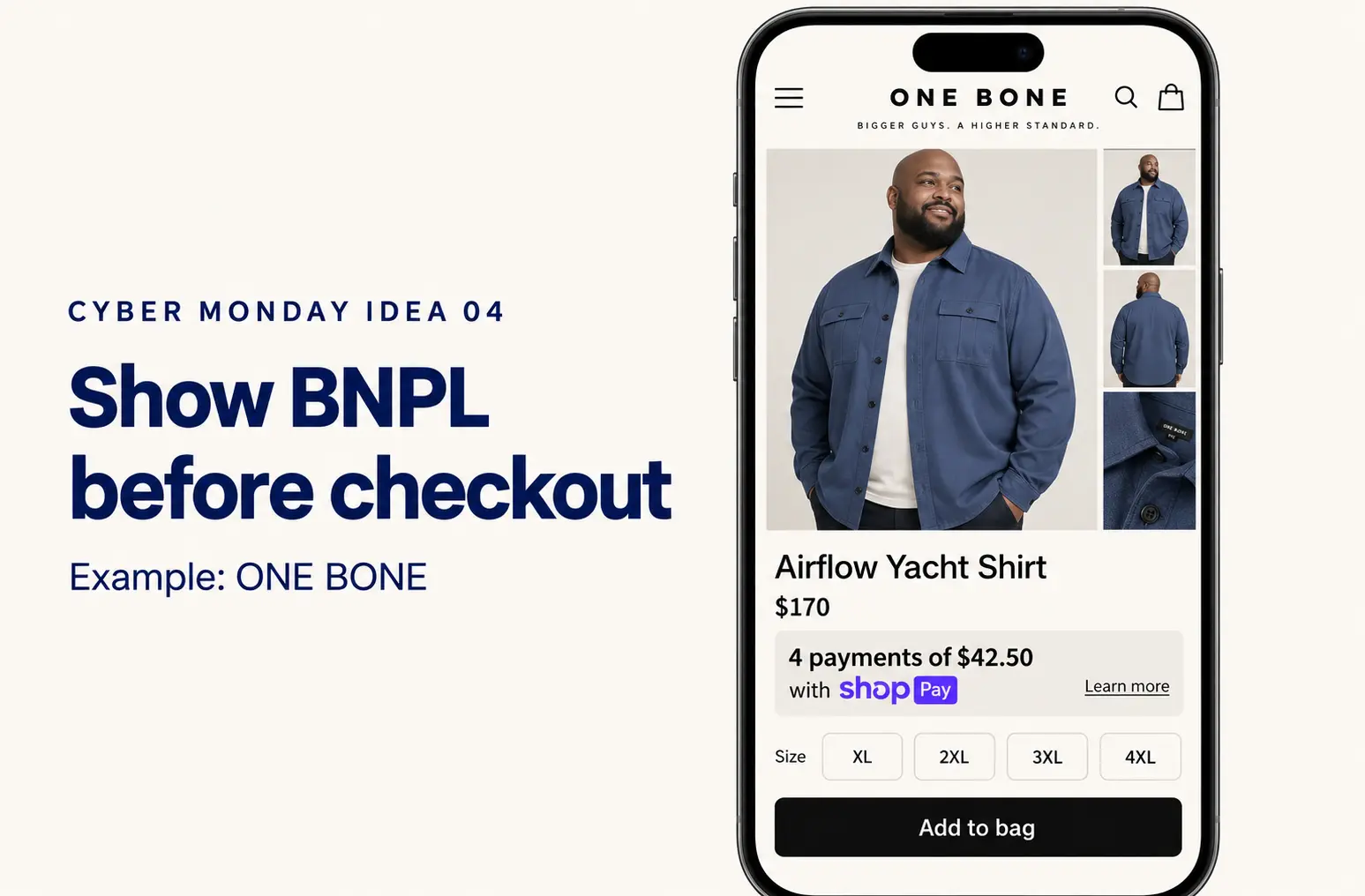
Example: On Cyber Monday 2025, apparel brand One Bone took 53 app orders at a $170 average order value, above its $155.66 web AOV, on a catalog where higher-ticket items suit installment options (Appbrew network data, Cyber Monday 2025).
5. Segment email using weekend behavior
Do not send the same Monday email to your entire list. Separate at least three groups:
- Subscribers who opened a Black Friday email but did not purchase.
- Shoppers who viewed a product or abandoned a cart.
- New subscribers who joined before or during the weekend.
Exclude customers who already purchased from another general discount send. Move them into order updates and relevant cross-sell flows instead.
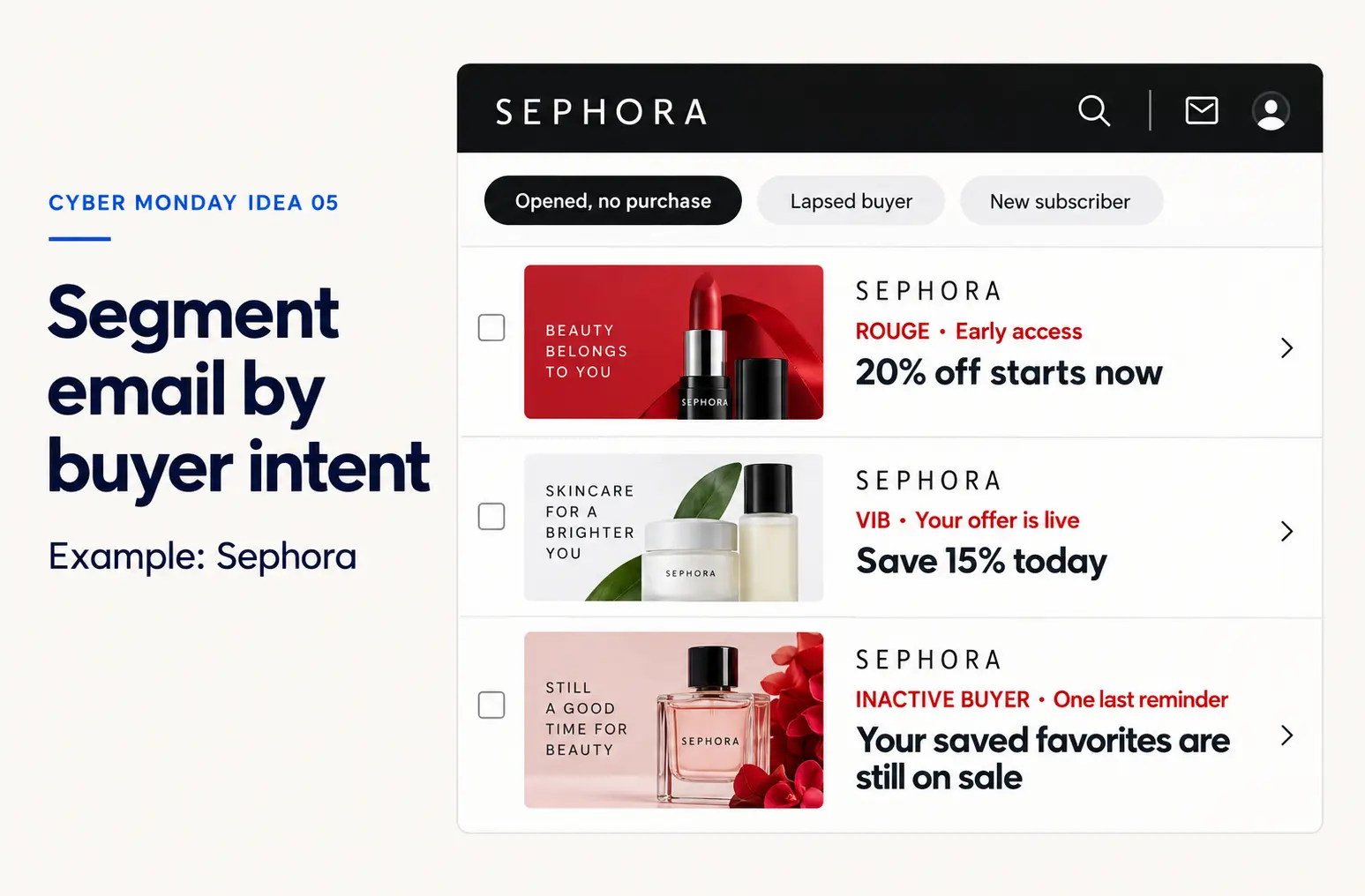
Example: Sephora segments its holiday email by Beauty Insider loyalty tier and purchase history, so a VIB Rouge member and a lapsed first-time buyer get different sends, early access and reminders routed by segment rather than one identical blast.
6. Send a timed push sequence across the day
A Cyber Monday that converts runs push as a sequence, where each message has its own job across the day.
|
Timing |
Message type |
Copy direction |
|
Night before (8 to 9 PM) |
Teaser |
"Tomorrow's deals go live at midnight." |
|
CM morning (7 AM) |
Launch |
"Cyber Monday is live. Up to 30% off, today only." |
|
Midday (12 to 1 PM) |
Flash drop |
"3 hours only: [product] now $X. Ends 3 PM." |
|
Evening (7 to 8 PM) |
Final hours |
"Last call. Deals end at midnight tonight." |
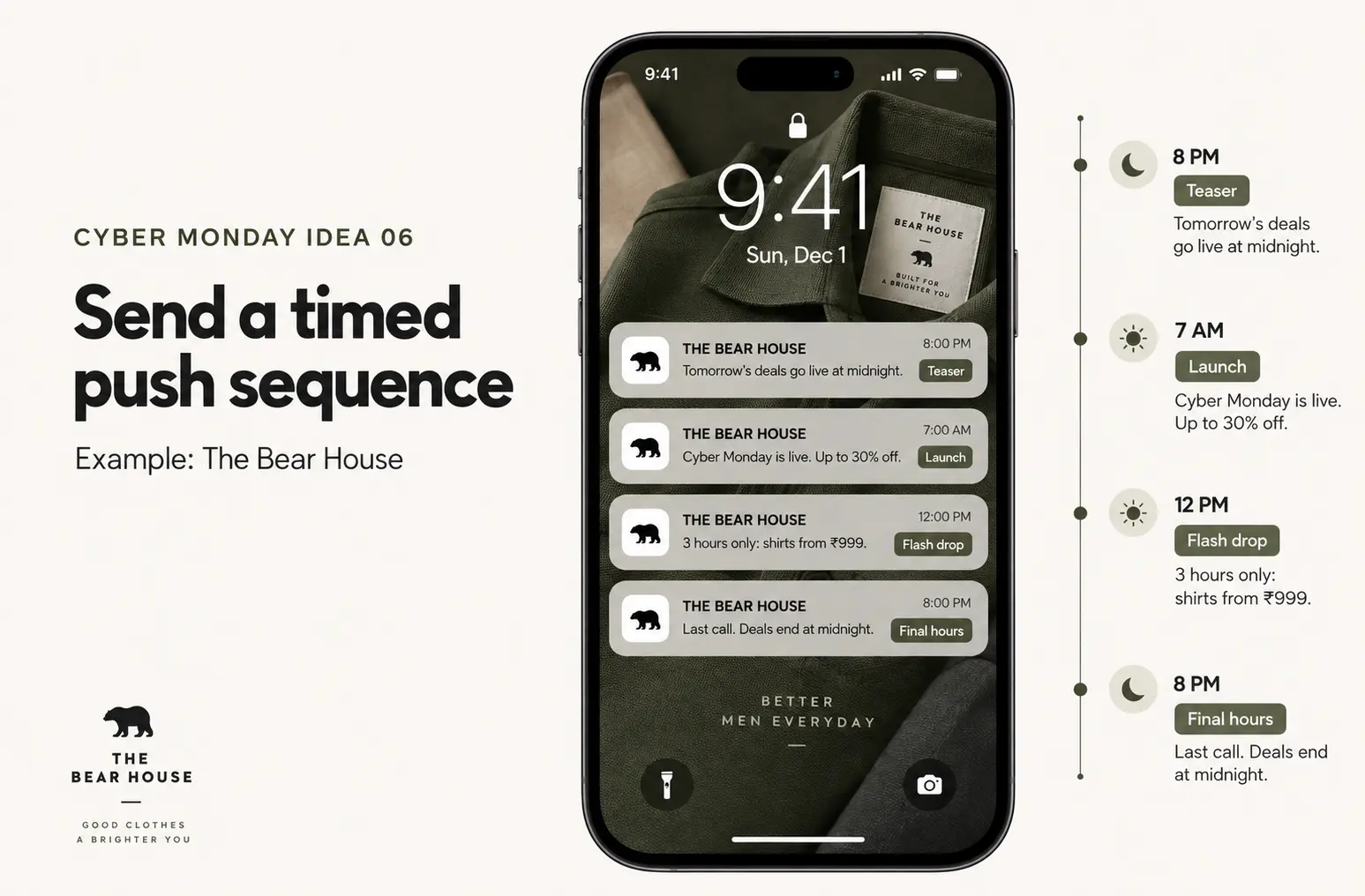
Example: On Cyber Monday 2025, apparel brand The Bear House took 3,237 app orders during the sale, using staged push through the day to open drops and drive its final-hours rush rather than one broadcast (Appbrew network data, Cyber Monday 2025).
Keep the total count reasonable. Three or four well-timed pushes hold attention, while a dozen gets you muted.
7. Use honest last-chance messaging
Many Monday buyers have already considered the product during the weekend. For this group, “Black Friday pricing ends tonight” is clearer than presenting the same offer as a completely new sale.
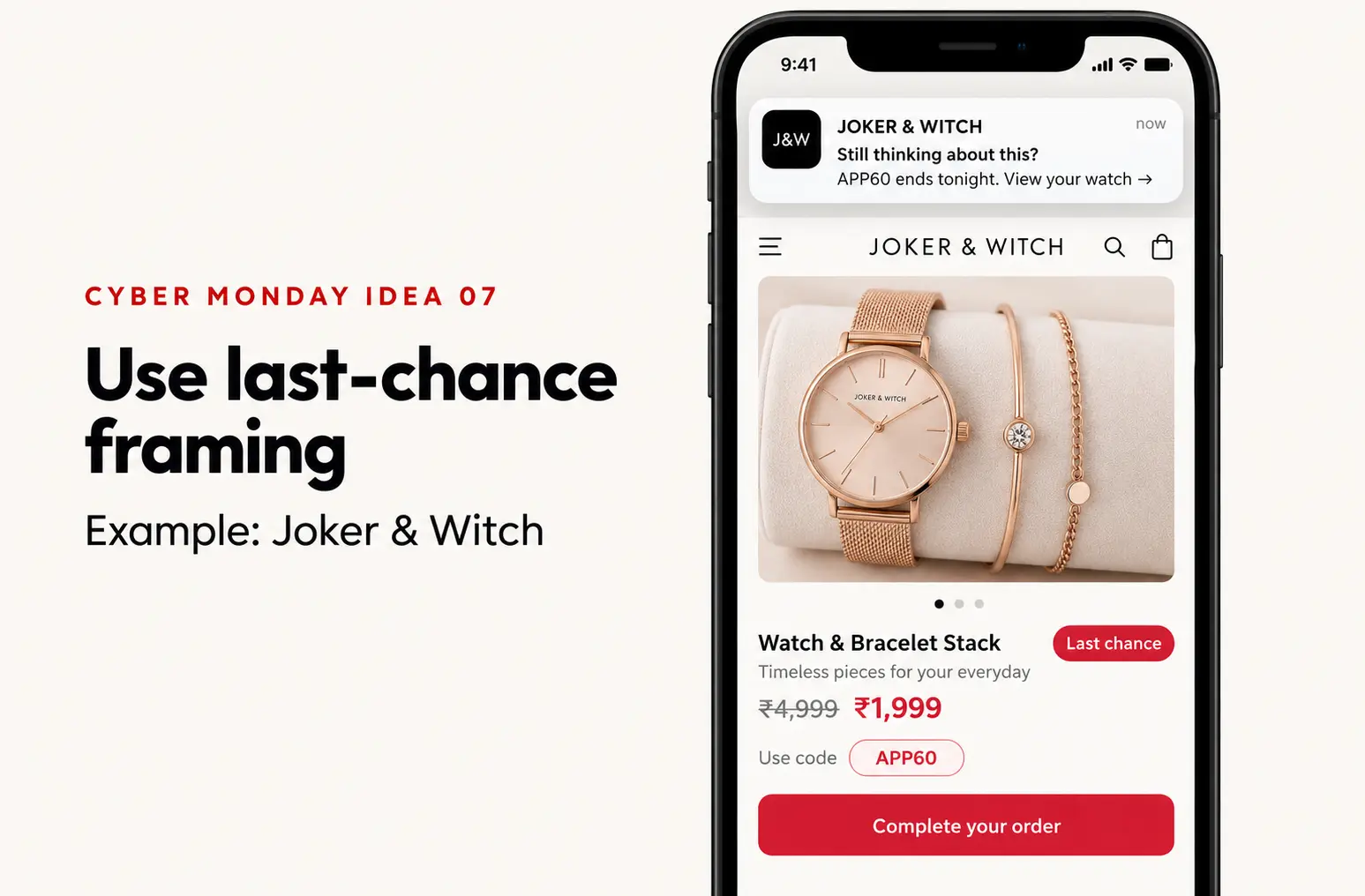
Example: On Cyber Monday 2025, accessories brand Joker & Witch re-engaged weekend browsers with app-exclusive codes (APP60 and a linked variant) that drove 747 orders and $8,949 in GMV (Appbrew network data, Cyber Monday 2025).
Keep the message honest. If the pricing really does end, say so, and do not extend it the next day or the framing stops working next year.
8. Gate app-exclusive discount codes
An app-exclusive offer can generate sales now and give you permission to reach the customer through push later. But the benefit must justify the install.
Offer a better price, early access, a private product drop or a gift unavailable on the website. Do not label an offer exclusive when it is identical everywhere else.
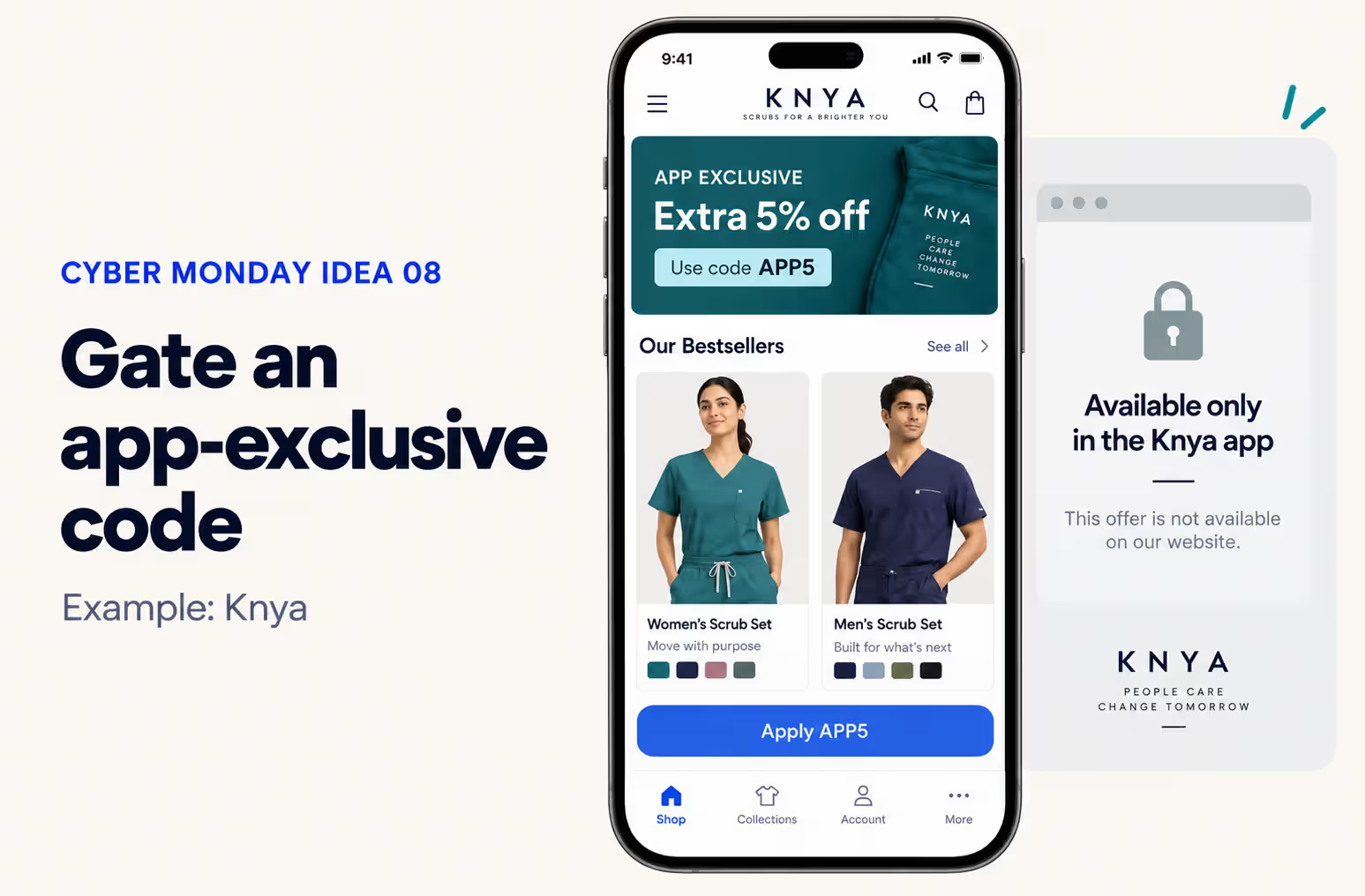
Example: On Cyber Monday 2025, apparel brand Knya ran an app-only discount (APP5) that drove 210 orders through the app during the sale, with the code available nowhere else (Appbrew network data, Cyber Monday 2025).
{{cta}}
9. Use BOGO or gifts to move selected inventory
BOGO and gift-with-purchase offers work well when you want to clear particular products without reducing the visible price of the full catalog.
Choose products with enough inventory and margin to support the offer. Set quantity limits and test how returns will be handled before launch.
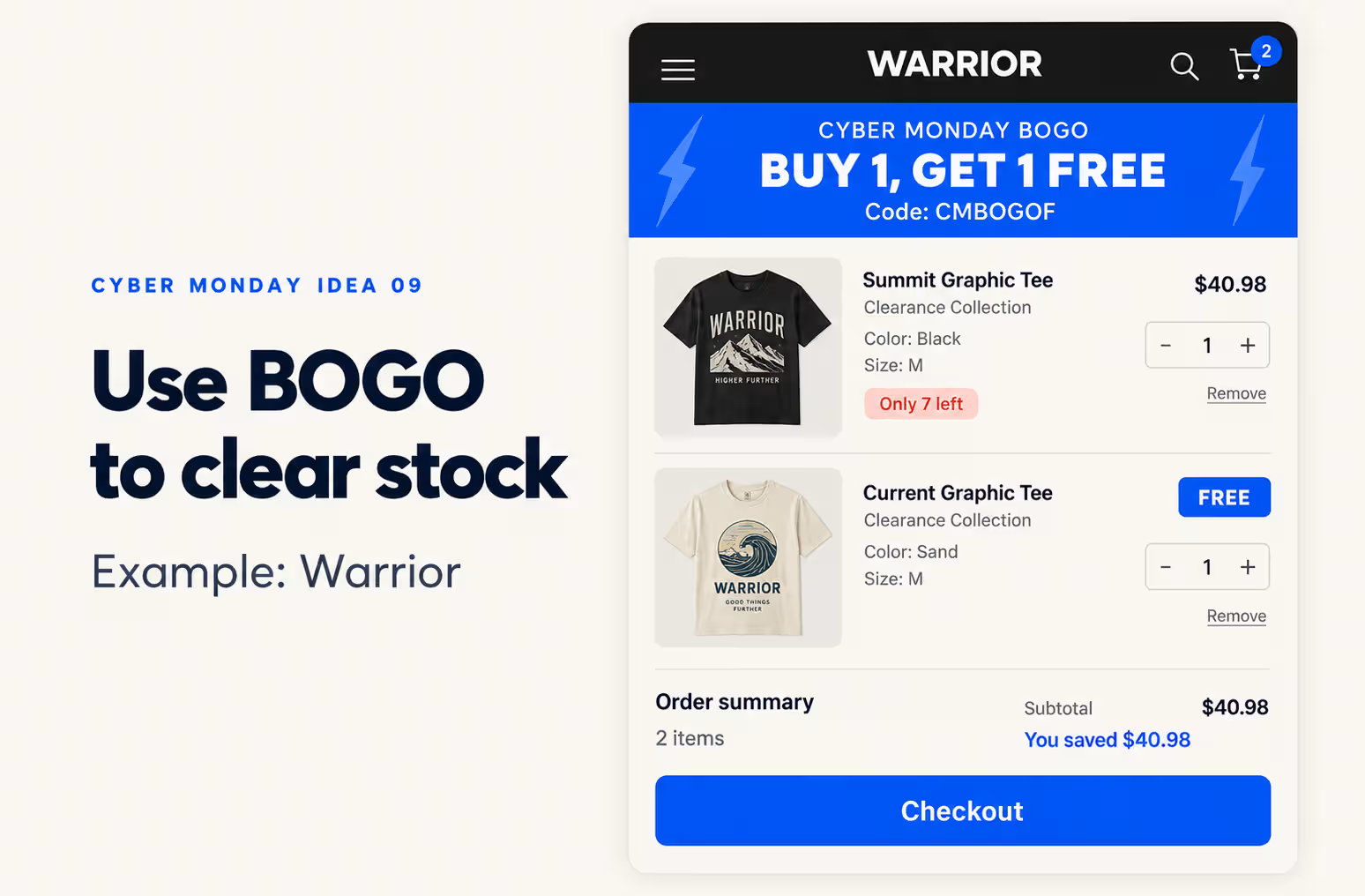
Example: On Cyber Monday 2025, apparel brand Warrior ran a BOGO offer through its app (code CMBOGOF) that drove 136 orders and $5,573 in GMV at a $40.98 average order value (Appbrew network data, Cyber Monday 2025).
10. Shorten cart-recovery timing
A cart reminder sent several hours later may arrive after a Cyber Monday offer or product has ended. Send the first reminder while the shopping session is still recent.
A 15-to-30-minute window is a sensible starting point for testing on the day. Remind the shopper what was left behind and state the real deadline or stock position. Avoid adding another discount automatically if the original offer is still active.
11. Use weekend sales data to choose Monday’s products
Your Black Friday results should decide what appears in Monday’s campaign. Review:
- Products with high views but low conversion
- Products frequently added to cart but not purchased
- Best-selling products with enough stock remaining
- Bundles that raised AOV
- Products generating returns, support questions or checkout issues
Feature proven products and fix obvious friction before sending more traffic. Do not keep promoting an item that is low on stock, producing errors or converting poorly without understanding why.
This is Cyber Monday’s main advantage over Black Friday: you are working with current buying data rather than a forecast.
12. Activate creators and TikTok Shop
TikTok Shop pulled in more than $500 million in US sales across the four-day Black Friday to Cyber Monday stretch in 2025, roughly $125 million a day, with nearly 50% more shoppers buying than the year before.
Established brands moved in for the season, with sales from brands over $10 million in annual revenue up 76% year over year, and names like Disney, Samsung, and Ralph Lauren joining earlier adopters like e.l.f. Cosmetics and Crocs.
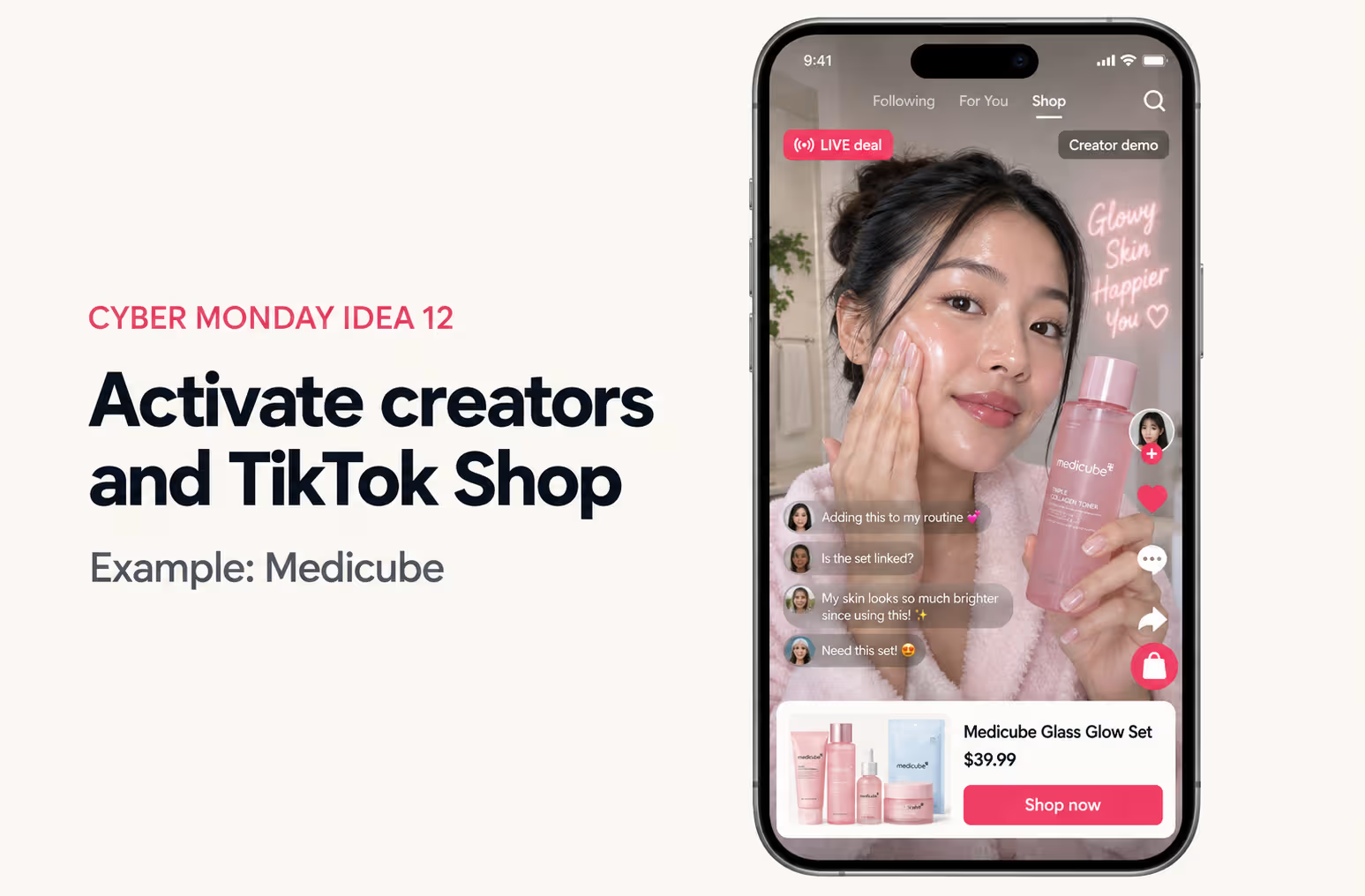
Example: Medicube's Glass Glow skincare set was one of the top-selling products across all categories on TikTok Shop during BFCM 2025, driven by creators showing it in short shoppable videos. Beauty led every category on the platform that year with $2.7 billion in US revenue (Charm.io and TikTok data, 2025).
Keep every code trackable so you can see which creators actually drove sales and rebook them next year.
13. Build gift guides around the buyer’s decision
Holiday shoppers often know who they are buying for but not which product to choose. Organize gift guides by recipient, interest or price instead of asking shoppers to browse the full catalog.
Useful categories include “gifts under $50,” “for new parents” or “for the home cook.” Put products with adequate stock and reliable delivery near the top.
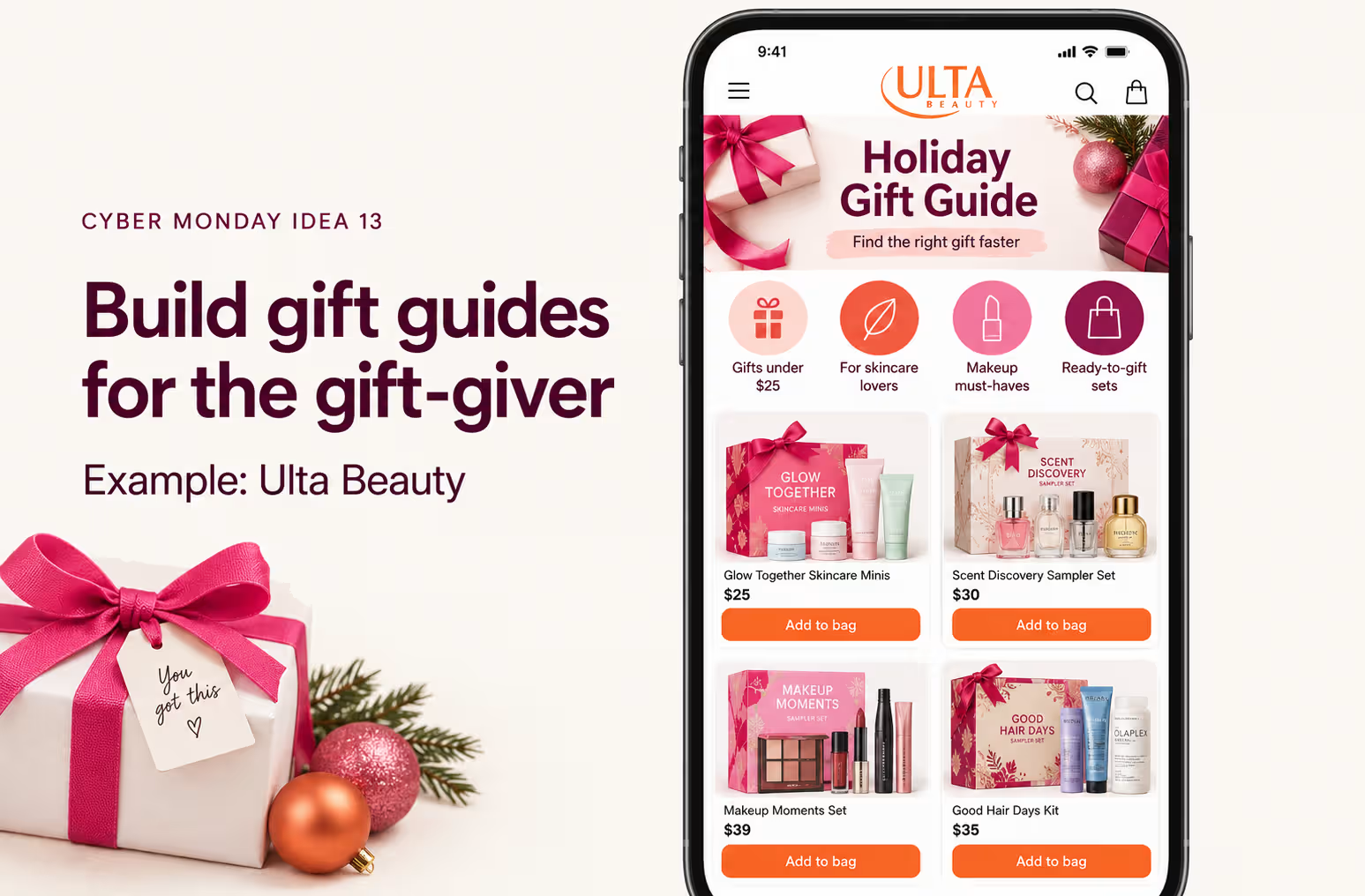
Example: Beauty retailer Ulta Beauty leans on curated gift sets and holiday bundles every Cyber Monday, packaging hero products into ready-to-give sets that take the decision-making off the shopper.
14. Make mobile checkout effortless
Most of your Cyber Monday traffic is on a phone, often late at night, so any friction at checkout costs you the sale.
Turn on one-tap wallets like Shop Pay, Apple Pay, and Google Pay, keep guest checkout available, and cut form fields to the minimum.
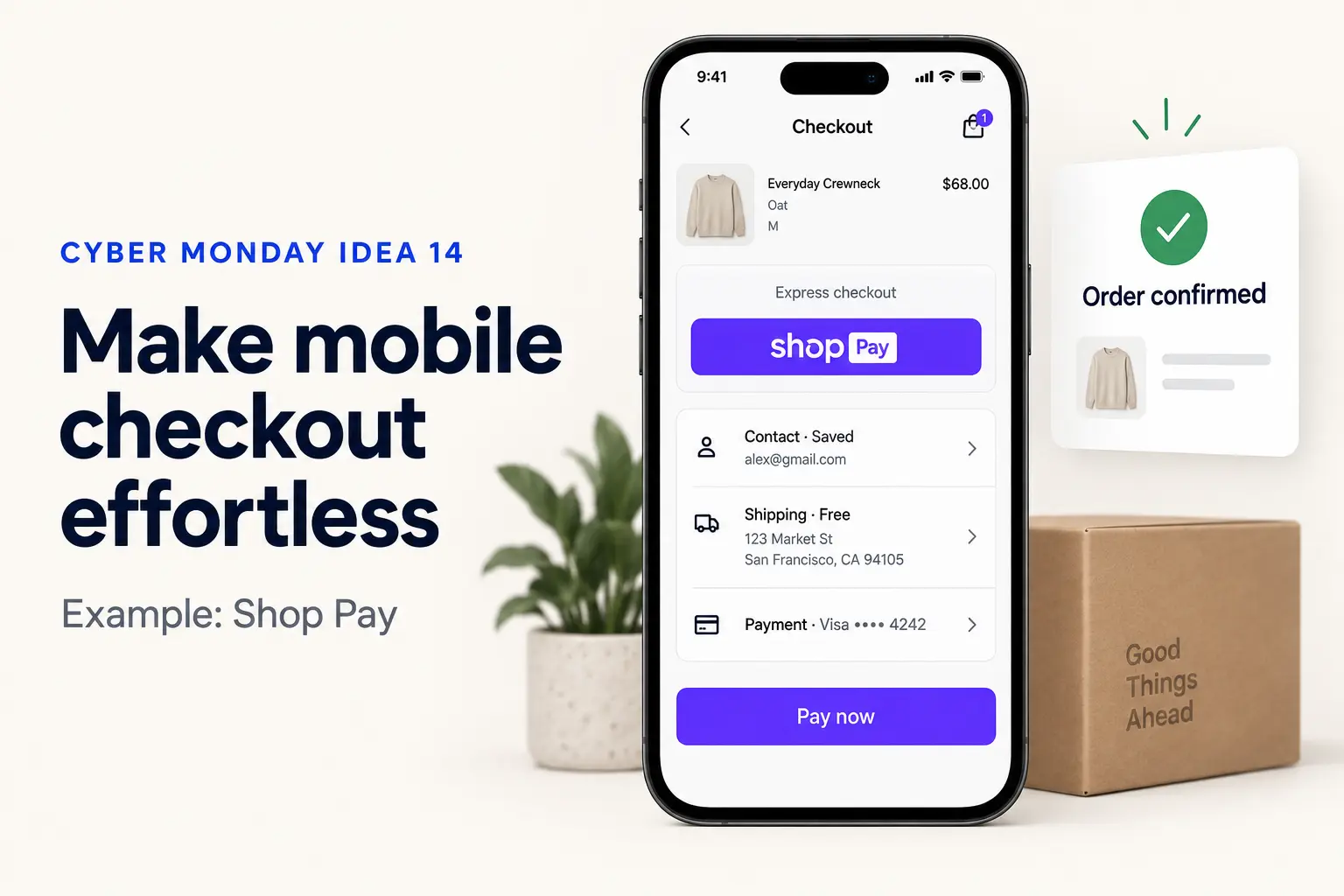
Example: On Cyber Monday 2025 across the Appbrew network, app orders paid through Shop Pay Installments averaged a $75.36 basket against $15.66 for standard credit-card orders, showing how much smoother, one-tap payment paths lift what shoppers are willing to spend.
Test the full flow on a real phone before the sale, because a checkout bug on your biggest day is the most expensive one to find late.
15. Deep-link every campaign to the relevant page
A shopper who taps a product message should not have to find that product again. Link ads, emails, SMS messages and push notifications to the exact product, collection or cart state they reference.
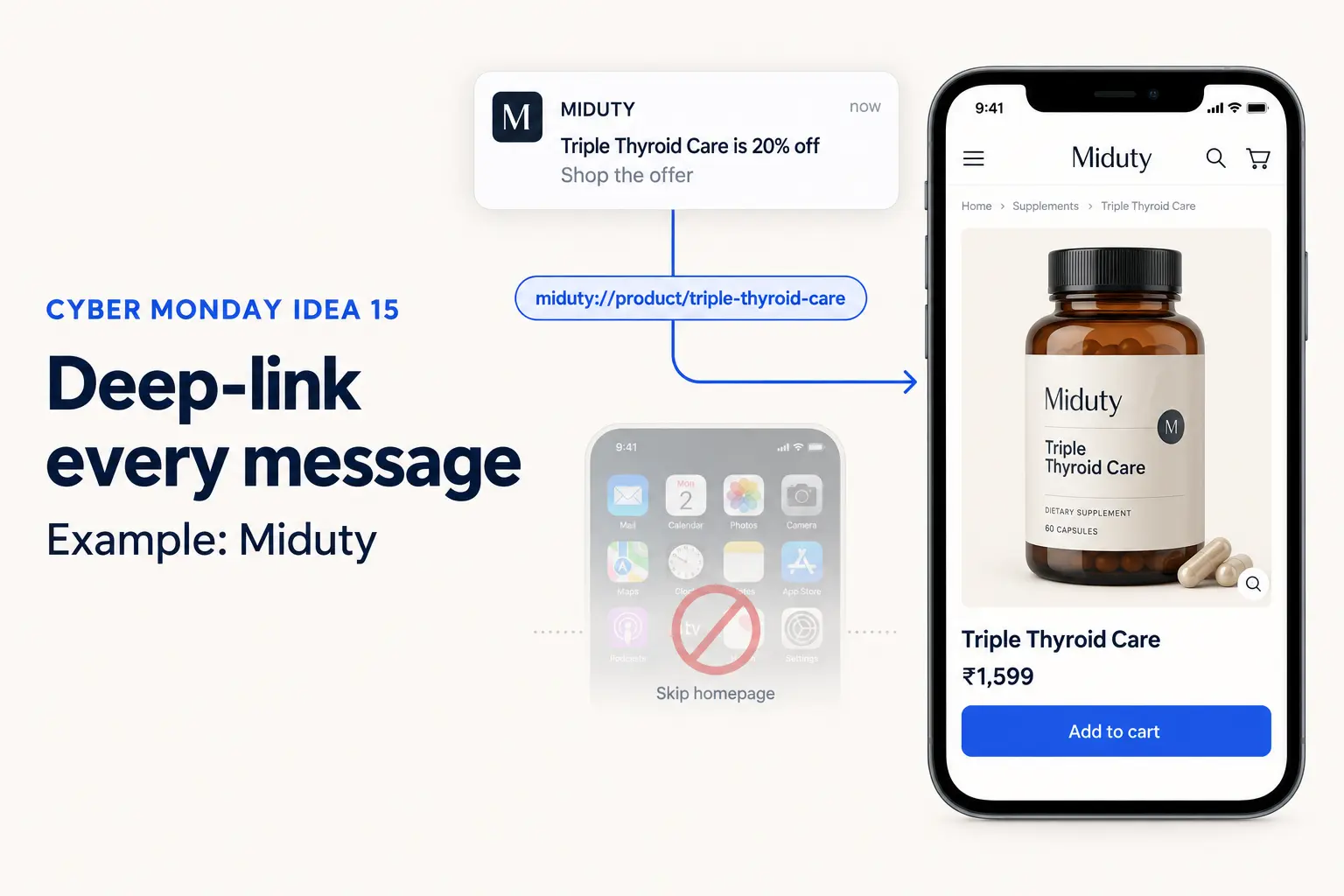
Example: Wellness brand Miduty used deep-linked push to send shoppers straight to the promoted product rather than the homepage, part of a mobile setup where its app AOV ran 32.7% ahead of web ($33.85 vs $25.51) (Appbrew network data, Cyber Monday 2025).
Test every link before launch, including logged-out states, expired offers and products with multiple variants.
Which Cyber Monday offer should you run?
Choose the offer based on the outcome you need, not on which discount appears largest.
|
Offer type |
Best for |
Margin impact |
AOV impact |
|
Flash drop (2–4 hrs) |
Driving urgency, app engagement |
Moderate |
Neutral |
|
Tiered discount |
AOV lift, full-catalog offers |
Low to moderate |
High |
|
App-exclusive deal |
Push channel monetization, LTV |
Low to moderate |
Moderate to high |
|
BOGO (category-specific) |
Inventory clearance, value perception |
Variable |
Moderate |
|
BNPL surfacing |
High-ticket conversion, mobile checkout |
None |
High |
|
BF last-chance framing |
Re-engaging non-converters |
Low |
Neutral |
Before choosing, calculate the contribution margin after the discount, product cost, shipping subsidy, payment fees and expected returns.
Cyber Monday marketing strategies from 250+ Shopify brands
We've watched more than 250 Shopify brands go through Cyber Monday on our platform, and the same patterns repeat every year.
1. The app-vs-web AOV gap is the real story of Cyber Monday.
The industry obsesses over traffic and conversion rate on the day, but the number that actually moved for our brands was average order value on mobile apps versus web.
On Cyber Monday 2025 app AOV ran ahead across every category we saw, from about 10% to over 40%.
|
Brand |
Category |
In-app CM AOV |
Web CM AOV |
App AOV lift |
|
Pashtush |
Apparel |
$52.78 |
$37.08 |
+42.3% |
|
The Bear House |
Apparel |
$27.65 |
$19.47 |
+42.0% |
|
Home Essentials |
Home |
$30.92 |
$21.93 |
+41.0% |
|
Miduty |
Wellness |
$33.85 |
$25.51 |
+32.7% |
|
Loved Baby |
Baby |
$117.89 |
$95.49 |
+23.5% |
|
Libas |
Apparel |
$28.60 |
$24.88 |
+14.9% |
|
alamode |
Apparel |
$47.43 |
$42.87 |
+10.6% |
Appbrew network data, Cyber Monday 2025.
Our take on why: the app removes the friction that kills big baskets on Cyber Monday. Saved payment, one-tap checkout, and a shopper who chose to install are all working in your favor before the sale even starts. That is why we tell brands the app for BFCM is where your highest-value orders come from.
2. Chasing deeper discounts is the wrong tactic in 2026
We watched network app order volume grow 225% year over year without brands cutting prices harder, which lines up with what happened industry-wide as average discounts actually shrank.
The brands that won Cyber Monday grew by reaching their existing customers more effectively, through push and app exclusivity, not by racing competitors to the lowest price.
For the wider set of tactics beyond discounting, see our BFCM marketing strategies to increase sales.
3. Push is the most underrated channel on the biggest day of the year
It drove 453,000 product views and 3,221 directly attributed purchases across our network of 250+ brands on Cyber Monday 2025 at no per-message cost. We would argue that for any brand with an app, push open and click rates are a better predictor of a strong Cyber Monday than email list size, and most brands still plan it backwards.
The 72 hours after Cyber Monday decide what it was worth
Buyers who came in through the app during Cyber Monday 2025 came back at a noticeably higher rate than web buyers, and the gap held all the way out to 90 days.
|
Repeat purchase rate |
App buyers |
Web buyers |
Relative lift |
|
Within 30 days |
23.42% |
17.15% |
+36.6% |
|
Within 60 days |
34.59% |
26.91% |
+28.5% |
|
Within 90 days |
41.88% |
33.63% |
+24.6% |
Appbrew network data, Cyber Monday 2025 buyer cohort.
If app buyers are worth ~24% more in repeat business over the next quarter, acquiring a customer into your app on Cyber Monday beats the same sale on the web, even at the same order value.
What to do in the 72 hours after Cyber Monday:
- Thank-you and order update first, before any new offer.
- Move buyers out of discount sends into a post-purchase flow: shipping, how-to content, then a cross-sell once the order lands.
- Prompt web buyers to install the app for order tracking, so you can reach them with free push.
- Ask for a review or UGC a few days after delivery, while it's fresh.
The brands that win the season turn a discounted first order into a second one at full price.’
10 checks to run before your Cyber Monday 2026 sale goes live
Traffic peaks on Cyber Monday evening, most of it on mobile, so small friction points cost real money at scale. Run through these ten before the sale goes live:
- Test the full checkout on a real phone. Product to paid, start to finish. A checkout bug on your highest-traffic day is the most expensive one to catch late.
- Turn on one-tap wallets. Shop Pay, Apple Pay, Google Pay. Fewer typed card details means fewer drop-offs.
- Show BNPL on the product page, not just at checkout, with the installment amount visible ("4 payments of $24.75").
- Put a real countdown on offer pages. A ticking timer at the point of decision, not vague "ends soon" copy.
- Deep-link every push, email, and ad to the exact product or offer, never the homepage.
- Show live stock levels on low-inventory items to add honest urgency.
- Keep guest checkout available. Forcing account creation at peak loses first-time buyers.
- Pre-test every discount code across devices and cart types so nothing fails live.
- Confirm your site holds up under load, since evening traffic spikes are when pages slow down.
- Set your final-hours messaging in advance so it fires on schedule without a scramble.
4 Cyber Monday campaigns from brands you know
You've seen the tactics and the data. Here's what a few of them look like in the hands of brands you'll recognize.
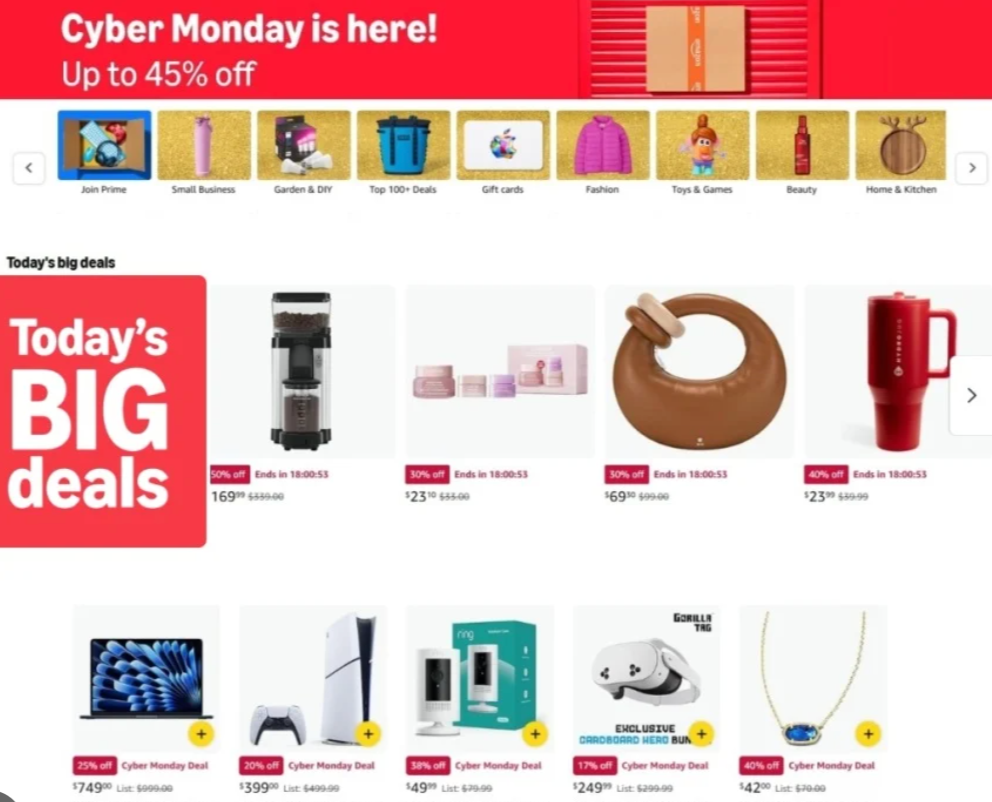
Amazon: flash deals with a countdown
Amazon's "Lightning Deals" last a few hours each, with a live countdown and a "% claimed" bar on the product. Deals rotate all day, so shoppers keep coming back.
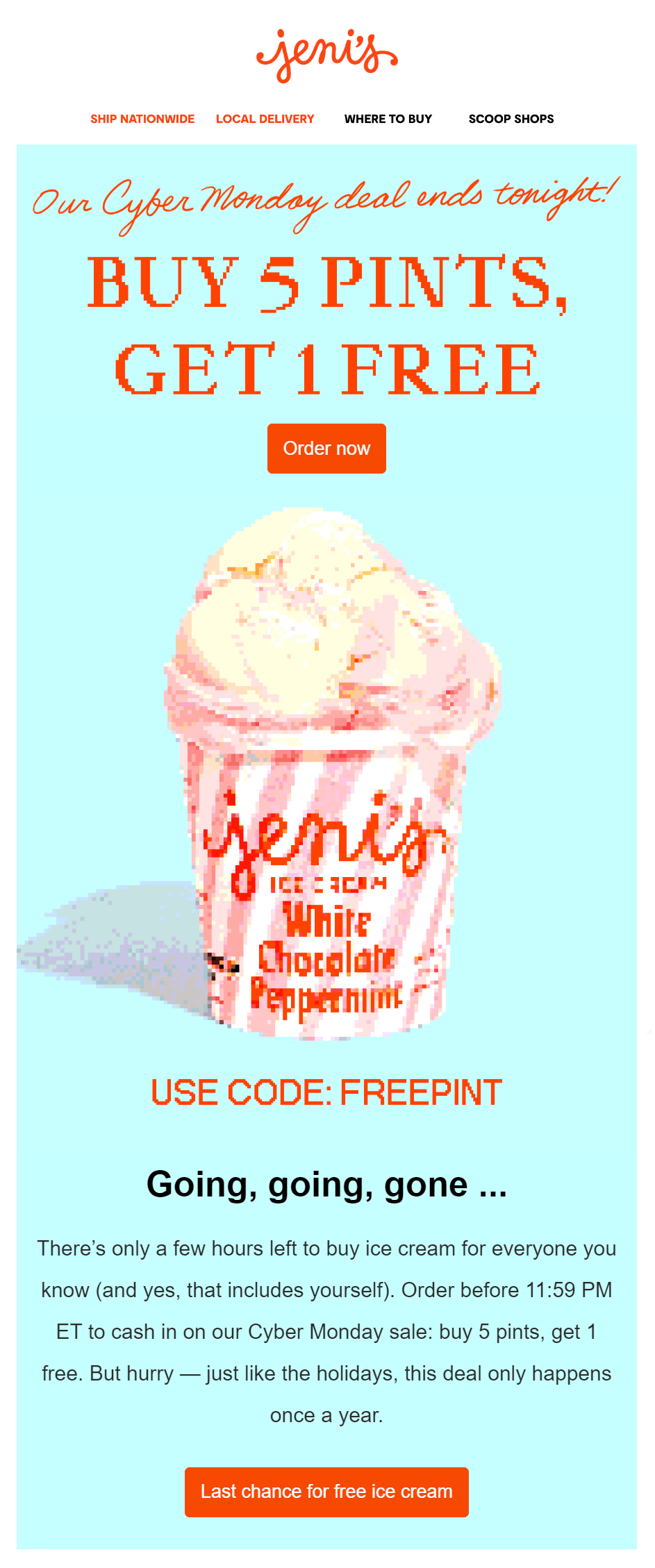
Jeni's Ice Creams: one scarce offer
Jeni's runs a single Cyber Monday deal, buy five pints get one free (code FREEPINT), and it's their only sale all year. The scarcity does the work: there's no better price coming. Rewards members get early access.
Bonobos: tiered offers that grow the basket
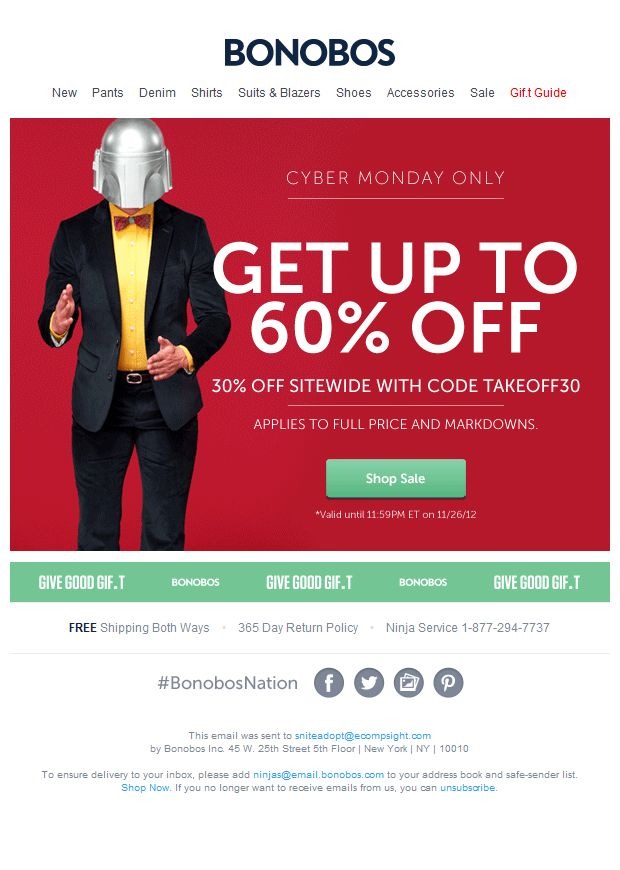
Bonobos tiers its holiday discounts, historically 25% off $150 and 30% off $250. The tiers give shoppers a reason to add an item to hit the next threshold, lifting order value while protecting margin on small carts.
Lowe's: turning the sale into sign-ups
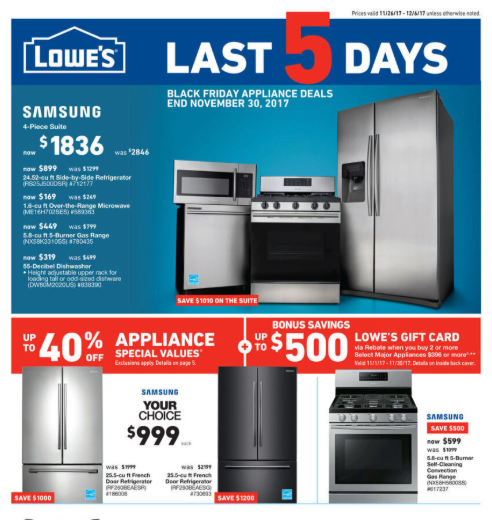
Lowe's stretched BFCM across a month and anchored it to MyLowe's Rewards, which hit 30 million members by end of Q4 2024, with online sales up 9.5% in the quarter. The discount isn't the goal, the reachable customer is.
These campaigns use different offer structures, but each makes the next action clear and considers what happens after the transaction.
Make this your best Cyber Monday yet
The brands that win Cyber Monday aren't the ones with the deepest discount. They're the ones who reach their customers on the right channel, remove friction from the buy, and turn a one-time deal into a lasting relationship. Across 250+ Shopify brands, the pattern holds every year: the mobile app is where the highest-value orders and the most repeat buyers come from.
If you want that edge before this Cyber Monday, Appbrew builds mobile apps for Shopify brands designed to convert on exactly these moments, from app-exclusive drops and push campaigns to a checkout built for the way people actually shop on the biggest day of the year.
{{cta2}}
Cyber Monday marketing FAQs
When is Cyber Monday 2026?
Cyber Monday 2026 falls on Monday, November 30. It always lands on the Monday after Thanksgiving, three days after Black Friday (November 27 in 2026).
What is the most important channel for Cyber Monday marketing?
For brands with a mobile app, push notifications, because they reach shoppers on the lock screen at no per-message cost on a day when email inboxes are saturated. Across the Appbrew network, push drove 453,000 product views and 3,221 directly attributed purchases on Cyber Monday 2025. For brands without an app, segmented email and SMS do the most work.
How is Cyber Monday different from Black Friday?
Black Friday shoppers are still browsing and comparing, so they respond to headline discounts and discovery channels. Cyber Monday shoppers have mostly decided and are buying before deals end, so urgency mechanics like countdowns and last-chance offers convert harder, and owned channels like push and SMS outperform a tired inbox.
Is it cheaper to buy on Black Friday or Cyber Monday?
It depends on the category. Black Friday tends to have the strongest deals on electronics, TVs, and big-ticket items, while Cyber Monday leans toward online-only categories like fashion, beauty, toys, and smaller tech. Many brands run similar discounts across both, with Cyber Monday framed as the last chance at weekend pricing.
What are good Cyber Monday marketing ideas for a small business?
Focus on the tactics that cost little and use what you already own: time-limited flash drops with a countdown, an app- or SMS-exclusive code, a tiered discount to lift order value, and a fast abandoned-cart nudge. A small, engaged owned audience reached well beats trying to outspend larger brands on ads.
When should I start planning my Cyber Monday campaign?
Start by early-to-mid November at the latest. Shoppers now begin buying during October and November promotions, so your audience building, app installs, and email or push segments should be in place well before the weekend. The campaign creative and offer structure should be finalized and tested a week ahead.
How do I keep Cyber Monday buyers after the sale?
Treat the sale as the start, not the end. Send an order thank-you first, move buyers into a post-purchase flow rather than more discounts, prompt web buyers to install your app for order tracking, and ask for a review after delivery. Appbrew network data shows app buyers repeat at a 41.88% rate within 90 days versus 33.63% for web.