


.webp)
.webp)
Learn how to plan high-converting back-to-school marketing campaigns with email, mobile commerce, segmentation, and retention strategies.
Back-to-school spending is expected to hit $85.42 billion in 2026 (eMarketer, 2026), yet most Shopify brands will capture only some or almost none of it.
Not because the season isn't relevant to them, but because the way they run BTS campaigns structurally guarantees poor returns: heavy spend on paid media during peak CPM windows, a blanket discount pushed to their full list, and a campaign brief that treats "back to school" as a product category rather than a customer moment. The families buying notebooks are the same ones buying clothes, phone cases, dorm-room storage, skincare, and sneakers. The $858 average K-12 per-household spend (NRF, 2025) is not going to school supply brands alone, yet most Shopify stores outside that narrow category never enter the conversation at all.
The ones that do enter it often pay too much to do so. Meta CPMs spike 20-35% during July and August as every retailer simultaneously bids for the same parent demographic. A brand that builds its BTS strategy entirely on paid acquisition is essentially funding its competitors' auctions as much as its own.
This guide covers how to structure a back-to-school campaign that doesn't depend on outbidding everyone in August: the right channel mix, the phase structure, and the campaign mechanics that drive revenue without torching margin.
TL;DR
- Back-to-school spending is expected to reach $85.4 billion in 2026, creating a major revenue opportunity for Shopify brands far beyond traditional school supply categories.
- The most successful BTS campaigns start in May and June, focusing on audience building, wishlist creation, and owned-channel growth before competition intensifies.
- Winning back-to-school marketing requires a three-phase strategy: pre-season audience building, peak acquisition during July–August, and last-mile conversion campaigns after school starts.
- Email remains the highest-ROI BTS channel when brands use segmented, multi-touch sequences instead of generic promotional blasts.
- Category bundles, checklists, teacher appreciation campaigns, UGC activations, and countdown launches often outperform simple discount-led promotions.
- Mobile commerce dominates BTS shopping behavior, making mobile-first experiences, streamlined checkout, and fast-loading campaign pages essential for conversion.
- Push notifications and owned channels help brands reduce reliance on rising summer ad costs while driving more personalized customer engagement.
- The brands that win BTS aren't necessarily spending more; they're starting earlier, segmenting better, and using owned channels more effectively.
Where the $85 Billion Actually Goes (and Who's Missing Out)
The back-to-school category label is misleading. It implies the season belongs to brands selling backpacks and composition notebooks, but the actual spending picture is much more interesting.
K-12 families plan to spend $295 on electronics, $249 on clothing and accessories, $169 on shoes, and $143 on school supplies per household, on average (NRF, 2025), with college students and their families budgeting $1,325 per person. Across both segments, the majority of that money flows into apparel, footwear, tech accessories, and home goods, not Staples-style school supply categories.

The practical implication is that if your Shopify store sells anything in those categories, you have a genuine BTS angle. Still, most brands never build one. They look at "back to school" as a theme that doesn't apply to them, let a season's worth of high-intent spending pass by, and then wonder why Q3 underperforms relative to BFCM.
Teachers are another segment that gets skipped entirely. Educators spend $500-$750 of their own money per year on classroom supplies and related items (Retail Dive, 2025). This means they're not a niche audience, but a loyal, high-LTV segment with specific purchase triggers, yet almost no mainstream BTS campaigns are built with them in mind.

The second structural problem is channel concentration. Most BTS campaigns live almost entirely in paid social, with email as a secondary afterthought. That's the opposite of what the economics suggest. Paid social CPMs peak when every retailer is competing for the same audiences at the same time. Owned channels, email sequences and push notifications carry conversion rates that paid can't match, at a fraction of the cost per conversion. Brands that build BTS on a strong owned channel foundation and use paid to amplify rather than anchor consistently outperform brands that invert that ratio.
One reason owned channels outperform over time is that they compound. Every email subscriber, app install, or returning customer makes the next campaign cheaper to run. We've broken down more strategies for building that long-term retention in our guide to Shopify customer retention strategies.
{{cta}}
The Three-Phase Campaign Structure
Winning back-to-school isn't about one big campaign. It's about three distinct phases, each targeting a different buyer mindset.

Phase 1: Pre-Season (May-June)
This phase has one job: build the owned audience you'll convert in July.
Families are beginning to think about the year ahead but aren't yet in active buying mode. Paid conversion campaigns here will underperform on ROAS. What pays off instead is list growth: an early-access sign-up for your BTS drop, a preference quiz that captures product intent, a "save to wishlist" flow that lets customers earmark items before the promotion goes live. Erin Condren, a lifestyle brand, did exactly this: an email sent two months before the school term let customers browse the new collection and save items to a list, with a timed reminder to complete the cart. By the time the sale opened, a significant share of purchases were already pre-decided.
Paid social in this window serves a different purpose than it does in July. CPMs are lower, competition is thinner, and you're building retargeting pools rather than closing transactions. A dollar spent acquiring a warm audience in June is worth more in July than the same dollar spent in a fully contested auction.
Phase 2: Peak Acquisition (July-August)
This is when you sell hard. Buyers are in the market, intent is high, and urgency messaging actually converts.
The key in this phase is segmentation. A parent replacing school supplies wants bundles and convenience, while a college student kitting out a dorm room is driven by aesthetics, independence, and social identity. Sending both the same email is the fastest way to convert neither.
What works here instead is tiered promotions, bundle offers, limited-time flash events, and targeted email sequences based on past purchase behavior. The "buy more, save more" mechanic performs well with value-conscious shoppers: it drives AOV while feeling like a deal rather than a discount.
Teachers are also worth a dedicated segment. According to Retail Dive analysis, educators spend $500-$750 of their own money each year on classroom supplies. Brands that create a teacher appreciation offer or educator discount during this window tap a segment that's highly loyal and heavily underserved by mainstream BTS campaigns.
Phase 3: Last-Mile (Late August-September)
After school starts, there's still real buying happening. Students arrive at college and realize they forgot things. Younger kids need replacement items. Parents discover what was left off the list.
This phase favors urgency and convenience messaging: fast shipping, frictionless checkout, "you might also need" recommendation sequences. The tone shifts from "get ready" to "we've got you covered." It's also the lowest-competition window, since most brands have mentally exited the season by late August, and a good time to grow the list you’ll market to during your BFCM sale.
Suggested Read: Personalized Product Recommendations in E-commerce (2026 Guide)
Back-to-School Email Marketing: What Actually Works
Email remains the highest-ROI channel for back-to-school campaigns, but only if you move beyond the blast.
The brands that win on email in this season do three things differently. First, they build their BTS list before the promotional period starts. An early-access teaser in June that captures opt-ins gives you a segmented, high-intent cohort to lead your July campaign. You're not emailing your entire list, but only the people who specifically raised their hand for this.
Second, they sequence rather than broadcast. A single "Back to School Sale!" email doesn't close revenue. A sequenced flow does: a teaser that shows what's coming, a launch email with your hero offer, a midpoint reminder with social proof (reviews, bestseller callouts), and a final urgency push 48 hours before the offer ends. Each email has one job, and none of them tries to do everything at once.

Third, they treat subject lines as conversion assets, not afterthoughts. Over 60% of emails are opened on mobile devices (TargetBay, 2025), which means subject lines are competing in a two-inch preview pane against every other notification a parent has received that morning. Personalization, specificity, and urgency outperform seasonal wordplay. "Get the dorm room checklist ready" beats "Class is in session!" not because it's clever, but because it's useful.
What not to do: subject lines like "Back to School Sale" are category noise. If your entire subject line could have come from any store in America, it will be ignored. Specificity here is the differentiator.
For BTS email, these mechanics consistently outperform:
|
Approach |
Why it works |
|
Early-access list building (May–June) |
Captures high-intent buyers before peak competition |
|
Segmented send by customer type |
Parents, students, and teachers each have different purchase drivers |
|
Sequenced flows (4–5 emails over 2–3 weeks) |
Guides buyers from awareness to conversion without a single-blast spike |
|
Bundle-specific emails |
Reduces decision fatigue and drives AOV |
|
Post-purchase "complete the kit" follow-up |
Captures the last-mile buyer and reactivates recent purchasers |
Back-to-School Campaign Ideas Beyond Discounts
Discounts are the most common BTS lever, but they're also the least defensible. If your only campaign idea is "20% off," you've handed the season to whoever is willing to go to 30%.
Here are campaign ideas that don't require you to race on price:
The category bundle: Group related products into a curated collection (dorm room essentials, first-day fit, study kit) and position it as a shopping shortcut, not just a discount. Bundles reduce the cognitive load of building a cart from scratch and create the perception of value without requiring a deep discount on individual items.
The checklist campaign: Build a downloadable or interactive back-to-school checklist that anchors to your product category. For instance, a skincare brand running a "glow through fall semester" checklist, a tech accessories brand running a "study setup guide," or a home brand running a "dorm room starter list." The checklist becomes a content asset with organic reach and functions as a soft product recommendation engine.
The teacher appreciation activation: A dedicated educator discount, sent to a teacher segment or promoted through teacher communities, earns loyalty from a group most brands completely ignore. Teachers buy for themselves and recommend to parents. The word-of-mouth value extends beyond the transaction.
The giveaway or UGC challenge: Back-to-school is a natural moment for social participation. A "show us your setup" or "rate your backpack" challenge with a branded hashtag generates social proof and widens reach without paid media spend. The key is making the barrier low: it needs to take less than 30 seconds to participate.
The countdown event: A "Back-to-School Drop" with a clear launch date and teaser content in the week prior creates event energy around a promotion that might otherwise feel routine. Countdown timers in emails, social countdowns, and a launch-day push notification to app users all reinforce urgency without requiring a bigger discount.
Many brands also layer FOMO marketing tactics like scarcity messaging, countdowns, and social proof into these launches to improve conversion rates.
Owned Channels and Why the Mobile Experience Matters More Than You Think
The brands that consistently outperform during seasonal campaigns aren't necessarily spending more on paid media. They're converting better across owned channels.
By 2026, nearly 50% of total online sales in the US will happen on mobile devices (WiserReview, 2026). Smartphones generate 75-78% of all ecommerce traffic. If your mobile checkout experience is slow, your navigation is clunky, or your campaign landing pages don't load cleanly on a 6-inch screen, you're burning campaign spend before a single conversion can happen.
For Shopify brands running a mobile app, back-to-school is one of the clearest use cases for push notifications as a campaign channel. App push notifications allow you to reach opted-in customers directly, with zero inbox competition, at precisely timed moments: a 48-hour early access window, a flash sale launch, a "last units remaining" alert. Unlike email, which gets filtered and delayed, push notifications land in real time.
Segmenting push campaigns by purchase history and browsing behavior lets you go further. A customer who bought shoes from you last BTS season doesn't need a generic category message. They need to know the new fall styles just dropped. That level of specificity, at scale, is what separates a seasonal campaign that drives incremental revenue from one that just eats into existing margin.
For brands that haven't yet built their mobile app, back-to-school is a strong moment to consider it. The season creates a natural acquisition moment: app download incentives, app-exclusive early access, and in-app deals give customers a reason to install and engage beyond a single purchase. Appbrew builds Shopify-native mobile apps with push notification capabilities, segmentation, and deep Klaviyo integration, designed to turn seasonal traffic into a retained customer base.

{{cta2}}
The Value Messaging Problem (and How to Get It Right)
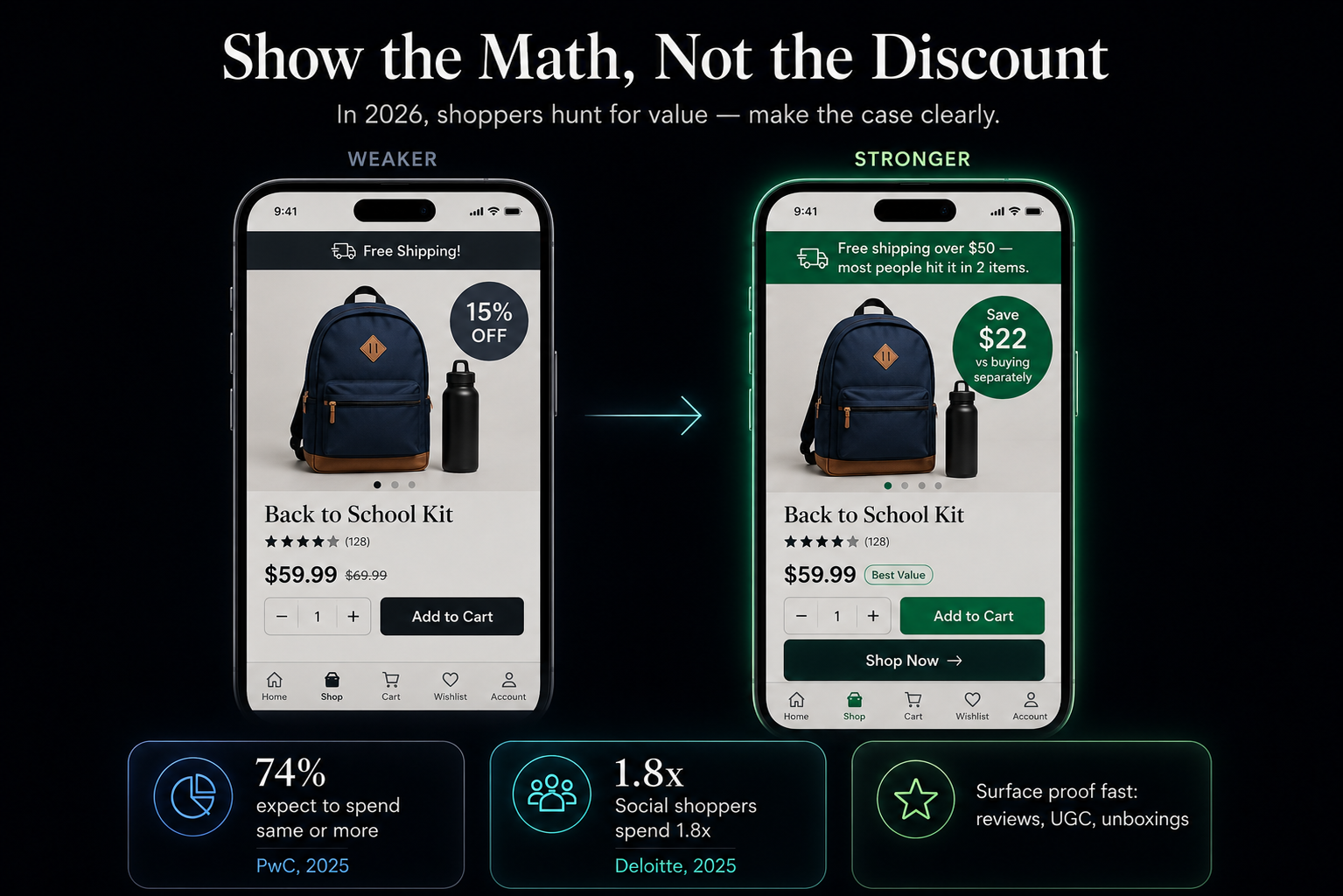
In 2026, families are not splurging. Nearly three in four back-to-school shoppers expect to spend the same or more as last year, but they're actively hunting for value (PwC, 2025). This means they're comparison shopping, stacking deals, and choosing brands that make the value case clearly.
"Value messaging" doesn't mean leading with the discount. It means showing the math. A bundle that saves $22 compared to buying items separately is more compelling framed as "save $22" than as "15% off." A free shipping threshold communicated as "free shipping on orders over $50, most people hit it in two items" is more actionable than a banner that says "Free Shipping!"
According to Deloitte's 2025 Back-to-School Survey, parents who plan to use social media in their shopping journey spend 1.8x compared to non-social shoppers. That's the audience that's actively seeking value signals and social proof. For brands investing in social content this season, peer reviews, creator unboxings, and UGC showing real products in real back-to-school contexts outperform polished brand ads because they're trusted as genuine cost-benefit signals.
The tactical implication: make sure your highest-converting social posts and reviews are surfaced prominently on your campaign landing pages. Shoppers aren't arriving from paid ads and converting on the first scroll. They're arriving, scanning for proof, and converting only if they find it quickly.
The brands that win back-to-school aren't necessarily the ones with the biggest ad budgets. They're the ones that started earlier, segmented better, and showed up in owned channels with messages that felt personal and timely rather than seasonal and generic. The calendar is the same every year, but the window to do this differently is right now. Plan the rest of your year with our ecommerce holiday calendar.
Ready to see what a mobile app could do for your store's retention and seasonal campaign performance? Book a demo with Appbrew.
Frequently Asked Questions
When should I start my back-to-school marketing campaign?
Earlier than you think. Awareness and list-building should start in May or June. Your main promotional push should launch in early July to capture the 67% of shoppers who have already started buying by the first week of July (NRF, 2025). An August-only campaign misses the most decisive portion of your target market.
Do back-to-school campaigns only work for brands selling school supplies?
No. Families spend across dozens of categories during this window: apparel, tech accessories, beauty and personal care, home goods, and more. Any Shopify brand with products that fit a parent or student's pre-September life has a legitimate angle. The key is framing the campaign around a customer moment ("getting ready for a new chapter") rather than a product category.
What's the most effective back-to-school marketing channel?
Email and push notifications deliver the best ROI for owned audiences because they're direct, segmentable, and measurable. Paid social is effective for acquisition, especially in May–June before CPMs spike. For peak conversion, the combination of a well-timed push notification (for app users) and a segmented email sequence consistently outperforms single-channel approaches.
How do I stand out when every brand is running a BTS sale?
Start earlier, segment harder, and lead with utility rather than discount. A curated bundle, a genuinely useful checklist, or an early-access drop targeted at your most loyal customers creates differentiation that a sitewide discount never can. Specificity, at the campaign level and the channel level, is what earns attention in a flooded inbox.
Should I target college students separately from K-12 families?
Yes. College students and their families plan to spend an average of $1,325.85 for the back-to-college season (NRF, 2025), compared to $858 for K-12. Their purchase drivers are different: independence, aesthetics, and dorm room setup over essentials. Messaging and product curation should reflect that difference.