

.webp)
.webp)
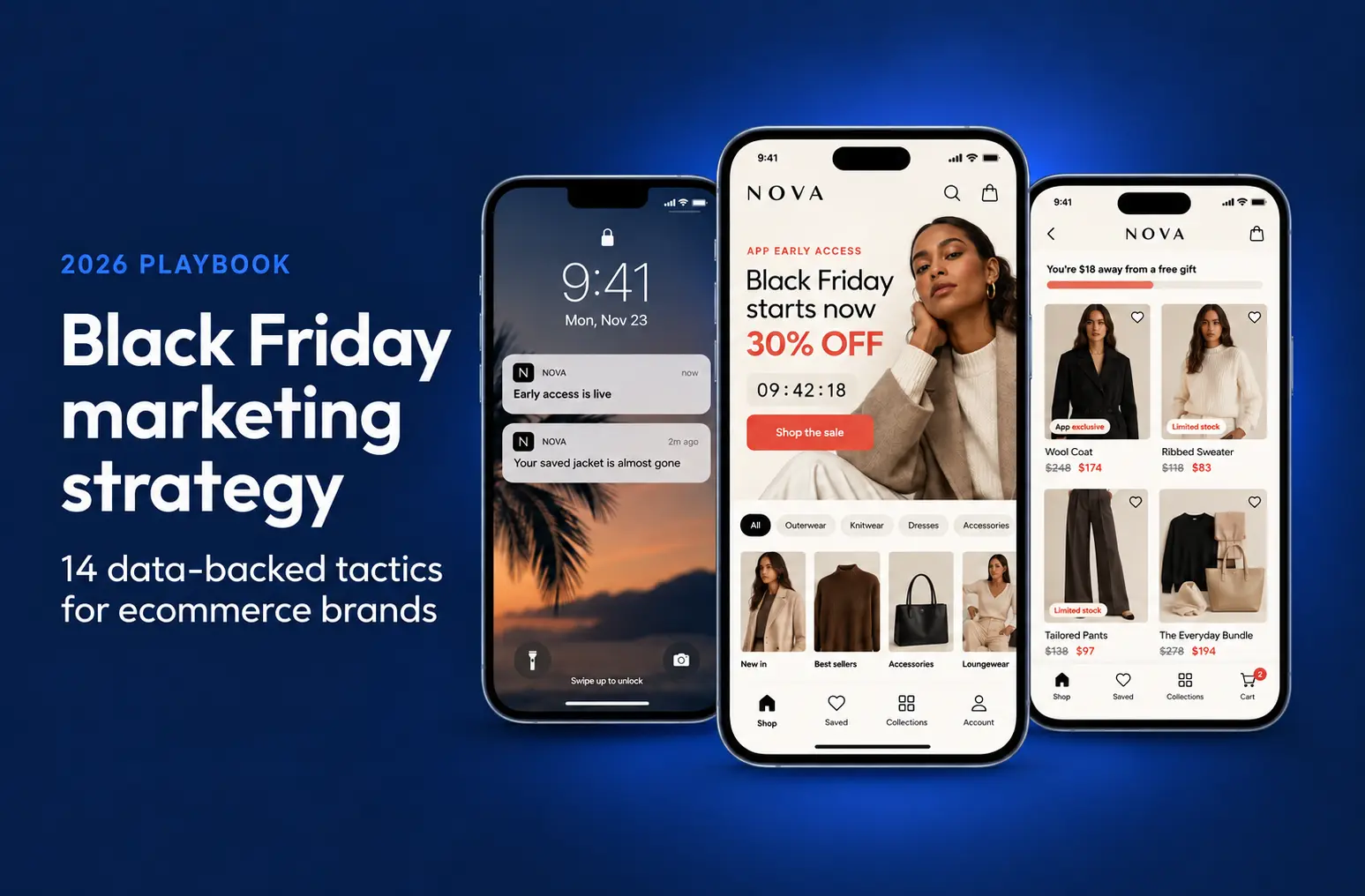
Build your profitable Black Friday marketing strategy for 2026 with 14 data-backed tactics for email, SMS, push, offers, mobile apps, paid ads, and retention.
|
A Black Friday marketing strategy is a coordinated plan for how an ecommerce brand attracts, converts, and retains customers across the Black Friday–Cyber Monday (BFCM) period. It spans owned channels (email, SMS, push notifications, and mobile app), paid media, offer structure, site readiness, and post-purchase retention, sequenced over the weeks before, during, and after the sale rather than executed as a single day-of push. |
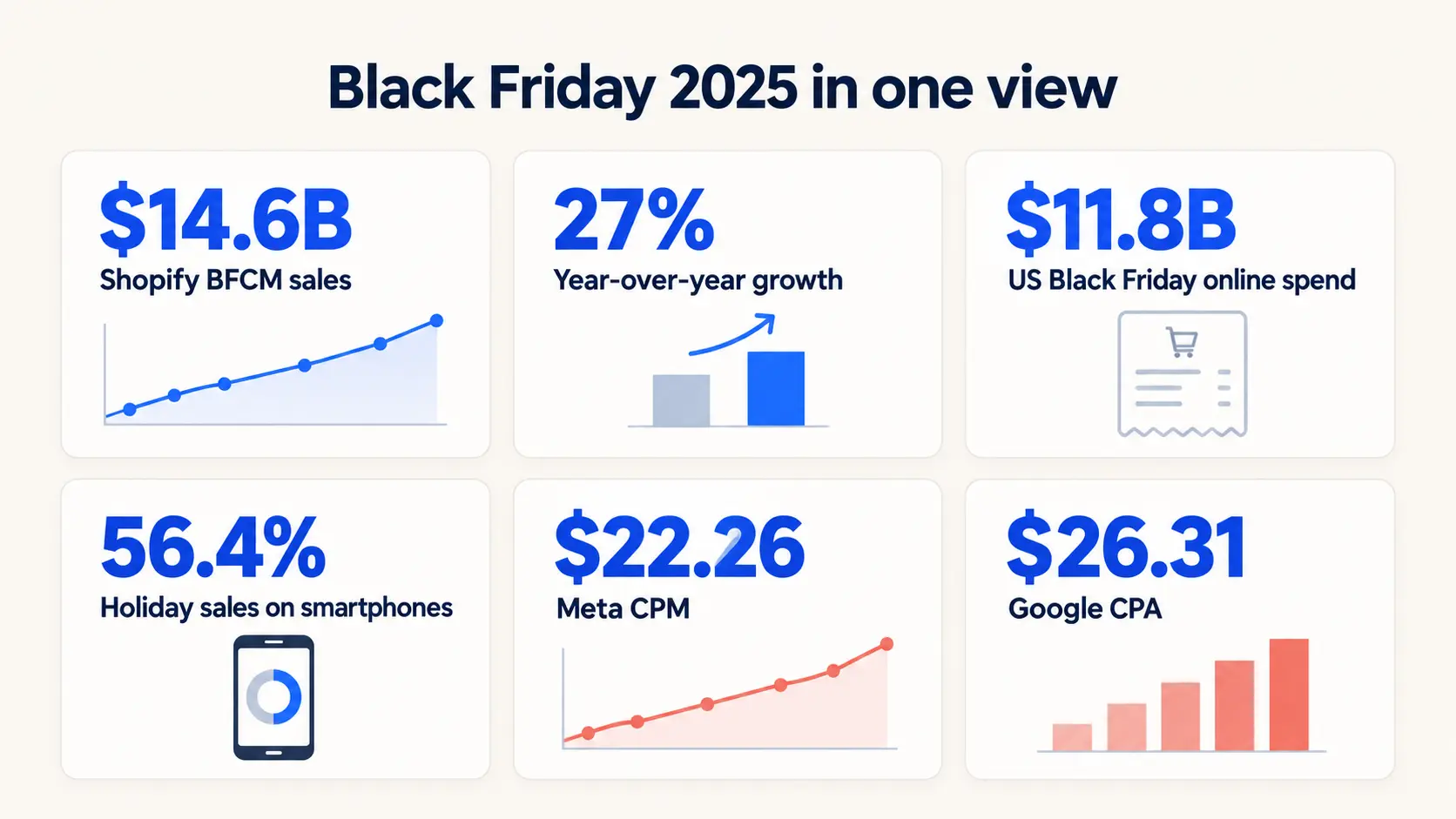
Do you know what your Black Friday marketing strategy is competing for? Shopify merchants generated a record $14.6 billion during BFCM 2025, up 27% from the previous year. More than 94,900 merchants had their biggest sales day ever.
That is a huge opportunity, but your customers also have more choices than they can possibly consider. Their inboxes are full, their phones are buzzing, and every brand is offering a discount. If your campaign starts on Black Friday morning, you are already late.
You need to reach customers before the rush, give them a clear reason to choose your offer, and make it easy to complete the purchase. That means planning your email, SMS, push notifications, paid ads, mobile app, offers, and checkout as one connected campaign.
This guide gives you 14 practical Black Friday marketing strategies for 2026. Each tactic includes clear steps and real BFCM 2025 data from Shopify, Adobe, and brands using Appbrew, so you can see what worked and decide what makes sense for your store.
New to BFCM as a concept? See our full breakdown of what BFCM means and why it matters.
Quick insights
- Owned channels become more valuable when ad costs peak. During Black Friday week in 2025, Meta CPMs reached $22.26 and Google CPA averaged $26.31. Build your email, SMS, and push audiences early so you do not have to pay peak prices for ads.
- Give your best customers early access. During peak BFCM 2025 windows, mobile apps generated 15% to 70% of daily sales for some Appbrew brands.
- Treat mobile as your main buying channel. App conversion rates reached 4% to 20%, compared with 1.5% to 3.5% on mobile web. App order values were also up to 40% to 50% higher.
- Start in August, not November. The brands that build owned audiences and segment their lists before the season capture demand without paying peak acquisition prices.
- Plan beyond Black Friday. Your strategy should cover the weeks before the sale, the move into Cyber Monday, and how you bring first-time buyers back afterward. Our US ecommerce holiday calendar shows how it fits with the rest of Q4.
Black Friday 2026 by the numbers
The 2025 results show what you are preparing for in 2026: more online spending, more mobile purchases, and more competition for paid traffic.
Shoppers are spending more
US shoppers spent a record $11.8 billion online on Black Friday 2025, up 9.1% from the previous year. Across the five days from Thanksgiving through Cyber Monday, online spending reached $44.2 billion.
Shopify merchants also had their biggest BFCM weekend yet:
|
2025 Shopify benchmark |
Result |
|
Total BFCM sales |
$14.6 billion |
|
Growth from 2024 |
27% |
|
Customers worldwide |
More than 81 million |
|
Merchants having their best sales day |
More than 94,900 |
|
Average cart price |
$114.70 |
|
Peak sales |
$5.1 million per minute |
Source: Shopify’s official 2025 BFCM report
The demand is clearly there. Your challenge is reaching those shoppers without spending too much to acquire each order.
Paid traffic became more expensive
Triple Whale tracked $2.9 billion in revenue, $607 million in advertising spend, and 26 million orders during BFCM 2025. Its data shows how quickly paid acquisition costs increased:
- Meta CPM reached $22.26, up about 7.8%.
- Google CPA reached $26.31, up 34.18%.
- Google ROAS fell 21.09% to 3.62.
Paid advertising can still produce strong returns. Google delivered the highest ROAS among the major platforms in Triple Whale’s analysis. But when acquisition costs rise this quickly, relying only on ads puts more pressure on your margins.
The practical move is to build your email, SMS, and push audiences before November. You can then use paid media to bring in new shoppers while your owned channels bring previous visitors and customers back.
Mobile is now the main shopping channel
Smartphones generated 56.4% of US online holiday sales in 2025.
But sending shoppers to a mobile website is not the same as giving them a strong mobile buying experience. Across Appbrew brands during BFCM 2025, mobile apps produced the following results:
|
Metric |
Mobile web |
Mobile app |
|
Conversion rate |
1.5% to 3.5% |
4% to 20% |
|
Average order value |
Baseline |
Up to 40% to 50% higher |
|
Push open rate during peak campaigns |
NA |
3.5% to 8.5% |
|
Share of daily sales during peak windows |
NA |
15% to 70% for app-focused brands |
Your customers are shopping on their phones while paid acquisition is getting more expensive. Your Black Friday plan should make mobile buying easy and give you direct ways to bring customers back without paying for every visit.
14 Black Friday marketing strategies and ideas in 2026
The following Black Friday marketing strategies are arranged in the order you should use them. They begin with audience building months before the sale and continue through Cyber Monday and post-purchase retention.
1. Start in August
If you only take one thing from this guide, take this: grow your email, SMS, and app audiences before November.
By Black Friday week, Meta CPMs and Google CPA are already high. If that's when you go looking for customers, you're paying the highest prices of the year to reach the same people your competitors are also bidding on.
So from late summer, run list growth like it matters:
- Put your capture forms and app-install prompts to work early, and offer early access instead of a one-time coupon.
- Favor channels you actually own. Email and SMS go with you anywhere. A mobile app gives you push on top, which is the only way to land on someone's lock screen without paying per message.
- Tag people as they come in (new vs. returning, what they browsed) so your November campaigns are already segmented and ready to fire.
Do this and everything else in this guide gets cheaper and works better, because you're activating an audience you already own.
2. Bundle products and set spend thresholds to lift order value
Your Black Friday offer should encourage customers to buy more, not simply pay less.
The average apparel discount on Black Friday 2025 fell to around 24% off, a low point, as names like Coach, Nike, and Levi's deliberately pulled back from deep discounting to protect brand value.
- Build two or three bundles around your best sellers, priced so the savings versus buying separately are obvious at a glance.
- Add spend thresholds. "Spend $75, get free shipping. Spend $150, get a free gift." That nudges cart size up without cutting into your core prices.
- Feature bundles on your app home screen and in early-access push.
One US intimates brand built its holiday offers around bundles and saw 41% higher AOV on app than web during BFCM 2025 (Appbrew brand data).
3. Segment your owned channels
Do not send the same Black Friday message to everyone. Someone who purchased last week should not receive the same message as someone who has never ordered from you.
Segmentation helps you match the offer to what each customer already knows, wants, or has purchased.
Start With these five segments
|
Segment |
Who belongs here |
What to send |
|
VIP and repeat customers |
Customers with multiple orders or high lifetime value |
Early access, loyalty rewards, and first choice of limited products |
|
Recent browsers and cart abandoners |
People who viewed a product or left it in their cart |
The exact products they considered, along with availability and the relevant offer |
|
Subscribers who have never purchased |
Email subscribers with no order history |
Your clearest offer, bestselling products, reviews, and an easy first purchase |
|
Lapsed customers |
Previous customers who have not ordered recently |
A win-back message based on what they bought before |
|
Recent customers |
People who purchased shortly before the sale |
Complementary products, a gift offer, or an exclusion from discounts on items they just bought |
4. Sequence your Black Friday sends
Each send should have a different purpose. Start by building interest, announce the offer clearly, follow up based on customer behavior, and save your strongest urgency for the real deadline.
- Teaser (1 week out): tell people something is coming, build the list.
- Early access (Thanksgiving): let VIPs and app users in first.
- Launch (Black Friday morning): the main event, clear offer, one call to action.
- Reminder (Black Friday night): "ends tonight" to the people who opened but didn't buy.
- Last chance (Cyber Monday): final push, real deadline.
Every channel below runs on this same segmentation and sequence. What changes is what each channel does best.
5. Add SMS to the mix
Email inboxes are a warzone on Black Friday. SMS lands in a place people actually check, and for time-sensitive moments it converts hard. Klaviyo brands drove over $100M in SMS-attributed GMV during BFCM 2025, up more than 20% year over year.
Don't overuse it. One or two well-timed texts outperform a stream of them, and they keep you off the unsubscribe list.
6. Use push notifications to reach past the inbox
If you have a mobile app, push is your highest-value owned channel during BFCM.
During BFCM 2025 flash drops and early-access windows, Appbrew brands saw push open rates of 3.5% to 8.5%, while email open rates sank under the holiday load.
One US pet care brand leaned on app push for its flash drops and its app converted at roughly twice its normal baseline during the sale (Appbrew brand data).
How to use it well:
- Save push for moments that matter: early access opening, a restock, a countdown ending. Don't spam.
- Segment the same way you do email. An abandoned-cart push beats a generic "sale is live" blast.
If you are not sure which channel to use for each message, read our comparison of push notifications vs. SMS.
7. Gate app-exclusive early access
Early access is the single best reason for a customer to install your app, and app installs pay you back all year, not just on Black Friday.
In peak early-access windows during BFCM 2025, Groove Life used app early access as a core part of its BFCM play and saw +11.1% app AOV vs web, 9.5% app conversion, 6.7% push open rate.(Appbrew brand data)
- Open the sale to app users 24 hours early. Make the exclusivity real, not cosmetic.
- Promote the app install hard in the weeks before, with early access as the hook: "Download the app for first access to Black Friday."
{{cta}}
8. Get your store and product pages ready
Before you drive a single visitor, make sure your store can take the traffic and convert it, because on Black Friday every second and every dead click costs you orders.
Run this check in early November:
- Speed: test your site under load. Your store needs to hold up on its own busiest day.
- Product pages: make sure stock, pricing, and offer badges are clear and correct. Confusion kills conversion.
- Checkout: strip out every extra step. Offer express and one-tap payment options.
- Exit-intent and abandoned cart: set up a pop-up to catch leavers and an automated flow to recover carts. A big share of Black Friday carts get abandoned, and the recovery flow is often the cheapest sale you'll make.
9. Add a little gamification
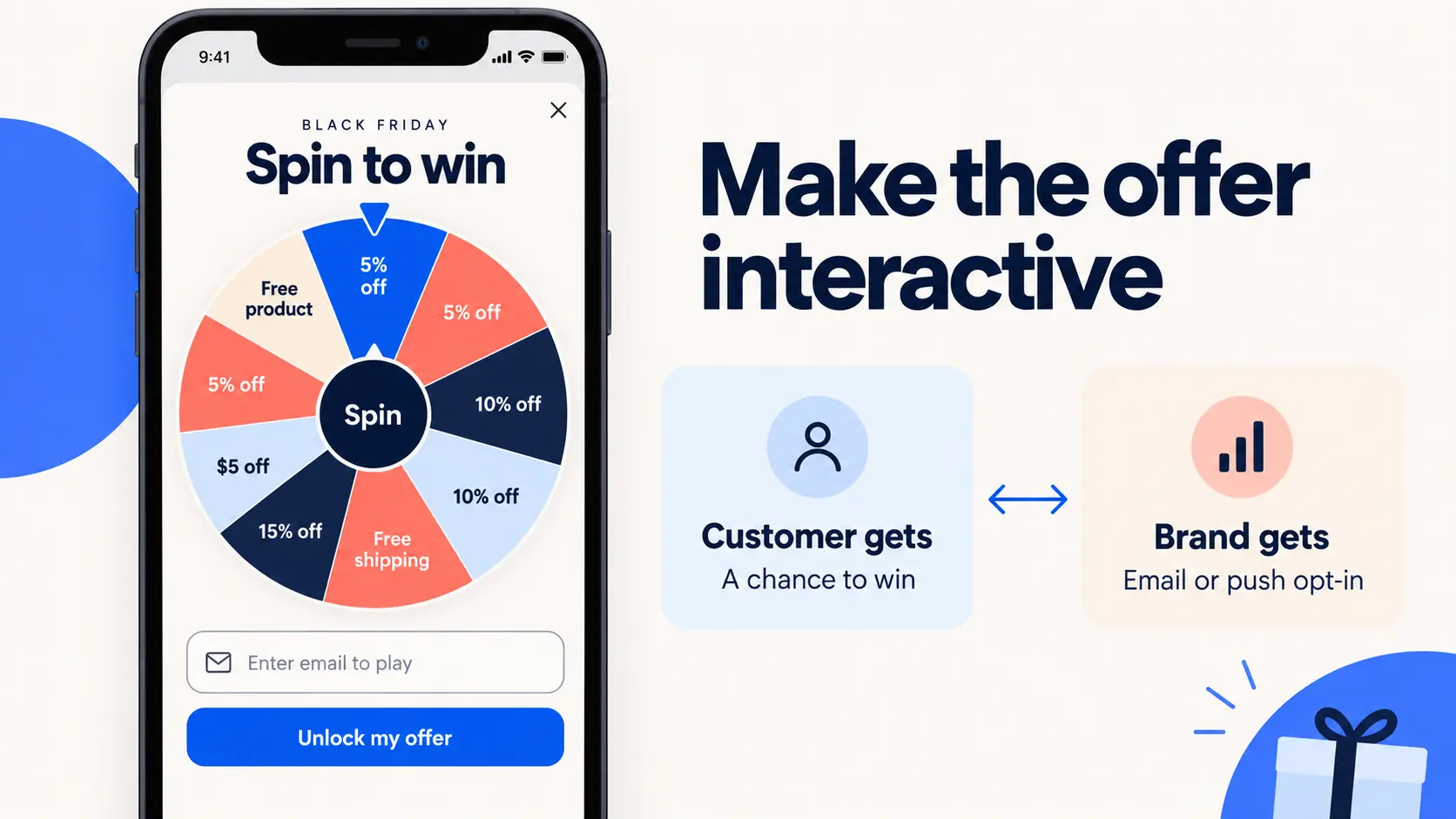
A spin-to-win wheel or a mystery deal turns a passive sale into something people want to interact with, and it captures emails and app installs at the same time. It works because it makes the discount feel earned instead of expected.
10. Turn on social commerce
Your customers are on their phones on Black Friday, and a lot of them are on social media before they ever reach your site.
Meet them there with content that sells, not just posts that announce.
Cover the three angles:
- Organic: post your deals where your audience already follows you, and make the offer and link obvious.
- Paid: yes, CPMs are high, but paid social still works for retargeting warm audiences who didn't convert. Aim to spend at people who already know you.
- Influencer and UGC: creator content and real customer posts carry more trust than a brand ad during the noisiest sale week of the year.
Point all of it at your highest-converting destination. If you have an app, drive social traffic to the install and early access, not just the website.
11. Reward loyalty and VIPs
Your repeat customers already cost you nothing to reach and convert better than anyone. Black Friday is when you should treat them best.
Give them a reason to feel like insiders:
- Layer VIP perks on top of the sale: double loyalty points, an extra discount tier, or a free gift for members only.
- Open early access to your loyalty members alongside app users.
12. Build gift guides
A huge share of Black Friday spending is gifts, and shoppers are often buying for someone else with no idea what to pick. A gift guide does the deciding for them and quietly raises your order value while it does.
- Curate guides by recipient ("for him," "for her," "under $50") or by use case.
- Feature bundles and higher-margin products, not just your cheapest items.
- Put the guides front and center: email, app home screen, and a pinned collection on your site.
Gift guides also earn their keep in search. People look for them by name every November, so a well-titled guide can pull in traffic on its own.
13. Use countdown timers and real urgency
Urgency works on Black Friday because the deadline is real. A countdown timer makes that deadline impossible to ignore and pushes fence-sitters to act before the offer is gone.
Keep it honest. Fake scarcity gets noticed and costs you trust. Real deadlines and real stock levels are enough.
14. Deep-link every ad, email, and push
Sending someone to your home screen during a sale is throwing away the click. Every link you send should drop the shopper exactly on the product, collection, or offer it promised, in one tap.
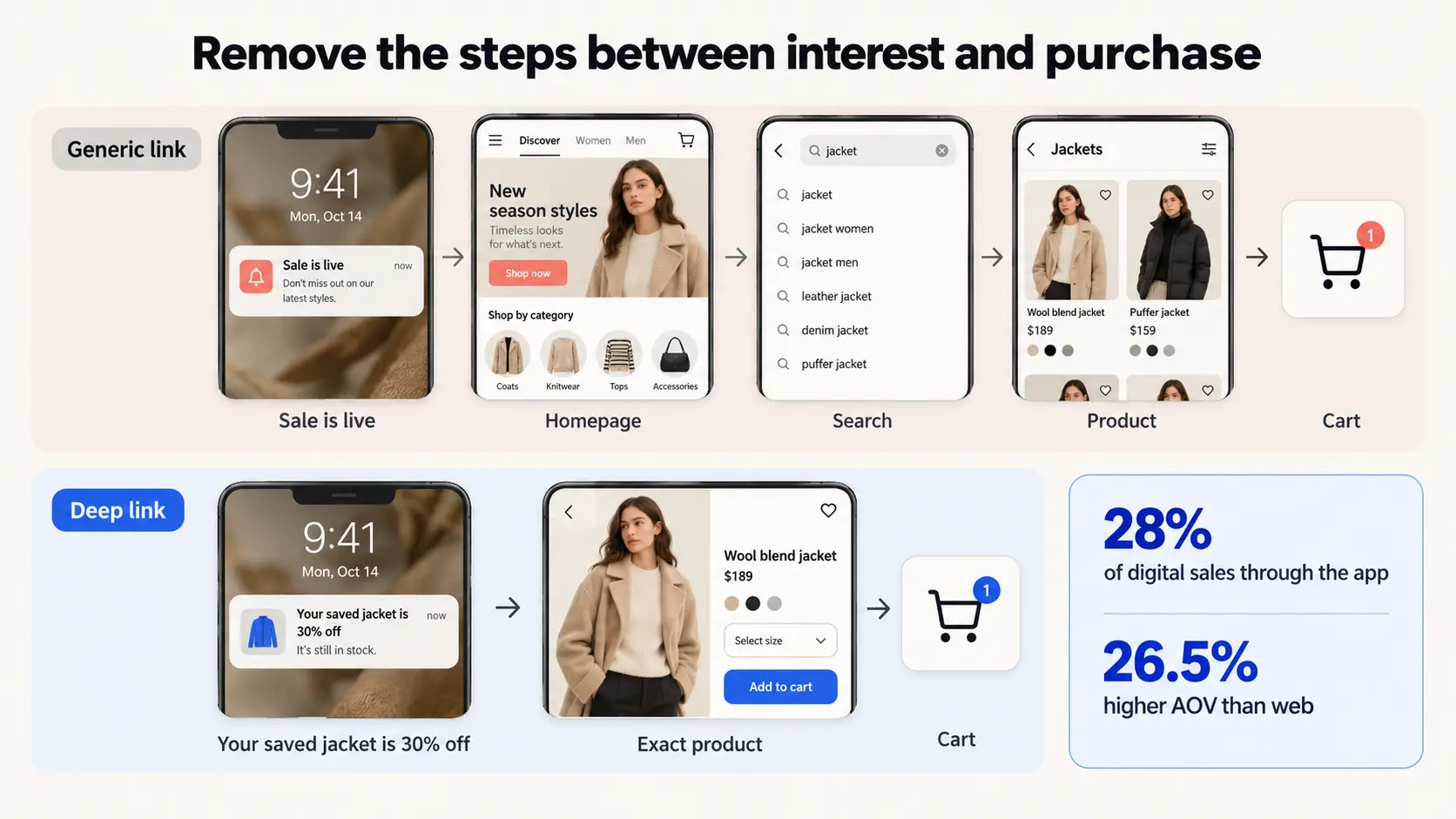
This matters most where intent is highest. One US baby apparel brand deep-linked its BFCM campaigns into the app and drove about 28% of its digital sales through the app, with 26.5% higher AOV than web (Appbrew brand data).
Black Friday marketing calendar for 2026
The brands that win Black Friday start in August. BFCM is a quarterly build, and the work you do in late summer is what makes November actually pay off.
Here's the month-by-month plan, working back from Black Friday 2026 on November 27.
|
Timeframe |
Focus |
Key actions |
|
August |
Strategy and offer design |
Finalize discount tiers, design bundles, audit app readiness, review last year's BFCM data |
|
September |
List and channel building |
Launch push opt-in flows, segment email into VIP / lapsed / new, create an early-access signup page |
|
October |
Teaser and audience warm-up |
Start teaser campaigns, set up Shopify Flow automations, build retargeting audiences, launch a pre-BF waitlist |
|
First half of November |
Warm-up sends and previews |
Send VIP preview emails, push early-access sneak peeks, load retargeting pixels, test checkout flows |
|
Black Friday week |
Full execution |
Day-by-day push and email, ad budget monitoring, inventory tracking, real-time CS coverage |
|
Cyber Monday |
Real-time optimization |
Use BF data to adjust CM offers, re-segment by BF purchase behavior |
Your Black Friday day-of execution checklist
You've done the prep. Now it's about running the day cleanly and reacting fast. Here's how to work Black Friday hour by hour so nothing slips when it matters most.
Early morning (before the rush)
- Confirm your sale is live everywhere: site banner, app, email, and ads all showing the same offer.
- Send your Black Friday launch email and push. Lead with one clear offer and one call to action.
- Do a live test purchase end to end. Catch broken links, wrong prices, or checkout errors before customers do.
Midday (peak traffic)
- Watch site speed and uptime. If pages slow under load, get your dev or platform support on it immediately.
- Monitor stock on hero products. Update or swap featured items before anything sells out and dead-ends a shopper.
- Check which offers and channels are converting, and shift ad spend toward what's working. Don't keep funding a flat campaign.
Evening (the second wave)
- Send your "ends tonight" reminder to people who opened but didn't buy. This send often rivals the morning one.
- Fire a matching push for the same urgency beat, deep-linked to the offer.
- Keep an eye on abandoned carts and make sure your recovery flow is firing.
Throughout the day
- Keep support staffed and fast. A quick answer on Black Friday is the difference between a sale and a refund.
- Track revenue by channel in real time so you know where the day is actually coming from.
- Note what's working. Tomorrow's Cyber Monday plan should be built on today's data, not last week's guesses.
Black Friday campaign examples to learn from
The best way to plan your own campaign is to see what's worked for others. Here are recognizable brand campaigns worth stealing from, plus real results from brands running on Appbrew.
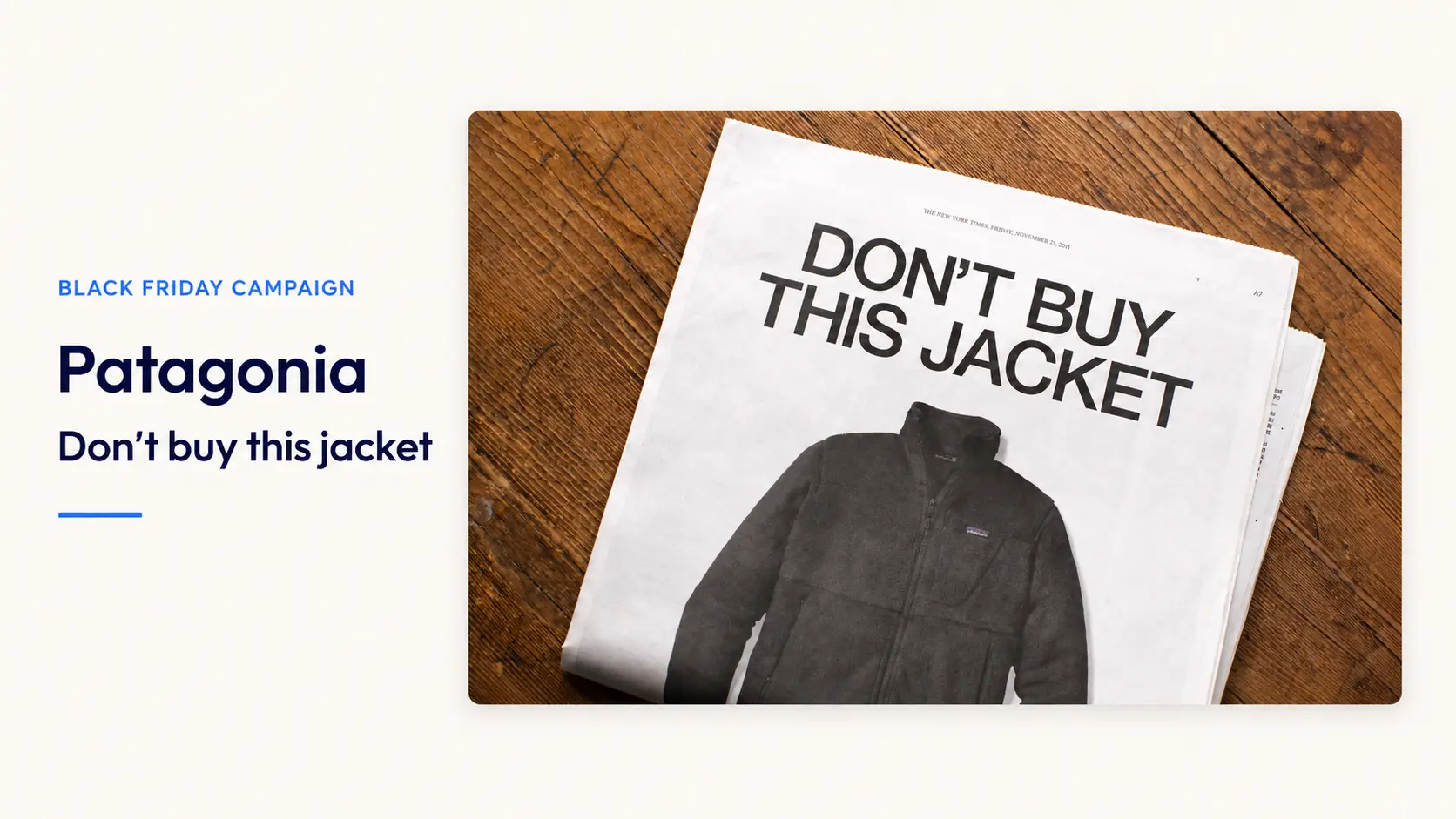
Patagonia's "Don't Buy This Jacket.
Patagonia ran a full-page New York Times ad on Black Friday telling people not to buy its jacket, detailing the environmental cost of production. The anti-sale became one of the most famous campaigns in retail history, and sales still rose about 30% the following year.
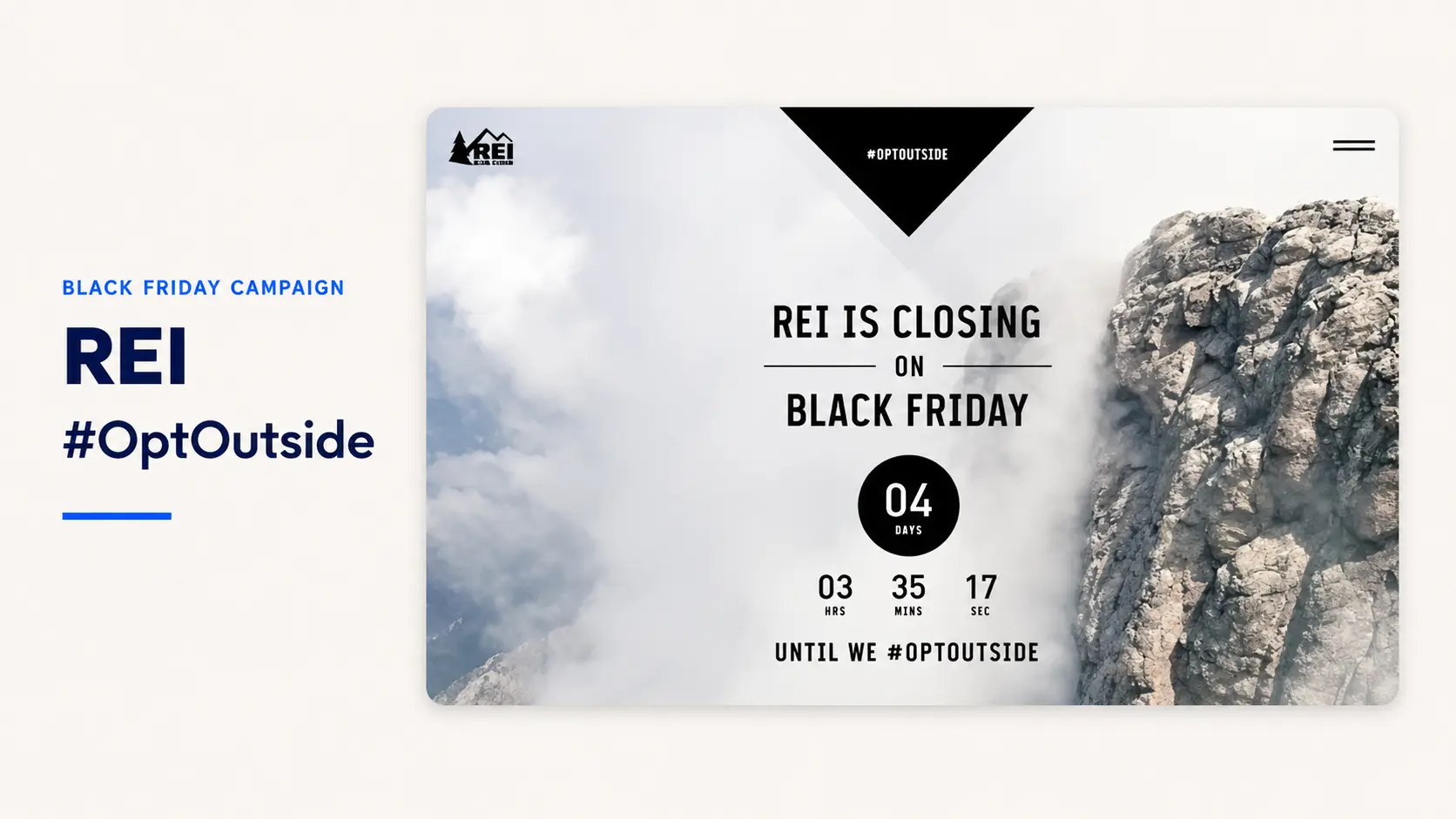
REI's #OptOutside.
REI closed its stores on Black Friday and paid staff to spend the day outdoors. The move earned huge press and goodwill and is now an annual signature.
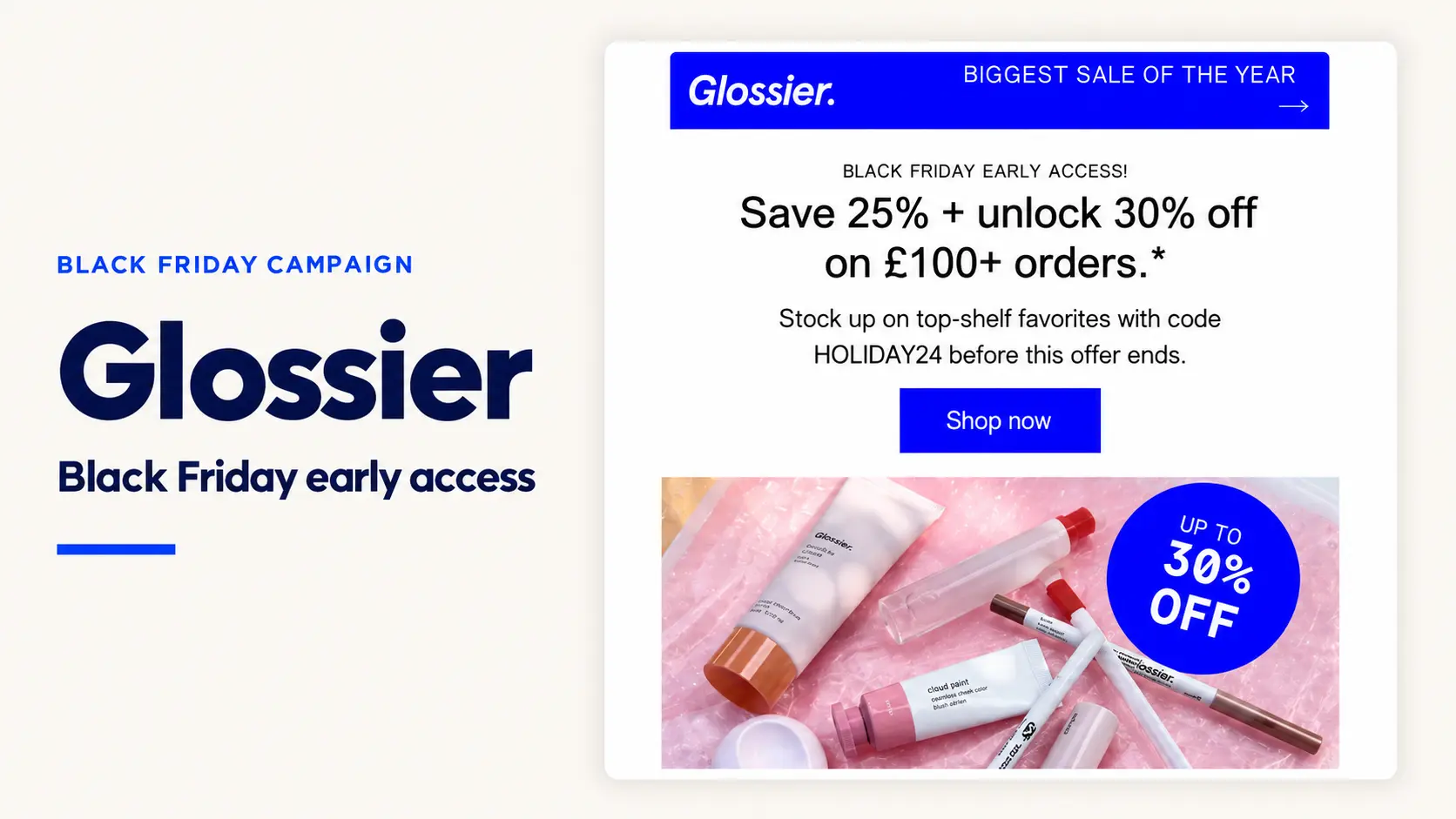
Glossier's "Pink Friday."
Glossier renamed the day in its signature pink, ran its only sale of the year to create scarcity, and gave VIP "Friends of Glossier" members early access with a members-only code. It stood out by looking unmistakably like Glossier.
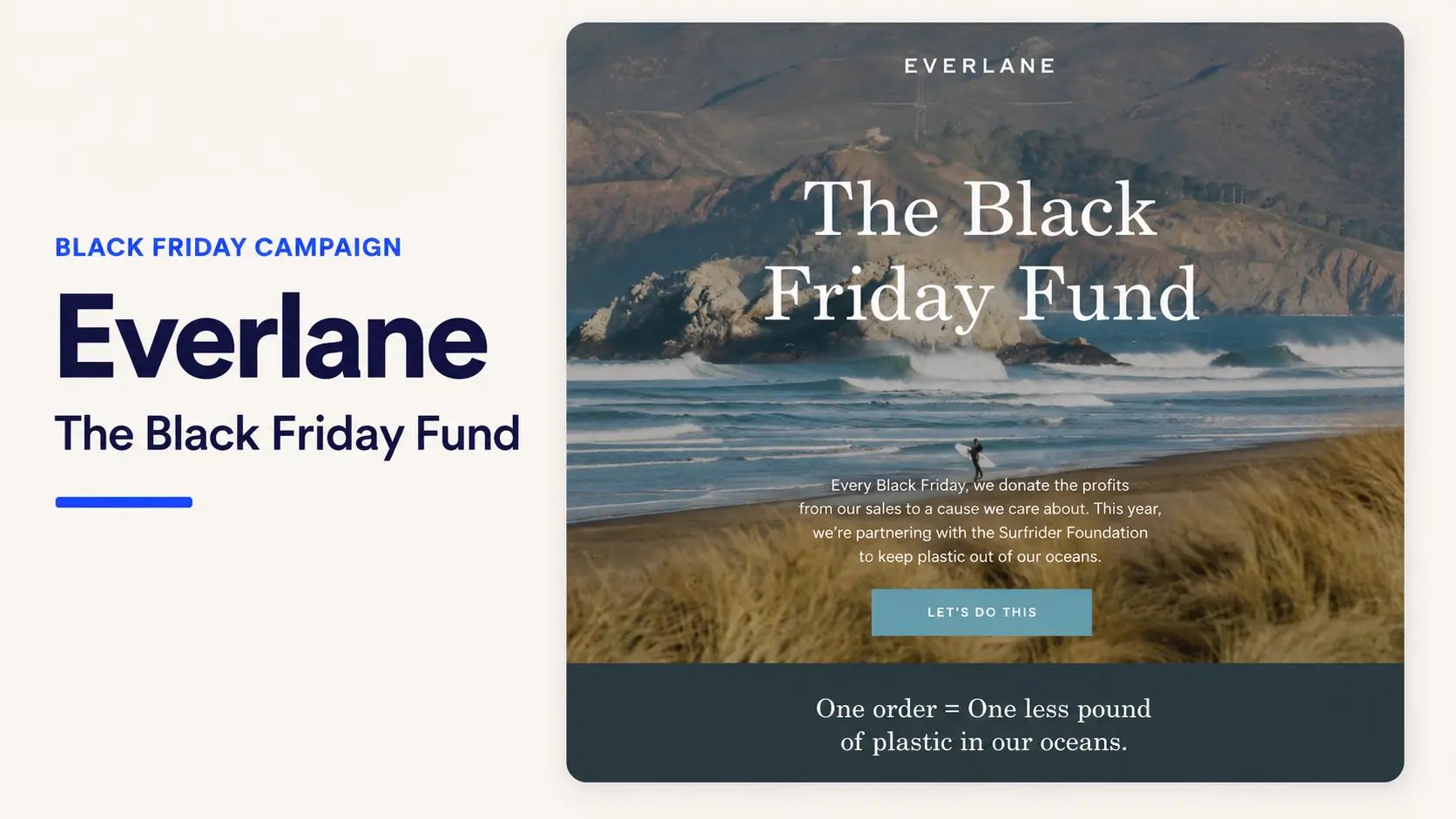
Everlane's Black Friday Fund.
Everlane tied Black Friday purchases to a cause, giving shoppers a reason to feel good about buying. It lands especially well in the Thanksgiving window when people are already thinking about giving back.
Apple's gift-card approach.
Rather than discount its products, Apple gives a store gift card with qualifying purchases during its Black Friday event. It drives sales without ever cutting the price or cheapening the brand.

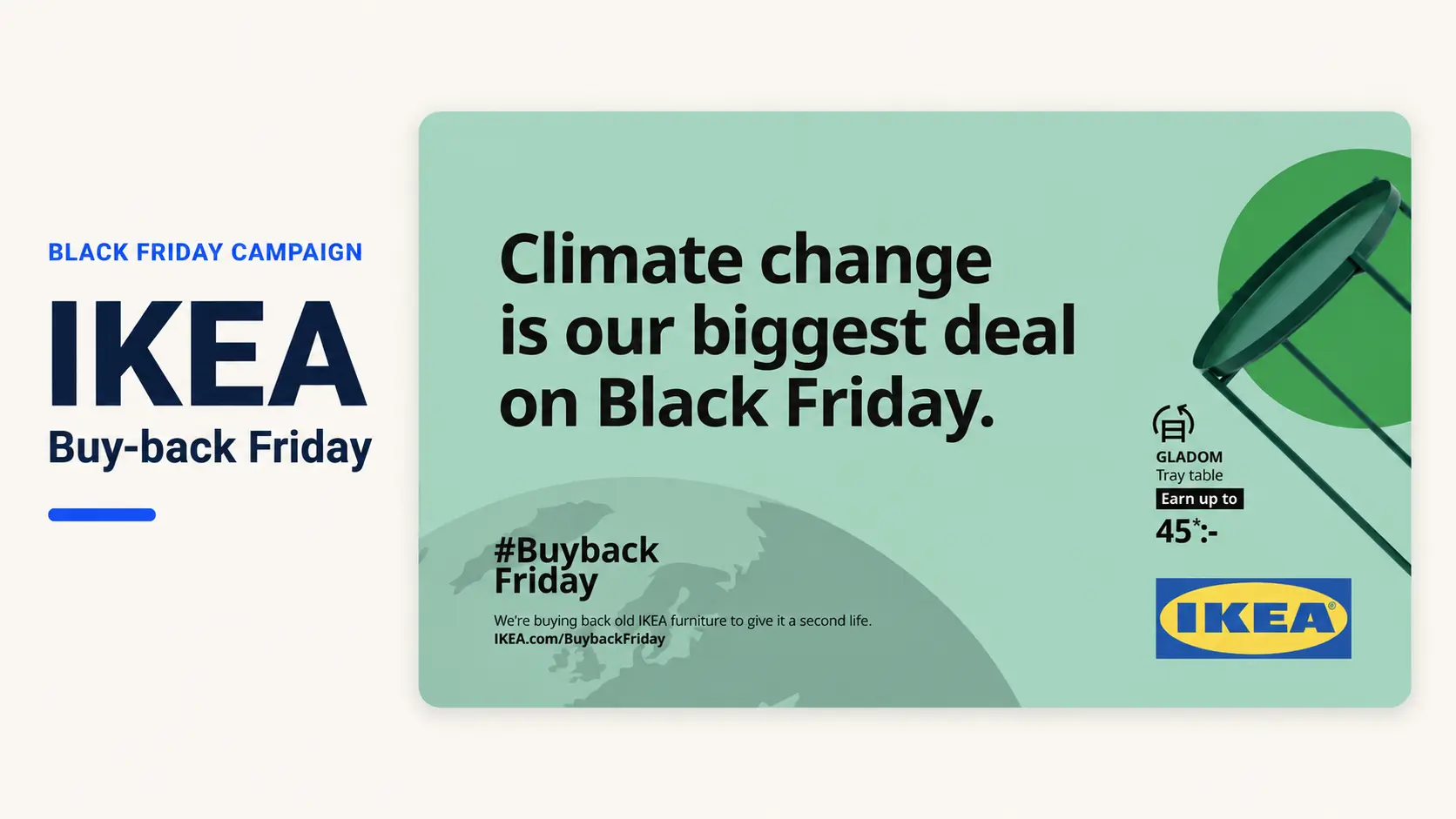
IKEA's "Buy-Back Friday."
IKEA invited customers to sell back used furniture for store credit, then resold it through its As-Is section. Around 55,000 products came back for resale under the program, turning Black Friday into a sustainability play.
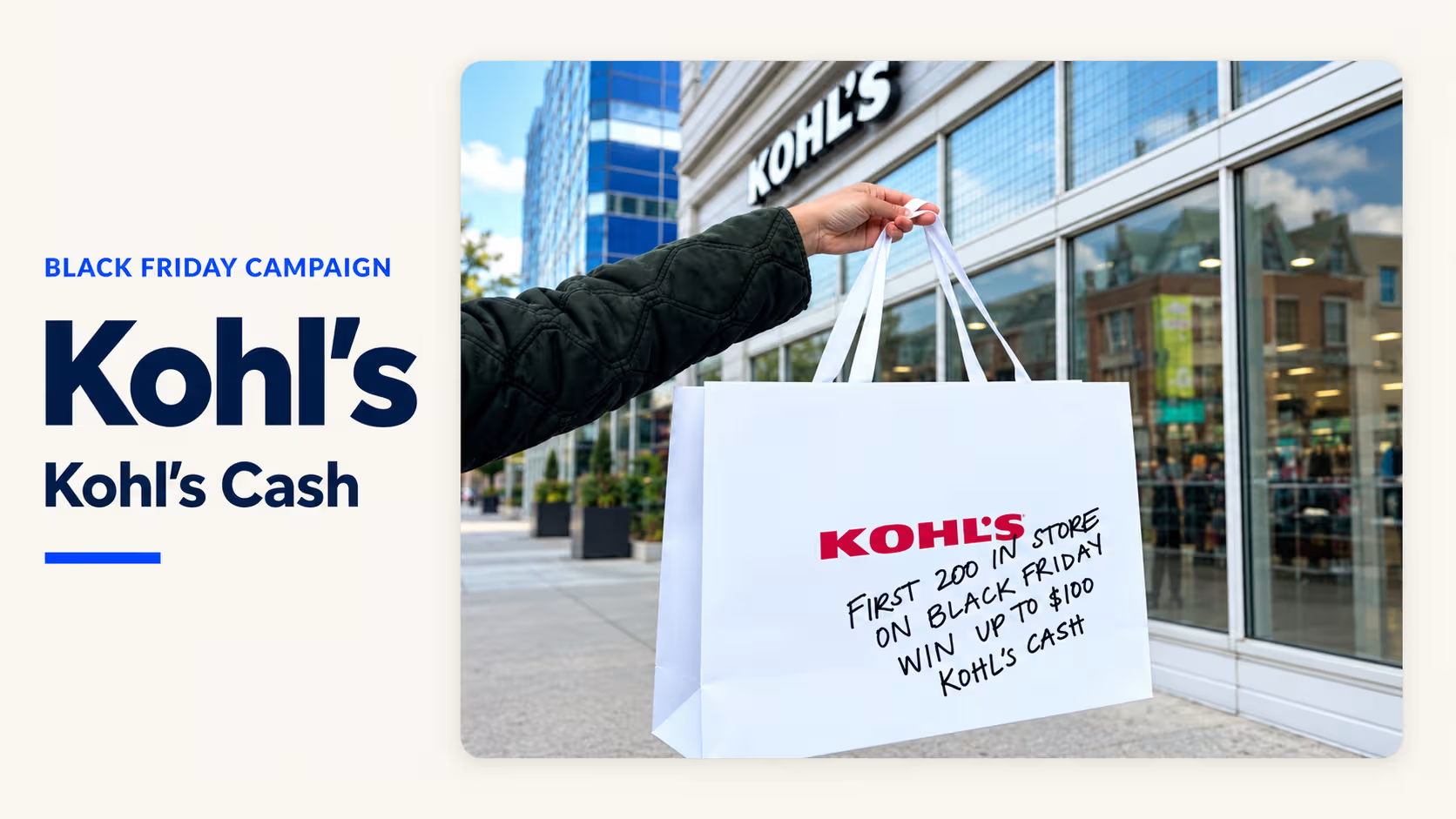
Kohl's Cash.
Instead of a one-time markdown, Kohl's rewarded Black Friday purchases with store credit to spend later, pulling shoppers back for a second trip.
The lesson across all of these: a campaign with a point of view, whether it's a cause, a reward, or a twist on the format, cuts through the noise better than one more "50% off" banner.
What worked on Appbrew during BFCM 2025
The recognizable-name playbook works, but so does a quieter one: making your mobile app the center of the weekend. Three brands show how far that goes.
Felina, the intimates and loungewear brand you'll find in Nordstrom, Macy's, and Costco, built its BFCM around gift-with-purchase and bundles surfaced right on the app home screen and cart. The result was 40% to 60% higher average order value on app than web, and app conversion running 2x to 4x its site.
Bailey's CBD, a well-known pet wellness brand, made its app the core channel for holiday drops and VIP offers. During the peak BFCM weekend, the app drove about 70% of total revenue, up from a roughly 10% baseline, with a 67% lift in conversion and 22% higher AOV than web.
Anatomie, a luxury travel apparel brand, ran an app-exclusive 30% off early-access sale the weekend before its site-wide launch, using QR codes to pull shoppers into the app before the rush.
The thread runs through this whole guide: the app shopper is the high-intent shopper, and the brands that pull customers into that channel before.
From Black Friday to Cyber Monday
Friday night isn't the finish line. Cyber Monday is a second sales peak three days later, and your Black Friday data is what lets you make the most of it.
By Monday you know who bought, who browsed and left, and which offers worked. Put that to use:
- Re-target Black Friday browsers who didn't buy with the exact products they looked at.
- Give Black Friday buyers a different message. Thank them, then cross-sell what goes with their order.
- Refresh the offer so Monday feels new. A different hero product or category keeps people interested.
- Lead your Monday sends with a real deadline. It's the last call of the weekend, and shoppers know it.
Cyber Monday has its own tactics worth planning separately. See our full guide to Cyber Monday marketing strategy for the deeper playbook.
How to measure your Black Friday performance
You can't improve what you don't track, and Black Friday generates enough data to sharpen every campaign that follows.
Track these during the sale
- Revenue by channel. Know how much is coming from email, SMS, push, paid, and organic as it happens, so you can shift budget toward whatever's working.
- Conversion rate by channel and segment. Watch how app compares to web, and how your VIP segment compares to new visitors. Big gaps tell you where to push.
- Average order value. If it's dropping, your bundles or thresholds aren't pulling their weight and you can adjust the offer mid-sale.
- Site speed and cart abandonment. A spike in abandonment often means a technical problem, not a pricing one. Catch it fast.
Track these metrics during the campaign
|
Metric |
What to look for |
|
Revenue by channel |
Compare email, SMS, push, paid search, paid social, organic, direct, website, and app revenue. |
|
Conversion rate |
Find gaps between devices, channels, customer segments, and landing pages. |
|
Average order value |
Check whether bundles, gifts, and spending thresholds are increasing cart size. |
|
Cost per acquisition |
Watch how much you are paying for each new customer as advertising costs change. |
|
Return on ad spend |
Shift paid budget toward campaigns that produce profitable revenue. |
|
Cart abandonment |
A sudden increase can point to a checkout, payment, shipping, or discount problem. |
|
Inventory |
Watch sell-through rates for featured products and replace sold-out items quickly. |
|
Support volume |
Repeated questions can reveal unclear terms or technical problems. |
Review these after BFCM
- Channel ROI. Which channels drove profitable revenue, not just clicks? Owned channels like push and email almost always beat paid on cost per order.
- New vs. returning revenue. How much came from customers you already had versus new ones you paid to acquire? This tells you whether your pre-season list building paid off.
- Discount depth vs. margin. Add up what the discounts actually cost you against the revenue they drove. Deep markdowns can hide thin or negative margins.
- App installs and push opt-ins gained. These are the assets you keep. Every install and opt-in from BFCM is an audience you can reach for free all next year.
The last point matters most. A single Black Friday is a spike, but the email subscribers, app installs, and push opt-ins you collect are what compound. Measure them, then move those new customers into post-purchase and win-back flows in December so a one-weekend buyer becomes a repeat one.
{{cta2}}
FAQs
What push notification tactics work for a Shopify store in 2026?
Save push for urgent moments (early access, restocks, "ends tonight"), segment like you do email, and deep-link every send to the product, not the home screen. Appbrew brands saw 3.5% to 8.5% push open rates on these sends during BFCM 2025.
How do you create an effective Black Friday marketing plan?
Work backward from Black Friday across three phases: list building (Aug–Oct), the sale (Thanksgiving–Cyber Monday), and retention (December). Lock offers early, sequence your sends, and test your site before traffic hits.
When is the best time to send Black Friday emails?
Send a sequence: teaser a week out, early access on Thanksgiving, launch Friday morning, "ends tonight" that evening, last chance on Cyber Monday. The evening reminder often matches the morning launch, so don't skip it.
Which platforms increase ecommerce revenue during Black Friday?
The ones you own: email, SMS, and app push. They cost almost nothing per send while paid hits peak prices. App was the standout for Appbrew brands in BFCM 2025, converting at 4% to 20% versus 1.5% to 3.5% on mobile web.
Is Black Friday still worth it, or is it a dying trend?
It's still growing. Black Friday drove a record $11.8B in US online revenue in 2025, up 9.1% from 2024, and Cyber Monday hit a record $14.25B. What's changing is how brands win: less on deep discounts, more on owned channels and smart offers.
What sells the most on Black Friday?
Electronics, toys, and apparel lead every year, but the biggest gains go to brands that bundle high-margin products and push gift-guide purchases rather than discounting single items.