


.webp)
Learn how to increase Shopify sales with CRO, mobile optimization, upsells, retention, push notifications, and owned channels.
Most Shopify stores don't have a traffic problem. They have a conversion problem, a retention problem, and a channel problem that no amount of additional ad spend will fix on its own. The average Shopify store converts at just 1.4%, according to LittleData's benchmark research, while the top 10% of stores convert at 4.7% or higher. That gap doesn't come from better products or bigger budgets, but instead from a sequence of structural decisions that compound over time.
This guide is written for Shopify merchants who are already getting traffic and want to understand which levers actually move revenue, in what order, and why. It covers everything from mobile conversion and product page optimization to cart recovery, owned channels, and customer retention, before arriving at traffic acquisition last.
TL;DR
- Increasing Shopify sales in 2026 is less about driving more traffic and more about improving conversion rate, retention, mobile UX, and owned-channel performance.
- The highest-performing Shopify brands focus first on mobile optimization, since mobile traffic dominates ecommerce but converts significantly worse than desktop.
- High-impact Shopify CRO improvements include Shop Pay, faster mobile load times, simplified checkout flows, sticky CTAs, and transparent shipping information.
- Product pages should function as conversion-focused sales tools, using strong visuals, benefit-led copy, social proof, and shipping transparency to reduce hesitation.
- Upsells, cross-sells, and free shipping thresholds are some of the fastest ways to increase average order value without additional acquisition spend.
- Abandoned cart recovery works best through a multi-channel approach combining push notifications, email, and SMS sequences.
- Shopify brands with strong owned channels like email, SMS, and app push notifications are less dependent on rising Meta and Google ad costs.
- The most profitable ecommerce brands prioritize retention and repeat purchases, since retaining customers costs significantly less than reacquiring them through paid ads.
Know Where You Stand
Before changing anything, you need an accurate baseline. According to LittleData's ecommerce conversion benchmarks, the average Shopify store converts at 1.4%, a rate above 3.2% puts you in the top 20% of Shopify merchants, and above 4.7% places you in the top 10%. Separately, Shopify's own data puts the 2.5–3% range as the benchmark for strong performance, with the top 10% sitting comfortably above it.
This means that if your store is below 1%, something fundamental is probably broken. Between 1% and 2.5%, you're in normal territory with clear headroom to optimize and above 3%, you're outperforming most of your peers, and the marginal gains come from compounding, not rebuilding.
Diagnose Your Store Performance
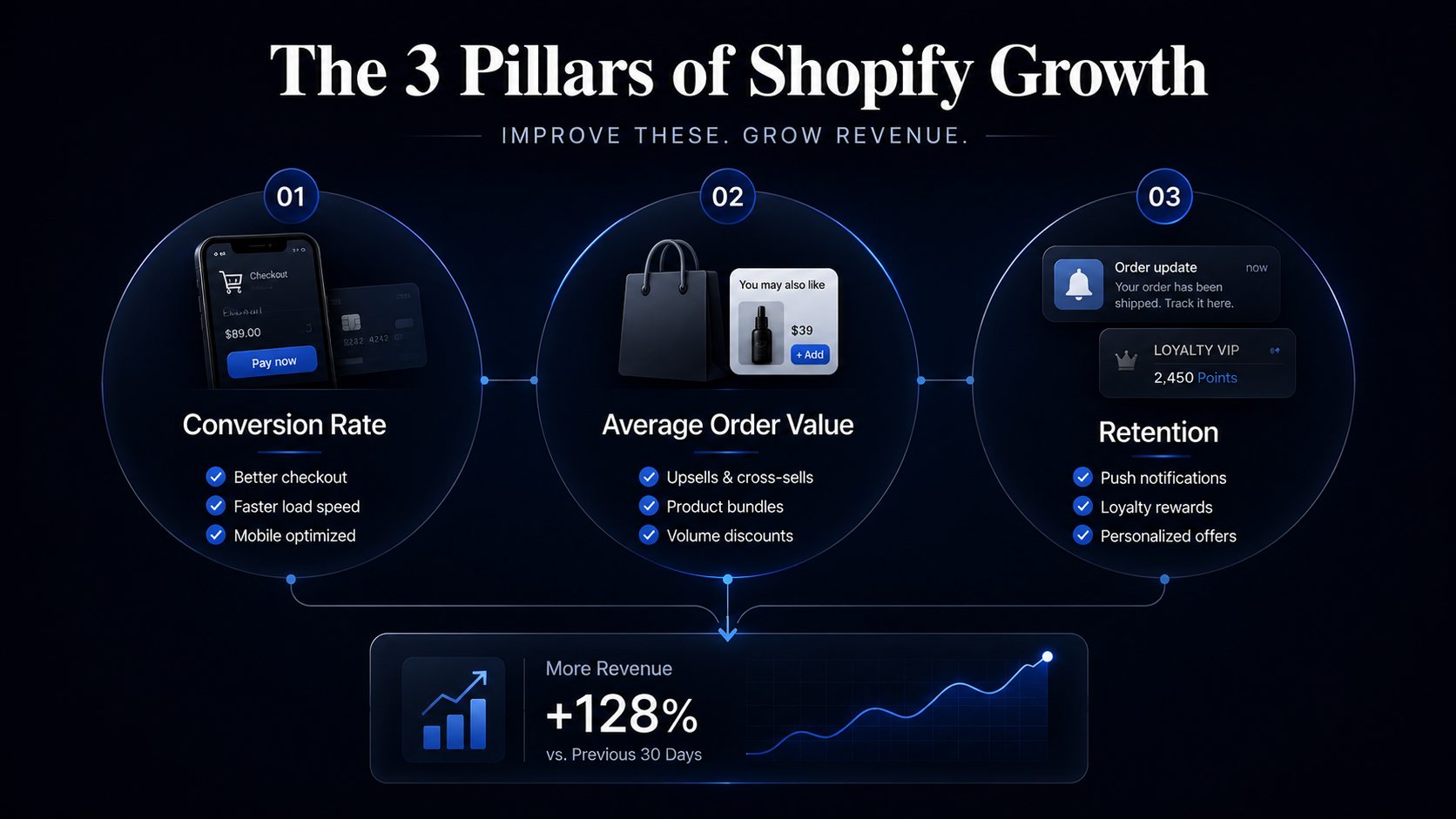
The three levers for growing Shopify revenue are distinct and should be diagnosed separately. The first is conversion rate: are you turning existing traffic into buyers efficiently? The second is average order value: is each transaction generating as much revenue as it could? The third is retention: are customers coming back without you having to pay to reacquire them?
Most stores that feel stuck have a primary leak in one of these three areas at least, and the most common mistake is treating them all the same way, typically by spending more on traffic when the real issue is conversion or retention.
To self-diagnose before reading further, pull your mobile CVR versus desktop CVR in Shopify Analytics. If mobile is significantly below 1.2%, the mobile experience is your biggest leak. If AOV is low relative to your catalogue depth, upsells and cross-sells are likely underperforming.
If your returning customer rate is below 25–30%, retention is costing you more than you realize. The section that addresses your weakest number is where to start. Once you know what to fix, select a Shopify app that will help you do that. You can check out our list of the best apps to improve your Shopify conversions for further details.
Fix Mobile First
Mobile devices account for over 85% of all traffic to Shopify stores, yet the average mobile conversion rate is 1.2% compared to 1.9% on desktop, according to LittleData's device-level benchmarks. That 0.7 percentage point gap looks small in isolation, but applied to a store with 1,000,000 monthly mobile sessions, it represents the difference between 12,000 and 19,000 mobile orders per month at zero incremental acquisition cost.
On an annualized basis, that's 84,000 transactions you were already paying to attract and simply failing to capture.
Mobile cart abandonment compounds this further. Shopify's CRO statistics show mobile cart abandonment at 85.65%, compared to 73.76% on desktop, a 12-point gap that is almost entirely attributable to UX friction rather than purchase intent. These shoppers aren't disinterested in your product, but they're hitting invisible walls preventing them from converting.
The three highest-ROI fixes are payment simplification, page speed, and checkout flow. Enabling Shop Pay alone can increase conversion rates by up to 50% compared to standard guest checkout, as per industry data cited by Shopify, because it eliminates manual card entry entirely through a network of over 100 million stored users. Adding Apple Pay and Google Pay alongside it delivers an additional 3–5% lift for mobile users, according to Eevy AI's 2026 benchmark data.
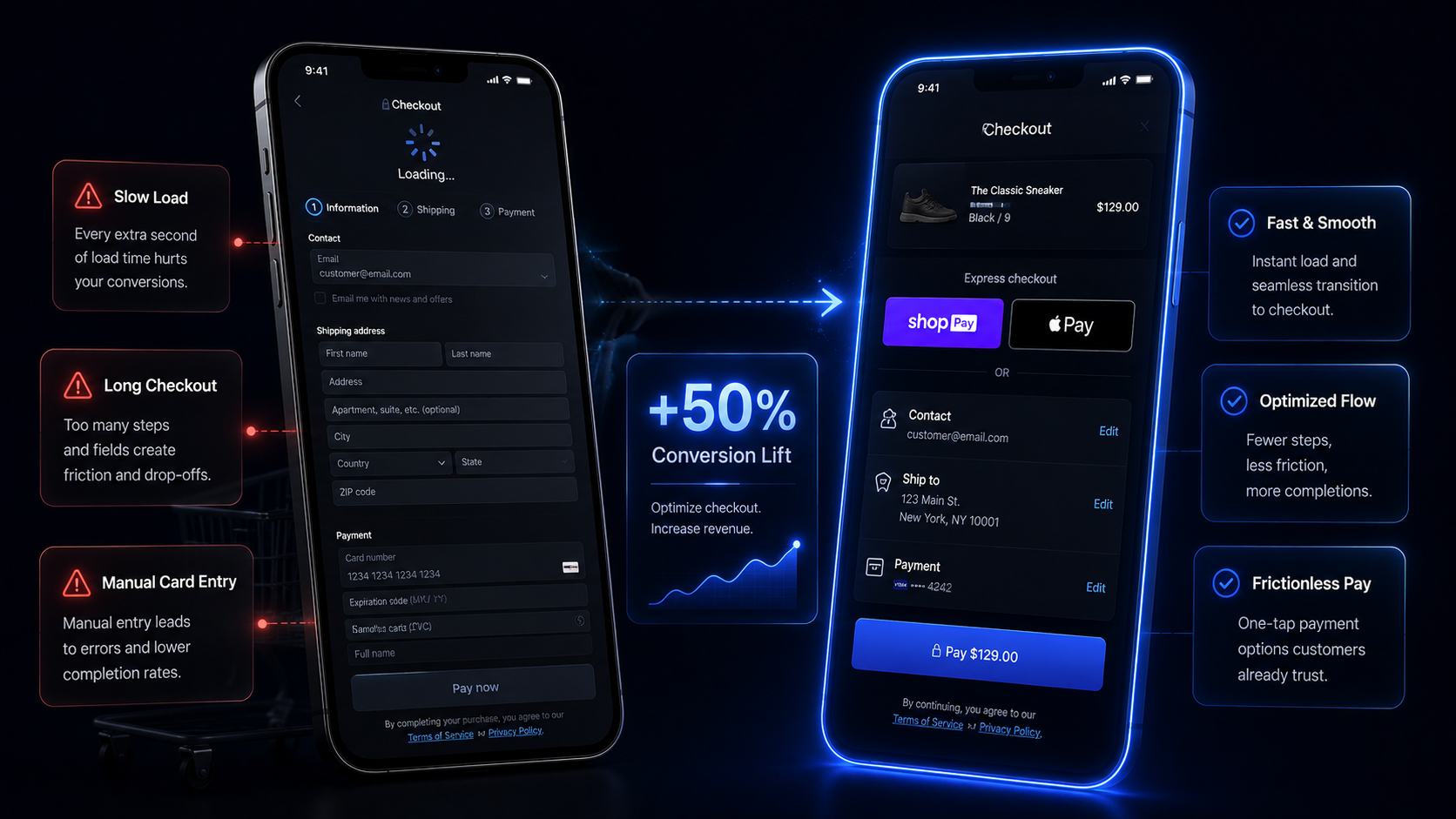
On the speed side, Shopify's research shows that every one-second delay in mobile load time translates to around a 20% drop in conversions. Checkout itself has an ideal flow of 12–14 form elements, with the average Shopify store having significantly more. For merchants who want to go further than mobile web optimization can take them, a native app is the next step.
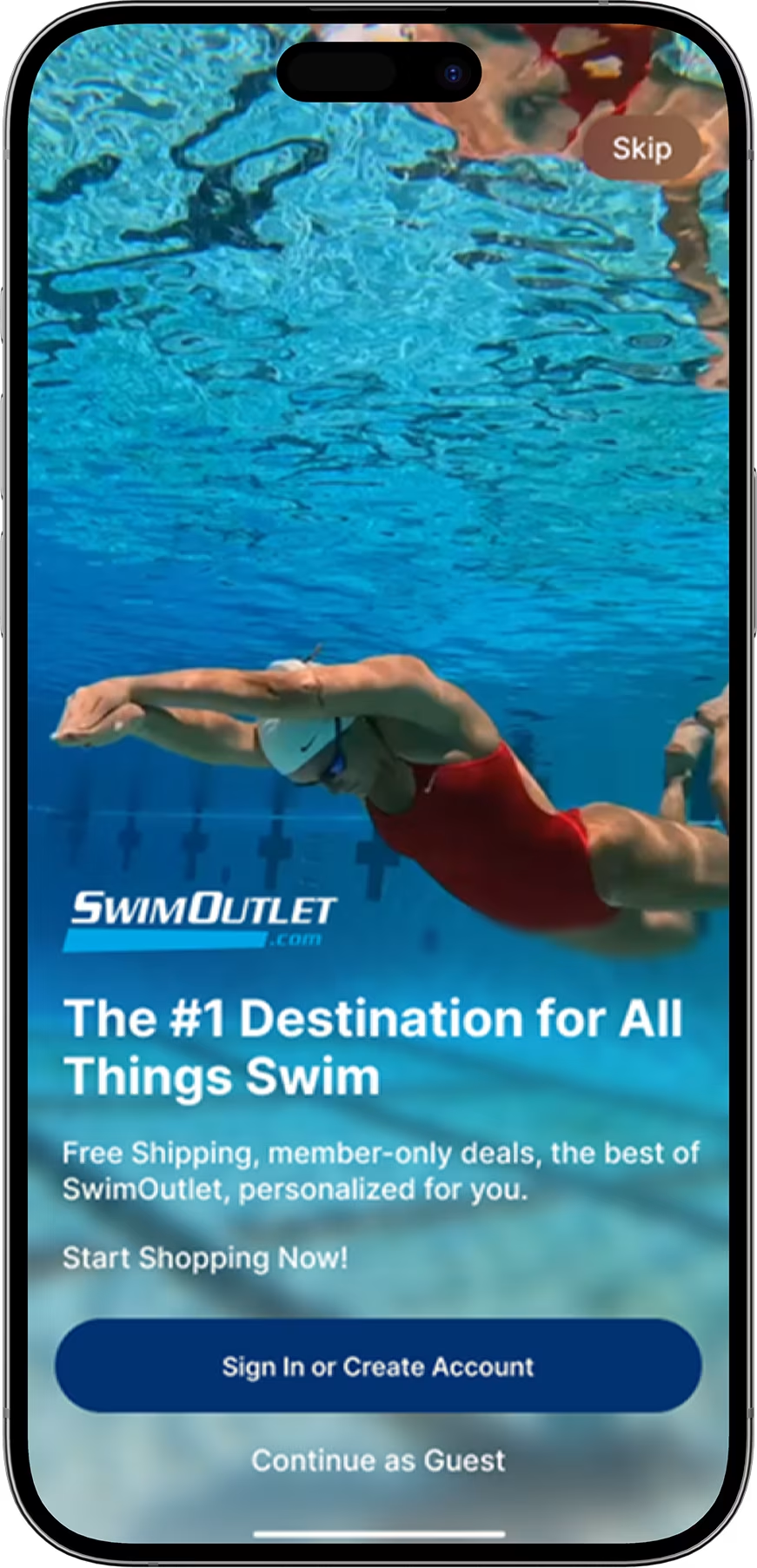
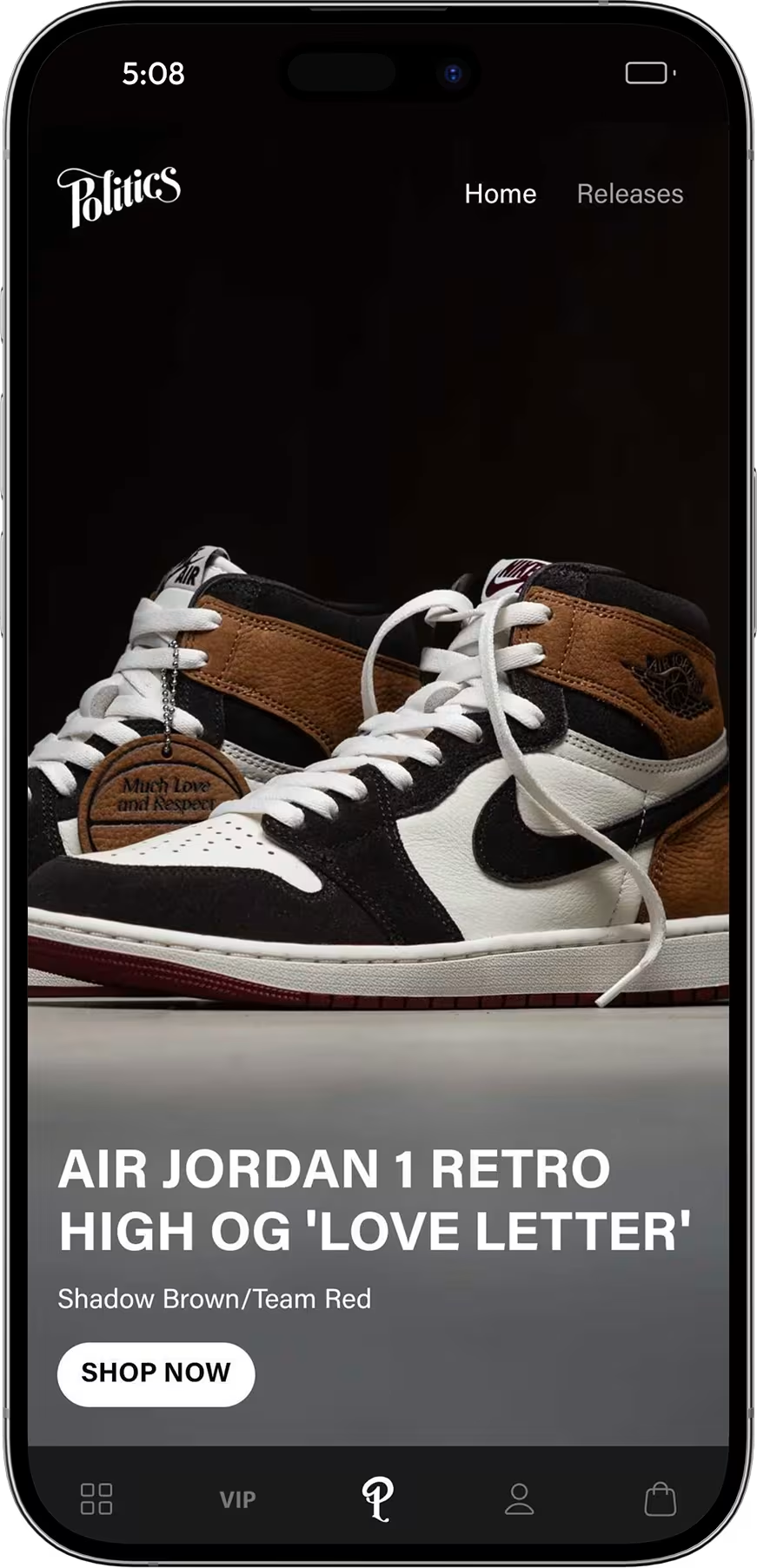
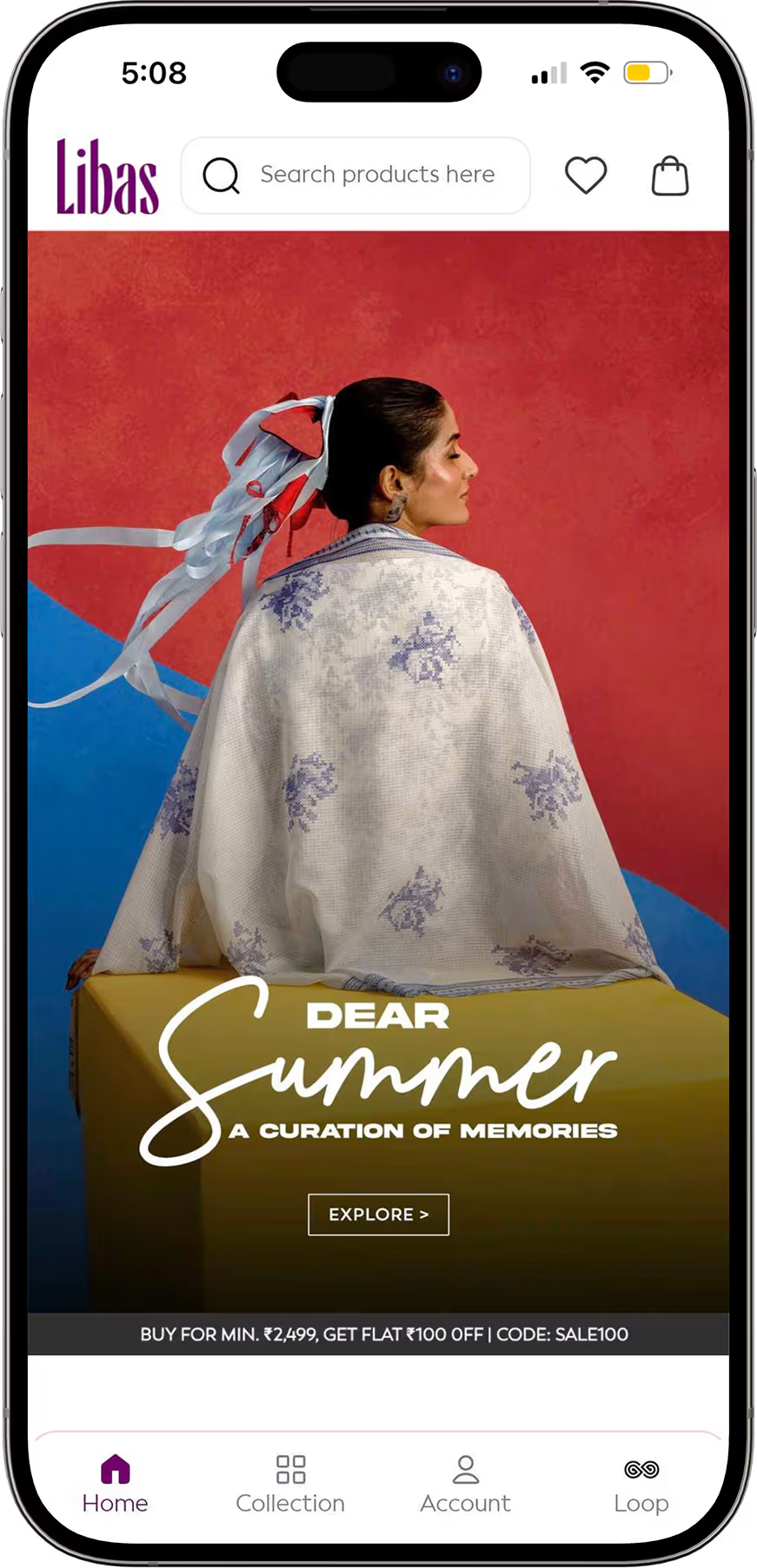
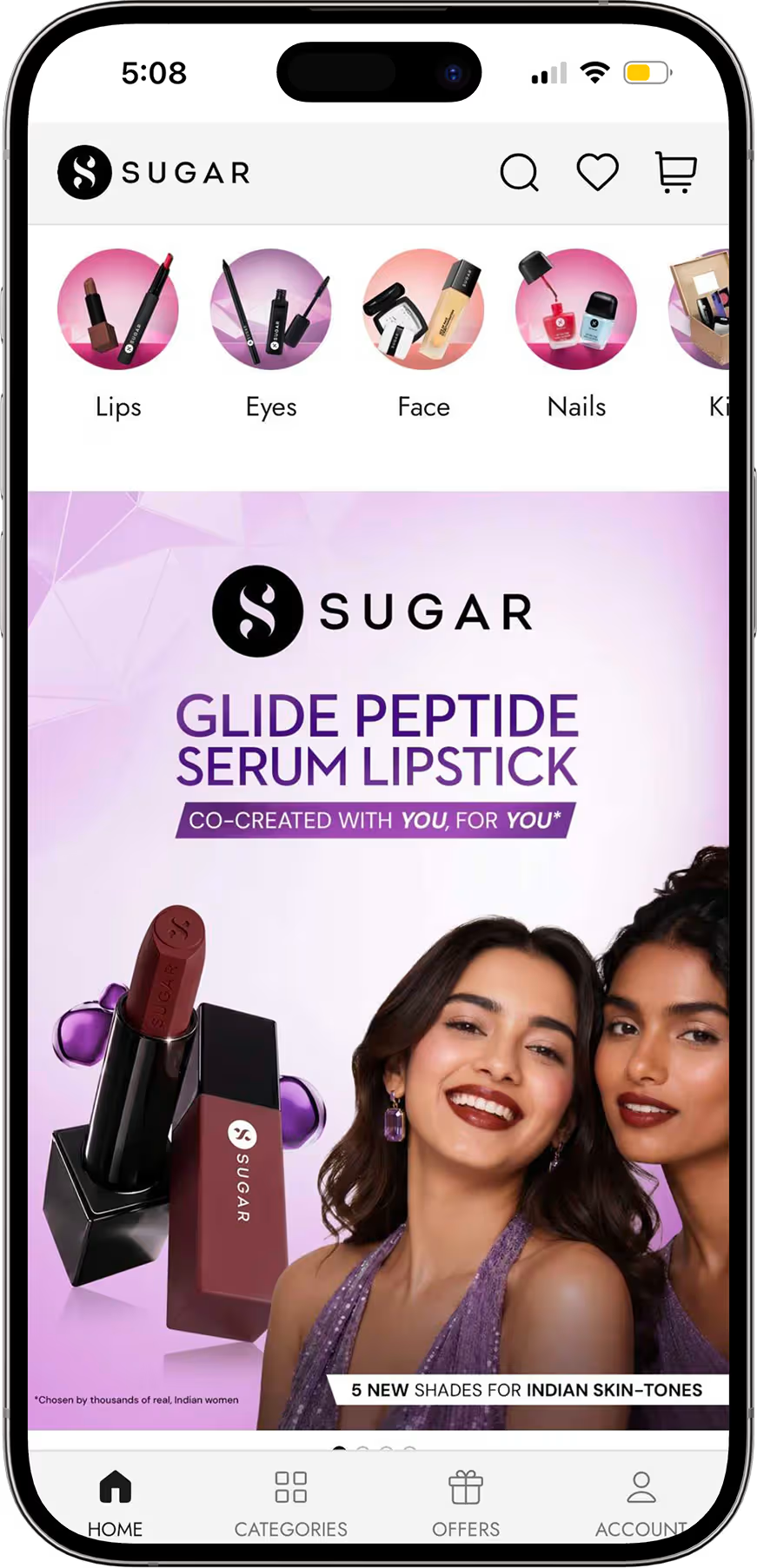
Apps bypass browser friction entirely, maintain a persistent presence on the customer's home screen, and deliver push notifications that mobile web simply cannot. Across Appbrew's client portfolio of Shopify brands, app CVR consistently and materially outperforms mobile web CVR. The gap is large enough that optimizing a Shopify store for mobile, without addressing the app question, leaves a meaningful portion of that upside on the table.
Turn Product Pages Into Closing Tools
It’s 2026, but most Shopify product pages still function as decade-old catalogues, rather than powerful sales tools. Displaying one product image and flashing the price tag isn’t enough to convert shoppers, you need a lot more:
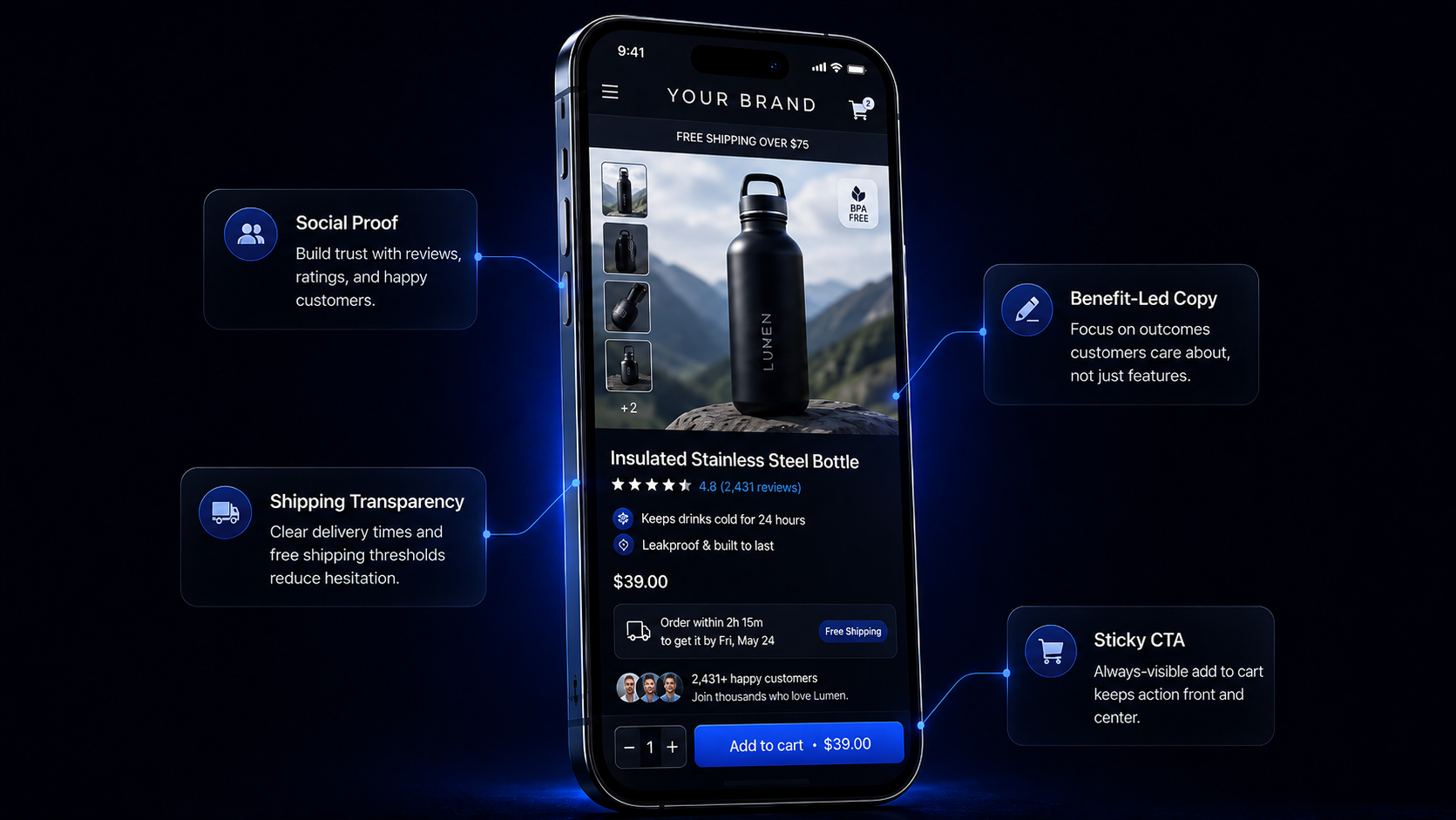
1. Visuals do the job that physical touch used to: Multi-angle, high-resolution images, including lifestyle shots that convey scale and real-world use, reduce the uncertainty that suppresses mobile conversions. The pictures should feel real, not doctored.
2. Benefit-led copy converts; feature lists don't: The difference between "200-thread-count Egyptian cotton" and "stays cooler than your current sheets through the night, guaranteed" is the difference between providing information and making a case. Customers buy outcomes, not specifications, and the copy that closes is written from the buyer's perspective outward.
3. Social proof work best near the Add to Cart button: Statista data consistently shows that approximately 73% of consumers prefer brands with strong, accessible social proof. Burying reviews in a tab below the fold means the trust signal that could close the purchase never reaches the customer at the moment they're deciding. Photo reviews and UGC that show real people with the product can increase conversion rates by up to 380%, according to research by The Good.
4. Shipping transparency is a conversion lever: Eevy AI's 2026 Shopify benchmark data shows that stores displaying free shipping thresholds prominently on product pages convert 8–12% higher than those revealing shipping costs only at checkout. The customer needs to know the total cost and the delivery timeline before they commit, not after.
A reliable test for any of these: walk through your product page on a phone as a first-time visitor. Every moment of hesitation maps directly to a conversion leak.
{{cta}}
Optimise Your Checkout
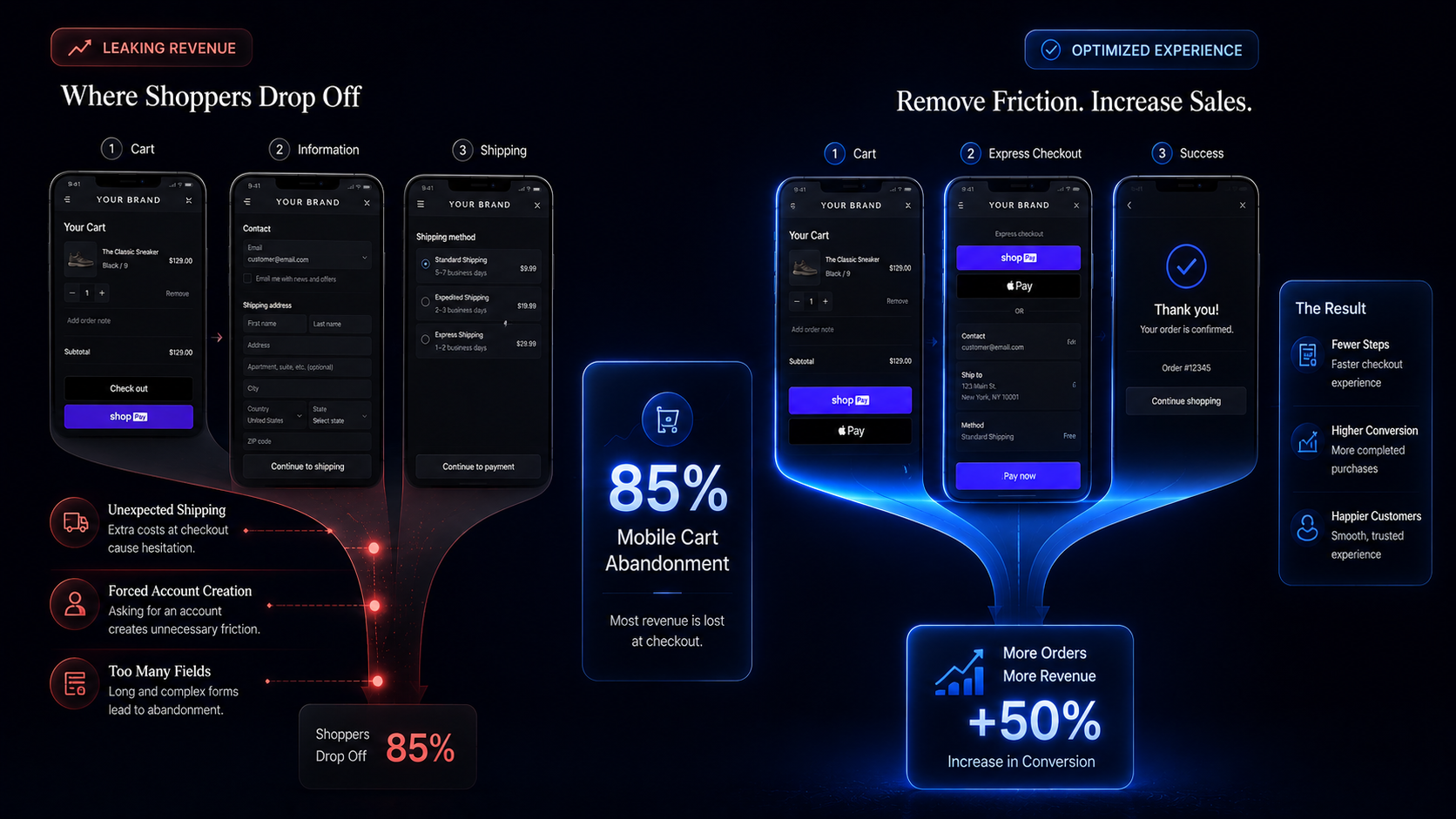
Cart abandonment across e-commerce averages 70%, according to Baymard Institute's study, and on mobile, that number climbs to 85%. What most merchants don't fully appreciate is where within the checkout that abandonment is concentrated: according to Shopify, 48% of abandonment is triggered by unexpected costs (shipping fees, taxes, and surcharges) that appear for the first time at the payment screen.
The customer was ready to buy, but the surprise was a problem.
The three most common friction points in Shopify checkouts are all solvable. The first is cost transparency: shipping fees and taxes that appear only at the final step cause nearly half of all abandonment, a problem that is straightforwardly addressed by surfacing shipping estimates on product and cart pages before the customer enters checkout.
The second is forced account creation, which Baymard's research shows causes 26% of checkout abandonment — solved by enabling guest checkout as the default and making account creation optional post-purchase. The third is checkout length: the average ecommerce checkout has 23.48 form elements, against Baymard's documented ideal of 12–14, and Baymard's analysis of US and EU sales data suggests that fixing checkout UX alone could recover up to $260 billion in otherwise lost orders.
For Shopify specifically, implementing Shop Pay, eliminating unnecessary form fields, and displaying trust signals (SSL badges, recognized payment logos) at the payment stage address the majority of these issues simultaneously.
Grow Average Order Value
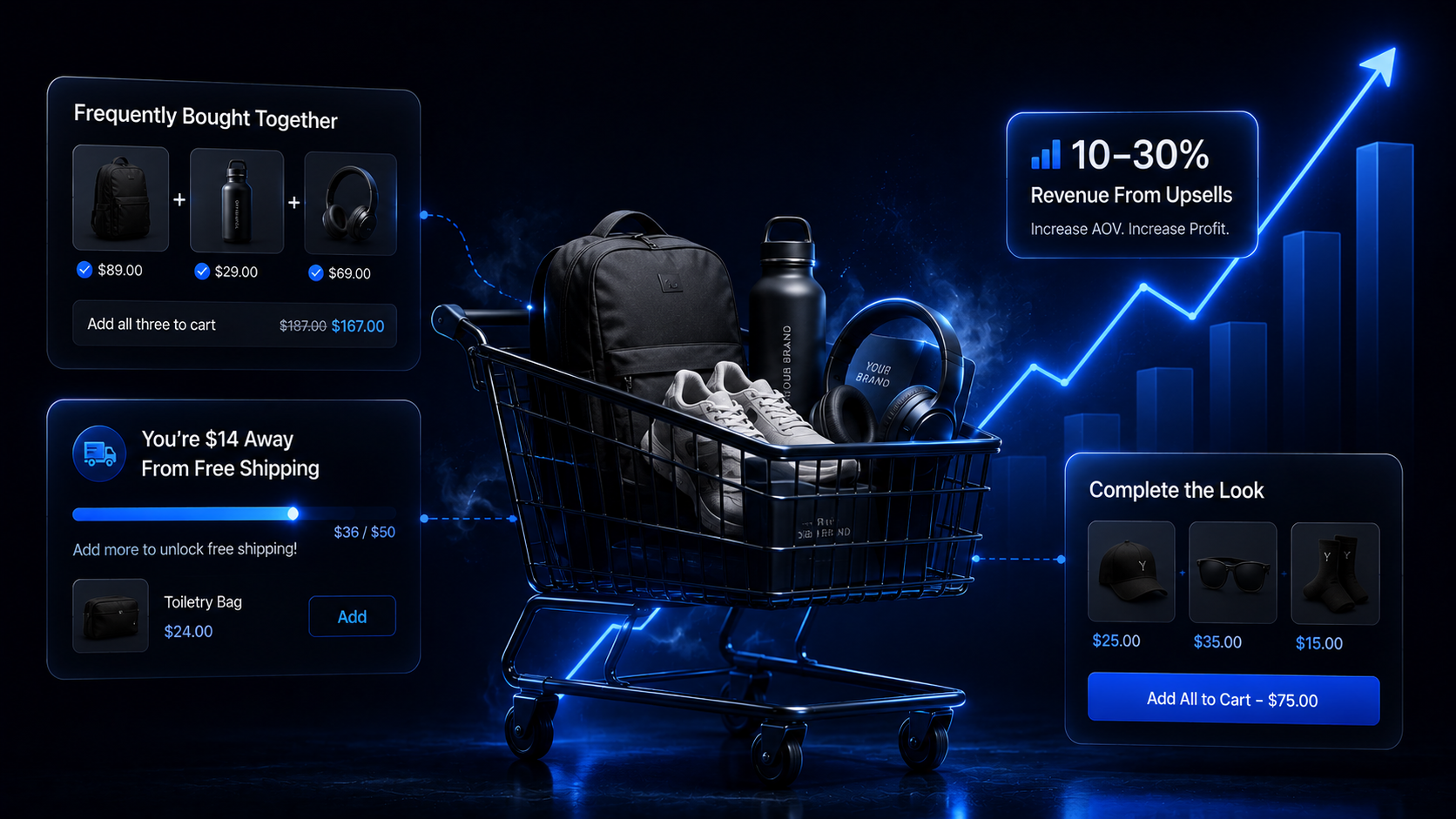
Product recommendations through upselling and cross-selling are responsible for up to 30% of ecommerce revenues. For a store doing $500,000 in annual sales, that's between $50,000 and $150,000 attributable to recommendations that required zero additional acquisition cost. Most Shopify merchants are capturing some portion of that potential; very few are capturing it systematically across the full purchase journey.
Cart-level upsells are the highest-converting placement because they intercept customers at the moment of maximum purchase intent. The mechanics that work best are complementary products priced below the primary item, framed as completing or enhancing the purchase rather than as an add-on sale. Free shipping thresholds work similarly: "You're $14 away from free shipping" creates a specific, low-friction incentive to add one more item, and the psychology of unlocking something already earned converts at consistently higher rates than a standalone discount.
Post-purchase upsells, shown on the order confirmation page after the transaction has already been processed, convert at rates that routinely surprise merchants who haven't tested them. The customer is in a state of positive momentum having just committed to a purchase, and their resistance to a relevant follow-on offer is at its lowest. Unlike cart upsells, they carry no risk of disrupting the original transaction.
Product page cross-sells, structured as "frequently bought together" or "complete the look" recommendations, reduce the number of separate purchase sessions a customer needs to have and improve both AOV and the perceived helpfulness of the shopping experience. The quality of the recommendation matters as much as the placement: suggestions that feel algorithmic rather than curated are ignored or, worse, damage trust. App selection matters as much as strategy here, and the top Shopify upsell apps vary significantly in how well they handle catalogue-specific recommendation logic.
Recover Abandoned Carts
Mobile cart abandonment at 85.65% means that of every 100 mobile shoppers who add something to their cart, fewer than 15 complete the purchase. These are not browsers who wandered in casually; they signaled intent by selecting a product and initiating the transaction. The sale was closer than the abandonment metric suggests, and a well-structured recovery sequence can bring a meaningful portion of those customers back before their intent fully decays.
The most important variable in recovery is timing, not incentive. Klaviyo's benchmark data shows that sending the first recovery message within 60 minutes yields approximately 15% recovery rates, while waiting 24 hours produces a sharp drop. Push notifications outperform email in that first 30-minute window because they reach the customer's lock screen immediately, without requiring an inbox open, and can deep-link directly back to the cart in a single tap.
Email at the one-to-two hour mark, then captures the customers who didn't engage with the first message, and according to Klaviyo's benchmark data, three-email abandoned cart sequences generate dramatically more revenue than single emails with one analysis finding a ratio of $24.9 million versus $3.8 million for the same audience.
For high-value carts, typically those above $150, a follow-up message at 24 hours offering free shipping or a modest incentive can convert customers who were genuinely price-sensitive rather than simply distracted, though this tier should be deployed selectively to avoid conditioning customers to abandon carts in anticipation of a discount.

The channel mix, push versus email versus SMS, determines recovery rate more than message copy, and the brands with the strongest recovery economics are those with all three active. Push notifications require an app, which is one of the primary structural reasons app-equipped brands outperform mobile web-only brands on abandoned cart recovery.
Build Owned Channels
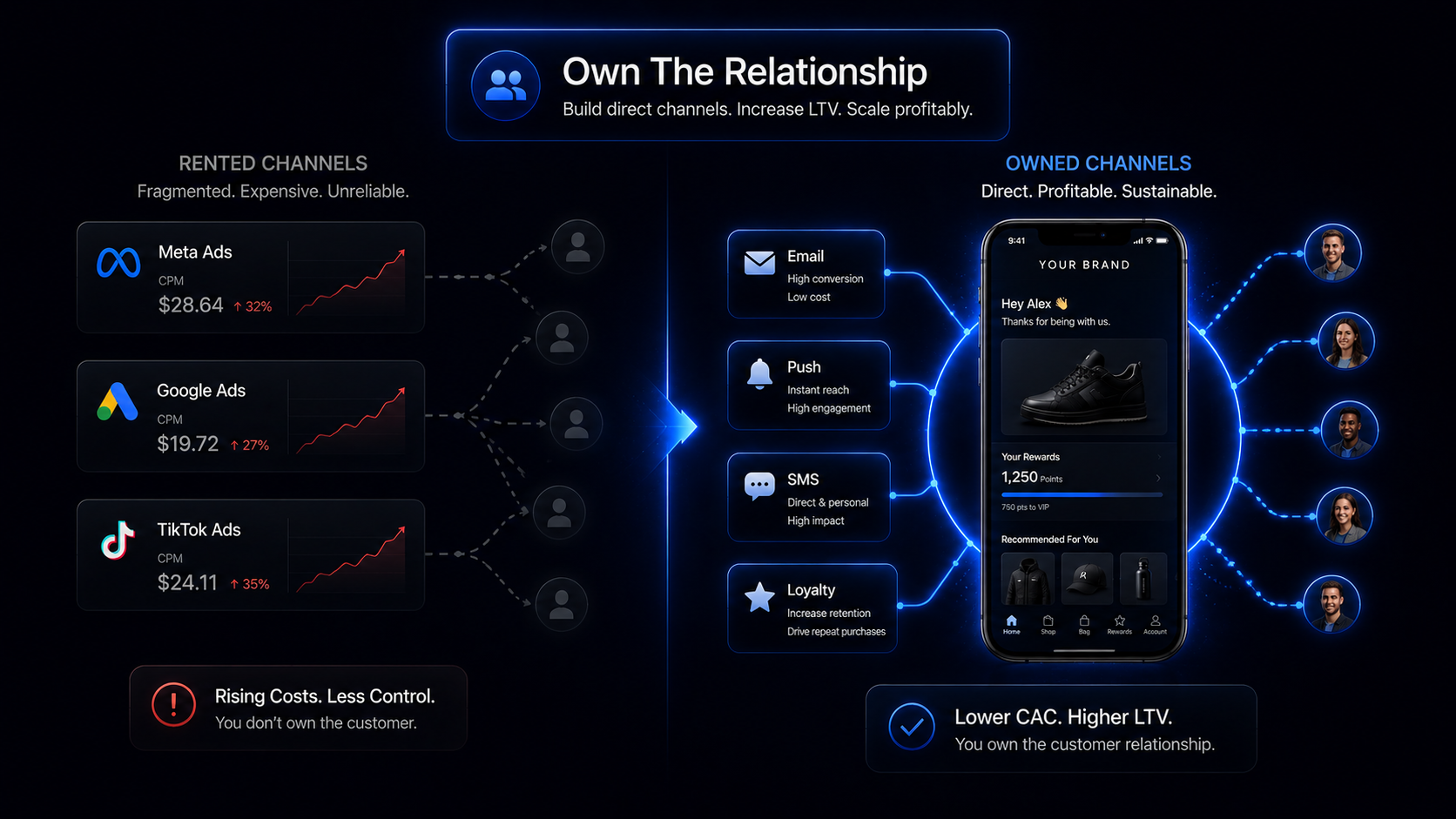
The strategic difference between a store fully dependent on Meta and Google for revenue and one with strong email, push, and SMS audiences is the difference between renting customer attention and owning it. When CPMs rise in Q4, when an algorithm changes, when a platform restricts your targeting, stores with owned channels absorb the shock. Stores with only paid acquisition have their revenue held hostage to forces they don't control.
Email Marketing
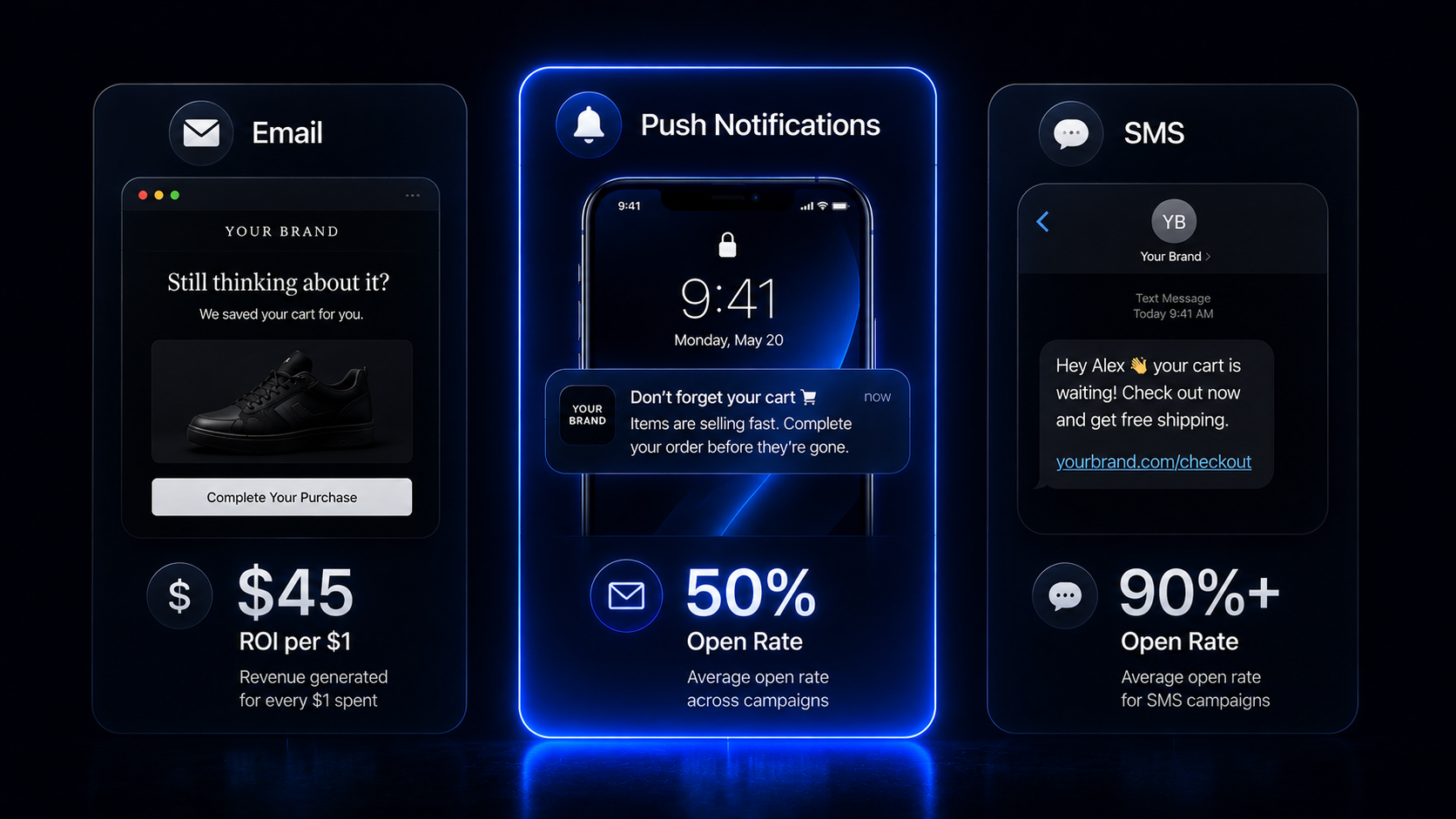
Email remains the highest-ROI marketing channel in ecommerce by a significant margin. According to Litmus's ROI research, cited by Klaviyo, email marketing returns $36 for every $1 spent across all industries, rising to $45 per $1 for the retail and ecommerce sector specifically; nearly 6x the return of Google Ads and 16x the return of paid social.
Klaviyo's 2026 benchmark data, drawn from over 183,000 customers, shows that automated email flows generate nearly 41% of total email revenue from just 5.3% of total sends, with revenue per recipient 18x higher than standard campaigns. The implication: building the list matters, but the automation architecture on top of it is where most of the value lives.
Push Notification Marketing
Push notifications, delivered through a native mobile app, operate at a different level of immediacy and cut-through. Across Appbrew's Shopify brand portfolio, push notification campaigns average a 50% open rate and 7x higher click-through rates compared to email, because they land directly on the customer's lock screen without inbox competition or spam filters.
They are also behavior-triggered by design: back-in-stock alerts, price drop notifications, and cart recovery messages sent at the moment of highest relevance rather than as scheduled broadcasts. Appbrew's push notification marketing guide for Shopify stores covers campaign types, timing frameworks, and message templates across the full customer lifecycle.
SMS Marketing
SMS is the third leg of the owned channel stack and, according to Klaviyo's 2024 benchmark data, revenue per recipient for SMS campaigns is now slightly higher than email across ecommerce industries, driven by open rates that consistently exceed 90% and the direct, frictionless nature of the channel.
For Shopify merchants without SMS active, it represents the clearest near-term incremental revenue opportunity in the owned stack, and the highest-leverage starting point for brands figuring out how to promote Shopify store through different channels.
{{cta2}}
Retain the Customers You've Earned
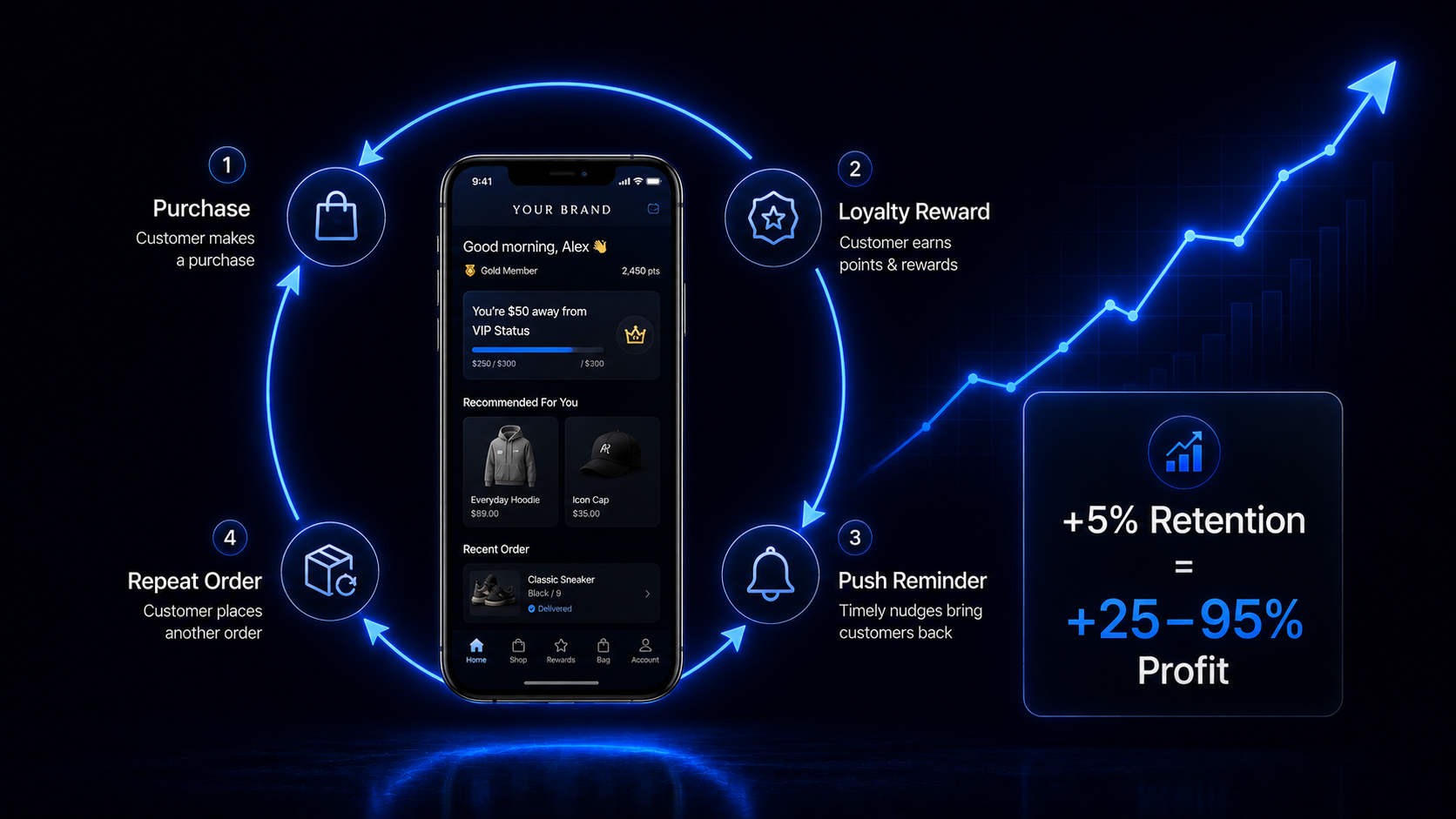
Harvard Business Review's research establishes that acquiring a new customer costs 5 to 25 times more than retaining an existing one, and that increasing customer retention by just 5% can increase profits by 25–95%. For Shopify merchants whose CAC has risen steadily alongside platform CPMs over the past several years, the math here is increasingly compelling: the most efficient revenue in the business is the revenue that comes from customers you've already paid to acquire.
The mechanics of retention for Shopify stores centre on two levers. Loyalty programs, structured as points systems, VIP tiers, or referral rewards, increase the cost for a customer to switch to a competitor by making accumulated value contingent on continued engagement with the brand.
The effectiveness is well-documented: Bain & Company's analysis shows that loyal customers spend 67% more in months 31–36 of their brand relationship than in months 0–6, as trust accumulates and price sensitivity decreases. App-exclusive loyalty programs perform better than web-based equivalents because the app environment creates a persistent, frictionless venue for point tracking, reward redemption, and ongoing engagement that a browser session simply doesn't replicate.
Winback campaigns, deployed to customers who have lapsed beyond their typical repurchase window, are the recovery mechanism for retention, and they work best when personalized to the customer's actual purchase history rather than sent as generic reactivation blasts. A customer who bought a skincare serum six months ago responds differently to "Your routine is missing something" than to "We miss you, here's 15% off everything." The former speaks to a known behavior; the latter speaks to no one specifically.
The deeper insight is that retention isn't a separate strategy sitting alongside conversion and AOV work but it's what happens when all the other sections of this guide are executed well. A mobile experience that converts, a checkout that doesn't surprise, a recovery system that catches lapsed intent, and owned channels that maintain engagement between purchases collectively produce a customer base that returns without being expensively re-acquired. The margin question is where most brands eventually stall: the discount structures that retain Shopify customers without eroding long-term LTV are meaningfully different from the ones that just move inventory.
Drive Traffic That Converts
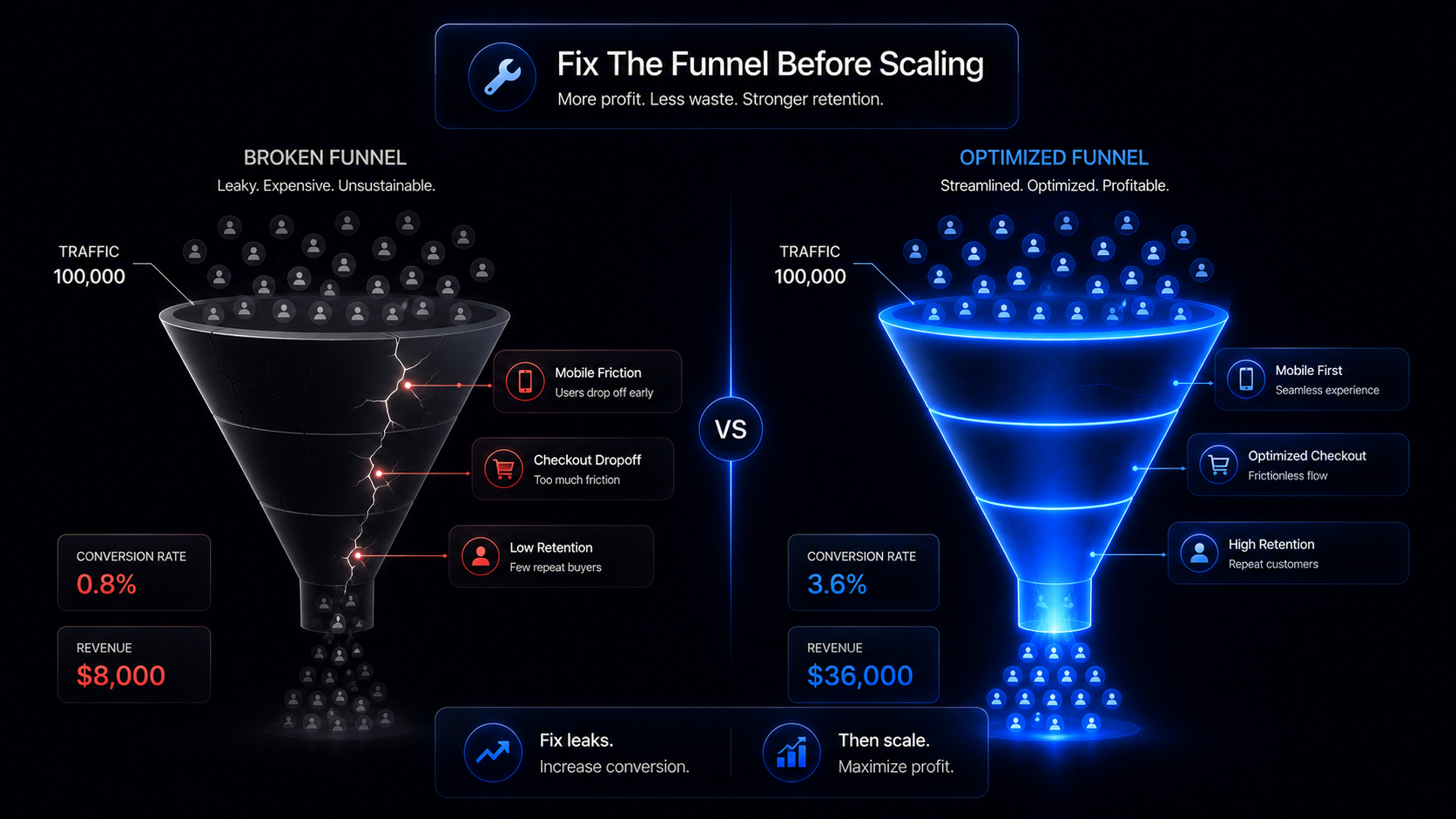
Traffic acquisition belongs last in this guide because traffic scaled into a broken funnel is amplified waste, not amplified revenue. Every additional visitor who lands on an under-optimized mobile page, hits an unexpected shipping cost, and abandons without converting is a compounding cost rather than a growth investment. Fix the funnel first, then scale what works.
SEO
SEO delivers the highest-quality organic traffic for most Shopify stores, but the common mistake is treating it primarily as a blog content strategy rather than a product and collection page strategy. According to Shopify's Enterprise research, collection pages with keyword-optimized titles, rich product descriptions, and structured data markup consistently outperform blog content for direct revenue attribution because they intercept shoppers at the moment of active purchase intent rather than earlier in the research phase. Blog content builds topical authority and supports long-tail keyword rankings, but the conversion-driving SEO work happens at the product and collection page level.
Paid Acquisition
Paid acquisition on Meta and Google works when it's treated as a top-of-funnel amplifier for a store that already converts, rather than as a primary revenue machine. The structural shift that's changed paid performance is the decay of third-party cookie-based targeting since 2021, which has pushed effective Meta advertising toward creative-led, broad targeting and first-party data audiences rather than granular interest segmentation. For Google, Shopping campaigns remain the most efficient format for Shopify stores because they intercept active search intent with a product image and price before the customer visits the site, and they're informed by the same product data that drives organic search rankings.
Influencer and UGC content marketing
Influencer and UGC partnerships are selected most effectively on conversion data rather than reach. A creator with 40,000 highly engaged followers in a product-relevant niche routinely outperforms one with 400,000 followers in a broad category, because the audience-product alignment determines conversion rate far more than the raw impression volume. UGC generated through these partnerships, repurposed as product page imagery, email creative, and paid social assets, compounds in value over time in a way that one-off influencer campaigns don't.
Measure, Test, and Prioritise
Most Shopify merchants measure the wrong things. Sessions, follower counts, and email list size are visible and satisfying to track, but they don't predict revenue. The three metrics that actually do are conversion rate by device (not blended), AOV by traffic source or channel, and returning customer rate by cohort. Conversion rate by device tells you where the UX is failing. AOV by channel tells you which acquisition sources bring high-value buyers versus window shoppers. Returning customer rate by cohort tells you whether your retention mechanics are working or whether you're running a leaky bucket that requires constant acquisition spend to maintain revenue.
The prioritization principle that follows from this is straightforward: find the biggest leak and fix it first, before optimizing anything else. A store with a 0.8% mobile CVR and a 3.2% desktop CVR has a mobile problem, and adding upsells or building an SMS list will have minimal impact until the mobile experience is repaired, because 79% of traffic never gets far enough for those tactics to activate. A store with strong mobile conversion but a returning customer rate of 15% has a retention problem, and scaling paid acquisition will accelerate losses rather than compound gains.
Testing should be structured around one change at a time, with clear metrics defined before the test runs. Conversion rate lifts from product page copy changes, AOV lifts from upsell placement variations, and recovery rates from push versus email timing experiments all tell you something specific and actionable but only if you're not changing multiple variables simultaneously.
Conclusion
The compound effect of executing these levers in sequence is what separates stores that grow steadily from those that feel permanently stuck despite consistent ad spend. Fix mobile conversion, optimize the product page, reduce checkout friction, implement upsells, build recovery flows, develop owned channels, retain the customers you earn, and then scale the traffic that feeds a working system.
If you're exploring what a branded mobile app could contribute to this stack, Appbrew builds high-converting iOS and Android apps for Shopify brands that integrate natively with your existing marketing tools and CRM. Book a demo to see what it looks like for your store.
Frequently Asked Questions
What is a good conversion rate for a Shopify store?
The average Shopify store converts at around 1.4%, according to LittleData's benchmark data. A rate above 3.2% places you in the top 20% of Shopify merchants, and above 4.7% in the top 10%. That said, blended CVR without device segmentation is a misleading number: a store with 80% mobile traffic converting at 1.6% overall may actually be performing strongly on a device-adjusted basis, while a store with heavy desktop traffic at the same number is likely underperforming. Always segment by device before drawing conclusions.
How do I increase Shopify sales without increasing ad spend?
Conversion rate optimization, cart recovery, and owned channel development all generate revenue from traffic you're already paying to attract. Enabling Shop Pay, surfacing shipping costs before checkout, adding behavioral push notifications, and building an email automation stack — welcome flows, cart recovery sequences, post-purchase flows are changes that compound over time without scaling acquisition costs. In terms of return on effort, mobile checkout improvements and push notification setup typically deliver the fastest payback.
Why does my Shopify store get traffic but no sales?
Traffic without conversion almost always traces to one of three problems: trust (no reviews near the Add to Cart button, unclear returns policy, no security signals at checkout), friction (slow mobile load time, multi-step checkout, surprise shipping fees), or intent mismatch (traffic arriving from channels whose audience doesn't match your product or price point). The fastest diagnostic is to complete your own checkout on a mobile device as a first-time visitor and note every moment of hesitation. That journey maps directly to your conversion leaks.
What is the fastest way to increase average order value on Shopify?
Free shipping thresholds and cart-level upsells are the fastest mechanisms for lifting AOV because they intercept customers mid-transaction at maximum purchase intent. A threshold framed as "You're $12 away from free shipping" leverages the psychology of unlocking something already earned, while a cart upsell offering a complementary product below the primary item's price capitalizes on momentum without creating a separate purchase decision. Both can be implemented within a day and measured within a week.
How do push notifications help increase Shopify sales?
App push notifications deliver time-sensitive messages (like cart reminders, flash sale alerts, back-in-stock notifications, price drop alerts), directly to the customer's lock screen, bypassing inbox competition entirely. Across Appbrew's Shopify brand portfolio, push campaigns average 50% open rates and 7x higher click-through rates compared to email, and the behavior-triggered variants (abandoned cart reminders sent within 30 minutes of abandonment) consistently recover revenue that email, arriving later, does not reach. They require a native mobile app to function, making them the primary reason app-equipped brands structurally outperform mobile web-only brands on revenue recovery metrics.