

.webp)
.webp)
Explore 18 mobile ecommerce trends shaping 2026, backed by 2025–26 data. Plus what Shopify brands should do about each.
Mobile commerce just crossed a line it won't uncross. For the first time, a full year of US online shopping ran majority-mobile: smartphones drove 56.4% of online spend during the 2025 holiday season, up from 54.5% the year before, according to Adobe Analytics.
Yet here's the uncomfortable truth I keep telling founders: most Shopify brands are still treating mobile like a responsive afterthought, a shrunken version of their desktop experience, while the brands actually winning are building mobile-native ecosystems that convert at 3–5x higher rates.
I've spent the past several months studying what's changing in mobile commerce, talking to DTC operators, and digging through the data. What's emerging isn't just a list of shiny features. It's a fundamental shift in how consumers discover, evaluate, and purchase products on their phones, and the brands that get ahead of these shifts in 2026 will compound that advantage for years.
Here are the 18 trends I believe will define mobile commerce this year, grouped into the five shifts that matter, with real brand examples, first-hand results we've seen from brands going app-first, and what you should actually do about each one.
TL;DR
- Mobile is now the majority of US ecommerce: 56.4% of online holiday spend came through smartphones in 2025.
- AI is the new front door. Generative AI traffic to US retail sites rose 693.4% year over year during holiday 2025, and AI-referred visitors convert 16% better than other traffic.
- Agentic commerce is a board-level number now: Morgan Stanley projects $190–385 billion in US agentic spending by 2030; McKinsey's projection runs up to $1 trillion in the US and $3–5 trillion globally.
- Checkout has gone wallet-first. Digital wallets carried 56% of global ecommerce value in 2025 (Worldpay Global Payments Report, March 2026), and 82.2% of holiday BNPL purchases happened on smartphones.
- The retention math favors apps. Cart abandonment averages 70.22% overall and 80.02% on mobile web, which is exactly the gap a native app exists to close.
AI is rewiring how customers arrive and decide
The first shopper evaluating your product is increasingly a model, not a person.
1. AI agents are starting to shop for your customers
Morgan Stanley Research estimates agentic shoppers could drive $190 billion to $385 billion in US ecommerce spending by 2030, between 10% and 20% of the entire market. Their AlphaWise survey found 23% of Americans already bought something via AI in the past month. It means the first "customer" evaluating your products is increasingly a model, not a person.
As Nathan Feather of Morgan Stanley Research put it: "Agentic will be a paradigm shift for e-commerce."
McKinsey's research sizes the prize even larger: up to $1 trillion in orchestrated US B2C retail revenue by 2030, and $3 trillion to $5 trillion globally. McKinsey senior partner Becca Coggins describes the shift simply: autonomous agents now "do the legwork" of searching, filtering, comparing, and purchasing.
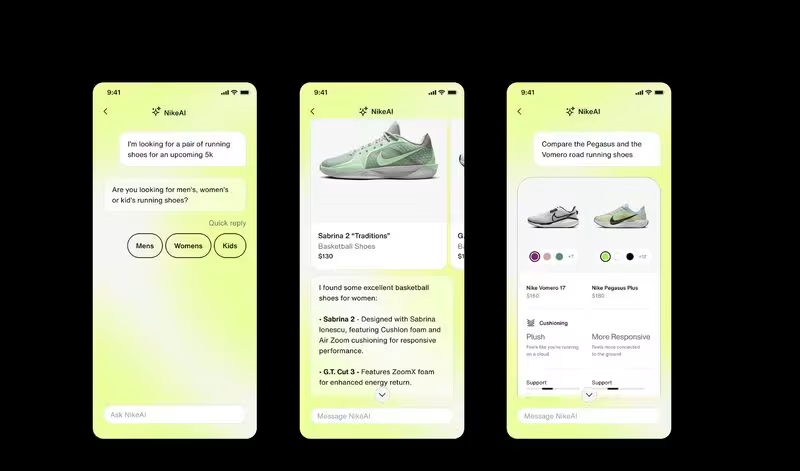
What does this look like in practice? Nike launched "NikeAI Beta" in August 2025 for its iOS app - a conversational AI shopping assistant where you type something like "running shoes for a half marathon on wet roads" and it returns hyper-personalized product suggestions. Nike's CTO Muge Erdirik Dogan called it "a meaningful shift in how we connect our athletes with products." Nike Direct now accounts for roughly half the company's total profits.
The bigger implication for Shopify merchants: 93% of businesses now see AI agents as a competitive edge, and 97% plan to increase budgets for them. As Purva Gupta, CEO of Lily AI, predicted for 2026: "The biggest shift won't be more AI, it will be trust in AI. We'll see the first wave of paid product placements inside AI-driven search and checkout experiences."
What to do: If you're not already testing conversational AI in your shopping experience, 2026 is the year to start. Even a basic AI concierge that helps customers find the right product based on natural-language questions (instead of clunky filter menus) can meaningfully lift conversion.
{{cta}}
2. AI-referred traffic is becoming a real acquisition channel
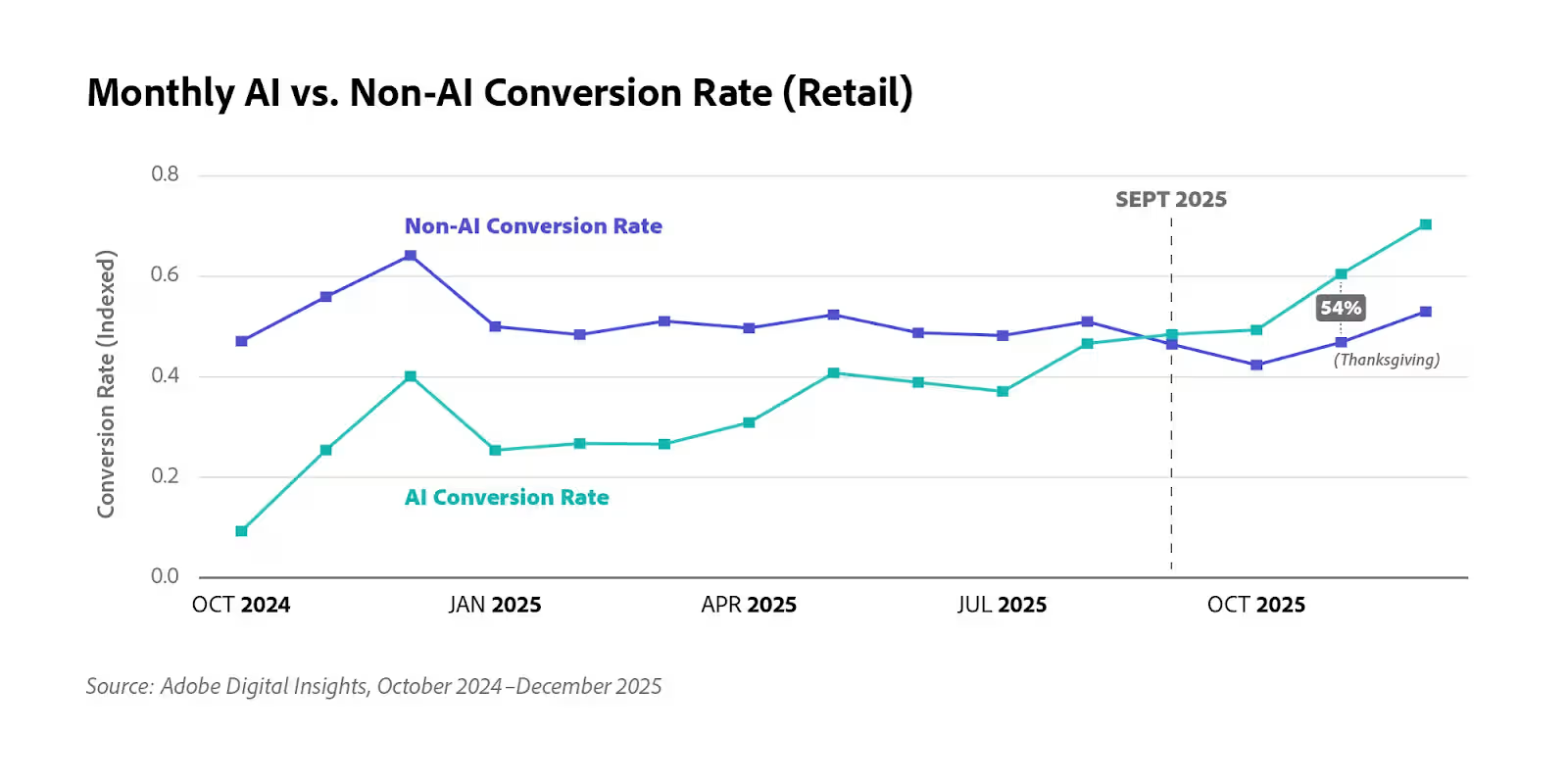
The pipes have already been laid. During the 2025 holiday season, traffic to US retail sites from generative AI tools rose 693.4% year over year (Adobe Analytics, January 2026). And this traffic isn't just browsing: by October 2025, AI-referred visitors were 16% more likely to convert than non-AI traffic, generated 8% more revenue per session, and bounced 31% less (Adobe Digital Insights). Adobe's lead analyst Vivek Pandya noted that consumers "embraced generative AI more than ever as a shopping assistant" this season.
The implication is clear, if SEO built your last five years of traffic, GEO (getting cited and recommended by AI systems) will shape your next five. The brands appearing in AI answers are collecting the highest-intent traffic on the internet right now.
What to do: Treat AI platforms as a channel with its own funnel. Track AI referrals separately in analytics, keep product feeds, reviews, and structured data pristine, and publish content that answers real buying questions in a liftable format.
3. Personalized feeds are replacing static homepages
The era of the static homepage is ending, and consumers are the ones ending it. AI-driven revenue per visit on U.S. retail sites climbed 84% in the first seven months of 2025 (Adobe Digital Insights), and shoppers arriving through AI increasingly expect the page to already know them.
McKinsey's research puts a dollar figure on this: companies that invest in AI-driven personalization earn 40% more revenue from those activities than average performers. Dynamic real-time personalization, where the feed adapts to each user's behavior in-session, delivers 20% higher conversion than batch-processed personalization. Bloomreach found that AI-assisted shopping sessions convert at roughly 12.3% versus 3.1% without AI, nearly a 4x lift.
Jones Road Beauty offers a masterclass for Shopify brands. Using an AI-driven product quiz, they lifted average order value from $60 to $90, achieved a 16% quiz conversion rate, and captured 50,000+ customer emails in a single month, all while collecting rich zero-party data that powers even better personalization downstream.
What to do: Stop thinking about your homepage as a fixed layout. Treat it as a dynamic feed that adapts to each user. At minimum, implement personalized product recommendations, they drive up to 31% of eCommerce site revenues in sessions where customers engage with them.
If you're on Shopify and using a mobile app, tools like Appbrew's Milo AI can analyze every interaction in real time to dynamically optimize what each user sees.
{{cta2}}
4. AI-powered search inside the app is table stakes
Basic keyword matching is now a liability. Microsoft found that Copilot-assisted shopping journeys are 33% shorter and 76% more likely to reach lower-funnel conversion. Shorter journeys mean fewer moments to lose the shopper, which is exactly what mobile sessions need. The gap between an app that understands "gift for a runner under $80" and one that returns zero results for it is a revenue gap, not a UX nicety.
What to do: Audit your app's search this quarter. If it can't handle natural-language queries, synonyms, and typos, it's quietly leaking your highest-intent sessions.
Discovery has moved to social, video, and creators
Live shopping converts at 10x a standard checkout on a channel most Shopify brands still treat as a branding exercise.
5. US social commerce crosses the $100 billion mark
U.S. social commerce sales are projected to reach $100.99 billion in 2026, up 18% year-over-year. But the story within the story is TikTok Shop, which generated $15.82 billion in U.S. sales in 2025, a staggering 108% year-over-year growth, and is on pace to exceed $20 billion in 2026. Globally, TikTok Shop's GMV roughly doubled to an estimated $66 billion in 2025.
The conversion data explains why brands are pouring resources here. TikTok's average conversion rate of 3.4% beats Instagram (1.08%) and YouTube (1.4%). Meanwhile, live shopping events convert at rates as high as 30%, compared to 2–3% for standard eCommerce. By 2026, one in every two U.S. social buyers is expected to purchase on TikTok.
Steve Weiss, CEO of Snakkidz, captured the consensus when he said: "Social commerce will dominate, with platforms like Instagram, TikTok, and emerging players becoming primary shopping destinations. Live shopping by influencers will be a game-changer."
SHEIN embodies this fusion of social and commerce. With 215 million monthly active users, the app blends user-generated content, social profiles, and shopping into a single feed. Users create outfit posts, earn commissions when others buy based on their content, and participate in style contests, turning the shopping app into a social platform.

What to do: Treat social commerce as the top of your funnel and your mobile app as the retention engine. Integrate TikTok Shop and Instagram Checkout for acquisition, but always build pathways to drive your best customers into your owned app experience where you control the data and relationship.
Fashion brands like SHEIN show what's possible when the app becomes the storefront. For fashion retailers evaluating the wider technology stack behind that experience, Ecommerce Paradise has a practical guide to the best Shopify apps for clothing stores.
6. Live and video commerce stop being experiments
Weiss called live shopping a game-changer, and the platform investment agrees with him: TikTok, Instagram, YouTube, and Amazon all expanded live and shoppable video formats through 2025. The format works because it compresses discovery, social proof, and checkout into one session, on the one device people already hold while watching. For a DTC brand, a weekly 30-minute live drop is now a legitimate conversion event, not a branding stunt.
What to do: Pick one platform and run a recurring live format for a quarter before judging it. Route the audience to app-exclusive early access so the spike becomes a retained customer, not a one-off order.
7. Creators and affiliates now drive a fifth of online revenue
Here's a number most brands haven't internalized: affiliates and partners, a category that includes social media influencers, drove 20.4% of US online holiday revenue in 2025, up 15.9% year over year, while social media's direct revenue share jumped 40.3% to 4.6% (Adobe Analytics). One in five online dollars now arrives through someone else's recommendation. If your attribution and your app's deep links can't follow that journey from a creator's video to checkout, you're both undercounting and underconverting the channel.
What to do: Make sure every creator link deep-links into the exact product screen in your app, not a mobile web page that asks the shopper to start over. Then pay creators on tracked app revenue, which is cleaner data for both sides.
Closing the confidence gap at checkout
Mobile carts die 14 points more often than desktop ones, for one reason: doubt.
8. AR try-ons and flexible payments are closing the confidence gap
The mobile conversion gap exists largely because of uncertainty.
- "Will this fit?
- Will it look right?
- Can I afford it right now?"
AR and modern payments are attacking both sides of this problem.
Shopify's own data shows that merchants adding 3D/AR product views saw conversions climb 94% higher than static images. Sephora's Virtual Artist feature, which lets users virtually try on over 1,000 lipstick shades, drove 90% higher conversion rates among users who engaged with it, with over 200 million shades tried on in the first two years.
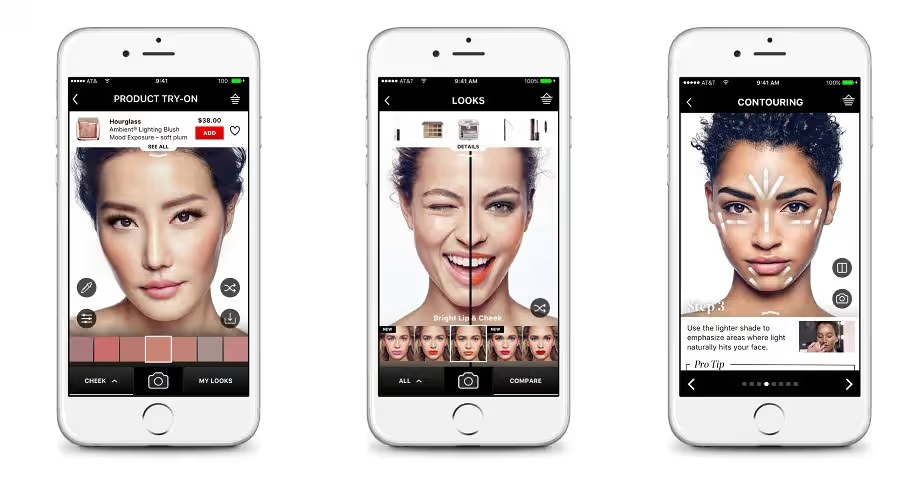
Warby Parker's AR try-on (powered by Apple ARKit) has become so central to their experience that it carries a 4.9-star App Store rating from 265K+ reviews.
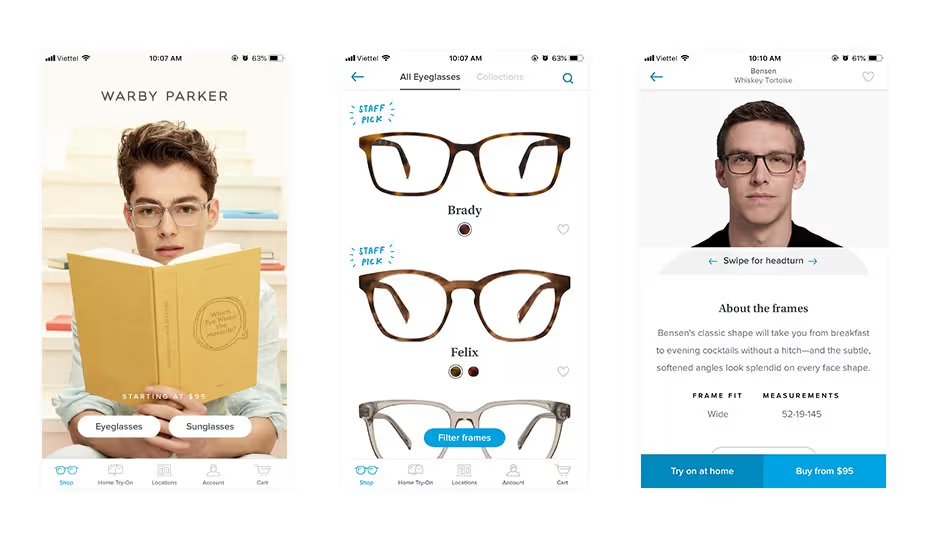
Notice what those two have in common: the AR lives in the app, where the camera, speed, and session persistence make it actually usable.
What to do: If you sell anything customers try before buying (apparel, beauty, eyewear, home goods), AR is no longer a nice-to-have. Start with your top 20 SKUs rather than the full catalog.
9. Digital wallets become the default, not an option
Digital wallets accounted for 56% of global ecommerce value in 2025. Across online and in-store combined, they moved more than $13.8 trillion in spend, according to the Worldpay Global Payments Report (March 2026). In the US, wallets are already the most-used online payment method for shoppers aged 18–34. If your mobile checkout still leads with card-number fields, you're optimizing for a shrinking minority, and you're doing it on the device where typing sixteen digits hurts most.
What to do: Put Apple Pay, Google Pay, and Shop Pay above the fold at checkout. Then measure your checkout completion rate by payment method; the delta will make the case for you.
10. BNPL is a mobile-native behavior
Buy now, pay later stopped being optional. BNPL drove $20 billion in US online holiday spend in 2025, up 9.8% year over year, and 82.2% of those purchases happened on smartphones (Adobe Analytics, January 2026). Cyber Monday alone crossed $1.03 billion in BNPL spend. Read those two numbers together: flexible payments aren't a desktop finance product, they're a mobile impulse-enabler, and they concentrate exactly where your app lives.
What to do: Offer at least one BNPL option and surface it on the product page, not just at checkout. Shoppers make the "can I afford this now" calculation before they add to cart.
11. Omnichannel pickup keeps pulling app users into stores
Click-and-collect held its ground even as shipping got faster: curbside pickup accounted for 17.1% of online orders during holiday 2025 (Adobe, January 2026). Zara's "Store Mode" app feature shows what good execution looks like: real-time stock checking, fitting room reservations, and 30-minute click-and-collect, all inside the app. The pickup moment matters because it converts a digital order into a physical visit, and physical visits reliably produce add-on purchases.
What to do: If you have any physical footprint (stores, stockists, popups), wire inventory visibility and pickup into your app. If you don't, partner-based pickup networks get you most of the benefit.
Retention is the new growth math
At a $70 CAC, a customer who never returns loses you $27.50. Rising ad costs didn't create that problem, they just stopped hiding it.
12. The retention-first economy has arrived
Run the math on your own store and this trend stops being abstract. At a $70 CAC and 50% gross margins on an $85 order, you net $42.50 against $70 in acquisition cost. You lose $27.50 on every first-time buyer who never returns. Rising ad costs didn't create this problem, they just removed the margin that used to hide it. Acquisition without retention is a money-losing strategy, and the fastest way to cut effective CAC is to stop re-buying customers you already paid for.
Gymshark's retention-first mobile strategy is the perfect example. With 96% of sales through owned direct channels, their app offers exclusive product drops, early access to launches, and deep integration between fitness tracking and shopping. The result: a $1.45B+ valuation, 245K downloads in a single month, and a 4.9/5 App Store rating.
What to do: Before approving next quarter's ad budget, calculate your first-order contribution margin and repeat purchase rate. If the first number is negative and the second is under 30%, retention infrastructure is your highest-ROI spend.
13. Apps outconvert mobile web, and the gap is widening
Here's the stat pair that frames everything: average cart abandonment sits at 70.22% across Baymard Institute's 2026 meta-analysis of 50 studies, and on mobile web it climbs to 80.02% versus 66.41% on desktop. Four out of five mobile web carts die. That's not a customer-intent problem - Baymard estimates $260 billion in US and EU orders are recoverable through better checkout experience alone.
.avif)
Apps are that better experience. Logged-in sessions, saved payments, one-tap wallets, and no browser friction attack every major abandonment cause at once. Shopify's own BFCM 2025 made the direction obvious: $14.6 billion in sales, up 27% year over year, with roughly 69% on mobile (Shopify, December 2025).
Across the brands running on Appbrew, the pattern repeats:
- Karma and Luck (home decor): 50% increase in conversion rate
- Snitch (fashion): 2.5x conversion rate, 60% mobile revenue growth
- Sukoshi Mart (beauty and lifestyle): 30% higher conversion after switching
What to do: Measure the gap between your mobile web and app conversion rates. If you don't have an app yet, turning your Shopify store into a native app is the cleanest way to quantify what that gap is costing you.
{{cta2}}
14. Push notifications get intelligent
Push already wins on raw economics: roughly a 20% open rate versus about 2% for email, at zero per-message cost. But the real shift in 2026 is intelligence. Automated, behavior-triggered push (abandoned cart, back in stock, price drop, win-back) massively outperforms batch-and-blast campaigns, because relevance and timing do the work that volume can't. Fashion brands are already running this playbook for cart recovery and retention.
What to do: Set up three automated flows before any broadcast campaign: abandoned cart within the first hour, back-in-stock, and a 30-day win-back. Personalize with at least name and last-viewed category.
15. Gamification and loyalty loops are becoming mandatory
The global gamification market reached $29.11 billion in 2025, growing at 26% annually and nearly a third of that comes from retail and eCommerce. This isn't about slapping a spin-to-win wheel on your homepage. It's about building engagement architectures that create habitual behavior.
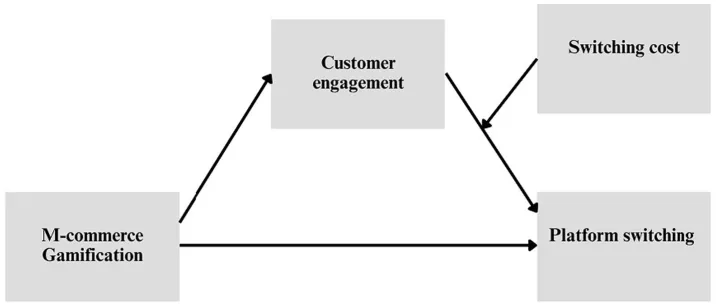
The data makes a compelling case: gamified ecommerce systems raise purchase intent by 30-50%, and businesses leveraging gamification see up to 7x higher conversion rates. Crucially, a 2025 peer-reviewed study in Frontiers in Communication found that m-commerce gamification directly reduces switching tendencies, it creates "a unique competitive advantage that is difficult for rivals to replicate."
Sephora's Beauty Insider program is the gold standard. Its three-tier system (Insider, VIB, Rouge) uses progress mechanics, exclusive rewards, and status recognition to drive repeat engagement. The program has become so embedded in beauty culture that it's a primary reason customers choose Sephora over competitors. E.l.f. Beauty took a different approach, launching "Fortune Island" on Roblox in April 2025, a financial literacy game tied to their loyalty program that drew over 22 million visits, targeting Gen Z through interactive gameplay.
On the aggressive end, SHEIN and Temu use daily check-ins, streak-based bonuses, mini-games, and flash challenges to manufacture habitual engagement. SHEIN's lower churn rate compared to Temu, despite similar price points, suggests that deeper gamification (community, content, progress) outperforms purely transactional incentives.
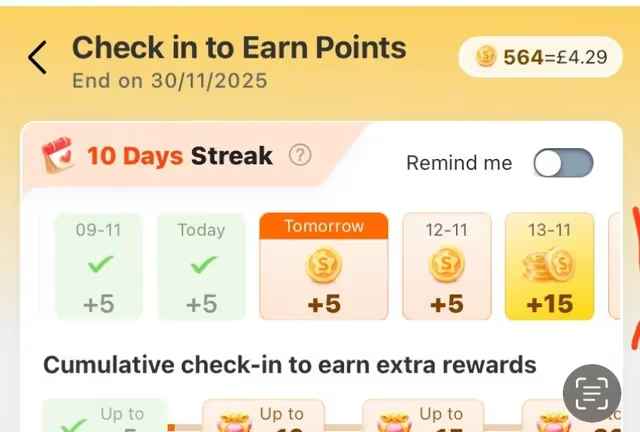
What to do: Start simple but start now. Implement a tiered VIP program with experiential perks beyond discounts. Add progress mechanics like free-shipping progress bars or points-for-actions (reviews, referrals, social shares). Use gamified quizzes for both engagement and zero-party data collection.
16. Subscription commerce via apps builds predictable revenue
Subscription-based app spending grew 15.8% year-over-year through mid-2025, and the subscription ecommerce market is expanding at a 14.4% CAGR, far outpacing overall ecommerce growth. RevenueCat's State of Subscription Apps 2026 report found that ~14,700 new subscription apps launched per month by January 2026, up from just 2,000 per month in 2022.
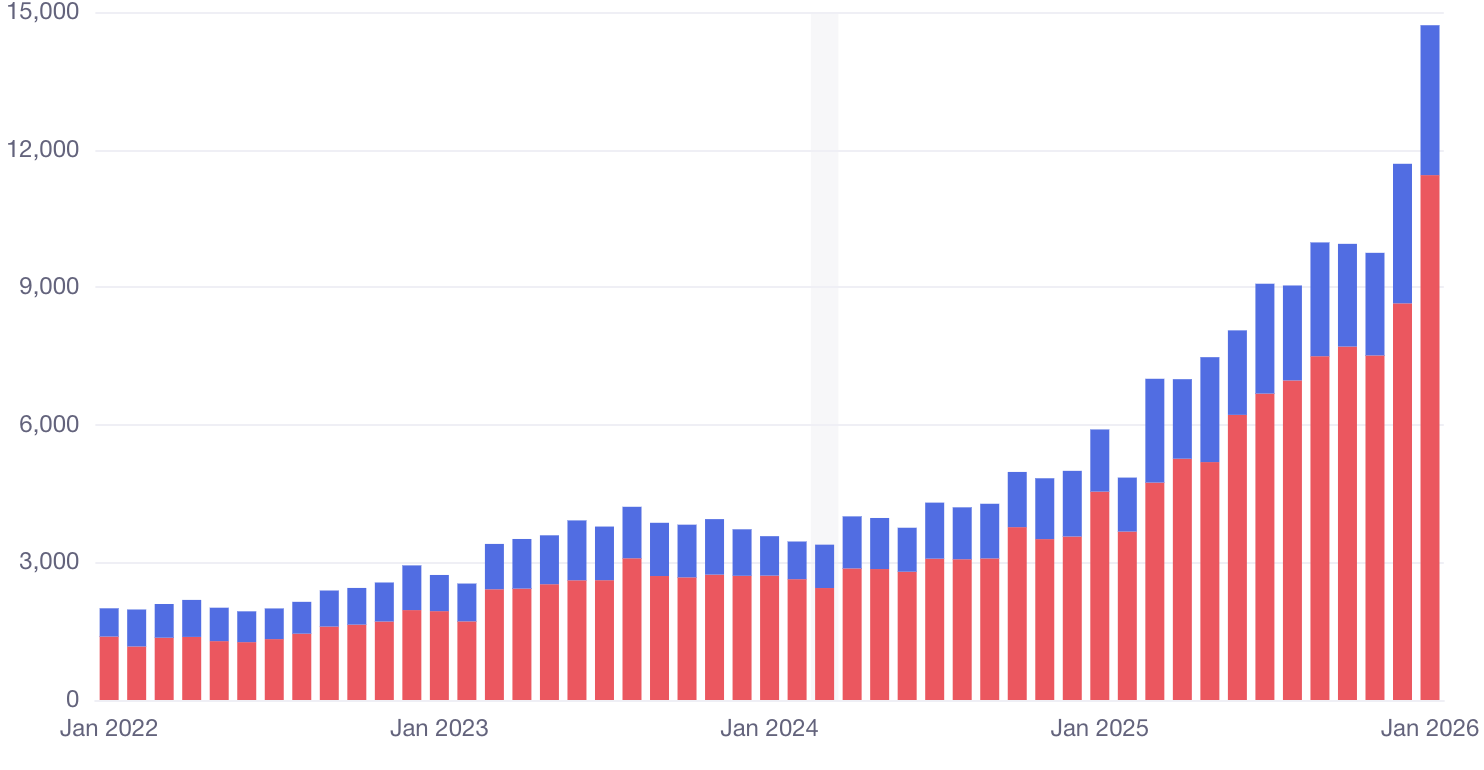
What's changed is the sophistication. The "subscribe and save 10%" model is table stakes now. The winners are brands building flexible, community-driven subscription architectures managed through mobile apps, with features like pause/skip/swap, AI-powered churn prediction, and tiered membership with escalating perks.
Stay AI, one of the top Shopify subscription apps, exemplifies this evolution. Its RetentionEngine uses AI to power cancel flows (showing the right offer at the right moment to prevent churn), while WinbackEngine automates re-engagement of lapsed subscribers. The data backs the approach: loyal repeat customers represent just 21% of a typical customer base but generate 44% of revenue and 46% of orders.
For DTC brands selling replenishable products, beauty, supplements, pet food, coffee, wellness, subscriptions via mobile apps represent the highest-LTV customer segment. The app is the ideal interface because customers can manage deliveries, swap products, and receive personalized recommendations all in one place, reducing friction that drives cancellation.
What to do: If your products have a natural replenishment cycle, test a subscription offer on your top-selling SKU. Offer genuine flexibility (pause, skip, swap) because rigidity is the #1 driver of cancellation. Then invest in retention technology (AI-powered cancel flows, winback automation) to protect recurring revenue.
The infrastructure bets
As platform tracking degrades, the data a customer hands you directly is worth more than the data you used to buy.
17. Privacy-first mobile strategies are a competitive moat
Privacy regulation keeps tightening: over 20 US states now have comprehensive privacy laws, and the EU AI Act becomes fully enforceable in August 2026 with penalties up to €35 million or 7% of global turnover. The flip side is opportunity. When platform tracking degrades, the data customers share inside your app becomes disproportionately valuable, because every tap, wishlist, and purchase belongs to you, not to a platform.
ASOS uses in-app purchase history to power recommendations while staying transparent about how data shapes rankings. Jones Road's quiz captures zero-party data customers volunteer gladly in exchange for better matches. And Shopify's Hydrogen framework added Storefront MCP support in its Winter 2026 update, letting brands build AI agents directly on storefronts while keeping first-party data ownership.
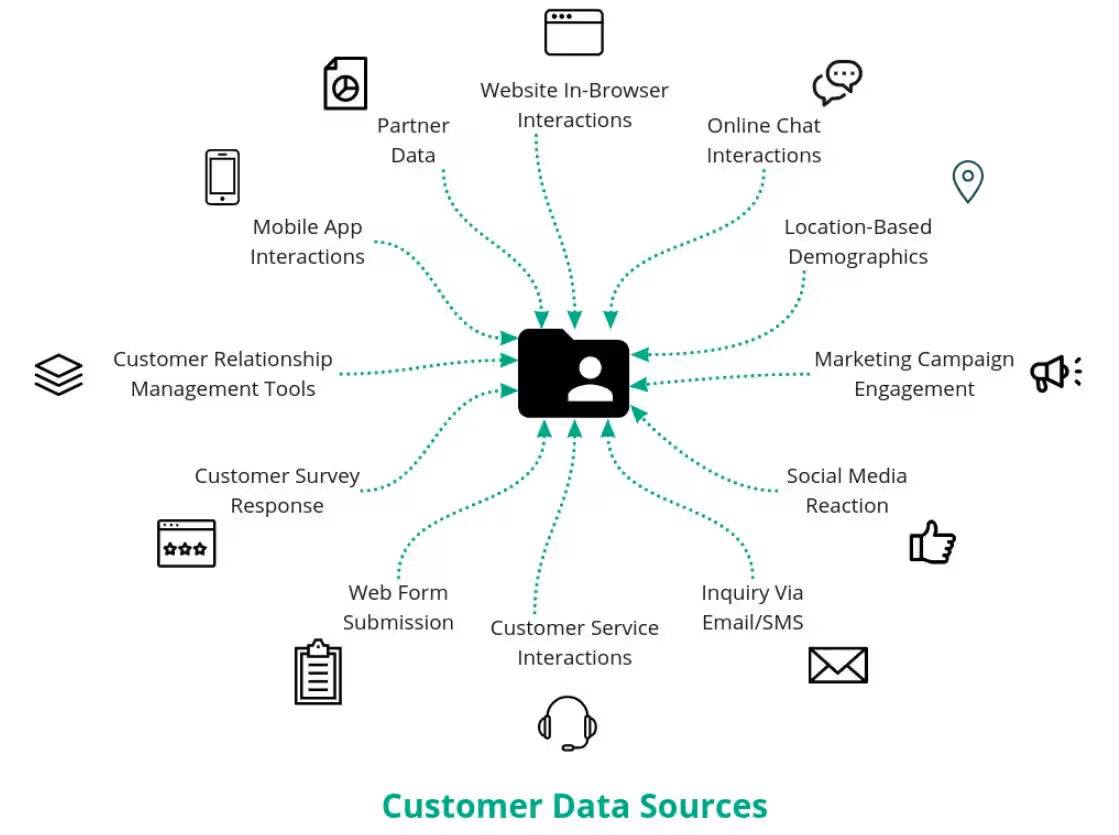
The brands that own their data will be able to personalize at scale. Those that don't, as one analyst put it, will find their capabilities "severely constrained regardless of which AI tools they deploy."
What to do: Implement a Customer Data Platform to unify first-party data from your app, site, email, and POS. Use progressive profiling, collect customer data through app interactions like quizzes, wishlists, and preference centers rather than demanding it upfront. Design loyalty programs as data-exchange mechanisms where customers share preferences in return for tangible value.
18. The PWA + native app dual strategy is replacing "responsive design"
The "PWA versus native app" debate has been quietly resolved, not with one winner, but with a dual-architecture strategy. Progressive Web Apps serve as the mobile web foundation for new visitors and one-time buyers. Native apps serve as the retention vehicle for loyal repeat customers. They're complementary, not competing.
The data makes each side's case clearly. PWAs reduce development costs by 50-70% compared to native apps and deliver faster initial performance (Starbucks' PWA is 99.84% smaller than its iOS app at just 233KB). AliExpress' PWA drove a 104% increase in conversion rates for new users. Jumia's PWA achieved 33% higher conversion and 50% lower bounce rates, and reached 12x more users than their native app because there's no install barrier.
But native apps win on engagement and retention. 70% of U.S. mobile shoppers prefer dedicated apps for repeat purchases. App users view 4.2x more products per session, spend 6.4x more time, and abandon carts at dramatically lower rates (20% versus 80.02% on mobile web). Customer lifetime value is 2.8-5x higher in apps versus mobile web.
Lancôme illustrates the dual strategy: their PWA serves as the acquisition and conversion layer (push notifications via PWA contributed to a 17% conversion lift), while their native app handles loyalty, subscription management, and deep retention.
What to do: If you're running only a responsive Shopify theme, you're leaving money on the table at both ends. Optimize your mobile web experience for speed and PWA basics (service workers, offline caching). Then turn your Shopify store into a native app for your top 20% of customers, the repeat buyers who justify a deeper relationship. Measure the gap between your mobile web and app conversion rates to quantify the opportunity.
{{cta}}
The numbers that should change your mobile strategy today
Stepping back from individual trends, the macro data tells a clear story about where the puck is heading:

Market size & mobile's share
- US online holiday spending hit a record $257.8 billion in 2025, up 6.8% YoY (Adobe Analytics, January 2026).
- 56.4% of that spend came through smartphones, up from 54.5% in 2024, peaking at 66.5% on Christmas Day (Adobe Analytics, January 2026).
- Shopify merchants sold $14.6 billion over BFCM 2025, up 27% YoY, with roughly 69% on mobile (Shopify, December 2025).
AI & agentic shopping
- Agentic commerce could reach $190–385 billion in US ecommerce by 2030, 10–20% of the market (Morgan Stanley Research, November 2025).
- 23% of Americans bought something via AI in the past month (Morgan Stanley AlphaWise, November 2025).
- McKinsey projects up to $1 trillion in US orchestrated agentic revenue by 2030, and $3–5 trillion globally (McKinsey, October 2025).
- 68% of consumers used an AI tool in their shopping journey in the past three months; 62% used AI to compare brands, models, prices, or reviews (McKinsey & ICSC, 2026).
- Generative AI traffic to US retail sites rose 693.4% YoY during holiday 2025, and AI-referred visitors converted 16% better with 31% lower bounce (Adobe, 2025–26).
- AI influenced over 20% of global retail sales during holiday 2025, roughly $262 billion, with AI-search referrals converting 9x better than social (Salesforce, January 2026).
Consumer habits & abandonment
- Average cart abandonment: 70.22% across a 50-study meta-analysis (Baymard Institute, 2026).
- Mobile web abandonment runs 80.02% versus 66.41% on desktop (Dynamic Yield, 2025).
- 48% of shoppers abandon when extra costs appear at checkout; $260 billion in US and EU orders is recoverable through better checkout design (Baymard Institute, 2026).
Payments & checkout
- Digital wallets carried 56% of global ecommerce value in 2025, over $13.8 trillion in combined spend, and are the top online payment method for US shoppers aged 18–34 (Worldpay Global Payments Report, March 2026).
- BNPL drove $20 billion in US holiday online spend, up 9.8% YoY, with 82.2% of purchases on smartphones (Adobe Analytics, January 2026).
Social & discovery
- US social commerce is projected at $100.99 billion in 2026, up 18% YoY; TikTok Shop passed $15.82 billion in 2025 US sales, up 108% (eMarketer, 2025).
- Affiliates and influencers drove 20.4% of online holiday revenue; social media's direct share jumped 40.3% YoY to 4.6% (Adobe Analytics, January 2026).
Where this all leads
If I had to compress 2026's mobile commerce story into a single sentence, it would be this: the brands that treat their mobile app as an intelligent, owned, retention-first channel, rather than a miniaturized website, will structurally outperform those that don't.
Every trend I've covered points in the same direction. AI agents and personalized feeds make apps smarter. Social and live commerce drive discovery. AR and modern payments close the confidence gap. Gamification and subscriptions build habits. Privacy regulations make first-party data invaluable. And the dual PWA + native strategy ensures you reach new customers efficiently while retaining your best ones at dramatically higher rates.
The mobile conversion gap, desktop at 3.9% versus mobile at 1.8%, isn't a technology problem anymore. It's an investment problem. The brands closing that gap are the ones investing in native apps, AI-powered personalization, intelligent push notifications, and retention-first architectures. The tools to do this on Shopify exist today. The question is whether you'll build this moat before your competitors do.
Shopify CEO Tobi Lütke put it bluntly in his April 2025 memo: before asking for more resources, teams must demonstrate why they can't get what they want done using AI. The same logic applies to mobile commerce. Before spending another dollar on acquisition, ask yourself: have you built the mobile experience that turns first-time buyers into lifelong customers?
That's the real trend of 2026. Not any single technology but the compounding advantage that comes from getting mobile right.
Why I keep recommending Appbrew to Shopify brands
I've covered eighteen trends above. Most Shopify brands won't act on all of them, the realistic question is how many you can execute without spinning up three new vendors, an engineering sprint, and a six-month roadmap.
That's where Appbrew fits in, practically speaking. It's a native iOS and Android app builder built exclusively for Shopify, which sounds narrow until you realize how much that focus matters. Generalist app builders make you configure around commerce. Appbrew starts from it.
On the AI side: Milo handles real-time personalization and home feed optimization. Concierge is the in-app shopping assistant - conversational product discovery, sizing guidance, bundle building. Both sit inside the same platform, not bolted on from separate vendors. For the push notification trends I covered, Appbrew runs automated flows (abandoned cart, back-in-stock, win-back) with deep linking and segmentation, no per-send fee.
The retention mechanics are native too - tiered loyalty, cart-redeemable rewards, referral flows, app-exclusive discounts. Subscription management connects with Recharge and Stay AI so customers can pause, swap, or skip without leaving the app. That matters because the brands hemorrhaging subscribers are usually the ones routing customers to a third-party portal with no context and no save offer.
On the data side, everything customers do in the app feeds back to Shopify and connects to your existing stack - Klaviyo, AppsFlyer, Meta, Google. Your first-party data stays yours.
The honest caveat: Appbrew isn't built for merchants just starting out. Pricing starts at $499/month, and it makes the most sense when you already have mobile traffic that isn't converting the way it should, or when you can see that your repeat purchase rate and LTV are lower than they'd be if you owned the channel.
If that's where you are, the demo is worth an hour of your time. Book it here.
FAQs
What percentage of ecommerce is mobile in 2026?
In the US, smartphones drove 56.4% of online spend during the 2025 holiday season, up from 54.5% the year before, according to Adobe Analytics (January 2026). Mobile share peaked at 66.5% of online sales on Christmas Day. 2025 was the first full year mobile held the majority of US online spend, and the share keeps climbing.
What is the biggest mobile ecommerce trend in 2026?
Agentic and AI-assisted shopping. Morgan Stanley projects $190–385 billion in US agentic commerce by 2030, 23% of Americans already bought something via AI in the past month, and generative AI traffic to retail sites grew 693.4% year over year during holiday 2025. AI is becoming the front door of mobile commerce.
Do mobile apps really convert better than mobile websites?
Yes, and the abandonment data explains why. Mobile web carts are abandoned at 80.02% versus 66.41% on desktop, largely due to checkout friction that apps remove through saved payments, logged-in sessions, and one-tap wallets. Brands on Appbrew, like Snitch, have seen conversion rates 2.5x their mobile web baseline after launching an app.
How is AI changing mobile ecommerce?
Three ways at once: discovery (AI answers and agents now recommend products before a shopper ever reaches your store), on-site experience (personalized feeds and conversational search replace static layouts and keyword search), and retention (AI-triggered push, churn prediction, and cancel flows). AI-referred visitors already convert 16% better than other traffic.