


.webp)


.webp)

What does Shopify advertising actually cost in 2026? Real CPC, CPM, and CPA benchmarks by platform, plus the hidden post-click costs draining your margins.
Shopify does not charge you to advertise. You pay Meta, Google, TikTok, or another platform directly. In 2026, benchmark costs range from roughly $0.63 per click on Meta to $3.49 on Google Shopping, while Meta customer acquisition costs average around $39.
But those numbers do not tell you whether your ads are profitable. A Shopify apparel founder we recently talked to showed us a 2.1 return on ad spend and thought the campaign was performing well. Once we included retargeting costs, first-order discounts, and the number of customers who never purchased again, it had barely broken even.
That is why Shopify advertising cost is difficult to calculate. The platforms show what you paid for a click or purchase. They do not account for everything that happens afterward, even though those costs often determine your actual margin.
This guide breaks down what Shopify advertising actually costs in 2026. The real CPC, CPM, and CPA benchmarks by platform, how much you should budget at each stage of your store, and the post-click costs that quietly decide whether any of it was profitable.
TL;DR
- Shopify doesn't charge an advertising fee. You pay the ad platform (Meta, Google, TikTok) directly.
- In 2026, Meta ads run roughly $15.60 CPM, $0.63 CPC, and about $39 to acquire a customer. Google Shopping CPC sits near $3.49.
- A realistic first test budget is $300 to $500 per month. Spend less and you won't collect enough data to make a decision.
- Ad costs have climbed about 60% over five years. Meta CPMs for Shopify brands rose 20% year over year in 2025 alone.
- The click is the cheap part. Cart abandonment, one-time buyers, and retargeting spend on customers you already paid for are where the real cost hides.
Does Shopify charge for advertising?
No. Shopify does not charge an additional fee for advertising your store. You create and manage campaigns through platforms such as Meta, Google, TikTok, Pinterest, or Reddit.
Shopify does offer built-in advertising tools.
- Shop Campaigns lets you run pay-per-outcome ads across the Shop app and partner placements. You set a target cost per customer and pay when a sale comes in, so the spend is tied to results rather than clicks.
- Shopify Audiences (on Shopify Plus) builds high-intent buyer lists from Shopify's commerce data that you push into Meta and Google to sharpen targeting.
- Marketing in Shopify admin connects your Meta, Google, and TikTok accounts so you can launch and track campaigns without leaving Shopify.
Every one of those still sends your actual ad dollars to the ad platform. Shopify is the control panel.
How much do Shopify ads cost in 2026?
What you pay depends on where you advertise, how you bid, and what you sell.
In 2026, Shopify brands pay approximately $0.63 per click on Meta, $0.93 on Google Ads, and $0.67 on TikTok. The median cost to acquire one customer is $38.99 on Meta, $28.14 on Google, and $17.07 on TikTok.
Average cost per click by advertising platform
Cost per click, or CPC, is the amount you pay when someone clicks your ad.
Implied CPC = CPM ÷ (1,000 × CTR)
|
Advertising platform |
Typical ecommerce CPC (2026) |
Best for |
|
Meta Ads |
$0.63 |
Broad reach, retargeting, most DTC niches |
|
Google Ads |
$0.93 |
High-intent buyers already searching |
|
TikTok Ads |
$0.67 |
Cheap reach, younger audiences, viral products |
|
Pinterest Ads |
$0.10-$1.50 |
Home, fashion, beauty, high purchase intent |
|
Reddit Ads |
$0.50-$4.00 |
Niche communities, planning range |
Source: Triple Whale Benchmarks, TrackBee
TikTok and Pinterest clicks look cheap next to Google, and they are. But a cheap click into a niche that doesn't buy from you is still wasted money.
Note: Meta, Google, and TikTok CPCs are calculated estimates. Triple Whale reports CPM and CPA directly rather than a median CPC per platform.
Average CPM by advertising platform
Cost per mille, or CPM, is the amount you pay for 1,000 ad impressions. It shows how expensive it is to reach an audience before clicks and purchases are considered.
|
Advertising platform |
Median ecommerce CPM (2026) |
|
Meta Ads |
$15.60 |
|
Google Ads |
$15.35 |
|
TikTok Ads |
$4.08 |
|
Pinterest Ads |
$2-$5 |
|
Reddit Ads |
$3.50-$15 |
Source: Triple Whale Benchmarks, Tinuiti Q4 2025 Digital Ads Benchmark Report
TikTok currently offers lower median CPM than Meta and Google. Meta CPMs sit higher than the rest, and in the US they run at the top of that range, around $16. That gap is the cost of Meta's targeting and its three-billion-user reach. You pay more to be seen there because more of the people worth reaching are there.
Average customer acquisition cost by industry
Cost per acquisition, or CPA, measures how much advertising spend is required to acquire one customer. For most Shopify brands, CPA is more useful than CPC because it connects advertising spend to an actual purchase.
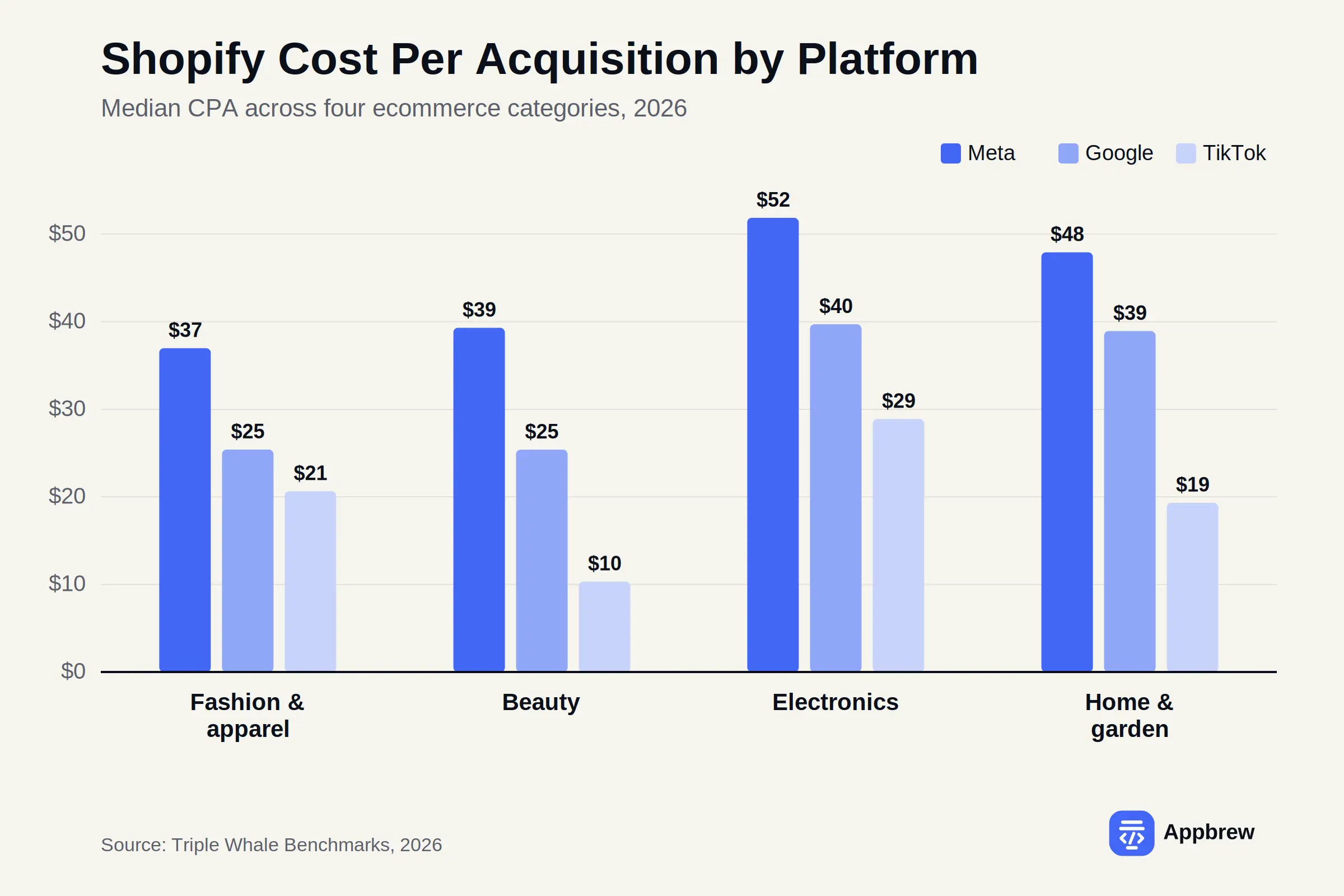
The latest Triple Whale data shows how median CPA varies across four major ecommerce categories:
|
Shopify store category |
Meta CPA |
Google Ads CPA |
TikTok CPA |
|
Fashion and apparel |
$36.98 |
$25.40 |
$20.64 |
|
Beauty |
$39.31 |
$25.39 |
$10.32 |
|
Electronics |
$51.86 |
$39.72 |
$28.90 |
|
Home and garden |
$47.93 |
$38.94 |
$19.33 |
|
Overall platform median |
$38.99 |
$28.14 |
$17.07 |
Electronics sits at the top because the purchases are considered, compared, and slow. It takes more touches, and more ad spend, to move someone from interest to checkout. The tighter and more niche your market, the more predictable your CPA becomes, which is its own kind of advantage.
Why are Shopify advertising costs rising in 2026?
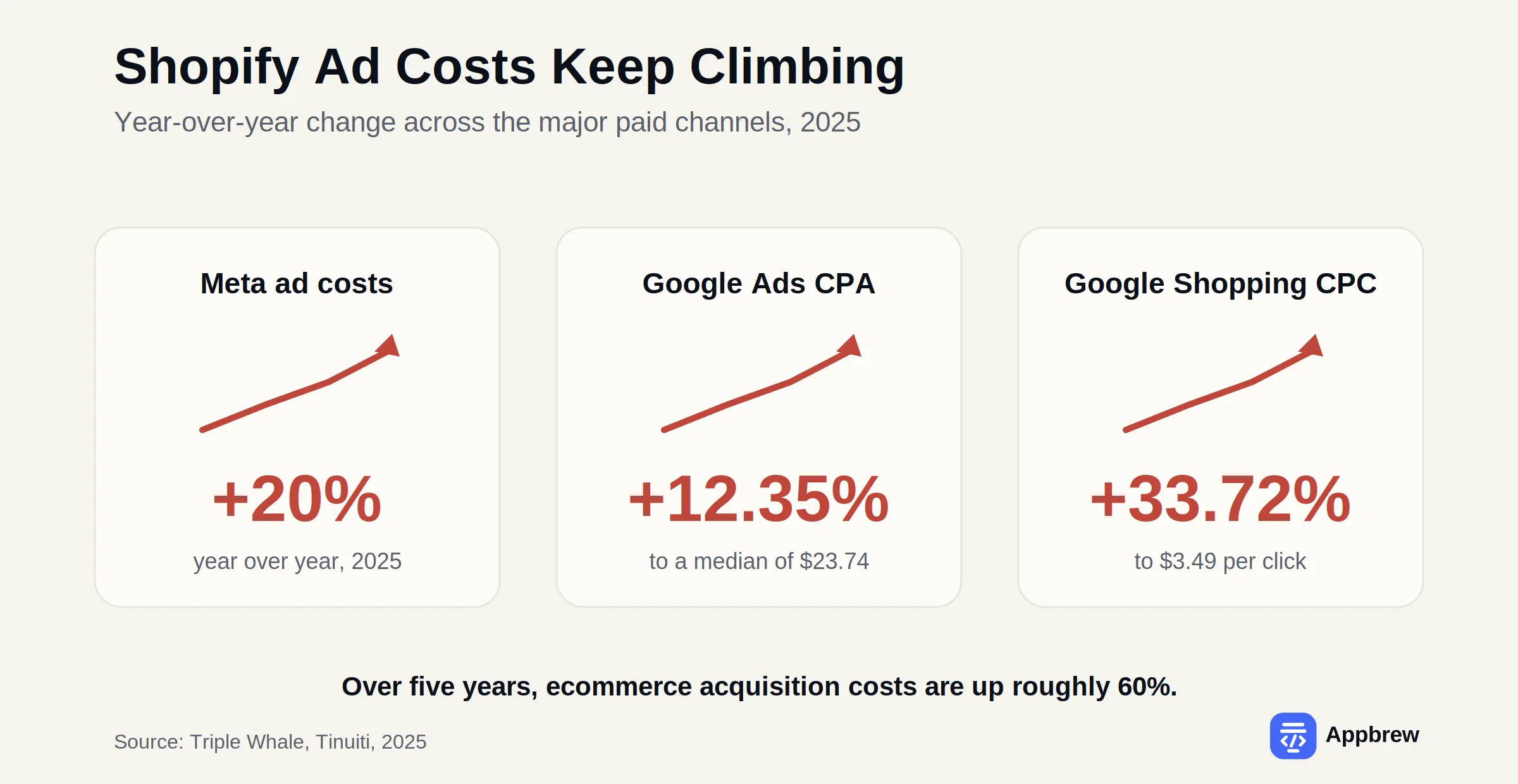
Ad costs aren't just high, they're climbing every year. Meta ad costs for Shopify brands rose 20% year over year in 2025, Google Ads CPA climbed 12.35% to a median of $23.74, and Google Shopping CPC jumped 33.72% to $3.49.
Over five years, ecommerce acquisition costs are up roughly 60%.
Three structural forces drive that, and none of them reverse.
1. Privacy changes gutted targeting
After Apple's iOS 14.5 update, only about 14% of iOS users opted into tracking. Meta's ROAS dropped 38% almost overnight, from 3.13 to 1.93.
"The cost to acquire a customer using social media ads had jumped from $27 per customer to $270," founder Andy Hayes told the Wall Street Journal.
2. Deep-pocketed competitors inflated the auction
Temu spent roughly $1.2 billion on Meta ads in 2023 alone, and Shein has run the same playbook. That spend raises prices for every merchant in the auction. You're bidding against companies buying customers at a loss to grab market share.
3. Targeting precision keeps degrading
As tracking signal drops, platforms lean on broad targeting and lookalike audiences built on thinner data. The result is lower conversion and higher cost per click for the same placement.
"What has gone away is the idea that it's as simple as cutting out the middleman and taking advantage of really cheap customer acquisition. That story has not played out really well," said Allbirds co-CEO Tim Brown.
Despite Meta's higher costs, 68% of Shopify ad budgets still flow there, with 23% to Google and 8% across TikTok, Pinterest, and others. Most brands are concentrating on the platform where costs rise fastest, and feeling every increase.
What factors affect your Shopify advertising cost?
Two stores can sell the same product on the same platform and pay very different amounts per customer. Five things move your number the most.
1. Your industry
The more brands bidding for the same buyer, the more you pay. Apparel, beauty, and supplements are crowded, so clicks cost more. A quieter niche stays cheaper. Check how many sellers compete for your category before you trust any "average" cost.
2. Who you target
Cold audiences cost more than retargeting. Reaching a stranger takes more spend than nudging someone who already visited your store. Retargeting converts better, but the audience is small, so you can't scale on it alone. Growth means paying the premium for cold traffic.
3. Your creative
Platforms reward ads people engage with. Meta and Google both lower your costs when your creative performs and raise them when it flops. A strong video can cost far less per view than a flat product image. Weak creative taxes every dollar behind it.
4. How you bid
Automated bidding (Meta's Advantage+, Google's Performance Max) lets the algorithm chase conversions and often lowers your cost per customer, but it needs volume to learn. Manual bidding gives you more control on a small budget.
5. The season
Costs spike in Q4. Every store piles into the same auctions for Black Friday, and CPMs can jump 20% or more in November. On a fixed budget, your dollar buys less in December than in July. Plan for when you spend, not just how much.
How much should you spend on Shopify ads in 2026?
Enough to learn something, not so much that a bad test hurts. Most stores should start at $300 to $500 a month per platform. Below that, you don't get enough clicks or conversions to know what's working, so you're guessing. What you spend after that depends on where your store is.
New store: $10 to $30 a day
If your store is new, start with $10 to $30 per day on one platform. That gives you a monthly testing budget of approximately $300 to $900.
Keep the test focused. Choose one product or collection, one platform, one clear offer, and a small group of creatives. Spreading a limited budget across Meta, Google, TikTok, Pinterest, and Reddit will leave each campaign with too little data to judge properly.
|
Know this: Advertising cannot fix weak product-market fit, an unclear offer, poor reviews, or a storefront that does not convert. If visitors click but rarely add products to their cart, increasing the budget will usually increase the loss. |
Growing store: $50 to $150 a day
A growing store with an established conversion rate and regular sales can consider spending $50 to $150 per day, or approximately $1,500 to $4,500 per month. Add a second platform, build proper retargeting, and test new audiences against your winners.
Watch your cost per customer as you scale, because it usually creeps up when you push past your best audiences. That creep is normal. Just don't let it pass what a customer is worth to you.
Scaling brand: $150+ a day
There is no fixed upper limit for a scaling brand. The right budget is the amount you can spend while continuing to acquire profitable customers.
The moment scaling drives that cost past your margin, you've found your ceiling for now. More spend won't fix it. Better creative, better retention, or a better offer will.
The number that actually decides your budget: Break-even ROAS
The figure that tells you whether to speed up or stop is your break-even ROAS: how many dollars back per ad dollar you need just to cover costs.
The formula is simple:
|
100 ÷ your profit margin = break-even ROAS. |
Run a 40% margin? You need 100 ÷ 40 = 2.5. Any campaign under 2.5x is losing money, even though the dashboard shows revenue. Any campaign above it has room to scale. That one number turns "how much should I spend" from a guess into a decision.
What's a good ROAS for Shopify ads?
A common rule of thumb calls a 3:1 ROAS "good," meaning $3 back for every $1 spent. But the real answer depends on your margin. At 50% margins, a 2:1 ROAS breaks even. At 25% margins, you need at least 4:1 just to cover costs.
Across ecommerce, the average ROAS sits around 2.87:1, and it varies widely by category.
Here's where Shopify stores actually land in 2026, based on TrueProfit's benchmark data from 5,000+ stores (Aug–Sep 2026):
|
Industry |
Average ROAS |
|
Jewelry & Accessories |
8.1 |
|
Furniture |
5.7 |
|
Luggage & Bags |
5.3 |
|
Sporting Goods |
4.5 |
|
Home & Garden |
3.9 |
|
Apparel & Accessories |
3.2 |
|
Toys & Games |
3.1 |
|
Animals & Pet Supplies |
2.9 |
|
Electronics |
2.5 |
|
Health & Beauty |
2.4 |
The spread is huge. Jewelry is a ROAS leader in 2026, it runs an 8.1x average while health and beauty sits at 2.4x, and that gap is mostly margin and consideration time, not ad skill.
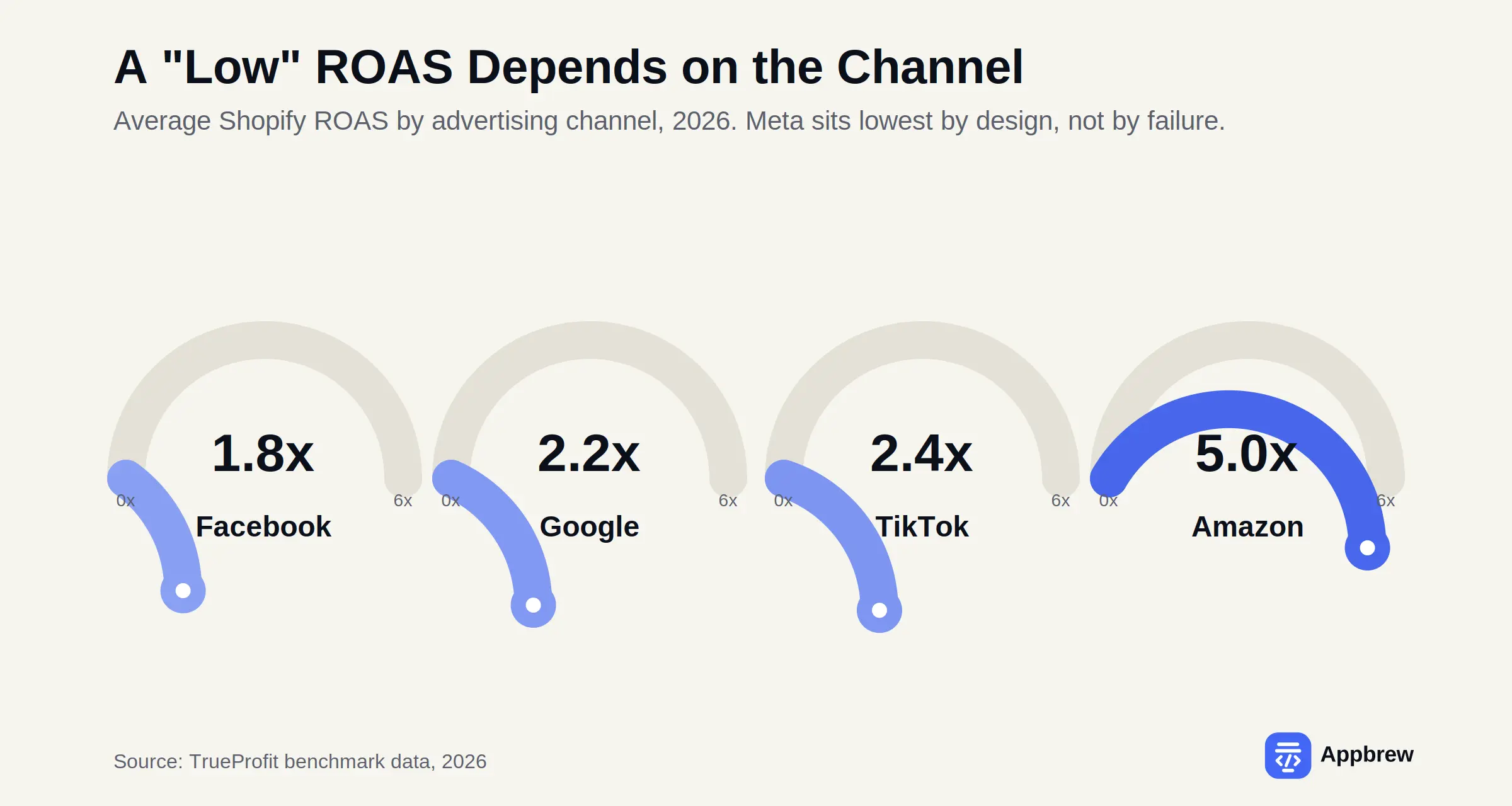
Channel matters just as much. Facebook averages 1.8x, Google 2.2x, TikTok 2.4x, and Amazon 5.0x. A "low" Meta ROAS isn't necessarily a broken campaign. It's the platform norm.
But every one of these numbers has the same flaw: they measure ROAS on the first transaction. That's the problem.
When 72% of ecommerce customers only buy once, Day-1 ROAS is measuring the value of customers who will never come back. It tells you whether the first sale was profitable. It says nothing about whether acquiring that customer was profitable.
Take a store with an $85 average order value and a $70 CAC. On the first transaction, ROAS is 1.2:1. By traditional metrics, that campaign is a loss.
Now factor in repeat purchases:
- 27% of first-time buyers make a second purchase
- After the second, 49% make a third
- After the third, 62% make a fourth
With a 2.3-purchase average lifetime, LTV reaches roughly $220. LTV-adjusted ROAS is 3.14:1. That same "unprofitable" campaign is actually making money.
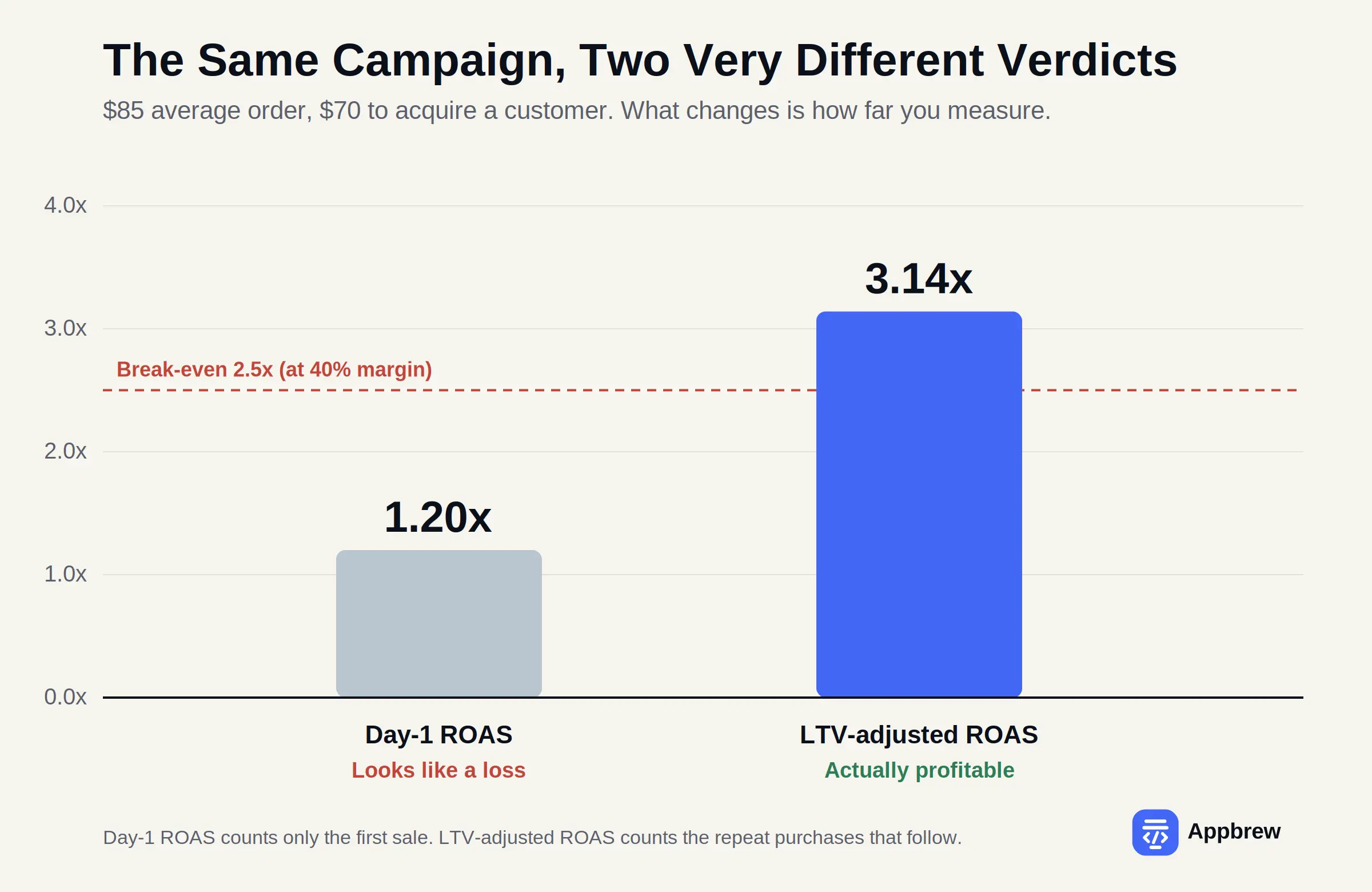
Most brands optimize ads against a metric that ignores most of the customer's value. Standard ROAS is a fine operational number for the ad platform. It's a poor one for judging whether your acquisition economics are actually healthy.
The hidden costs of Shopify advertising in 2026
Your ad dashboard shows how much you spent and how much revenue the platform attributed to it. It does not show how much margin disappeared after the click. Four costs give you a more accurate view.
1. One-time buyers
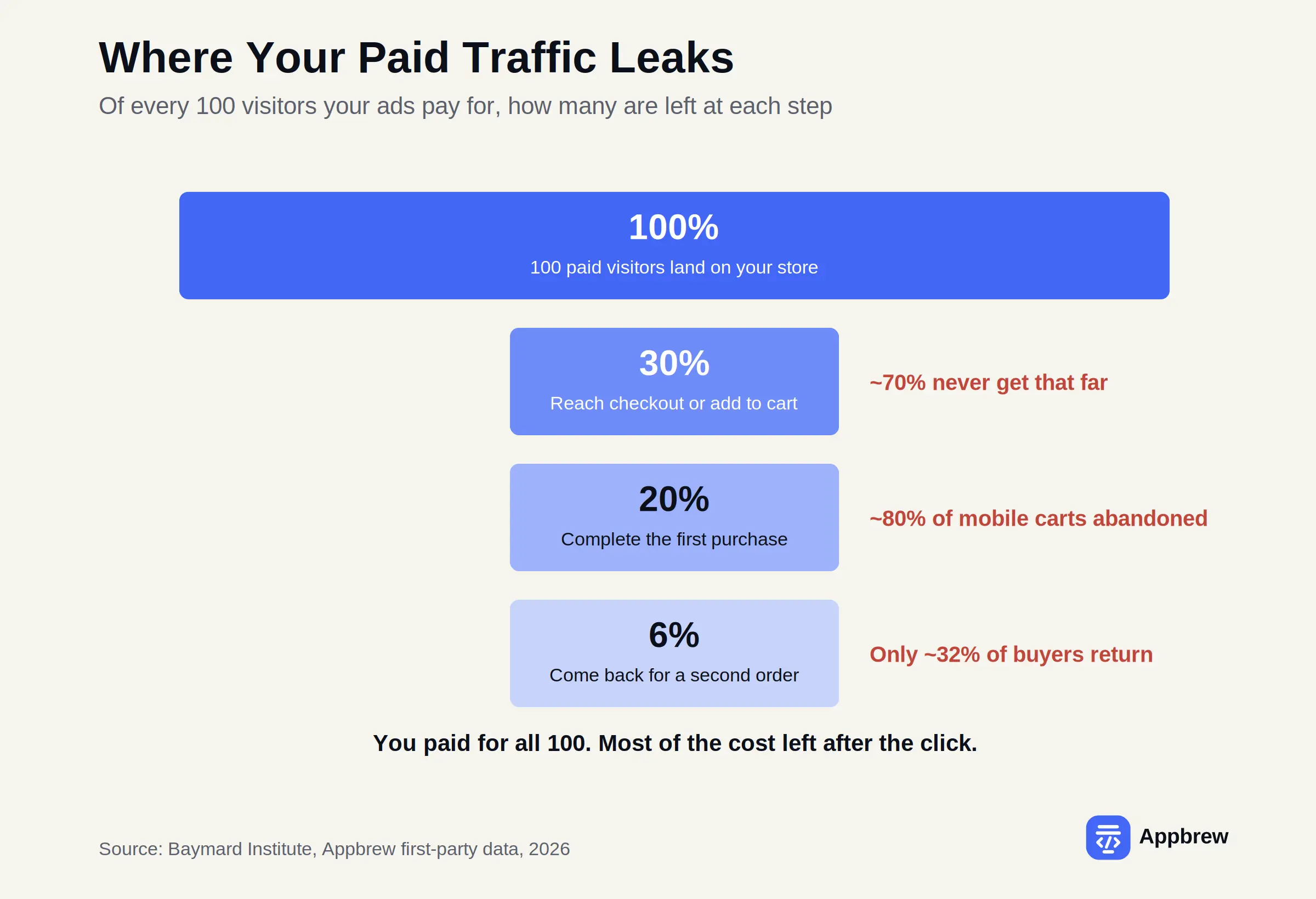
Most first-time buyers never return. Across Appbrew's 250+ Shopify brands, only 32% of app buyers place a second order, and on the open web it runs lower.
Brands now lose an average of $29 per newly acquired customer, up from about $9 five years ago, a 222% rise. Without a repeat purchase to close that gap, the unrecovered CAC becomes a permanent loss.
2. Cart abandonment
Cart abandonment averages 70.22% in 2026, and about 80% on mobile, where most Shopify traffic lands. For every 100 shoppers your ads push to a cart, 70 to 80 leave without buying, after you've already paid for the click.
Most reasons have nothing to do with your ads: surprise shipping and fees (48%), forced account creation, security worries, and a slow or clunky checkout. That's why fixing checkout lowers your effective acquisition cost more reliably than raising budget does.
3. Retargeting the same shopper twice
Retargeting works, with conversion lifts of 35 to 38% and roughly 50% lower CPA than search. But it's still a second charge to reach someone your first ad already paid for. Social retargeting runs $5 to $12 CPM on top of creative and tooling, so every recovered sale carries the cost of two impressions instead of one.
4. Weak retention and low LTV
The average Shopify store loses 70 to 75% of its customers year over year, and that decides whether acquisition is survivable at all. A healthy LTV:CAC ratio is 3:1, so a $70 CAC needs about $210 in lifetime value to clear the bar, and a single first order rarely gets close.
Sources: Appbrew first-party data (2026), SimplicityDX (2026), Baymard Institute (2026), Bain & Company
How to Reduce Shopify Advertising Costs in 2026? 4 steps
You can't out-spend rising ad costs. But you can lower how much you depend on paid acquisition, and that's where the margin comes back. Four levers do most of the work.
1. Shift from acquisition to retention
Every repeat purchase you earn is an acquisition you didn't pay for. That is why retention has such a large effect on profit.
Chewy is the extreme proof, running 90% of revenue from existing customers on an app-based subscription model. Not every Shopify brand can build a subscription business, but the principle is the same: predictable repeat purchases reduce the pressure to acquire a new customer for every order.
2. Reduce ad dependency with a mobile app
The biggest retention lever for a Shopify store is a mobile app, because it fixes the exact leaks that inflate ad costs: it converts the paid traffic you already bought, and it re-reaches customers for free.
For example:
- Sneaker Politics drives 58% of in-app purchases through push notifications, at zero ad spend, replacing what would otherwise be paid retargeting. Repeat purchase rate runs 2.4x higher in-app.
- Dermaclara converts at 8.3% in-app versus 1.01% on mobile web, roughly 8x, so the same paid click works far harder.
App users also spend more and stay longer (Anatomie 5x higher LTV), which widens the CAC you can profitably afford.
{{cta}}
3. Use email, SMS, and SEO to reduce paid dependency
Paid traffic stops the second you stop paying. Email, SMS, direct traffic, and organic search can continue producing visits and orders without charging you for every click.
- Klaviyo’s 2026 benchmarks found that automated email flows generated nearly 41% of email revenue from only 5.3% of sends.
- Organic search drives 43% of all ecommerce traffic and keeps arriving after the work is done.
None of this replaces paid. It reduces how much paid traffic you need to reach the same revenue target.
Suggested Read: Shopify SEO Checklist: 34 Steps to Rank in 2026
4. Tighten campaign efficiency
Campaign optimization helps you avoid overpaying for that customer in the first place.
- Let AI bidding do the heavy lifting. Meta Advantage+ and Google Performance Max lower cost per customer once they have conversion volume to learn from.
- Add negative keywords on Google so you stop paying for clicks that never buy.
- A/B test creative, not just audiences. Creative is the single biggest lever on Meta costs, and a stronger hook lowers your effective CPM.
- Scale gradually. Jumping budgets resets the algorithm's learning and spikes CPA. Raise in steps.
Sources: Bain & Company, Appbrew case study library (2026), Ringly (2026), ecommerceFastlane (2026)
When are Shopify ads too expensive to run?
When you lose money on every order and scaling only loses more.
Use this calculation:
First-order contribution profit = order revenue − product cost − discounts − shipping subsidy − payment fees − variable fulfillment and return costs
Then compare that figure with your fully loaded CAC.
If it costs $50 to acquire a customer who nets you $30, more ad spend doesn't fix that. It multiplies the loss.
Two situations usually mean advertising is not the first problem to solve:
- Your funnel is not converting. If visitors click but rarely add products to their carts or complete checkout, more spend will buy more abandonment. Fix the product page, checkout experience, site speed, trust signals, or offer first.
- Your offer is weak. Advertising can expose an offer to more people, but it cannot create product-market fit. Thin reviews, unclear positioning, uncompetitive pricing, or a product customers do not want will not improve simply because the budget increases.
Ads become safer to scale when customer contribution profit, including repeat purchases supported by real cohort data, exceeds acquisition cost within the payback period your cash flow can support.
Making expensive Shopify ads profitable
In 2026, making Shopify ads profitable depends less on finding cheaper clicks and more on earning more from the traffic you already buy. If mobile visitors convert poorly, abandon checkout, or never return, your effective customer acquisition cost keeps rising even when the platform metrics look acceptable.
Across the 250+ Shopify brands we work with, the strongest gains often come after the click. A better app experience converts more paid traffic, while push notifications recover carts and bring customers back without another per-click or per-impression charge. This gives each acquisition more opportunities to generate revenue.
Meta and Google will remain important acquisition channels. The goal is to make each acquired customer valuable enough to support higher advertising costs. When conversion rates, repeat purchases, and contribution margin improve, the same Shopify ad spend can generate more profitable revenue instead of simply buying more traffic.
{{cta2}}
FAQs
Does Shopify charge for advertising?
No. Shopify doesn't charge an advertising fee. Your ad budget goes directly to the platform you run on, whether that's Meta, Google, TikTok, or Pinterest. Shopify's own tools, like Shop Campaigns and Shopify Audiences, help you run and route that spend, but the money still goes to the ad auction, not to Shopify.
Does Shopify advertise your store for you?
Not automatically. Shopify gives you the tools to advertise (campaign management in admin, Shop Campaigns for pay-per-sale ads, and Shopify Audiences for targeting), but you set up and fund the campaigns yourself. The one exception is Shop Campaigns, where Shopify places ads across the Shop app and partner channels on your behalf and you pay per customer acquired, not per click.
How much should a beginner spend on Shopify ads?
Start with $10 to $30 per day on a single platform, roughly $300 to $900 a month. That's enough to gather real data without risking much on an unproven setup. Keep it focused on one product, one offer, and a few creatives, and don't scale until a campaign hits a cost per customer you can actually afford.
What's a good ROAS for a Shopify store?
A 3:1 ROAS is the common rule of thumb, but the real answer depends on your margin. At 50% margins a 2:1 return breaks even; at 25% margins you need at least 4:1. In 2026, the ecommerce average sits near 2.87:1, and it varies widely by category, from about 2.4x in health and beauty to 8x in jewelry.
What's the cheapest way to advertise a Shopify store?
The cheapest paid clicks are usually on TikTok and Pinterest, but cheap clicks in the wrong niche still waste money. The genuinely lowest-cost channels are owned ones: email and SMS return $36 to $40 per dollar spent versus about $2.50 for paid ads, and organic search keeps driving traffic long after the work is done. Most brands lower their blended acquisition cost by leaning on those, not by chasing the cheapest ad platform.
Why do Shopify advertising costs vary so much?
Because the auction prices every advertiser individually. Your industry's competition, whether you're targeting cold or warm audiences, your creative quality, your bidding strategy, and the season all move your number. That's why two stores selling the same product on the same platform can pay very different amounts per customer.
Do Shopify ads get more expensive over time?
Yes. Meta ad costs for Shopify brands rose 20% year over year in 2025, and ecommerce acquisition costs are up roughly 60% over five years. Privacy changes, deep-pocketed competitors like Temu, and degrading targeting precision are pushing costs up structurally, which is why retention and owned channels matter more each year.