

How AI dynamic pricing works, 8 real examples that worked or backfired, US surveillance pricing rules as of Nov 2026, and a safe playbook for Shopify.
Your best seller sold out in four days last month, at the same price it had in January. Meanwhile 600 units of last season's colorway are still sitting in the warehouse, also at the same price. Somewhere in between, a competitor dropped their price on a near-identical product and you found out from a customer email.
None of that is a demand problem. It's a pricing problem, and specifically a speed problem. Your prices change when someone on the team remembers to change them, while demand, stock and competitors change every day.
AI dynamic pricing promises to close that gap. It also comes with real legal and trust risks. This guide covers how AI pricing actually works, real dynamic pricing examples (including the ones that backfired), what US law says as of November 2026, and how a Shopify brand can use it without becoming the next headline.
TL;DR
- Dynamic pricing AI uses machine learning to adjust prices automatically from signals like demand, stock levels, competitor prices and time. Everyone sees the same price at a given moment.
- Personalized (or "surveillance") pricing is different. It sets a price for an individual based on their personal data, and it is the part regulators are targeting. New York requires a disclosure, Maryland banned it for large grocery retailers from October 1, 2026, and the FTC proposed an enforcement policy on August 19, 2026.
- The upside depends on the SKU. Dynamic pricing earns most on clearance, seasonal and comparison-shopped products, where customers already expect prices to move.
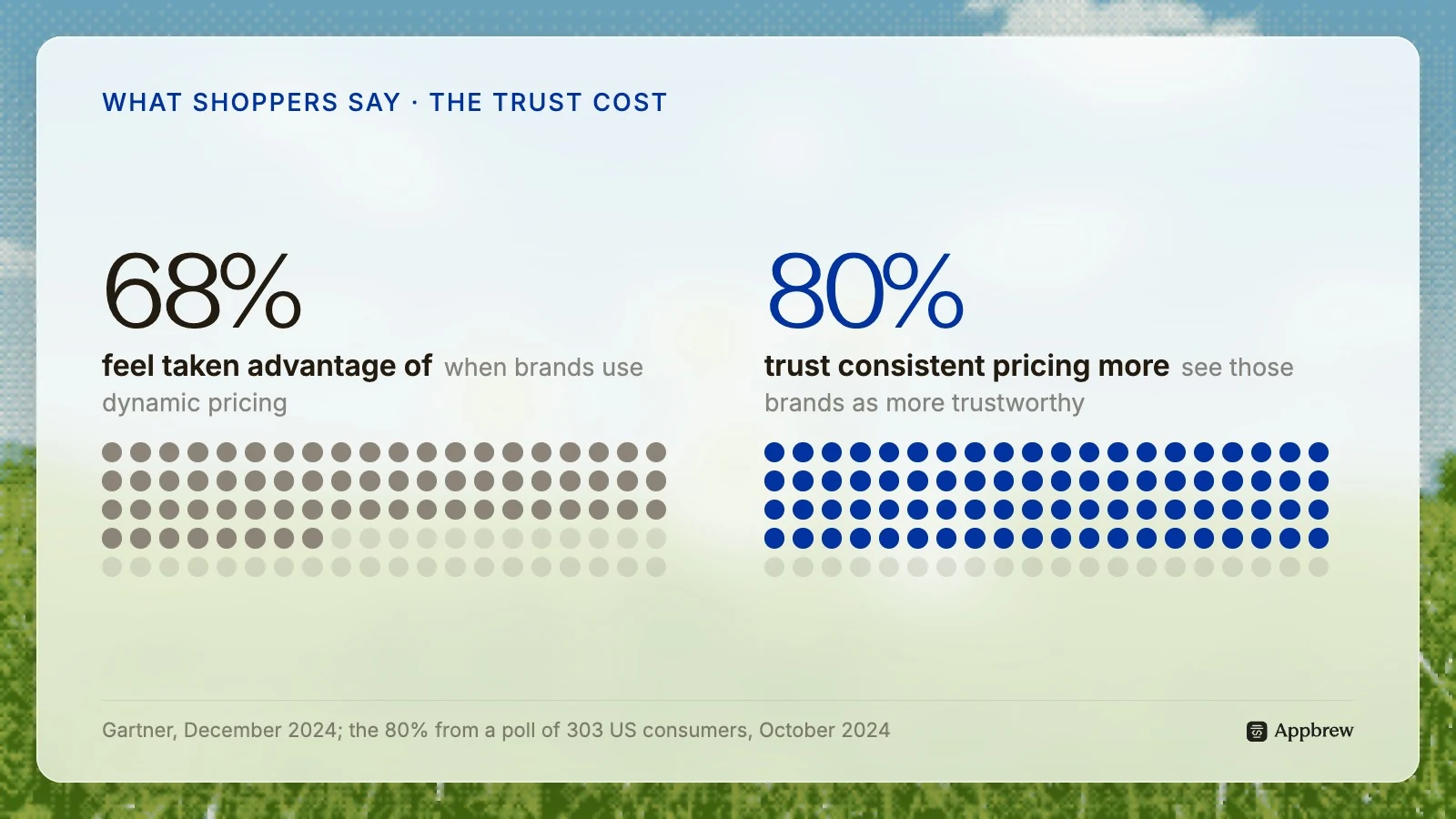
- The trust cost is real too. 68% of consumers say they feel taken advantage of when brands use dynamic pricing (Gartner, December 2024).
- For most Shopify brands, the safe play is rules-based AI pricing on markdowns and competitor gaps, with guardrails, plus visible offers (app-only deals, loyalty pricing) instead of hidden personal prices.
What is dynamic pricing AI?
Dynamic pricing AI is software that uses machine learning to set or recommend prices automatically, based on live signals such as demand, inventory, competitor prices, seasonality and time of day. Unlike a fixed price list, it updates continuously within limits you set, so prices move as market conditions move.
The idea isn't new. Airlines have priced seats this way since the 1980s. What changed is access. A Shopify brand with 300 SKUs can now plug in a competitor-monitoring and repricing tool for less than a monthly agency retainer, and the models doing the work have moved from simple "if competitor drops, drop 1%" rules to forecasting demand at the SKU level.
Two words get used loosely here, so it helps to pin them down.
- Dynamic pricing changes the price for everyone based on conditions. Uber's surge price is dynamic.
- Personalized pricing changes the price for one person based on who they are. Regulators increasingly call this surveillance pricing.
The same algorithm can do both. The difference is what data you feed it, and that difference now decides whether you're running a pricing strategy or a compliance risk.
How does AI dynamic pricing work?
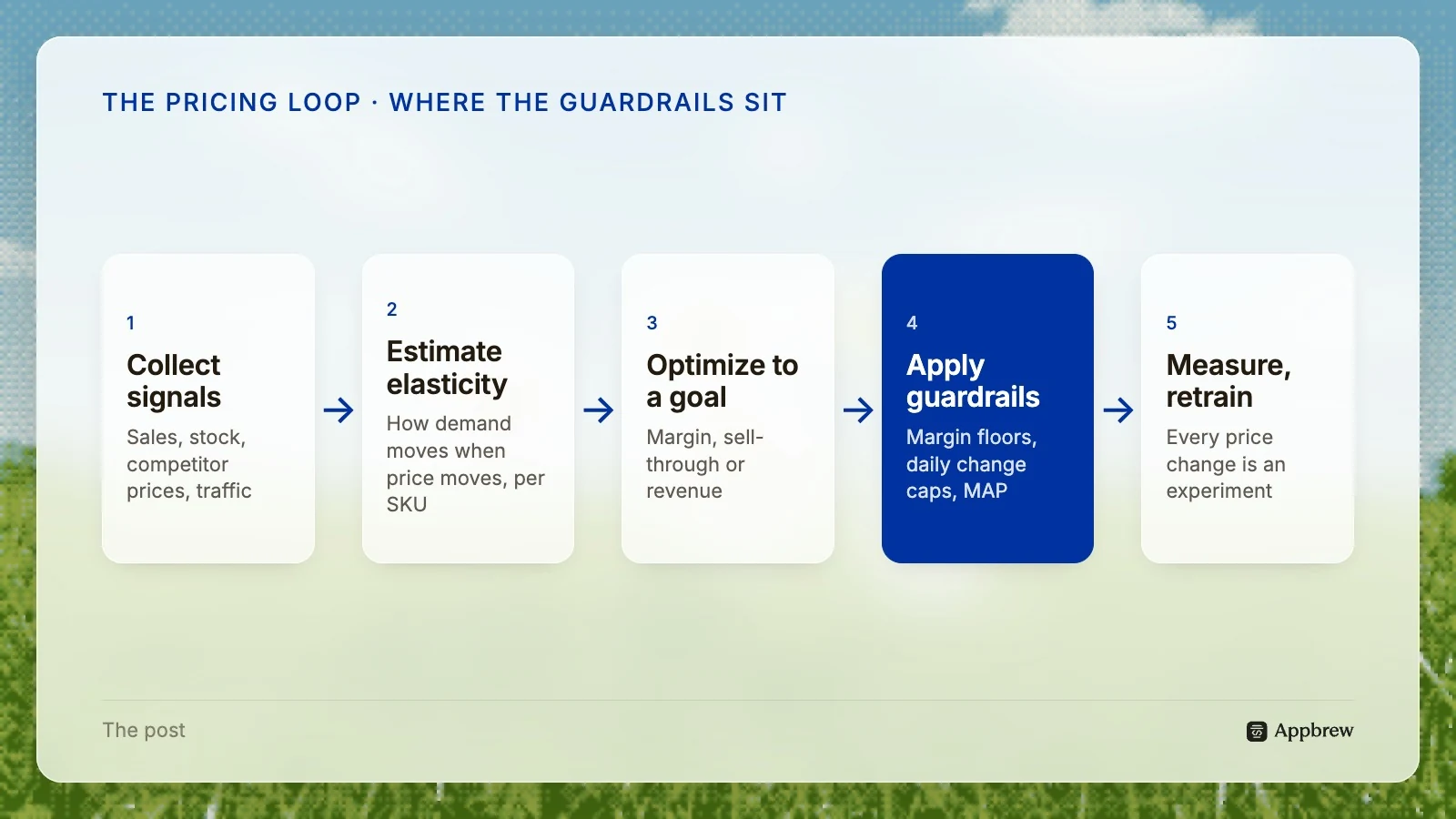
AI dynamic pricing works in four steps. It collects signals (sales velocity, stock, competitor prices, traffic), forecasts how demand responds to price for each product, picks the price that best meets your goal (margin, sell-through or revenue), and applies it within floors and ceilings you set. Then it measures the result and adjusts.
In practice, the loop runs like this.
- Collect signals. Your own sales history and conversion rate by price point, current inventory and days of cover, competitor prices scraped or pulled from feeds, seasonality, and sometimes external data like weather or events.
- Estimate price elasticity. The model learns how much demand for each SKU moves when the price moves. A hero product with loyal buyers might barely react to a 10% increase. A commodity accessory might lose half its sales.
- Optimize against a goal. You choose the objective. Clearing aged stock before a season ends calls for a different price than protecting margin on a bestseller that's about to stock out.
- Apply guardrails. Minimum margin, maximum change per day, MAP (minimum advertised price) agreements, and "never go below this" floors. Good tools won't touch a price outside these bounds.
- Measure and retrain. Every price change is an experiment. The model compares predicted and actual sales and updates.
The guardrails matter more than the model. Most pricing disasters (a $0.01 listing, a 400% overnight spike) come from missing limits, not bad math.
{{cta}}
Dynamic pricing vs personalized pricing: what's the difference?
Dynamic pricing changes prices for all shoppers based on market conditions, so two people looking at the same product at the same moment see the same price. Personalized pricing shows different people different prices based on their personal data, such as browsing history, location or device. US regulators treat the second as a distinct, higher-risk practice.
| Aspects | Dynamic pricing | Personalized (surveillance) pricing |
|---|---|---|
| What sets the price | Demand, stock, competitors, time | The individual shopper's personal data |
| Same price for everyone at a given moment? | Yes | No |
| Typical examples | Uber surge, airline fares, clearance markdowns | Different prices by browsing history or device |
| US legal status (Nov 2026) | Generally legal; price-gouging rules apply in emergencies | Disclosure required in New York; banned for large grocers in Maryland; FTC enforcement policy proposed |
| Customer trust risk | Moderate, depends on transparency | High |
There's a gray zone in between. Segmented offers, like a student discount, a loyalty tier price or an app-only deal, give different groups different prices. The difference is that the customer can see the rule and choose to qualify. Maryland's new law, for example, carves out loyalty programs and discounts.
Dynamic pricing examples: what worked and what backfired
The most useful dynamic pricing examples come from companies that ran it at scale and either built a business on it or paid for getting it wrong. These eight cover ride-hailing, travel, retail, grocery and live events.
1. Uber surge pricing
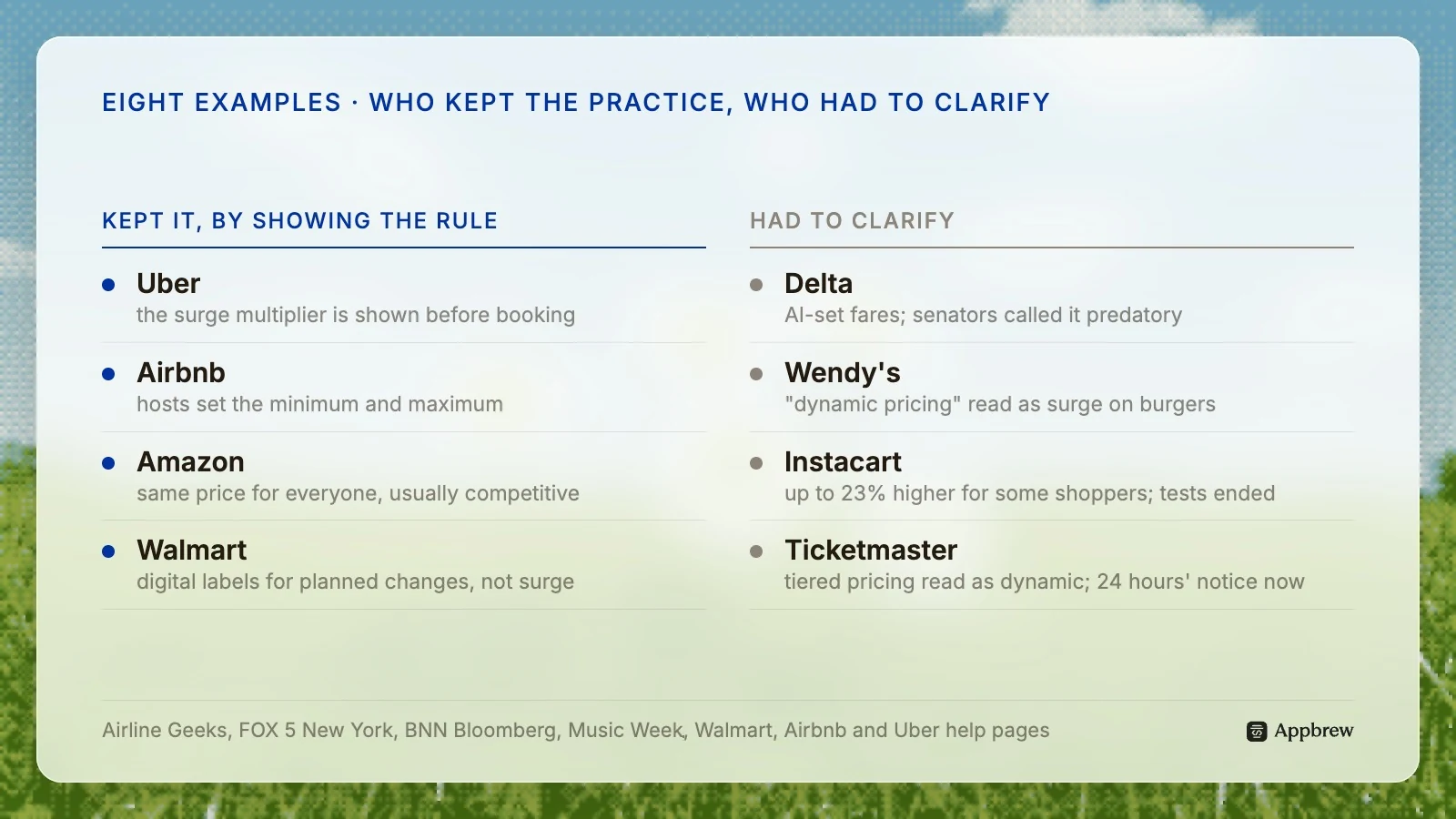
Uber raises fares when rider demand outstrips available drivers in an area, and shows the surge to the rider before they book. Uber's own driver guide frames surge as a way to pull more drivers onto the road where they're needed. The lesson is that dynamic pricing survives backlash when the customer sees the multiplier before paying and understands why it exists.
2. Airbnb Smart Pricing
Airbnb lets hosts turn on Smart Pricing, which adjusts nightly rates based on demand, seasonality and local listings, within a minimum and maximum the host sets (Airbnb Help Center). This is the cleanest model for merchants, because the algorithm suggests and the owner sets the bounds.
3. Delta and AI-set airfares
On its July 2025 earnings call, Delta said AI from pricing partner Fetcherr was setting about 3% of its domestic fares, with a goal of roughly 20% by the end of 2025 (Airline Geeks, July 16, 2025). The announcement drew criticism from US senators who called it predatory. Delta responded that its fares are based on trip-related factors, not individual data. For merchants, the takeaway is that the moment customers suspect "AI" means "personal," you're defending yourself.
4. Amazon's constant repricing
Amazon is the textbook ecommerce case. Its prices move frequently across millions of listings, and third-party sellers can switch on automated repricing rules in Seller Central. Shoppers have largely accepted it because the price is the same for everyone and usually competitive. If you sell on Amazon and DTC, your Shopify prices are being compared against a number that changes daily.
5. Walmart's digital shelf labels
Walmart said in March 2026 that roughly 2,300 US stores already use digital shelf labels and that it expects them to be chain-wide within a year (Walmart, March 2, 2026). Walmart says the labels make planned price changes faster and are not for surge pricing. The fact that it has to keep saying so tells you how sensitive shoppers are to the idea.
6. Wendy's "surge pricing" backlash
In February 2024, Wendy's CEO mentioned testing "dynamic pricing" on digital menu boards. Headlines read it as surge pricing on burgers, and Wendy's spent the following weeks clarifying that it would use the boards for discounts in slower hours, not higher prices at peak (FOX 5 New York, February 2024). Burger King ran a "No urge to surge" promotion in response. A pricing idea died on its name alone.
7. Instacart's price tests
In December 2025, a study by Consumer Reports, Groundwork Collaborative and More Perfect Union found some Instacart shoppers saw prices up to 23% higher than others for the same items, from the same store, at the same time. Instacart said these were randomized retailer tests, not personalized pricing, and ended all item price tests on December 22, 2025 (BNN Bloomberg, December 2025). Randomized or not, unexplained price differences read as unfair.
8. Ticketmaster and the Oasis tour
After fans saw ticket prices jump during the 2024 Oasis reunion sale, the UK's Competition and Markets Authority investigated. In September 2025 it concluded Ticketmaster had not used algorithmic dynamic pricing. The jump came from tiered pricing that opened a pricier tier when the cheaper one sold out. Ticketmaster still agreed to give fans at least 24 hours' notice of tiered pricing (Music Week, September 2025). Perception had already done the damage.
Across these examples, the pricing logic was rarely the problem. Transparency was. The companies that show the rule (Uber's surge multiplier, Airbnb's host-set limits) keep the practice. The ones that surprise customers end up issuing clarifications.
Is AI dynamic pricing legal in the US?
Yes, market-based dynamic pricing is legal in the US, subject to price-gouging laws during declared emergencies and antitrust rules. Personalized pricing based on individual data is where the law is changing fast. As of November 2026, New York requires a disclosure, Maryland bans it for large grocers, and the FTC has proposed treating undisclosed personalized pricing as deceptive.
Here's the state of play as of November 16, 2026. This is a summary, not legal advice, and it changes month to month.
- New York, Algorithmic Pricing Disclosure Act. Sellers that set a price with an algorithm using a consumer's personal data must show the notice "THIS PRICE WAS SET BY AN ALGORITHM USING YOUR PERSONAL DATA" (McGuireWoods, September 2026). The New York attorney general enforces it and can seek civil penalties of up to $1,000 per violation if a business doesn't fix the problem after notice. A federal judge dismissed the National Retail Federation's First Amendment challenge in October 2025. The Second Circuit heard the appeal on October 19, 2026, and had not ruled as of November 16, 2026 (Bloomberg Law, October 2026).
- Maryland, Protection From Predatory Pricing Act (HB 895). Signed April 28, 2026 and effective October 1, 2026, it bans surveillance pricing by food retailers with stores of at least 15,000 square feet and third-party grocery delivery services. Supply and demand, seasonality, loyalty programs and discounts are exempt (Hunton, April 2026).
- California, AB 325. Effective January 1, 2026, it bans using or distributing a "common pricing algorithm" as part of a conspiracy to restrain trade. This targets shared tools that use competitor data to coordinate prices, not your own repricing rules (office of Assemblymember Aguiar-Curry, October 2025).
- FTC proposed enforcement policy. On August 19, 2026, the FTC proposed a policy statement saying it will treat personalized pricing as deceptive or unfair under Section 5 of the FTC Act when the personalization and its basis aren't clearly disclosed. The comment period closed September 18, 2026, and the statement was still a proposal as of November 16, 2026 (FTC, August 2026).

For a Shopify brand, the practical line is simple. Pricing on market signals is fine. Pricing on who the customer is, without telling them, is where you'll need a lawyer and a disclosure.
Does dynamic pricing actually increase profit?
Yes, when it's applied to the right products with guardrails. The gains come from two places. Aged stock sells earlier and at a higher average price, and products shoppers compare every day stop losing sales to a cheaper listing. Hero products rarely gain much, because loyal buyers weren't price shopping in the first place.
The cost side is customer trust. In a Gartner survey released in December 2024, 68% of consumers said they feel taken advantage of when brands use dynamic pricing. In the same release, a Gartner poll of 303 US consumers in October 2024 found that 80% see brands with consistent pricing as more trustworthy (Gartner, December 2024).
That trade-off shapes the strategy. Run dynamic pricing where customers already expect prices to move (clearance, seasonal stock, commodity accessories, marketplaces) and keep hero-product prices stable. A 5% margin gain on slow stock is worth having. A 5% margin gain on your bestseller that costs you repeat buyers is not.
How should a Shopify brand use AI pricing?
A Shopify brand should start with AI-assisted markdowns and competitor-gap repricing on a defined set of SKUs, with hard margin floors and daily change limits. Keep core product prices stable, and deliver targeted value through visible offers, like app-only deals or loyalty pricing, rather than hidden personalized prices.
Pick the right products first
Split your catalog into three groups.
| Product group | Pricing approach | Why |
|---|---|---|
| Hero products (top 10% to 20% of revenue) | Stable price, planned promotions only | Repeat buyers notice changes and trust drops |
| Competitive or marketplace SKUs | Competitor-based repricing within MAP and margin floors | Shoppers comparison-shop these daily |
| Aged, seasonal or overstocked SKUs | AI-driven markdown cadence | Every week of holding cost eats margin |
A before and after (illustrative)
Take a hypothetical apparel brand with 600 units of a discontinued colorway. Before the change, it ran one 30% markdown in week 10, then a 50% clearance dump in week 14, clearing about 70% of the stock. After the change, a markdown tool drops the price 10% in week 6, watches sell-through, and steps down in 5% increments only when weekly velocity falls below target. Stock clears earlier and the average selling price lands higher, because most units sell at the first or second step instead of at 50% off. The numbers will differ for your store, but the shape holds: smaller, earlier, data-driven steps beat one panic markdown.
Use tools built for Shopify
- Competitor monitoring and repricing. Prisync's "Prisync AI | Dynamic Pricing" app syncs with Shopify and adjusts prices based on rules and competitor data, with plans listed from $49 per month and a 14-day free trial on the Shopify App Store (checked November 16, 2026). Enterprise brands often look at Competera, Pricefx or Wiser.
- Markdown and offer timing. Shopify's native discounts, automatic discounts and Shopify Flow can schedule and trigger price-based promotions without a separate pricing engine.
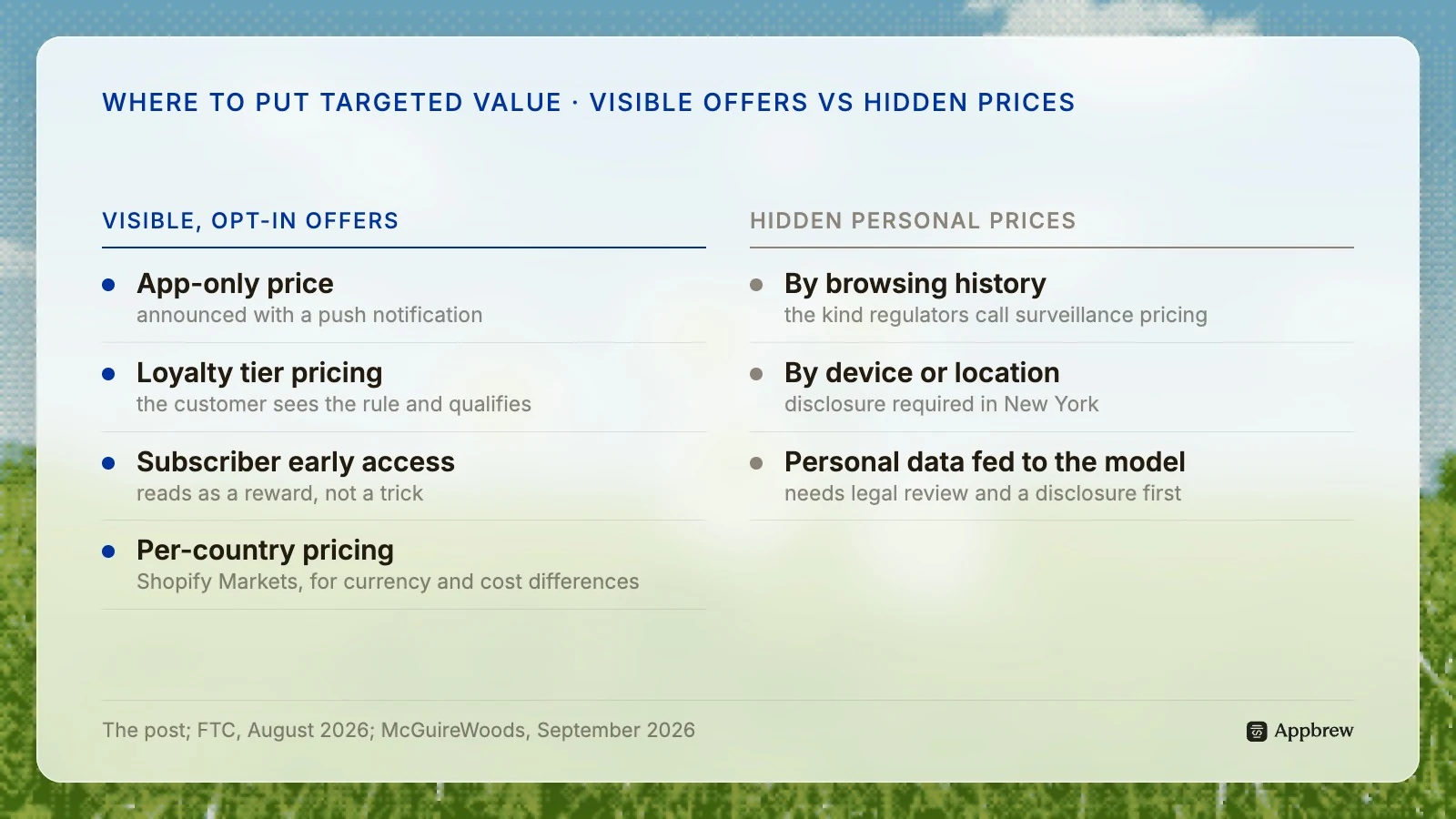
- Per-market pricing. Shopify Markets lets you set different prices by country, which covers currency and cost differences without touching individual shoppers.
For the wider tools, see our roundup of the best AI tools for ecommerce.
Make offers visible instead of personal
Here's where most Shopify brands get the most value with the least risk. Instead of quietly showing one customer a lower price, give a defined group a clearly labeled offer they can see and choose, such as an app-only price, a loyalty tier discount or early access for subscribers. The customer knows the rule, so it reads as a reward, not a trick.
A mobile app is well suited to this. App users are your most engaged buyers, and you can reach them directly with push notifications when an app-exclusive price goes live, instead of buying the attention again on ads. Our guide to discounts and promotions covers the offer types that work best in-app, and personalization handles which offers each shopper sees on the home screen, without changing the list price.
With an Appbrew app, Milo builds from your Shopify store, so an app-only offer section can be drafted from your existing products and collections. Milo drafts the change and waits for your yes before anything goes live.
Dynamic pricing checklist for Shopify brands
- Define the goal per product group, whether that's margin, sell-through or revenue.
- Set hard floors (minimum margin) and ceilings (maximum price change per day or week).
- Confirm MAP agreements with brands you resell and encode them as limits.
- Exclude hero products from automated changes.
- Use market signals only, such as demand, stock, competitors and time. Don't feed the model personal data unless you have legal review and a disclosure in place.
- Keep a log of every automated price change for at least a year.
- Review margin, sell-through, refund rate and customer complaints mentioning price every month.
- Put targeted value into visible, opt-in offers (app-only, loyalty, subscriber) rather than hidden price differences.
For peak-season planning, our BFCM discounting strategies guide covers how to stack these offers without training customers to wait for sales.
{{cta2}}
Frequently asked questions
What is dynamic pricing AI?
Dynamic pricing AI is software that uses machine learning to adjust prices automatically based on demand, inventory, competitor prices and timing. It works within limits the merchant sets, such as minimum margins and maximum daily changes, and shows every shopper the same price at a given moment.
Is dynamic pricing legal in the US?
Yes. Pricing based on market conditions is legal, subject to price-gouging laws during declared emergencies and antitrust rules. Personalized pricing based on an individual's personal data is more restricted. New York requires a disclosure, Maryland bans it for large grocers from October 1, 2026, and the FTC proposed an enforcement policy in August 2026.
What is an example of dynamic pricing in ecommerce?
Amazon is the best-known example. Its prices change frequently based on demand and competitor prices, and sellers can turn on automated repricing in Seller Central. Clearance markdowns that step down as stock ages are a simpler example most Shopify stores already run manually.
Does dynamic pricing hurt customer trust?
It can. Gartner found 68% of consumers feel taken advantage of when brands use dynamic pricing (December 2024). Trust holds up better when the rule is visible, as with Uber's surge multiplier, and when core products keep stable prices.
Can I use dynamic pricing on Shopify?
Yes. Shopify doesn't include a dynamic pricing engine, but apps such as Prisync connect to Shopify for competitor-based repricing, and Shopify's automatic discounts, Shopify Flow and Shopify Markets cover scheduled promotions and per-country pricing.