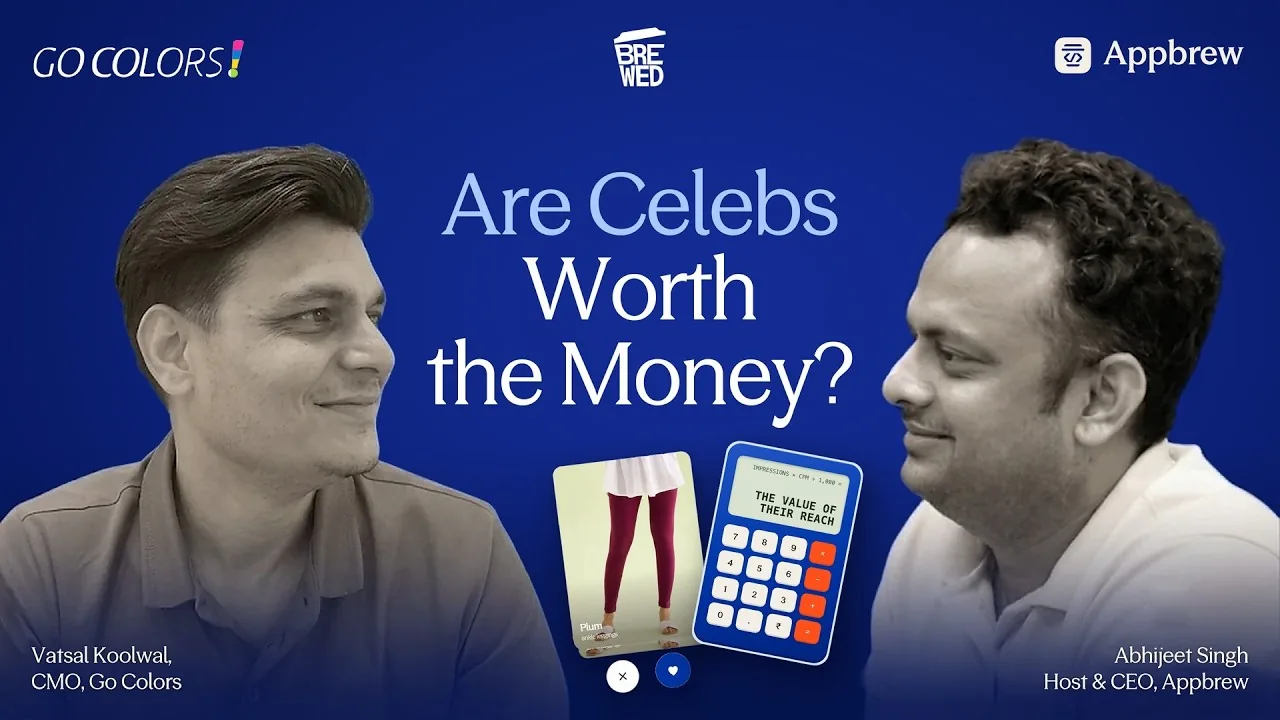
Celebs, Views and What Really Sells: Go Colors CMO Vatsal Koolwal on Building a ₹1,000 Crore Brand


Views can be bought. Loyal customers can't. Vatsal Koolwal, CMO of Go Colors, on building a 1,000 crore bottomwear brand that customers come back to for a decade.
About this episode
Vatsal Koolwal spent nearly a decade at Amazon, the kind of company people tend to retire from. The last few years were spent running marketing for Amazon's private label business, inside an ecosystem that teaches customer obsession and data discipline but keeps a marketer's world small. Vatsal wanted the offline world too: stores, high streets, retail marketing. Go Colors offered it at scale. It's a listed brand doing almost 1,000 crore in revenue, with a lot of headroom left in digital, DTC and brand building.
In this episode of Brewed, Vatsal breaks down why bottomwear shopping works like matchmaking, and how to split budget between brand and performance at 50 crore versus 1,000 crore. Vatsal also explains why views are "a highly overrated metric." The Go Colors app converts at three times the website, with nine times the engagement time. And stores that once folded and stacked every legging into a colour shade card are making way for 5,000 square foot flagships.
This conversation is for fashion CMOs deciding where the next rupee goes, DTC founders weighing their first store or their first celebrity, and anyone who suspects the loudest metric in the room isn't the one that matters.
What you'll learn
- The Go Colors story: from Amazon's private label to a 1,000 crore bottomwear brand
- Bottomwear shopping is matchmaking
- Mental availability is an output, not an input
- Brand vs performance: how to split the budget at 50 crore and at 1,000 crore
- Celebrity partnerships: borrowing associations, not buying views
- AI in fashion marketing: discovery moved online, and teams got sharper
- The app: three times the conversion, nine times the engagement
- Offline stores are an underappreciated marketing asset
- Quick commerce is a supply problem, not a demand problem
- The broader lesson: retention outlasts reach
The complete breakdown
1. The Go Colors story: from Amazon's private label to a 1,000 crore bottomwear brand
Ten years at Amazon is a long time. Most people who get that far stay.
Vatsal Koolwal spent nine and a half years there, the last few running marketing for Amazon's private label business. Amazon laid the foundation: customer obsession, operational discipline, SOPs and a data-driven way of making decisions.
But marketing inside Amazon means marketing inside a constrained ecosystem. Much of what a marketer wants to learn happens outside it.
"I wanted to solve problems that were beyond that ecosystem. I especially wanted to experience the offline world of marketing, retail marketing."
Go Colors was the intersection Vatsal was looking for. It wasn't a turnaround or a startup. It was a scaled, listed brand at almost 1,000 crore in revenue with healthy fundamentals, and plenty of room to grow in digital, DTC and brand building.
Vatsal's definition of the job is simple. Marketing is demand generation. Sometimes that means brand building, staying top of mind over the long term. Sometimes it means performance marketing, capturing intent that already exists.
"At the very core, it is about generating demand and affecting consumer behavior at scale, which I don't think any other function does."
2. Bottomwear shopping is matchmaking
Topwear is an impulse buy. Bottomwear isn't.
Go Colors operates in a niche, women's bottomwear, and has reached real scale inside it. What the team has learned is that the customer arrives with a very different mindset.
"Bottomwear shopping is almost like matchmaking. Most of our customers have already purchased the top. Now they're looking for a match, something that works for the use case that is already in their head."
The evaluation set is tight. She comes in knowing what she wants, and the brand's only job is to have it. That is the logic behind offering the widest bottomwear range in the market: the more options on the shelf, the more matches get made.
It also explains the brand's retention. A successful match is hard to forget, and customers who find one keep coming back, some of them over 7, 8 or 10 years.
"If you are able to satisfy the customer once, then you have a loyal customer for a very long time."
The work that follows is about discovery: helping her see that this particular pair is the perfect match for the top she already has in mind.
3. Mental availability is an output, not an input
One school of brand thinking says brand building is mostly about mental availability: being the first name a customer thinks of when the need comes up. Another says it's about emotional connection.
Vatsal doesn't see two schools. One is the result of the other.
"Mental availability is an outcome. As a controllable input, what we can do as a brand is continue to build that emotional association with whatever attributes work for your brand. If we do a good job of it over a period of time, the mental availability comes as a result."
A brand can't directly control whether it gets recalled. It can control the associations it builds, and the consistency with which it builds them.
That consistency has to cover far more than ads.
"Brand building can't happen just with ads. You have to be consistent across all touch points, whether it's your stores, the product you're sending through DTC, or something as small as your push notification."
4. Brand vs performance: how to split the budget at 50 crore and at 1,000 crore
It's a never-ending debate, Vatsal says, because the answer is always contextual.
Performance marketing captures intent that already exists. The results are visible and easy to attribute. Brand building pays off over the long term and is hardly attributable at all. That is exactly why it gets cut.
"If you completely ignore brand building and rely on performance marketing to drive growth, growth only happens when you increase marketing dollars."
The mechanism is simple. Customer acquisition keeps getting more expensive. A brand that only buys intent has to keep paying more for every new customer. Brand building lowers CAC down the line, so the money needed to keep growing comes down while the incremental returns go up.
For a young brand trying to move from 50 crore to 500 crore, a heavier performance share is fine, since new customer acquisition is the job. But some share has to go to brand, and that share needs to grow. For a scaled brand like Go Colors, brand building may reach 40 to 50 percent of the budget.
"Customers have short memories, so you have to keep reminding them. That's the same reason super brands like Coca-Cola and Pepsi keep investing so much money behind their brand."
A small brand with, say, a 10 crore annual budget can't build a brand on mass media. Five to ten crore won't cut it there. Instead, it can use every touchpoint it already owns: packaging copy that speaks in the brand's voice, product tags that say what the brand stands for, and a homepage section explaining why the brand exists. None of these are directly attributable, but customers read them and remember them. Social media is the other lever. Smaller brands have built half a million to a million followers with relatable content, which then becomes a strong organic channel.
5. Celebrity partnerships: borrowing associations, not buying views
The most common mistake Vatsal sees: signing a celebrity or a big creator, then not using them well.
A famous face without enough media budget behind the campaign gets no legs. Vatsal's view is that the money is often better spent on customer experience than on paying for reach.
"Views is a highly overrated metric. It can be bought very easily. You just put some money in and you get millions of views. Look at customer retention. Look at repeat rates. Look at the loyalty metrics."
When a celebrity partnership is the right call, the purpose is to borrow associations. A brand brings in Rahul Dravid for trust and reliability, or Ranveer Singh for energy and individuality. So the first question is whether the brand needs to borrow attributes right now at all. If it does, two more follow: what does this celebrity bring, and is there a genuine brand fit?
Go Colors signed Prajakta Koli last year with clear answers to both. The brand wanted relevance with younger customers for a more fashion-forward collection. Prajakta brought cultural relevance, a younger and social-media-savvy audience, content capability and real fashion sensibility. The collection did well, and the second drop has just launched.
The numbers side is less exotic than people expect. Before signing, estimate the reach the celebrity brings and its earned media value at normal CPMs. After the campaign, track total reach, CPM and click-through rates, and read social listening and comments to see what associations are forming. Sales are the eventual output, but many other factors sit between a campaign and a sale.
The response is immediate. The latest campaign went live around 6 pm, and DTC traffic spiked right away and held through midnight into the next day. The organic lift carries the first two to three days, and then performance marketing takes over to keep the momentum going.
6. AI in fashion marketing: discovery moved online, and teams got sharper
Five years ago, digital marketing was mostly about visibility and conversion. Now it is where fashion gets discovered.
"A lot of customers find fashion online before anywhere else, and that number is close to 70 percent right now."
By the time a customer walks into a mall, she has already seen the product on a creator's reel, on social media or on a marketplace. The only decision left is whether to buy online or at the nearby store.
On AI, Vatsal looks past the tools. Agentic AI is now built into almost every product the team uses, and that will soon be a commoditized advantage everyone has. The bigger shift is in how the team works: a more structured way to iterate ideas, stress-test campaign scenarios and analyze data faster.
"What I'm really excited about is how teams adapt themselves to operate, how strategic thinking can be refined faster and better with the use of AI."
There are limits. AI video ads aren't there yet, and Vatsal expects customers to start distrusting brands that are visibly sold by AI. "The brands that still use human models will stand a little apart," Vatsal says. Abhijeet hears the same from other brands, who would rather run stills than AI video because "nobody wants to buy from robots." Static and catalog imagery is the opposite case: AI can now shoot an entire catalog in seconds. The most underrated use, according to Vatsal, is breaking down data to understand consumer personas.
7. The app: three times the conversion, nine times the engagement
Go Colors launched its app in May last year. For the first few months, Vatsal didn't track revenue or installs.
The first people to download a brand's app are its most loyal customers, almost a beta community. Vatsal didn't want them to have a below-par experience, so the team focused on navigation, product discovery and checkout, and watched one number.
"The only metric I was constantly tracking in the initial days was the rating on the App Store and the Play Store. It was at 4.7, and it's still at 4.6. We were more obsessed with the experience than the sales in the very beginning."
Revenue contribution and installs have grown steadily since. Today the app drives around 40 to 50 percent of Go Colors' DTC sales.
In an ideal world, Vatsal argues, app and mobile web would offer the same experience. In practice, the app feels more native, smoother and more personalized, and customers feel it is more secure and more accessible.
"That is the reason why we see almost three times the conversion on the app. And not just conversion. If you look at the engagement time for an average user, it's almost nine times what happens on the website."
The second number matters more than it looks. It doesn't mean the customer is just shopping more. She is discovering more and engaging more with the brand, and that has a large downstream effect.
8. Offline stores are an underappreciated marketing asset
"Offline stores are a very underappreciated marketing asset. People don't look at them as a marketing asset, but they are."
A large share of the awareness Go Colors enjoys comes from its retail presence across the country. But a store only becomes a marketing decision past a certain density. If a brand isn't visible on most of the key high streets and malls, its stores are not yet doing marketing work.
Snitch is the example. More than a hundred stores opened in two years turned the store network into a marketing decision, a permanent billboard in every major shopping area. A brand that is only testing offline should treat it as a retail decision instead, judged on catchment and store fixed-cost economics.
Go Colors is also changing what its stores look like. The legacy stores were 200 to 300 square feet, built around the brand's original promise: bring in any kurti and find the matching colour of leggings, churidars or kurti pants. Garments were folded and stacked on the shelves, creating the colour shade card effect customers still associate with the brand.
But customers moved toward wider silhouettes and new use cases, and the brand followed. Leggings, churidars and kurti pants are now only around 25 to 27 percent of the business. The rest is casual, western, formal and denim, and a folded legging looks the same as a folded white pant or casual trouser. Larger formats give every product room to be seen. New stores now run 800 to 1,000 square feet, more than three times the legacy format, and the flagships are close to 4,500 to 5,000 square feet.
9. Quick commerce is a supply problem, not a demand problem
Quick commerce is already one of Go Colors' bigger channels, and the demand isn't in question. Customers love fast access.
The hard part is supply. Dark stores have limited space, and fashion is a long-tail category with many colours, designs and sizes. Selection and inventory optimization decide everything.
Go Colors had an advantage: its store network had already built pin-code-level demand understanding and a solid fulfillment process. That let the team optimize selection and set up fast replenishment quickly.
"If as a brand you're able to supply the product to the right dark store, working in coordination with the quick commerce company, the demand will take care of itself. That's 90 percent of the job done."
The optimization now happens down to the pin code: forecast closely with the quick commerce category teams, get the right product to the right dark store, and keep it replenished.
10. The broader lesson: retention outlasts reach
Asked which metric apparel brands over-index on, Vatsal didn't hesitate: views and reach. Asked what they should watch instead: customer retention.
Every thread of this conversation leads back to it. Celebrities are worth it when they build associations, not view counts. Brand budgets compound because customers forget. The app was judged first on the experience of its most loyal users. And Go Colors' own position rests on matchmaking done well enough that customers return for a decade.
Looking ahead to May 2027, Vatsal's goal is a distinct brand identity that customers can recognize instantly: what Go Colors offers, what it stands for, and the higher-order emotions it connects with.
"If you're able to satisfy the customer once, then you have a loyal customer for a very long time."
Vatsal Koolwal is CMO at Go Colors and was a guest on Brewed, a podcast for e-commerce CMOs and brand builders hosted by Abhijeet, CEO of Appbrew.
The complete episode transcript
Abhijeet: Welcome to Brewed, Vatsal. This podcast connects people working in DTC and e-commerce, and anyone trying to build or scale a brand. Ten years at Amazon is a very long time. It's the kind of company people retire from. You moved from a marketplace to a brand, and to leading an omnichannel brand as CMO. Tell us that story, and how the transition into marketing has been for you.
Vatsal: Thanks for having me, Abhijeet. The question about leaving Amazon for Go Colors isn't new to me. I've been asked it many times over the last couple of years. I spent almost a decade at Amazon, and the last few years I was managing marketing for their private label business. To be completely honest, Amazon was a great learning ground. It famously teaches you customer obsession, operational discipline, SOPs and a data-driven decision framework. My foundation was laid there over those nine and a half years.
But when you work in marketing at Amazon, you work in a very constrained ecosystem. A lot of what a marketer wants happens outside that ecosystem, and after so many years that's what I felt was missing. I wanted to solve problems beyond it, and I especially wanted to experience the offline world of marketing, retail marketing. That was the primary reason.
When this opportunity came up, Go Colors was the perfect intersection of scale and opportunity. I wasn't entering a turnaround or a startup. It was a scaled brand, almost 1,000 crore in revenue, with very healthy fundamentals and already listed. At the same time, there was so much headroom to grow from a digital, DTC and brand building point of view that the marketer in me couldn't skip it. I was also looking for a broader horizon to expand my own learning, and Go Colors gave me the perfect platform. After some initial thinking, it honestly wasn't a difficult decision. It has been very fruitful, I've really enjoyed my time at Go Colors, and hopefully it goes on for a long time.
Abhijeet: You've seen the digital side and now omnichannel. How do you define marketing for yourself? From first principles, what job does marketing do that no other function in the business can do?
Vatsal: At the very core, marketing is about demand generation. Depending on the context, that could mean brand building, creating a long-term perception so you're top of mind, or it could mean performance marketing, capturing existing intent. But at the core it's about generating demand and affecting consumer behavior at scale, which I don't think any other function does.
Abhijeet: As CMO of a 1,000 crore brand, how do you imagine your customer? How do you want to touch her life?
Vatsal: That's a deep question. A lot goes on at the same time, and we have multiple brand challenges we're addressing at once. But narrowing it down to the Go Colors customer, it's a very unique place to be. We operate in a niche segment, women's bottomwear, and have still achieved real scale.
What we've observed is that it's very different from how a customer shops for topwear, which is more impulse-led. Bottomwear shopping is almost like matchmaking. Most of our customers have already purchased the top. Now they're looking for a match, something that works for the use case already in their head. So the evaluation set is much tighter. She comes in with a very clear understanding of what she wants, and we need to make sure it's available with us. That's why we offer the widest range of bottomwear, so the matchmaking is done well by Go Colors.
It also gives us a great way to unlock retention. If you're able to satisfy the customer once, then you have a loyal customer for a very long time. That's why the brand enjoys really good retention over 7, 8, even 10 years. Most of our effort goes into understanding that behavioral difference and addressing it. How do we drive better product discovery? How do we tell a customer this will be the perfect match for the top she already has in mind? That's where the nuance is, and where the teams work a lot to bridge that communication gap.
Abhijeet: That's very different from how discovery happens on Meta for most brands, which is very top-heavy. You're on marketplaces, you have wide retail distribution, and you have your DTC app. The challenge is mental availability: whenever someone needs bottomwear, they should think of Go Colors. One school of thought says brand building is mostly mental availability work, being the first thing the customer thinks of when the need arises. Another says it's about emotional connection. Where do you stand?
Vatsal: To be honest, I don't think they're different or opposing schools of thought. If you break it down, mental availability comes from emotional connection. If we've built top-of-mind recall for a customer whenever the need arises, it's because we've been building a positive emotional association with certain attributes. You see a lot of brands consistently building a narrative and associations with the attributes they want to be identified with, and that's where availability kicks in when the need arises. So it's a consequence. Mental availability is an outcome. The controllable input, as a brand, is to keep building emotional association with the attributes that work for you. If we do a good job of it over time, mental availability comes as a result.
Abhijeet: So the inputs are things like product experience, offline availability, ads and celebrity associations, and the result is that we're top of mind whenever the need arises.
Vatsal: 100 percent. And brand building can't happen just with ads. You have to be consistent across all touch points, whether it's your stores, the product you send through DTC, or something as small as your push notification. Consistency in brand tone and in what you stand for has to show everywhere. That's how you build the association over time.
Abhijeet: Say a DTC fashion brand is at 50 crore, and its CMO is weighing brand building against performance marketing. What framework would you recommend for allocating budget? And how does that equation change for an omnichannel brand doing thousands of crores?
Vatsal: It's a never-ending debate, and I think it's never-ending because the answer is so contextual. Performance marketing captures existing intent, so the results are very visible and directly attributable. Brand building isn't visible in the short run. It's a long-term investment and not directly attributable at all.
But that's the catch. If you completely ignore brand building and rely on performance marketing to drive growth, growth only happens when you increase marketing dollars. Structurally, in the long run, that's very inefficient, because performance marketing keeps getting more expensive. We've all seen that over the last few years, and customer acquisition will continue to get more expensive. So it's extremely important to build the brand while continuing to capture existing intent through performance, because brand building lets you acquire that customer at a much lower CAC down the line. Over time, the money you have to spend to keep driving growth comes down, and your incremental benefits go up.
For a young brand trying to move from 50 crore to 500 crore, the share spent on performance might be higher, because they want to capture initial intent and bring more customers in. It's fine to invest in new customer acquisition. But some percentage has to go to consistent brand building, and over time that budget needs to strengthen so you build top-of-mind recall.
For a brand like Go Colors, the balance is very important. We know Go Colors enjoys a certain brand equity, but there's a lot of competition, and they're consistently doing great things to win that share of wallet. So even for a scaled-up brand that has built equity, having enough brand budget is super important. It's the only way to keep telling customers: we exist, this is what we stand for, this is what we offer you. Customers have short memories, so you have to keep reminding them. That's the same reason super brands like Coca-Cola and Pepsi keep investing so much behind their brand, to drive top-of-mind recall. For a smaller brand, the brand share may be small at the beginning. For a scaled-up brand it may move up to 40 or 50 percent of the budget. But you can't do without brand building in the long run.
Abhijeet: Take that 50 crore brand, mostly digital, across DTC and marketplaces, with a 10 crore annual budget. What small things can its CMO do to build brand equity at that scale, specifically for fashion?
Vatsal: It's a very important question, because a lot of brands work with that budget and you have to be very smart. If you're brand building on mass media, 5 to 10 crore isn't going to cut it, to be honest. You have to look at all the touch points available to you. Something as simple as the packaging of your DTC order: make sure the language on it is in line with your branding. Even product tags. Some brands do a great job of designing tags that talk about what they stand for. On your website and your app, dedicate some space to why you exist. A homepage section about why you exist and what's different about your brand won't give you direct sales, but customers read it and retain it, and those who identify with it become your customers in the long run.
Social media is another great channel. Some smaller brands have done a great job of creating relatable content that consumers identify with, and they've built half a million or a million followers. It becomes a great organic channel. Branding isn't only about spending big bucks on a TVC or a digital film. You have to understand all your touch points, and minor tweaks there can play a very important role.
Abhijeet: What are the common mistakes you've seen DTC fashion brands make in brand building?
Vatsal: A lot of them are doing a really great job. But the most common mistake is the temptation to get a celebrity or a big content creator on board and then not use them the right way. Celebrities bring a lot of positive traction if used well, and many factors go into identifying the right partnership. But if you rush into finding a face for views and reach, that's not the right approach. If you get a celebrity on board, you need enough media budget to give that campaign legs. So don't rush into finding a famous face. That budget can often be better used to improve customer experience than to pay for views and reach, because those metrics fade away. If you delight customers through small things, that goes a very long way in driving retention.
I often say this: views is a highly overrated metric. It can be bought very easily. You put in some money and you get millions of views. Look at customer retention. Look at repeat rates. Look at loyalty metrics. Those are very, very important.
Abhijeet: You've run one of the largest celebrity campaigns, so you've seen this at scale. When any brand brings in a celebrity, how should it evaluate the endorsement against outcomes? What framework do you use?
Vatsal: Whenever a brand looks for a partnership, the primary intent is to borrow associations. A known celebrity has built a certain image over time and is associated with certain attributes. When you bring them on board, you're saying as a brand: I also stand for what this celebrity stands for. That's why a brand brings in Rahul Dravid for trust and reliability, or Ranveer Singh for energy and individuality. So always start there. Is the brand at a stage where it needs to borrow attributes from a celebrity? That's your first answer: whether you need it or not.
Once you know you need it, look at two things: what does the celebrity bring to the table, and is there a good brand fit? Those are the two most important questions. Prajakta Koli is someone we brought in last year, and the choice was very clear. We wanted to build relevance among younger customers, and we were working on a collection that was a little more fashion-forward and trendy. We wanted someone who could bring reach and relevance, and Prajakta fit really well. She brought cultural relevance, a younger and social-media-savvy audience and content capability, along with great fashion sensibility. The collection did really well, and we've very recently dropped the second round of styles. The new campaign has just come out and it's doing really well. Why we needed Prajakta, and why Prajakta was the right fit, were the most important things to figure out before going ahead.
Abhijeet: Beyond the qualitative side, which quantitative metrics do you use when onboarding a celebrity, and which do you track after the campaign?
Vatsal: The quantitative measures of success aren't different for a celebrity-led and a non-celebrity-led campaign. First, understand the reach the celebrity brings. Every celebrity comes with a social media following, and since we all do digital marketing day in and day out and understand CPMs, it's not hard to estimate what that reach is worth. So you do an earned media evaluation: the organic lift the association will get you, and what that ROI looks like in earned media terms. That's the pre-campaign analysis.
Post-campaign effectiveness is standard: total reach, at what rates, the CPM, engagement rates like CTRs and click-throughs. Then some qualitative, anecdotal feedback. Social listening tools help you understand how customers are reacting, and you can always read the comments on the ad film or content to get the flavor of the initial response. Sales is the output, and it may or may not happen, because a lot of other factors come in between. Campaign effectiveness is about capturing the right engagement and seeing, through social listening, how the association is building.
Abhijeet: Whenever we run a campaign, we usually see a lag. If a celebrity posts a reel on a Sunday, the impact shows up three or four days later, peaks, and then fades. What have you seen?
Vatsal: Interestingly, the impact is almost immediate. We put out the most recent campaign around 6 pm in the evening and saw a spike on our DTC immediately. It carried on till midnight and into the next day. The organic spike continues for the first two or three days, and then performance and digital marketing kick in and carry the momentum. It's a fast world. We were tracking it the moment we put the content out, and it just skyrocketed.
Abhijeet: We're now in the era of AI in marketing, and the digital marketing stack changes every year. Compared with how you got things done five years ago at Amazon, what contrast do you see, and what are the good and bad sides?
Vatsal: Let's break it down. Five years ago, digital marketing was largely about driving visibility and conversion. Now a lot of product discovery, especially in fashion, happens online. A lot of customers find fashion online before anywhere else, and that number is close to 70 percent right now. That's huge, so as a fashion brand you can't ignore digital. Customers aren't discovering so much by browsing in malls anymore. They've already seen it online, through their favorite creators on reels, on social media, on marketplaces. They've done the research and made up their mind, and the next step is deciding whether to buy online or at the nearby high street or mall store.
Abhijeet: So discovery has gone digital. What about internal tooling?
Vatsal: From an AI point of view, it has completely changed. Agentic AI is now built into almost every tool we use. But beyond the tools, team efficiency has gone up a lot. AI has brought a more structured way to iterate ideas, stress-test campaign scenarios and analyze data faster. It has brought efficiency and discipline to how we operate as a team. To me, that's the bigger and more differentiating impact. AI tools are becoming an everyday thing and will soon be almost a commoditized advantage everyone has. What I'm really excited about is how teams adapt the way they operate, and how strategic thinking can be refined faster and better with AI. There are some great thinking tools out there.
I don't see any cons as of now. It's about using it responsibly. There are areas where AI is overhyped and not ready, AI video ads for example. You can very easily tell it isn't capturing what you want, and it can't yet give you what a real human touch can. But in other areas, like static and catalog imagery, AI does a fantastic job and makes things much faster. You can get your entire catalog shot in seconds instead of the days it used to take. So there are areas with very positive impact, and areas where AI still has some way to go.
Abhijeet: Let's get into the app. We see very strong app adoption among Go Colors users, around 40 to 50 percent of DTC sales. You launched last year, in May if I remember correctly. What surprised you in the first quarter after launch?
Vatsal: Honestly, in the first few months it wasn't about tracking revenue or installs at all. We were focused on making sure the experience on the app was absolutely top-notch: navigation, product discovery, checkout, the entire journey. The reason was that the first customers to download the app would be our most loyal customers, almost a beta community, and we didn't want them to have a below-par experience. The only metric I was constantly tracking in the initial days was the rating on the App Store and Play Store. Thankfully it was 4.7, and it's still 4.6. Since then there's been a steady increase in DTC revenue contribution and installs. But in the very beginning we were more obsessed with the experience than the sales.
Abhijeet: You come from the Amazon school of customer experience. How is, or how should, the app experience differ from mobile web? What can a brand do on an app that it can't do on mobile web?
Vatsal: In an ideal world, I don't think there should be a difference. That parity should exist, but the reality is slightly different. The app is a more native shopping experience. It gives you smoother, more seamless navigation, a more personalized experience, and customers feel it's more secure and accessible. If I had to explain the difference, it's like shopping on your phone versus going to a website. It just feels more native and personal.
Brands should try to keep the experience the same across both, but an app brings certain things mobile web doesn't, and that's why we see almost three times the conversion on the app. And not just conversion. If you look at engagement time for an average user, it's almost nine times what happens on the website. That doesn't just mean the customer is shopping more. It means she's discovering more and is willing to engage more with the brand, and that has massive downstream impact. It's also simply how customers are used to shopping now. There's an inherent advantage to having an app that mobile web can't really match right now.
Abhijeet: Something interesting happened with a brand from Surat in ethnic wear. In their first month, their customers asked them for an app. Customers didn't want to search Google, find the website and work out what the brand sells. They were used to buying from Myntra and Amazon in three clicks. The founder told me his customers were asking for an app. Two years later, they've crossed 100 crore and the app does 60 percent. It was counterintuitive for me, and the founder's insight was simply that they did what their customers asked for.
Now, for a CMO running a digital brand and looking at offline: when is adding a physical store a marketing decision, and when is it a retail decision? How do you tell which one you're making?
Vatsal: First of all, offline stores are a very underappreciated marketing asset. People don't look at them as marketing assets, but they are, and it has worked really well for Go Colors. A large part of the equity and awareness we have comes from our retail presence across the country.
But you need a certain volume and visibility density for a store to become a marketing decision. Until your stores are present and visible on most of the key high streets and malls, it isn't one. If your brand can open a large number of stores very quickly, then it is a marketing decision too, and it starts contributing there. But if you're expanding responsibly, in a way that's economically feasible, it has to be a retail decision. You have to understand the catchment and the store's fixed-cost economics, and only then decide.
Take Snitch. They've been doing really well and have opened more than a hundred stores in the last two years. That's a big marketing decision, because they're now on every major high street and in every major mall and shopping area, and the impact of that visibility is very clear. It's almost like a permanent billboard in all the major shopping areas. That's when it becomes a marketing decision. But if you're testing offline retail, back it with retail basics. Don't make it a marketing decision. Be very cautious about the economics.
Abhijeet: Go Colors' journey used to be about smaller, high-throughput stores, but now Go Colors and other brands are opening larger stores. What's driving that trend?
Vatsal: That's the right observation. Retail follows what customers are trending toward. Customers want to discover products themselves and find them easily in the store, and that's where larger spaces become critical. They give a brand enough room to display all its products, so the customer can come in and easily find what she's looking for. That's the basic consumer shift.
For Go Colors specifically, the legacy stores were 200 to 300 square feet, because the business was built on a category that offered colours. That was the brand's primary USP: bring in any kurti, and we have the matching colour of leggings, churidars and kurti pants. But consumer trends have changed over the last few years. Customers are moving to other silhouettes, wider silhouettes, different contexts and use cases, and the brand has evolved with them. We've expanded our offering so much that our core, leggings, kurti pants and churidars, is only around 25 to 27 percent of our business now. The rest is driven by casual, western, formal and denim silhouettes, and they're doing really well.
That's why we need a format where customers can find these products easily. Historically, we folded each legging and stacked it on the shelves. Our stores are known for that colour shade card effect, and customers really recall it. But when you fold a garment, you can't tell a legging from a white pant, or a legging from a casual trouser. You need far more display options, which larger formats enable. That was a conscious call. Most of the stores we've opened in the last year, and will open going forward, are more than 800 to 1,000 square feet, and the flagship stores are close to 4,500 to 5,000 square feet. It's a very different Go Colors experience, with a very wide bottomwear offering that's easy to find, and it does justice to what we actually offer.
Abhijeet: Let's touch on quick commerce before we close. Large omnichannel brands are building quick commerce capabilities into their apps and stores, with store pickups and more, and quick commerce is growing very fast in India. How are you looking at the opportunity, and what challenges does it bring from an operations and marketing perspective?
Vatsal: Quick commerce is already one of our bigger channels, and everybody agrees the growth there is fast. What we've learned is that on the demand side, customers love the convenience of fast access. The challenge is the supply side. The model relies on inventory management and on optimizing your selection, because dark stores have limited space. In a long-tail category like fashion, with so many colours, designs and sizes, inventory optimization becomes super important.
Thankfully, our wide store network gave us pin-code-level demand understanding, and we already had robust fulfillment processes, so we adapted quite quickly. We optimized our selection across quick commerce fast and built the capability to replenish quickly. It all comes down to inventory management. You need the right processes to forecast, work closely with the quick commerce category teams to understand near-term demand, deliver on time and make sure it gets replenished. To be very honest, that's 90 percent of the job done. If as a brand you're able to supply the product to the right dark store, working in coordination with the quick commerce company, the demand will take care of itself. Demand forecasting and supply are the most important things in quick commerce. The demand is there, and you need the right forecasting tools to address it. It has come down to the point where optimization has to happen at the level of each pin code.
Abhijeet: Time for the rapid fire. Five simple questions. First: the best DTC campaign in the last 12 months that wasn't yours.
Vatsal: I don't know if it was in the last 12 months, but there was a Zepto campaign around Soan Papdi, "Make Soan Papdi Great Again," around Diwali. It was fun, highly topical and highly culturally relevant, because Soan Papdi is infamous for being the most re-gifted item. They did a great job of capturing that cultural insight. I loved that campaign.
Abhijeet: The marketing metric most apparel brands over-index on?
Vatsal: Views and reach. It should be customer retention.
Abhijeet: The most overhyped use case of AI in fashion marketing?
Vatsal: As I said, AI video ads. They're not there yet.
Abhijeet: I've heard the same from other brands. Most would rather run still ads than AI videos. Nobody wants to buy from robots.
Vatsal: Exactly. I feel it will soon become very apparent and a differentiating factor. Customers will start recognizing when a brand is being sold by AI, and that creates distrust. The brands that still use human models will stand a little apart. I feel that change will happen soon.
Abhijeet: What's an underrated use case for AI in fashion?
Vatsal: I don't think it's fashion-specific, but using AI to analyze and break down data and understand consumer personas.
Abhijeet: Your favorite AI tool?
Vatsal: We use Claude for a lot of our strategic thinking at the moment. That's my go-to tool for strategy. Claude is great for writing and thinking. I'm a big ChatGPT user as well, and I find it works better for data crunching. But for strategic thinking, Claude takes the cake.
Abhijeet: Same in our organization. Everybody is a Claude fan. Our team finds Claude strong for dev, design and strategic planning, and ChatGPT good for content creation and copywriting. Next: two fashion founders you closely follow, apart from Go Colors.
Vatsal: One would be Siddharth from Snitch. You can't ignore Snitch at the moment; they're everywhere. The other is Akshay from SAADAA. Shout out to him. We speak a lot about fashion retail and DTC.
Abhijeet: Jump ahead to May 2027. What's the single thing in Go Colors' marketing strategy you hope we'll be talking about that doesn't exist today?
Vatsal: For Go Colors specifically, we're trying to create a unique brand identity. If we do it well, I hope that a year from now it's something customers easily identify us with: an identity that makes us stand out from other brands through what we offer, what we stand for, what customers can expect and the higher-order emotional attributes we connect with. That's what we're trying to establish, and it would be great to get there in a year's time.
Abhijeet: Great. We'll sync up in a year, probably on Brewed Season 3. Thank you for your time, Vatsal.