





18 BFCM marketing and discounting strategies for 2026, from VIP early access and push to app-exclusive codes, BNPL and post-sale retention, with data from 250+ Shopify brands.
U.S. shoppers spent $11.8 billion online on Black Friday 2025, up 9.1% year over year, and another $14.25 billion on Cyber Monday, according to Adobe. For Shopify brands, those four days can decide the quarter.
The brands that came out ahead in 2025 did not simply cut prices deeper. They started earlier, reached customers on channels they own, and planned what happens after the first order.
This guide covers 18 BFCM marketing and discounting strategies for 2026, each tied to a campaign you can run and, where we have it, data from 250+ Shopify brands on Appbrew.
Recap: What is BFCM?
BFCM stands for Black Friday Cyber Monday, the four days from the Friday after Thanksgiving to the following Monday. For the full definition and how Cyber Week fits in, read our guide on what BFCM means.
BFCM is the one weekend shoppers actively look for you. Make sure that when it’s over, you’re one tap away, not one ad away.
— Abhijeet Singh, Co-founder & CEO @ Appbrew
When is BFCM 2026?
In 2026, Black Friday falls on Friday, November 27 and Cyber Monday on Monday, November 30. Thanksgiving is November 26, and Small Business Saturday is November 28. For every other date worth planning around, see our US ecommerce holiday marketing calendar.
Most of the result is decided before the weekend starts. Here is how the work splits across the season:
|
When |
What to do |
|
Early November |
Lock offers and margins, clean your email and SMS lists, push app installs, start teasers |
|
7–10 days out |
Run paid ads while costs are lower, open wishlists and gift guides, test checkout on a real phone |
|
24–48 hours before |
Give VIPs and app users early access |
|
Black Friday to Cyber Monday |
Flash drops, timed push, segmented email and SMS, retarget warm audiences |
|
The week after |
Order updates, post-purchase offers, review requests, move buyers into loyalty |
|
December |
Fewer, sharper offers to bring BFCM buyers back for a second order |
Best Marketing Strategies to Increase Sales this BFCM Season 2026
There is no single way to run Shopify BFCM marketing. Pick the strategies below that fit your margins, inventory and customers, and test them before the big days.
We’ve grouped them into three parts: reaching shoppers (1–8), BFCM discounting strategies that protect margin (9–16), and converting and keeping shoppers (17–18).
1. It’s not too late to build an app
If you haven’t built a mobile app yet, there is still time before BFCM. An app gives you a channel you own and a direct line to customers through push.
“Right after that first purchase, we get them right into the app. And that’s where we’ve seen the most success. We’ve seen higher LTV, conversion rates and higher AOV from app customers.”
— Steve Morales, Head of Growth, Kut from the Kloth
Kut from the Kloth’s app converts at 5.4% against 2.3% on web, more than 2x, and app shoppers spend roughly 10% more per order.
You can still launch an app before Black Friday. Install Appbrew from the Shopify App Store and describe the app you want to Milo. It builds it from your products and branding, no developers needed. The part most brands dread, getting on the stores, is on us: our team helps you set up your App Store and Google Play accounts, handles the submission, and supports you through review.
After launch, we manage future releases on your behalf with automated updates, so your app stays current without extra work. Try it free for 30 days on the Starter plan.
Also Read: How Can Shopping Apps Help Shopify Stores Boost Customer Retention Rate
2. Increase your social media ad budget
Social media is still where many shoppers hunt for deals, so your ad budget should rise for BFCM. The question is when to spend it.
Ad costs climb as the weekend gets closer, so spend more on prospecting in early November, when reaching new people is cheaper.
During the weekend itself, shift most of the budget to retargeting people. Look at last year’s results by channel to decide how to split the budget.
Focus on cities and states that performed well last year and cut areas you don’t ship to. On TikTok, short demo and unboxing videos work well, and real customer photos and reviews make strong ad creative too.
3. Your customer won’t mind a sneak peek
Black Friday marketing is competitive, so why not give your customers an early look at what’s coming?
Sharing a sneak peek of your BFCM deals builds anticipation. Start teasers two to three weeks out, show the bestsellers that will be on sale, and tell people exactly when the sale opens.
Here’s how Glasses USA does it:

Then go one step further- give your best customers early access. Open the sale 24–48 hours early for loyalty members, past buyers or app users. Early access rewards loyalty without a deeper discount, spreads orders across more days, and gives you an early read on which products will sell out.
Use every platform you have to share the preview- email, SMS, push, social and your website. Add share buttons so customers can pass it to friends and family.
4. Incentivize your customers to build a wishlist
Encouraging customers to create a wishlist is a smart way to increase engagement before BFCM.
Take a page from POPFLEX, which ran a sweepstakes offering a shopping spree to customers who submitted a wishlist and signed up for email and SMS. It grew their list and told them exactly what each entrant wanted.
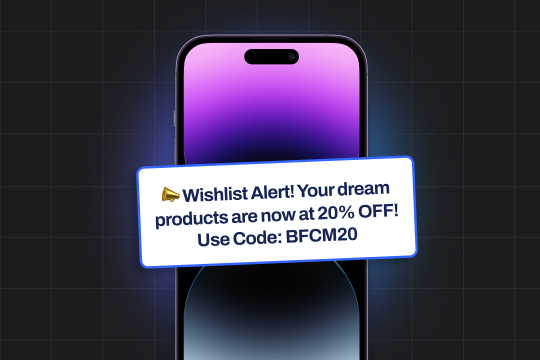
Wishlists tell you exactly what each customer wants before the sale starts. When BFCM opens, send each person a reminder that their saved items are now on sale. That message is far more relevant than a general announcement.
5. Set up a countdown clock on your emails
Countdown clocks in your BFCM emails create urgency. They remind customers that time is running out on your deals, and they push people to act before the offer ends.
Pair the clock with short flash drops: a two- to four-hour offer on a single product, with the exact end time shown. Put the same countdown on product pages and in the app, so the deadline is visible wherever the shopper is.
You can also run a “happy hour” deal in a quieter slot, like early morning or mid-afternoon, to turn slow hours into extra sales.
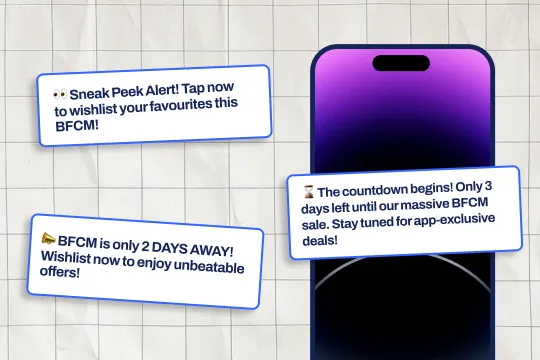
6. Send those personalized push notifications
On Cyber Monday 2025 alone, brands on Appbrew sent 9.02 million push notifications, up 177% year over year. Those sends drove 453,000 product views and 3,221 directly attributed purchases, with no cost per message.
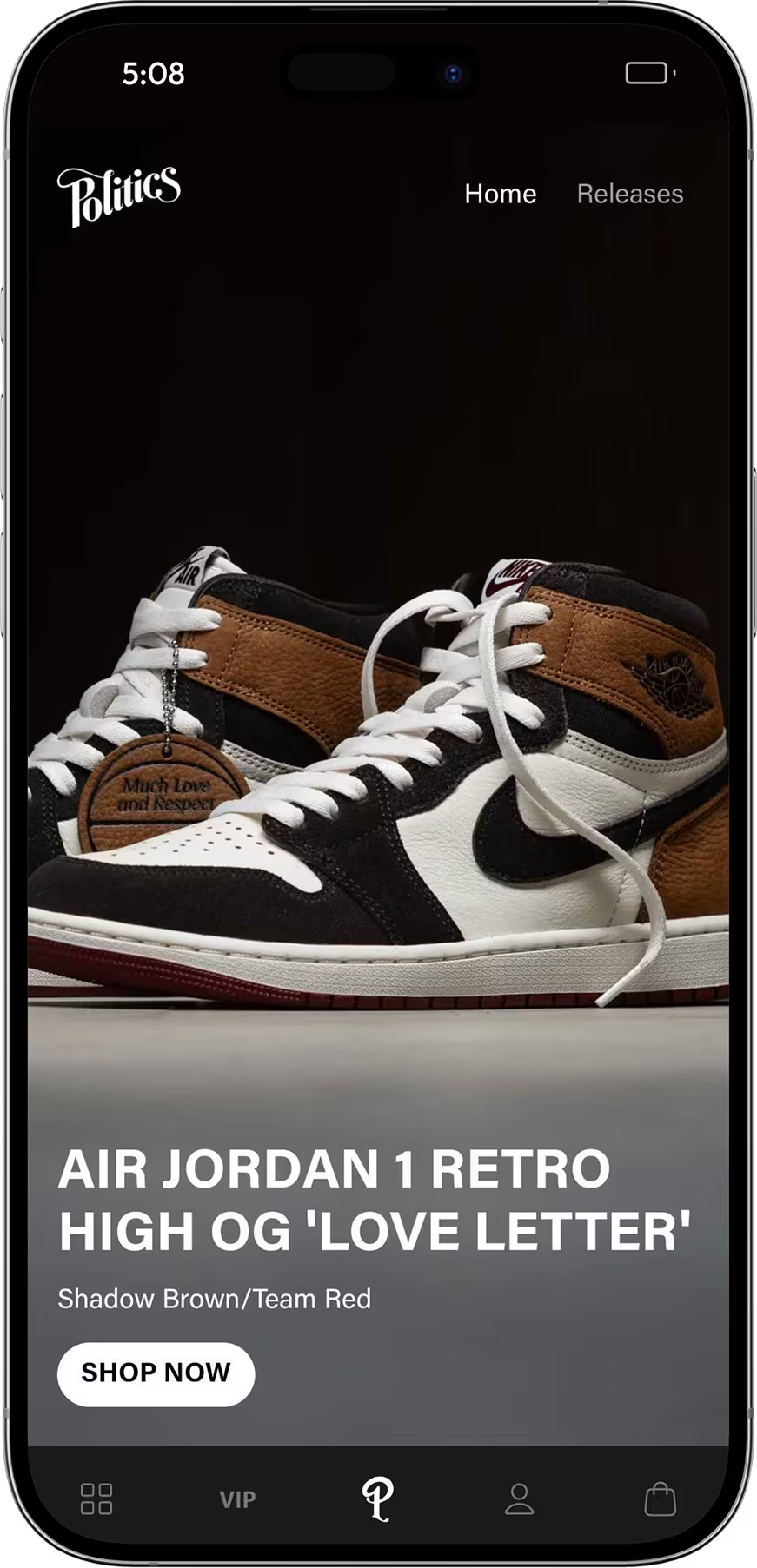
Example: Sneaker Politics tracked 131 push campaigns in its app, and push directly drove 57.9% of all in-app purchases. (Read the case study)
The key to making push work during BFCM is personalization. Use your app data to segment shoppers and send messages that match what they browsed.
Apply the same segments to email and SMS:
- VIPs and repeat buyers: early access before everyone else.
- Browsers and cart abandoners: the exact products they looked at.
- Lapsed email subscribers: leave them out of peak sends to protect deliverability.
Plan two kinds of push. Promotional pushes announce the sale, flash drops and final hours. Transactional pushes confirm orders and share shipping updates, and they keep buyers engaged after checkout.
To save time on the busiest week of the year, you can plan the whole push schedule in one go. On Appbrew, Milo can draft and schedule it from a simple request, like “send a final-hours push at 7 PM linked to the sale collection.”
7. If it’s not a competitor, it’s a potential BFCM promotions partner
Teaming up with complementary brands can strengthen your BFCM strategy. Partnering with brands that don’t compete with you lets you create unique offers, reach new audiences and give both customer bases extra value.
Here’s how to make these partnerships work:
- Joint Bundles: Combine best-selling products from both brands. For example, a skincare brand might pair with a makeup brand to offer a "Complete Beauty Kit."
- Exclusive Discounts: Offer special discounts on your partner’s products to your customers, and have them do the same for you. Example: "Shop with [Partner Brand] and get 20% off with our exclusive code!"
- Shared Giveaways: Host a joint contest where participants can win products from both brands, such as a referral contest where referrals for either brand count as entries.
- Cross-Promotion: Feature your partner in your emails, social posts or website, and they’ll do the same for you, such as a "Brand Spotlight" in your newsletter.
These partnerships can lift your BFCM campaign and build lasting relationships with other brands and customers.
8. Collaborate with Micro-Influencers
Micro-influencers can give your BFCM campaign a real boost without a big budget. Their audiences are smaller but more engaged, and their recommendations feel more trustworthy than ads.
TikTok is especially strong here. TikTok Shop pulled in more than $500 million in US sales across the four days of BFCM 2025.
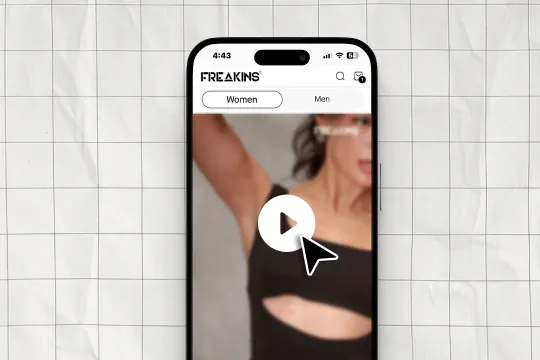
Give each creator a unique code so you can see who actually drove sales and rebook them next year.
{{cta}}
BFCM discounting strategies that protect margin
The right discount gets the sale without giving away your margin. These eight strategies replace the sitewide cut.
9. Say no to blanket discounts this year
This might sound controversial, but hear us out. Sitewide discounts on Black Friday are common, but they are not the best strategy for everyone.
Heavy discounts can attract attention, but they usually suit larger companies with big margins and strong repeat rates. Slashing prices by 50% can hurt your brand and may not cover the lost profit.
Across the Appbrew network, app order volume grew 225% year over year on Cyber Monday 2025 without brands cutting prices harder.
Before you set any offer, work out your margin floor per product, including shipping and payment fees. Then block discount codes from stacking with markdowns, so one order can’t take two discounts.
10. Create BFCM product bundles
Product bundling is a great way to offer value without resorting to heavy discounts. BFCM shoppers love a good deal, and offers like “buy two, get one free” can be very tempting.
For example, Lootcrate offered 30% off all crates and threw in a free mystery bundle with subscriptions of three months or more. This added curiosity and helped clear slow-moving stock.

Another brand, ‘A Kids Company About,’ offered a “buy two, get a third free” deal instead of a price cut. Pair a bestseller with a slower-moving product to raise perceived value without cutting your base margin.

11. Offer a free gift with every purchase
During BFCM, many brands worry that discounts might dilute their premium appeal. A free gift with purchase lets you attract shoppers without lowering your prices.
For example, Our Place kept its premium image by offering a mystery gift with purchases over a set amount. This raised average order value, cleared inventory and converted hesitant shoppers.

Keeping the gift a surprise adds curiosity. Make it feel limited, so shoppers know it won’t be around after the weekend.
12. Offer category-specific discounts
We said no to the blanket discount. So what’s the alternative? Focus on specific product categories. This lets you push items with higher margins, more stock or seasonal relevance.
For example, spotlight winter apparel with “40% off all winter jackets” as colder months arrive, or clear overstock with “50% off all summer sandals.”
You could also launch new products with an exclusive discount, like “30% off our new skincare range.” Highlighting bestsellers can drive even more sales, and niche categories such as eco-friendly products can attract specific customer segments.
By narrowing your focus, you make your BFCM offers more strategic and drive sales where you need them most.
13. Focus on Average Order Value
During BFCM, rather than just slashing prices, focus on increasing your Average Order Value (AOV). With rising customer acquisition costs (CAC) and competition, every sale needs to count.
Instead of a flat 20% off across the store, offer 30% off purchases over $200. This lifts AOV and protects your margins. Set the first tier just above your normal order value, so most shoppers need one more item to reach it.
Say a customer spends $215; after the discount, their order totals about $150. After cost of goods and CAC, you keep more profit than you would with a general discount.
The channel matters too. On Cyber Monday 2025, app orders beat web orders on AOV by roughly 10% to over 40% across brands on Appbrew.
14. Paid shipping takes away the value of a sale
No one likes paying for shipping, especially during a sale. For many shoppers, a shipping fee is the reason they abandon the cart.
If free shipping on every order isn’t realistic, set a minimum order value. Put the threshold slightly above your normal order value, so most shoppers need one more item to qualify. For example, Anthropologie offers free shipping on orders over $50.

Then make the threshold visible. A progress bar in the cart (“You’re $12 away from free shipping”) turns the fee into a reason to add one more product.
15. Make your best discount app-exclusive
An app-only code gives shoppers a reason to install, and gives you a customer you can reach with push long after BFCM.
Pick the format by price point. A percentage off works well on a full cart. A fixed amount, like $10 off orders over $50, is easier to grasp on lower-priced items. Only call the deal exclusive if it truly beats the web price, or shoppers stop trusting the label.
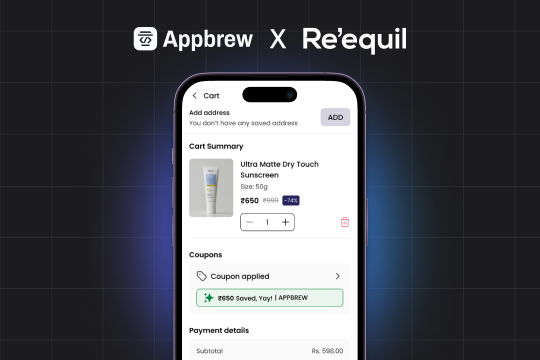
Example: On Cyber Monday 2025, apparel brand Knya’s app-only code drove 210 orders through its app.
16. Use BOGO on the products you need to move
Buy one, get one feels like the biggest deal of the weekend, and it suits gifting: one for them, one for you.
Run it on specific products with enough stock and margin, not the whole catalog. Cap quantities and decide how returns will work before launch.
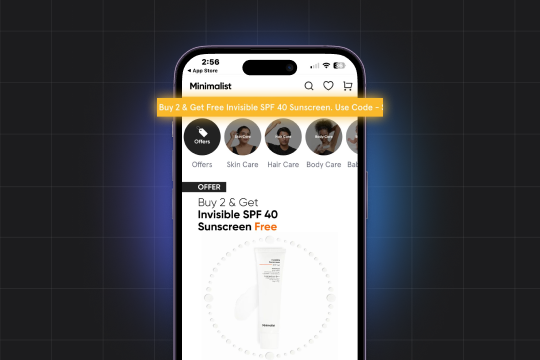
Example: On Cyber Monday 2025, apparel brand Warrior’s BOGO code drove 136 app orders at a $40.98 average order value.
How to convert and keep BFCM shoppers
17. Make mobile checkout fast and show BNPL early
Most BFCM shopping happens on a phone, often late in the evening. Every extra field or slow page costs you orders at the moment demand is highest.
Before the sale, test the full purchase on a real phone, from product page to payment. Turn on one-tap wallets like Shop Pay, Apple Pay and Google Pay, keep guest checkout, and check that pages still load quickly under heavy traffic.
Show Buy Now, Pay Later on the product page, not just at checkout, with the installment amount spelled out. Shoppers spent $1.03 billion through BNPL on Cyber Monday 2025, according to Adobe. Across the Appbrew network that day, app orders paid with Shop Pay Installments averaged $75.36, against $15.66 for standard card orders.
Prepare your support team as well. Update product FAQs, shipping deadlines and return policies before the rush, so shoppers get answers without leaving the page.
18. Build a BFCM Post Purchase Funnel
Don’t overlook post-purchase offers. They target customers who have already committed to buying, so there is less hesitation and a higher chance of an extra purchase.
After checkout, offer upsells like premium shipping, gift wrapping or discounted gift cards. These offers ride the shopper’s buying momentum and often convert well. Keep it to one relevant offer: a matching accessory or refill does better than a list of unrelated products.
Then look past the weekend. Send order updates first, ask for a review a week or two after delivery, invite new buyers into your loyalty program, and run fewer, sharper offers in December instead of extending the sale.
App buyers make this easier. Shoppers who bought through an app on Cyber Monday 2025 repeated at 41.88% within 90 days, against 33.63% for web buyers.
“All our best customers are on the app, and best customers tend to spend more, stick with us longer, and have larger order values.”
— Kiran Kotla, CEO, Dista
To Sum Up
BFCM is a time of intense competition, with every merchant chasing the same shoppers.
If you don’t have a massive ad budget or a deeply loyal customer base, standing out is hard. The strategies above help you win without simply cutting prices deeper: start early, reward your best customers first, protect your margins, and plan the second order before the first one ships.
This is where a mobile app becomes crucial. It lets you reach customers with push at no cost per message, run offers only app users see, and bring BFCM buyers back long after the sale.
If you’re looking to turn your Shopify store into a mobile app, Appbrew’s Shopify mobile app builder gives you everything you need. Don’t wait. Book a demo with Appbrew today and get ahead in the BFCM race!
{{cta2}}
BFCM marketing FAQs
When should I start my BFCM marketing?
Start in early November at the latest. Lock offers and margins, clean your email lists and push app installs first, then begin teasers two to three weeks before Black Friday (November 27, 2026).
What are the best BFCM campaigns for a small Shopify brand?
Focus on what you already own: VIP early access for past buyers, a tiered or bundle offer instead of a sitewide discount, short flash drops with a countdown, and fast cart reminders by email, SMS or push. A small, engaged audience reached well beats trying to outspend bigger brands on ads.
What BFCM discount strategy works best?
For most Shopify brands, targeted offers beat a sitewide cut: spend tiers set just above your normal order value, bundles, a gift with purchase, BOGO on chosen products, and an app-exclusive code for your most loyal shoppers.
How do I run BFCM email marketing without hurting deliverability?
Suppress long-inactive subscribers, raise volume gradually in November, and send different messages to VIPs, recent openers, cart abandoners and new subscribers instead of blasting the whole list.
Should I advertise more during BFCM?
Yes, but spend early. Prospect in early November when reaching new people is cheaper, then shift most of the weekend budget to retargeting warm shoppers and exclude anyone who has already bought.
What should I do after BFCM?
Send order updates first, then one relevant post-purchase offer. Ask for reviews a week or two after delivery, invite buyers into loyalty, and run fewer, sharper offers in December to win the second order.
Does a mobile app help with BFCM sales?
On Cyber Monday 2025, app orders across the Appbrew network averaged about 10% to over 40% more than web orders, and app buyers repeated at 41.88% within 90 days against 33.63% for web.