

.webp)
Explore 12+ ecommerce personalization trends shaping 2026, backed by Appbrew data, consumer research and practical examples for ecommerce brands.
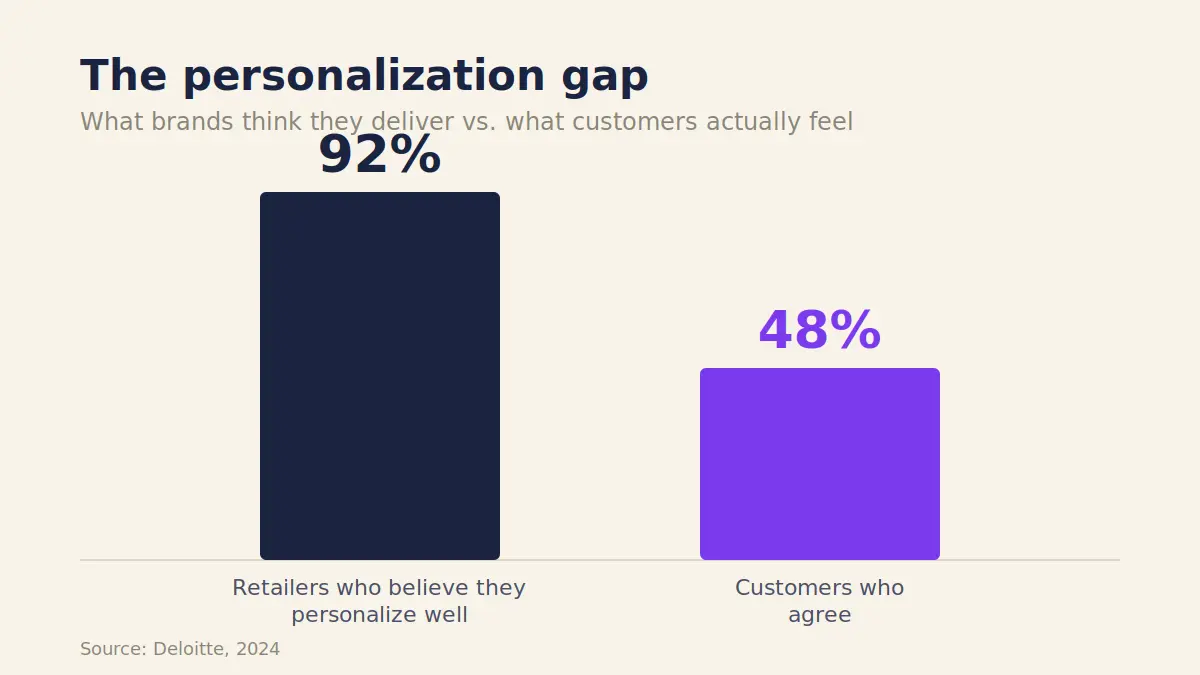
What counted as personalized in 2021 is now simply the price of admission, the baseline you meet before a shopper even decides whether your store feels built for them or for no one in particular. Deloitte found that 92% of retailers believe they deliver effective personalization, yet only 48% of consumers agree.
That gap between what brands think they deliver and what customers actually feel is the story of 2026.
This guide walks you through ecommerce personalization trends and statistics in 2026, from AI agents that shop on your customer's behalf to the shift from measuring clicks to measuring incremental profit.
The first-party benchmarks come from 13.4 billion in-app shopper behavioral events across the 250+ Shopify brands Appbrew powers, recorded between 2023 and 2026.
Key takeaways
- More personalization can make the customer experience worse. Gartner found that 53% of customers reported a negative experience with personalized marketing; those customers were 44% less likely to purchase again.
- Real-time intent is becoming more useful than a static customer profile. A current search, wishlist addition or abandoned cart can reveal more about the next likely purchase than demographics or an old order.
- AI shopping traffic has moved from low-converting research traffic to a high-value acquisition source. During the 2025 holiday season, AI referrals to retail sites converted 31% better than other traffic sources after previously trailing them.
- First-party data becomes valuable when it improves a decision. Saved sizes, product searches, loyalty activity and purchase history are useful only when they reduce discovery friction or make the next interaction more relevant.
- The next personalization metric is incrementality. Attributed revenue shows what happened after an interaction; a controlled holdout is required to establish whether personalization caused additional revenue.
Ecommerce personalization vs. customization
Ecommerce personalization is the practice of adapting a shopper’s experience using their preferences, behavior, purchase history and current context. It determines which products, content, offers or messages are most relevant to that individual at a particular moment.
Personalization can continue across a website, mobile app, email, SMS, push notification and physical store. Personalization aims to remove irrelevant choices and help each shopper reach the right product or action faster.
The difference is who adapts the experience.
An ecommerce experience can use both: the store can recommend the most relevant product, while the shopper customizes its final configuration.
12+ Ecommerce personalization trends and statistics for 2026
The connective thread across every trend below is timing. Personalization is shifting from something applied after the fact, a segment built overnight or an email sent the next morning, to something that responds inside the moment a shopper is deciding.
The statistics establish what changed. The trends explain how to respond.
1. AI shopping agents are becoming a new personalization interface
Approximately 50% of consumers begin a purchase without a predetermined brand preference, according to BCG. Personalization increasingly begins before a shopper reaches a brand’s website or app.
For example, a customer can ask an AI assistant:
“Find a fragrance-free moisturizer for sensitive skin under $40 that can arrive before Friday.”
The assistant can interpret the shopper’s budget, skin concern, ingredient preference and delivery deadline at once. It may then compare products across several retailers, summarize reviews and recommend a shortlist tailored to that request.
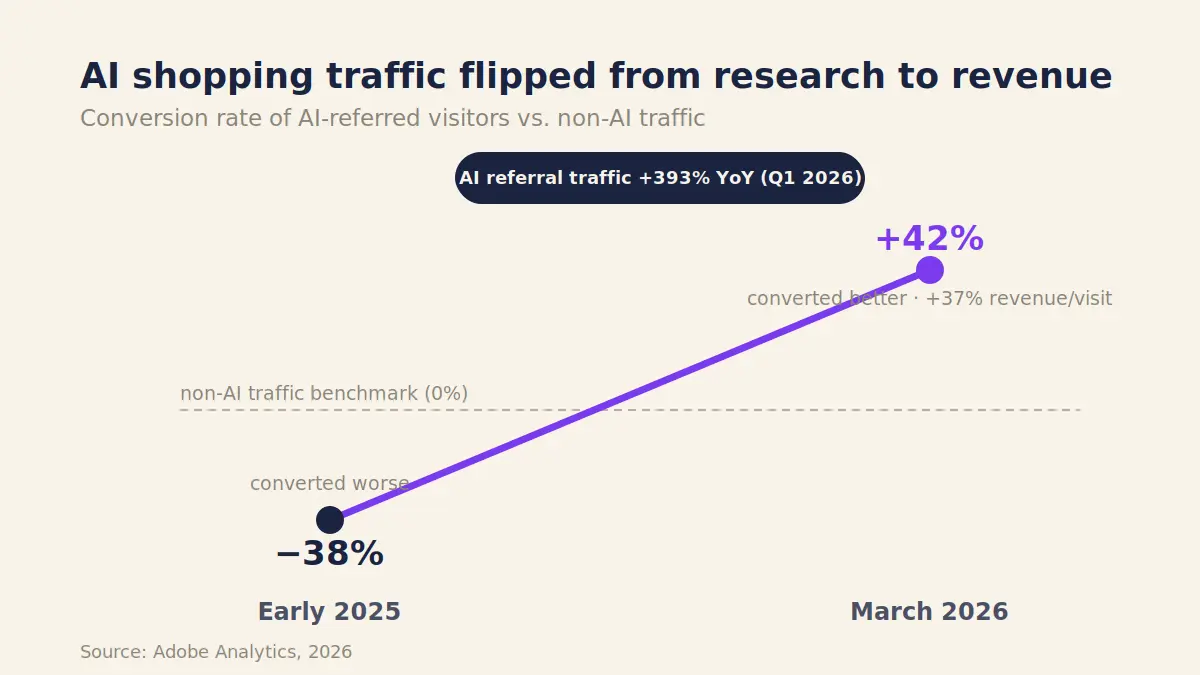
- AI referral traffic to US retail sites grew 393% year over year in Q1 2026 (Adobe Analytics, 2026).
- By March 2026, AI-referred visitors converted 42% better and generated 37% more revenue per visit than non-AI traffic. A year earlier, that same AI traffic converted 38% worse (Adobe, 2026).
- McKinsey projects agentic commerce could drive $3 trillion to $5 trillion globally by 2030.
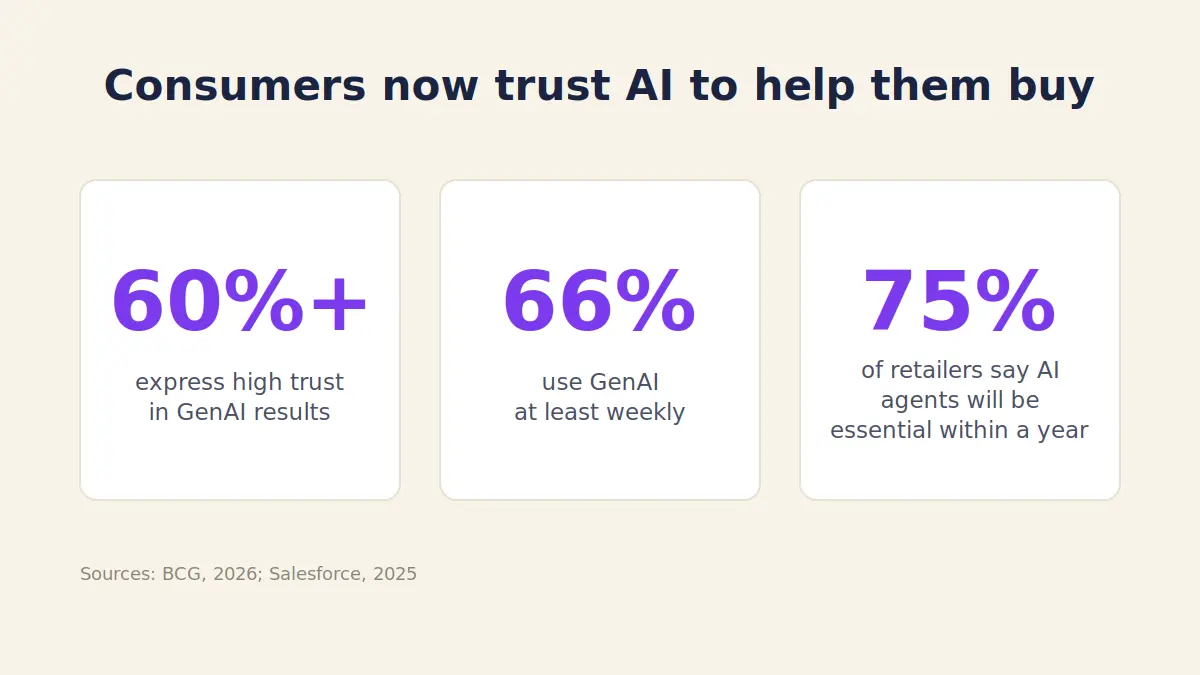
- In Salesforce’s research involving 8,350 shoppers and 1,700 retail decision-makers, 75% of retailers said AI agents would be essential for remaining competitive within a year.
Retailers are preparing for AI systems that can move beyond recommendations to answer questions, assemble carts, manage service requests and take actions across the customer journey.
What changed from 2024 and 2025?
AI-assisted shopping initially functioned primarily as a research tool. Shoppers used it to gather ideas or understand product categories before completing the familiar journey through search engines and retailer websites.
That role is expanding. AI agents can now:
- Translate an open-ended need into specific product criteria
- Compare products across retailers
- Filter options by budget, ingredients, fit or intended use
- Summarize reviews and product differences
- Check availability and delivery conditions
- Assemble a cart
- Move the shopper toward checkout
The result is an important change in ecommerce personalization: the brand may no longer control the first personalized experience.
What ecommerce brands should do
To be considered by AI shopping agents, product information must be complete, current and easy to interpret. The objective is not to write product pages for robots. It is to make the information a shopper needs explicit enough for both people and AI systems to understand.
Our guide to agentic commerce explains how these systems move from product discovery to comparison and checkout, and what "agent-ready" actually requires.
2. Personalization leaders grew 10 percentage points faster
Access to personalization technology stopped being the differentiator. Nearly every brand has the tools. The gap now is execution.
BCG found that personalization leaders achieved revenue growth rates 10 percentage points higher than laggards. Yet only 10% of the 200 brands studied qualified as personalization leaders.
The advantage did not come from owning better software. It came from connecting customer data, operational systems, and execution across the whole journey, the unglamorous integration work that most brands never finish.
3. Privacy-first personalization built on zero- and first-party data
Third-party cookies are gone as a dependable signal, and shoppers are sharper about the data they share.
BCG found that four in five consumers are comfortable with personalized experiences. Yet two-thirds had recently encountered inaccurate or invasive personalization that caused them to disengage, unsubscribe or not return.
Gartner found a similar paradox. Customers who received personalization were:
- 1.8 times more likely to pay a premium
- 2 times more likely to feel overwhelmed
- 2.8 times more likely to feel pressured to proceed
The problem is passive personalization. The brand infers what the customer wants and immediately presents another offer or recommendation, even when the shopper is still trying to understand the decision.
The FTC has flagged that browsing behavior, location, shopping history, and even mouse movements can be used to tailor what an individual pays.
The most useful boundary is traceability. A recommendation built on something the customer knowingly did (viewed this, saved that, bought the other) reads as service, because the logic is visible.
The brands winning in 2026 collect two kinds of data and use both transparently:
- Zero-party data, the preferences a customer volunteers directly (sizes, styles, categories they care about).
- First-party behavioral data, what shoppers actually do in the store and in the app.
Data the shopper knowingly gave you is the safest foundation for both.
4. Merchants are using AI agents to speed up their own execution
The gap between wanting personalization and shipping it isn't only your customer's problem. It's yours too.
The idea is always easy. Say you want early access for US loyalty members who bought from a category before but haven't touched the new collection. As a sentence, that takes five seconds. As a live campaign, it's slower. Someone has to turn it into audience conditions, content rules, and exclusions. That step is where the days go.
AI agents are starting to remove that step. BCG puts the speed gain at 30% to 50% faster processes, with 25% to 40% less time spent on low-value work.
But very few teams have actually made the shift. BCG's 2026 survey of 300 CMOs found the gap clearly:
- 96% say AI is transforming their function
- 42% still use it only for small, one-off tasks
- 8% run campaigns where agents work autonomously
That last number is the real story. Almost everyone claims AI maturity. Almost no one has built it. What separates the two, in BCG's words, is operating infrastructure, not another tool.
In Appbrew, Milo is one example of that infrastructure. You describe the audience in plain language, and Milo turns it into targeting logic across location, cart state, purchase behavior, and customer tags. You set the audience and the experience. Milo builds the rules underneath, so the campaign ships in minutes instead of sitting in a queue.
5. Search is becoming personalized, semantic and multimodal
Keyword search matches words. Semantic search interprets the need behind them, and in 2026 it is going multimodal:
- Text: natural-language queries instead of exact keywords
- Image: a screenshot or product photo as the query
- Voice: spoken requests
- Context: size, location, history, and live inventory shaping results
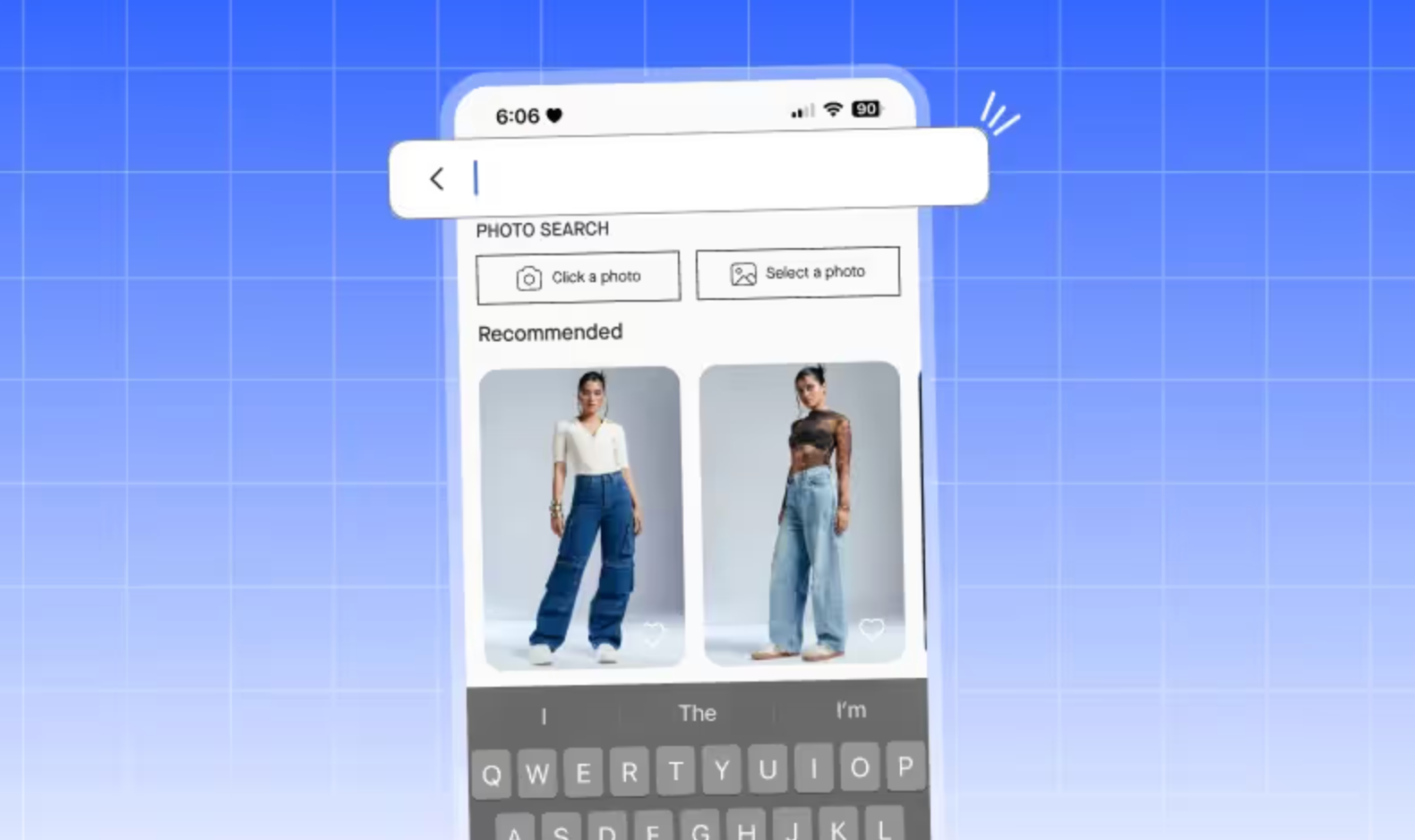
On Appbrew, FREAKINS uses image search so shoppers can find clothing from screenshots they saved off social media, turning a saved image into a direct path to the product instead of a dead end where a keyword would have failed.
6. Real-time intent is replacing static customer segments
Real-time personalization interprets the shopper’s current sequence of actions. For example:
Searches “waterproof jacket” → compares three products → checks the size guide → adds one to a wishlist → searches for insulated gloves
A static system sees someone interested in jackets. An intent-based system recognizes someone preparing for cold, wet conditions and can adjust product rankings, recommendations and messaging accordingly.
The practical insight is that a shopper’s last five minutes can sometimes be more useful than their five-year customer profile.
Brands can respond by:
- Combining signals instead of reacting to one isolated click
- Giving recent behavior more weight than older activity
- Updating recommendations during the session
- Triggering messages only after meaningful actions
- Suppressing recommendations and reminders after purchase
- Letting customers correct inferred preferences
The objective is not to predict everything about the customer. It is to recognize the current task early enough to make the next step easier.
7. Behavioral triggers are replacing calendar-based broadcasts
Generic promotional campaigns start with the marketing calendar. Behavioral campaigns start with something the customer has done.
Appbrew’s analysis shows the difference in attributed performance:
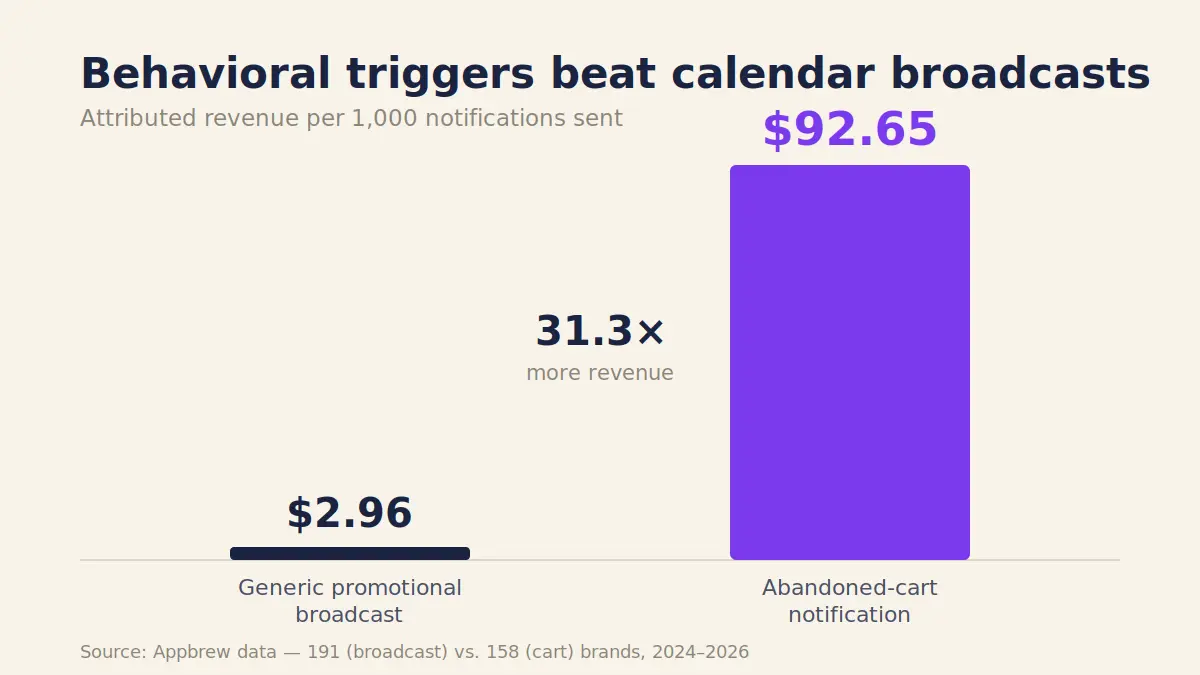
The cart notifications generated 31.3 times more attributed revenue per 1,000 messages. They did not necessarily perform better because of more persuasive copy. They reached customers who had already selected a product and demonstrated purchase intent.
Instead of asking, “What should we send this week?” brands can ask, “Which customer action deserves a response?”
Methodology note: Appbrew analyzed notification activity between 2024 and 2026. Purchases were attributed within 24 hours of a recorded notification interaction. These are aggregate observational benchmarks from different eligible cohorts, not randomized estimates of incremental lift.
8. Predictive personalization is shifting from “what” to “when”
Recommendation engines predict what a customer might buy. Predictive personalization also estimates when the need will arise.
A skincare brand can estimate a replenishment window using the purchase date, product quantity, typical usage cycle and reorder history. The same approach can identify churn risk, seasonal demand or the right moment to recommend a complementary product.
McKinsey describes this next frontier as delivering relevant offers and messages at the right time using predictive models and continually updated customer signals.
9. Native mobile apps are becoming persistent personalization environments
56.4% of US holiday ecommerce revenue came from mobile in 2025. Mobile became the majority shopping channel for the first full year in 2025, according to Adobe. The opportunity now is to turn that mobile traffic into a continuous customer journey.
Appbrew data: Across 250+ Shopify brands, Appbrew recorded 511.4 million native-app sessions between 2023 and 2026. These included:
- 73.9 million search-driven sessions
- 34.6 million wishlist-engaged sessions
- 103.8 million cart views
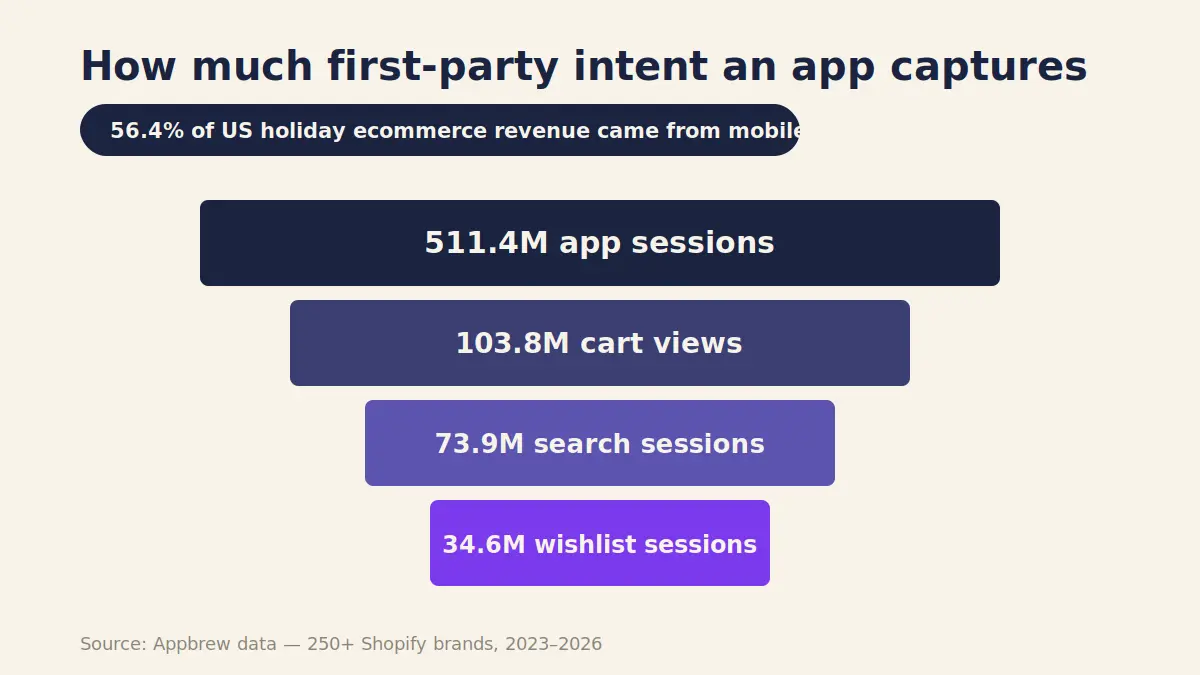
Those volumes do not prove personalization lifted sales; they show how much first-party intent an app captures that mobile web leaks.
Brands can use those signals to restore a shopper’s journey, reorder products around likely preferences and trigger messages based on current behavior. Anatomie, for example, lets app users save products and receive restock alerts instead of restarting their search later.
{{cta}}
10. Cart recovery is becoming individualized rather than discount-led
The global cart abandonment rate is 70.22%, and on mobile it climbs to roughly 80%, with Baymard estimating $260 billion in recoverable orders across the US and EU.
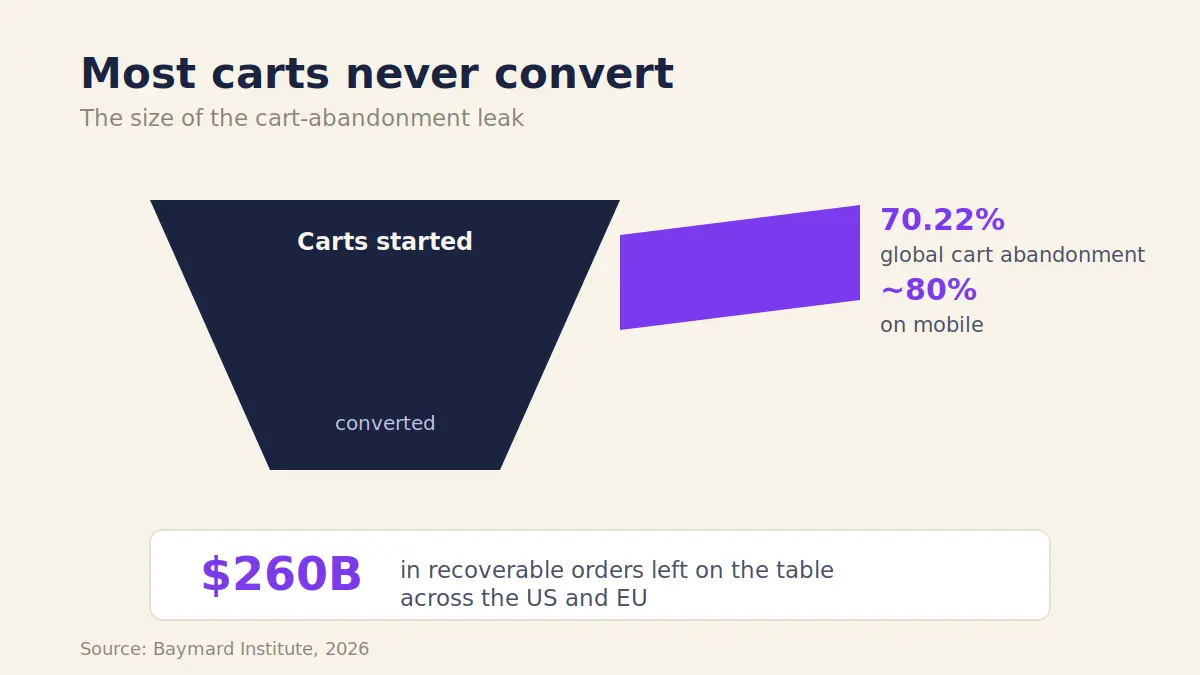
Fix checkout friction before anything else, since no message outruns a broken cart; the checkout-side playbook covers that groundwork. Once the cart itself works, four techniques make recovery personal.
- Preserve the cart context. Deep-link back to the exact products, variants, and quantities, and reference the specific item with its image, not a generic "you left something behind."
- Resolve the likely friction. Surface delivery dates, stock status, payment options, and returns or sizing information, since the barrier is often information, not price.
- Use intent signals to prioritize. A cart with repeat visits, size-guide views, or checkout progression deserves a faster, harder push than a first-touch browse.
- Reserve incentives, and coordinate channels. Hold discounts for price-sensitive or unresponsive shoppers instead of rewarding every abandonment, sequence push before email so a single channel does not carry the whole load, and suppress everything the moment someone buys or opts out.
11. Recommendations are becoming inventory-, margin- and fulfillment-aware
A recommendation is useless if the product is out of stock, arrives too late, or is likely to be returned.
Personalization engines increasingly need operational signals alongside customer behavior:
- Inventory by location
- Size availability
- Delivery estimates
- Return history
- Product compatibility
A behavior-only model asks, "what is this shopper likely to click?" An operations-aware model asks, "what can this shopper actually buy, receive on time, and keep?" The second question produces fewer clicks and more profitable orders.
Our personalized product recommendations guide explains how collaborative, content-based, and hybrid engines use these signals differently.
12. Loyalty and post-purchase journeys are becoming individualized
Deloitte’s survey of 5,564 US loyalty members found that consumers join eight programs on average but actively use only five. Another 40% sometimes forget to redeem rewards.
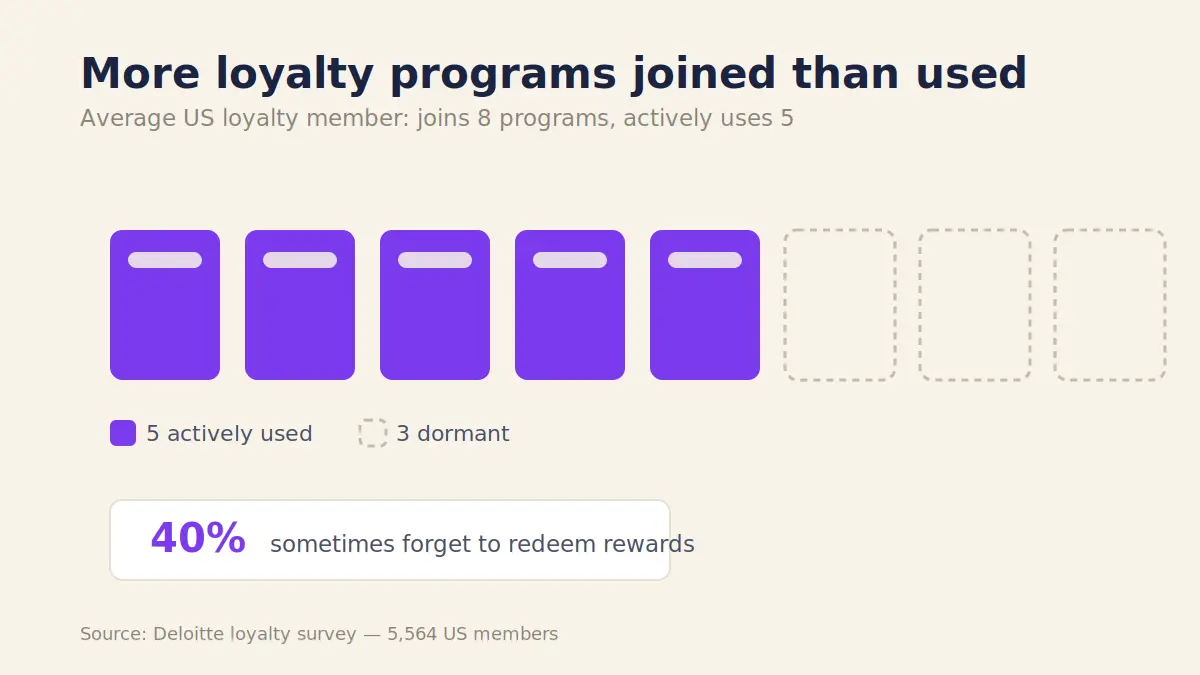
Personalization can close that gap by surfacing:
- Expiring rewards at checkout
- The highest-value available benefit
- Relevant products eligible for redemption
- Early access based on product affinity
The payoff shows up in repeat revenue. Repeat purchases were 32% of native-app orders in in 2026 YTD across Appbrew’s network of 250+ Shopify brands.
The overlooked form of post-purchase personalization is suppression. A customer should not receive a cross-sell before their first order arrives or a replenishment reminder before they could reasonably need it.
13. Personalization measurement is moving to incremental profit
A personalized message can receive credit for an order the customer would have placed anyway. That makes attribution useful, but incomplete. The stronger question is: how many additional orders did personalization create?
McKinsey recommends rigorous incrementality testing to validate personalization ROI. Brands can use:
- Randomized holdout groups
- Personalized versus generic treatments
- Profit and retention metrics
- Tests by customer-intent level
In 2026, credible personalization measurement separates correlation, attribution and incremental lift.
Data sources: BCG, Adobe, Salesforce, McKinsey, BCG, Deloitte, Appbrew
How to start personalizing your ecommerce store in 2026 step-by-step
A full personalization stack can wait. The fastest returns come from a few high-intent surfaces, tackled in this order. Start with one customer problem, establish the baseline, and prove a more relevant experience beats it before adding the next layer.
How to measure ecommerce personalization ROI in 2026
The primary metric should be incremental gross profit per 1,000 eligible shoppers. It captures whether personalization changed behavior and whether the change remained profitable after discounts, returns and delivery costs.
Attributed revenue is useful for comparing journeys under the same measurement rules. Incremental profit is the stronger basis for deciding whether to scale them.
Ecommerce personalization examples from Shopify brands
These Shopify brands show how personalization can solve specific discovery, fit, loyalty and merchandising problems. Reported performance figures refer to the wider app experience unless stated otherwise.
Anatomie: AI-assisted fit and recommendations
Anatomie introduced an AI-powered size guide to help shoppers choose the correct fit. Its app also uses “Style It With,” “You May Also Like” and app-only merchandising to support discovery.
The app recorded 3× higher conversion and 5× higher customer lifetime value.
Svaha USA: wishlists as intent data
Svaha USA sells limited, frequently fast-moving apparel collections. Its app organizes wishlists by collection and improves size visibility, helping customers compare products and revisit them during high-demand launches.
Here, the wishlist functions as more than storage. It records product and size intent that can support restock communication and launch planning.
Karma and Luck: intent-aware mobile discovery
Karma and Luck replaced a generic app experience with intent-aware search, native discount pages, social login and a daily horoscope feature aligned with its brand.
The broader redesign produced a reported 50% increase in conversion rate. The example shows that personalization can include navigation and content, not only product recommendations.
SUGAR Cosmetics: merchandising at scale
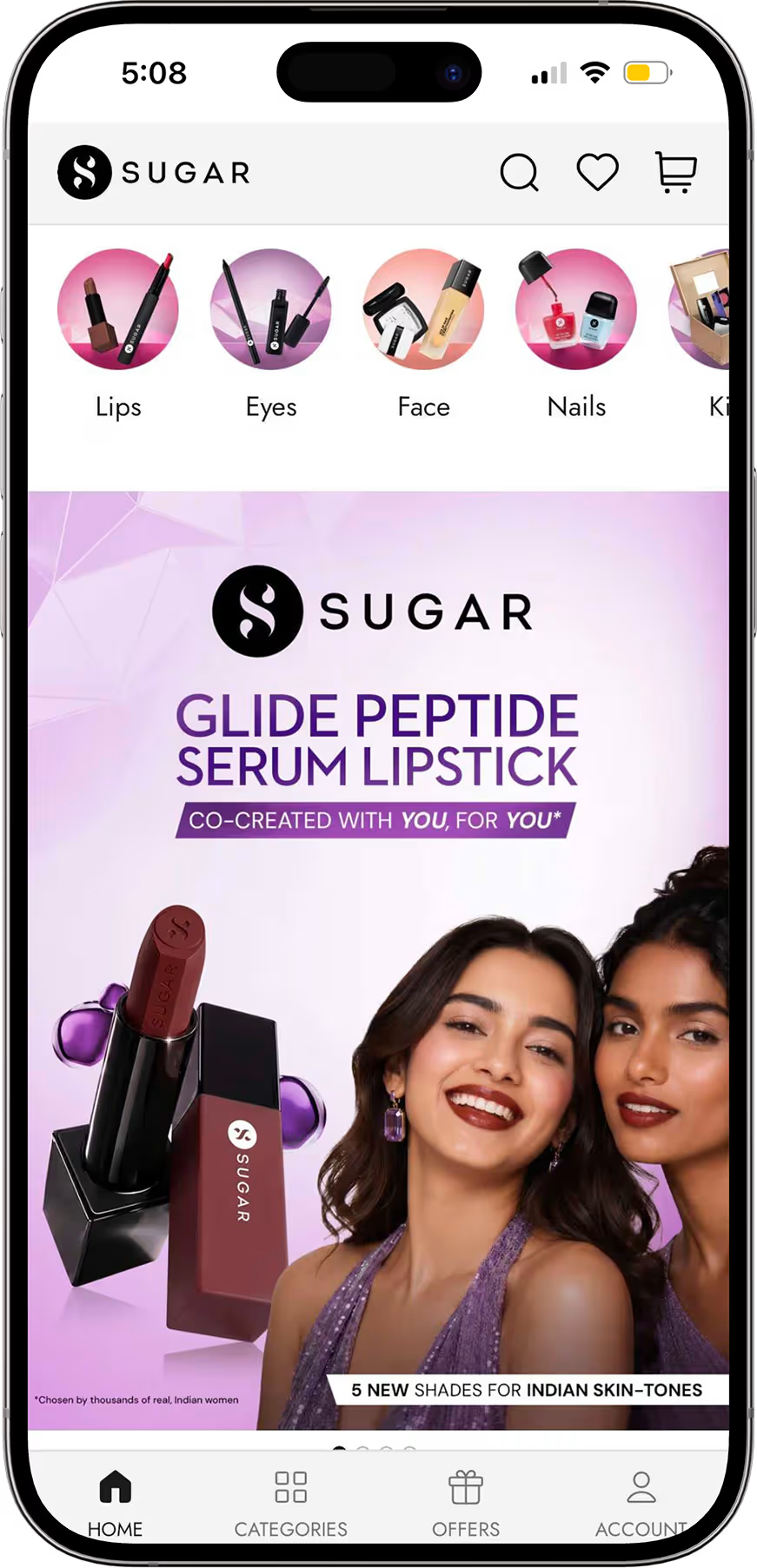
SUGAR Cosmetics uses its app to manage content-rich discovery, curated kits, native promotions and gamified incentives across a large beauty catalog.
The important lesson is operational. Personalization at scale requires merchandising teams to control which content, bundles and offers appear without rebuilding the app for each campaign. SUGAR reported 70% higher conversion through the wider app experience, not from any single personalization feature.
What these trends mean for ecommerce brands
The competitive advantage in 2026 is not collecting more customer data or generating more personalized content. It is making better decisions with the signals already available.
Start with high-intent moments. Connect customer and operational data. Suppress irrelevant experiences. Then test whether personalization creates incremental profit rather than merely claiming credit for existing demand.
The channel decides how far any of these compounds. Personalization on mobile web fights every other tab for attention. The same tactics, moved into a branded app with a push channel you own, accumulate context instead of leaking it.
Appbrew powers native apps for 250+ Shopify brands built for exactly that.
Ready to see what personalized push and recommendations could do inside a branded app for your store? Book a demo with Appbrew.
{{cta2}}
About the Appbrew data: Appbrew powers native mobile commerce experiences for 250+ Shopify brands. Native-app session figures cover July 28, 2023 through August 21, 2026. Notification benchmarks cover January 1, 2024 through August 21, 2026.
Generic promotional benchmarks include 191 brands, while abandoned-cart benchmarks include 158 brands. Open-to-order rate is the percentage of notification taps followed by an order within 24 hours. Revenue was attributed when an order occurred within 24 hours after a notification tap.
Each analysis includes only brands with sufficient activity and complete data for that metric. Cohorts differ by analysis. Results are pooled observational benchmarks, not randomized estimates of incremental lift and not a median or average brand result.
FAQs
Can ecommerce personalization work without third-party cookies?
Yes. Brands can personalize owned channels using first-party signals from searches, product views, wishlists, carts, purchases, loyalty activity and app sessions. Zero-party data from quizzes, preference centers and saved sizes can add context with the customer’s knowledge.
Does ecommerce personalization violate customer privacy?
Not inherently. Risk depends on what data is collected, whether the customer understands and controls its use, the sensitivity of any inference and how personalization affects price or choice. Clear consent, preference controls, limited retention and transparent explanations reduce that risk.
What are the biggest ecommerce personalization trends in 2026?
The biggest trends are AI shopping agents, real-time intent detection replacing static segments, behavioral triggers, first-party and zero-party data, semantic and multimodal search, persistent native-app experiences, and operationally aware recommendations.
What is hyper-personalization?
Hyper-personalization uses real-time behavior, customer history and contextual data to make decisions at an individual level. For example, it may combine a shopper’s recent search, preferred size, cart status and local inventory to choose the next experience.
What data is needed for ecommerce personalization?
Useful inputs include behavioral data such as searches and carts, transactional data such as purchases and returns, contextual data such as location and device, operational data such as inventory and delivery availability, and zero-party preferences intentionally shared by customers.
What are examples of ecommerce personalization?
Common examples include personalized search results, recently viewed products, replenishment reminders, back-in-stock alerts, dynamic homepages, loyalty rewards and cart-recovery messages.